
Most roleplay advice fails because it hands you a costume and a bad accent and calls it a scene. The couples who actually enjoy this stuff are not doing dinner-theater improv. They pick a small, specific situation, agree on who wants what inside it, and give themselves a clean way out before anybody's clothes come off.
If you have been circling the idea of roleplay ideas for couples and getting stuck on the "what if we feel stupid" part, that stuck feeling is the thing to solve first.
The stupid feeling is real, and it usually comes from aiming too high. Two people who have never tried this should not open with a full Victorian manor and a butler. They should open with something low-stakes enough that laughing mid-scene does not wreck it.
So here is the practical version: how roleplay works, why it works, how to pitch it to a partner who might say no, which scenarios land without cringe, and how to exit a scene gracefully when it goes flat.
What roleplay actually is (and what it is not)
Roleplay is putting on a character or a situation for a set amount of time to change the energy in the room. That is the whole definition. You are not trying to become a different person. You are borrowing a little distance from yourself so you can say and do things that feel awkward in your own voice.
That distance is the point. If your partner saying "yes, sir" in their normal voice would make you both giggle, having them say it as a stranger they will never see again does something else. The gap between who you are and who you are playing gives you permission. Lots of people find it easier to be direct, filthy, or vulnerable when they are technically somebody else for the next forty minutes.
What it is not: a test, a psych evaluation, or a way to smuggle a real complaint into the bedroom. If you want your partner to do the dishes, asking as "the strict headmistress" is a bit. Ask them directly on a Tuesday.
Why couples like it
The honest answer is that it strips the familiar off a person you have seen every day for years. You already know how your partner kisses, what they sound like in the morning, which side of the bed they steal. Roleplay lets you meet them as a stranger for an hour. A lot of long-term couples say the novelty is less about the acts and more about the eye contact.
It also lets people try things they would feel exposed requesting in their own name. A partner who wants to be bossed around might never say so plainly. Give them a scenario where the character is supposed to be bossed around and the ask gets easier.
And there is the plain fun of it. Not every scene needs to be a serious emotional event. Some of the best ones are two people doing slightly ridiculous accents and having a genuinely good time. That counts.
How to bring it up without making it weird
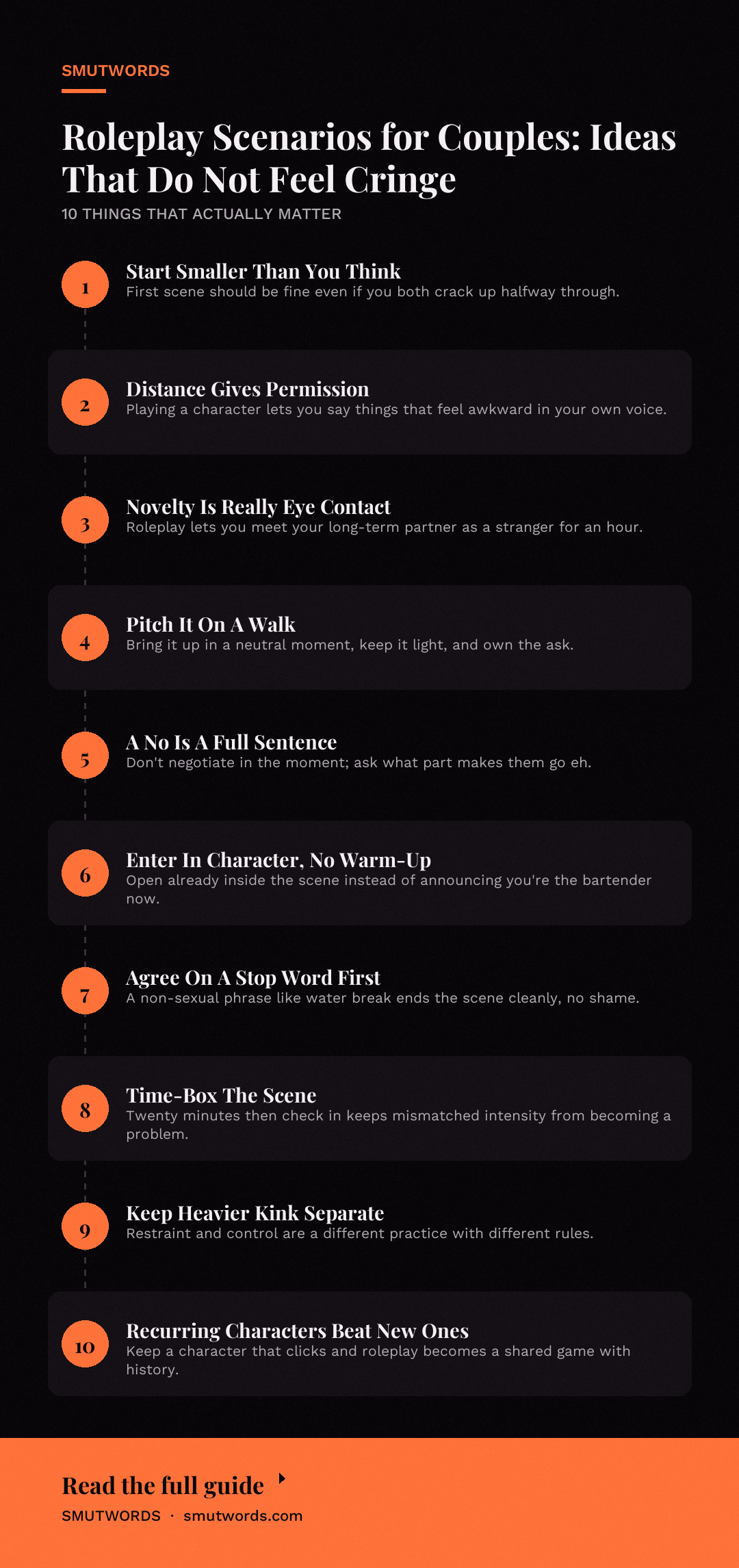
Pick a neutral moment. Not during sex, not right after an argument, not in the car with your mother-in-law in the back. A walk, a lazy Sunday, a drive home. Keep it light and own the fact that you are proposing something a little new.
The script is short: "I read something about couples trying little roleplay scenarios and it sounded fun. No costumes, nothing intense, just a character for twenty minutes sometime. Want to try one and see?"
If they say no, that is a full sentence. Do not negotiate it in the moment. Ask instead what appeals and what doesn't. "What part of that makes you go 'eh'?" often gets you to a smaller version they would actually try.
Maybe the answer is yes to a blindfold, no to a costume, yes to a hotel, no to talking in a fake accent. If they say yes, do not jump straight in that night. Set it up like you would a reservation. Pick a night, agree roughly on the scenario, and leave room to bail.
Start smaller than you think
The first scene should be almost embarrassingly low-stakes. Aim for something that would still be fine if you both cracked up halfway through. The goal of scene one is to prove you can do this together without it getting weird, not to hit some peak.
Good first scenes involve a small change in setting or status, not a full costume drama. Here is a useful sequence to work up through:
- Stranger at a bar. You are two people who just met. No backstory, no costume. You flirt as if for the first time.
- Service with a smirk. One of you is staff, the other is the customer who is being a little too friendly. The character dynamic does the work.
- Authority gap. Boss and employee, teacher and student, landlord and tenant. Pick one where the power is clearly fictional and both of you are glad it is.
- Fictional scenario. A story you both invent together. More setup, more payoff, and by now you have the muscle for it.
Notice none of these require props or a wig. That is on purpose. Buy a cheap prop later if you want. The dynamic carries the scene, not the plastic police badge.
Roleplay ideas for couples that do not feel cringe
1. The stranger at the bar
The classic, and the best first scene for a reason. You meet somewhere public-ish, even your own kitchen counter doubling as a bar, and you do not know each other. One of you opens. You invent a fake name, a fake job, a fake reason you cannot stay long.
The trick is committing to mild lying about yourselves. "I'm a wildlife photographer in town for two nights" is more fun than "hey, I'm your spouse."
What makes it work is that it lets you be forward and curious in a way you probably stopped being years ago. You get to ask your partner the first-date questions again.
What do you do? What are you drinking? Why are you out alone?
2. The service dynamic
Someone is serving, someone is being served, and the tension is in how polite it can stay before it cannot. Bartender and customer, masseuse and client, hairdresser and the person in the chair. The script is just customer small talk that gets steadily less small.
This one is great for couples where one person likes to be wanted and the other likes to be in charge of a moment. The service framing makes bossing someone around feel warm rather than mean.
3. The authority gap
Boss and new employee. Landlord and tenant. A demanding editor and the writer who is late. The power is fake, agreed, and loudly fictional, which is exactly what makes it work.
Do not pick a real-life authority that exists between you (money, work, family). Pick one that belongs entirely to the characters.
Readers who like this dynamic in fiction can see how far the fantasy can stretch in From Wall Street With Love, which runs the boss/underling tension for everything it is worth. That is fiction; your scene stays small and checked in.
4. The historical or period piece
Mostly this one is an excuse for formal language. Two people meeting at a formal event who are extremely interested in each other and extremely circumspect about it. The "cringe" risk is a little higher here because accents can wobble, so maybe skip the accent and just use the manners.
5. The captured or hostage scenario
Real talk on this one: the moment you introduce pretend restraint, you are borrowing from a heavier kink, and it needs real rules, not just enthusiasm. Fake situations of being "held" or captured can be hot for people who like the tension and a total no for people who do not.
If you try it, keep the restraint purely symbolic (a held wrist the other person can release instantly, a door that is not actually locked), keep talking, and agree on a stop word that is not a normal word. Never do breath restriction. Never do heavy or unsupervised restraint. If you want to go further into restraint play, do it separately and learn it properly first.
Same principle applies if you are curious about something like mummification: it is a real technique with real risks around panic and circulation, not a quick costume.
6. The secret admirer
Someone has been leaving notes. Someone has been watching. The scenario is a slow reveal, played entirely through text or letters before you are even in the same room. It is a pen-pal-and-secret-admirer setup, and it borrows neatly from pen pal romance energy without any of the danger.
Enjoyed this? Get a free book.
Join the list and we will send a complete free story straight to your inbox, plus new releases every week after that. No credit card, no catch.
The whole thing is controlled communication, which is a very safe way to build tension.
If the secret-admirer thing appeals and you want to see the darker version on the page, stalker romance is where fiction pushes the same idea to a dangerous extreme. Fiction is where the risk stays harmless. Your own notes keep a return address.
7. The recurring character
Once you find a character that clicks, keep them. A flirty bartender, a demanding boss, a stranger who keeps turning up. Recurring characters solve the "what do we do next time" problem and let you get better at a role. This is where roleplay becomes less of an event and more of a shared game with history.
Fans of the whole universe of invented people will get the appeal of a sprawling, recurring cast. If the two of you want a model for how many characters can share one world, Clusterfuck is a lot of people with a lot of overlapping motives. You do not need a cast of dozens. One recurring character who turns up on the right nights is plenty.
An easy script for getting into character
Getting into character without it feeling forced is the number one hurdle. The fix is to enter the scene in character with no warm-up, the same way you would step onto a stage. Do not say "so I guess I'm the bartender now." Open already inside it.
Here is a four-step entry that works for almost any scenario:
- Set the room in one line. "Get you something?" / "You're late." / "This seat's taken." One line establishes the scenario instantly.
- Give a tiny detail about the character that has nothing to do with the kink. "I'm only in town for the night." / "I just took over this place." Details make a person feel real.
- Ask your partner a question in character. Questions hand them the scene. "What are you drinking?" gets them talking.
- Stay in it for the first two minutes even if you feel silly. The silly feeling drops off fast. It does not go away if you keep breaking character to laugh.
The trick to staying in it is to keep the language slightly specific. Call them a stranger. Use a fake name. Talk like the character would.
If you want a great model of a snarky, one-sided-by-design dynamic that commits hard to a voice, He Never Shuts Down: The AI Boyfriend Who Claimed Me is about exactly that, a partner with an unshakable persona. Your character does not have to be an AI. It does have to keep talking like itself.
How to step out gracefully when it is not working
Some scenes die. The vibe goes flat, one of you is not feeling it, or the accent gets embarrassing. What you need is an agreed, no-shame exit that ends the scene without a mood shift. In kink terms this is a stop word or check-in phrase, and it should be non-sexual so it cannot be misread.
Agree on two things before you start. First, a word or phrase that ends the scene completely: something like "water break" or just your partner's real name said clearly. Second, a check-in that means "I'm fine but this is losing me." Something like "how's the room?"
When a check-in comes, the partner's job is to answer honestly in one line. "Still good." "Let's shift gears." "I'm not feeling this one." Nobody takes it personally. The scene is a thing you were both in, and you can both step out of it.
If the whole thing ends, the exit should be warm. "You were good. The accent was not."
Laugh it off. A flat scene does not mean a flat relationship. Some of the best couples give each other permission to call it a bad scene.
The real risks and how to lower them
Roleplay itself is one of the lower-risk practices, which is why it is a good place to start if you are new to kink in general. The risks are not physical for most scenarios. They are social and emotional, and they are manageable.
The first risk is the small script inside the scene turning into a real fight. If the fantasy bumps into a real insecurity ("so you think I'm the kind of person who..."), that is a sign the scenario is too close to home.
Stop the scene and talk about it outside the characters. If you like the childhood friends to lovers warmth but the scenario reminded one of you of an ex, that is a "next time" problem, and it is fine to have one.
The second risk is a mismatch of intensity. One person wants a light scene, the other wants to run it for three hours in a full costume.
Agree on the length and the intensity before you start. Time-boxing a scene keeps everyone in their comfort zone. "Twenty minutes, then we check in" is legitimate.
The third is a scene that has a heavier dynamic getting played out by two people who are not ready for the heavier kink. Repeating a note from above: if the scenario involves anything around restraint, breath, or pretending not to have control, that is a different practice with different rules. Learn it separately. Keep roleplay for the talking part.
If you want to see what intense sustaining of a heady dynamic looks like safely in prose, subspace and domspace explains the headspaces so you know the signs, and blind date romance is the fiction version of a low-stakes risk that still feels novel.
When to stop entirely
Stop the scene if at any point either of you feels like you cannot say what you actually want. If one of you is going along with it to keep the other happy, that is the moment to end it, not push through. A fake roleplay is not worth a real feeling. If either of you feels more anxious than excited, the scene is not working.
Also stop if either of you is using the character to say something real that will land badly. The line between play-talk and actual attack is not always obvious in the moment. If you are not sure, assume it is real and come out of character.
And if a scene went badly, do not immediately plan another. Sit with it. Decide together whether the scenario was wrong or the execution was.
A lot of them are fixable with a small change. Some are a clear no. Both are fine outcomes.
Fiction to steal from safely
If you and your partner want to see a specific dynamic run all the way out before you try it in a scene, the fiction on the site does that without any of the real-world risk. That is the right use for it: a shared reference. Send your partner a story and say "this kind of scene, want to try it at a tenth the intensity?"
For the sense of a scenario that is entirely about service, attention, and a foot massage that turns into more, Soles of Devotion runs the service dynamic straight. For a weekend that escalates a familiar setup into a bigger shared game, Bull for the Weekend is a whole scenario you can break into scenes.
One more to name because the character-voice problem is the thing most people get hung up on: if you want a model for committing to a persona and keeping it consistent, the writing on the site is a study in it. Read one story as a couple and steal the entry lines, not the ending.
A first-evening plan
Here is a starter plan if you both want to try this and are not sure where to begin.
- Pick one scenario. Stranger at the bar, service dynamic, or authority gap. One.
- Set a night and a time limit. Twenty to thirty minutes.
- Agree on a stop word and a check-in. "Water break" and "how's the room?" work.
- Agree on lights and clothes. Something that says this night is different. You do not need a costume. A jacket and a fake name go a long way.
- Enter in character with no warm-up. One line to open, then stay in it.
- Exit warmly. Talk about what worked, what felt silly, and what you would change next time. That conversation is as much the point as the scene.
If it is a hit, that is when you buy the cheesy prop. Until then, keep it small, keep talking, and treat the first scene as a one-star review with potential.
Final Thoughts
The easiest way to decide what you actually want from this is to read a whole scenario played out before you have to try one. Start with Soles of Devotion, which is a service dynamic from start to finish, and read it together. Whatever makes one of you sit up straighter is your next scene. Everything after that is a conversation and a stop word away from being safe to try.







Loading comments…