Somebody searching "lactation kink vs breeding kink" usually has the same problem. Both tropes keep turning up in the same recommendation threads, both get tagged "fertility," and half the blurbs describe them with the same three adjectives. You buy the book expecting one and get the other, and the heat you were chasing never shows up. They're two different fantasies that happen to share a body part and a pregnancy test.
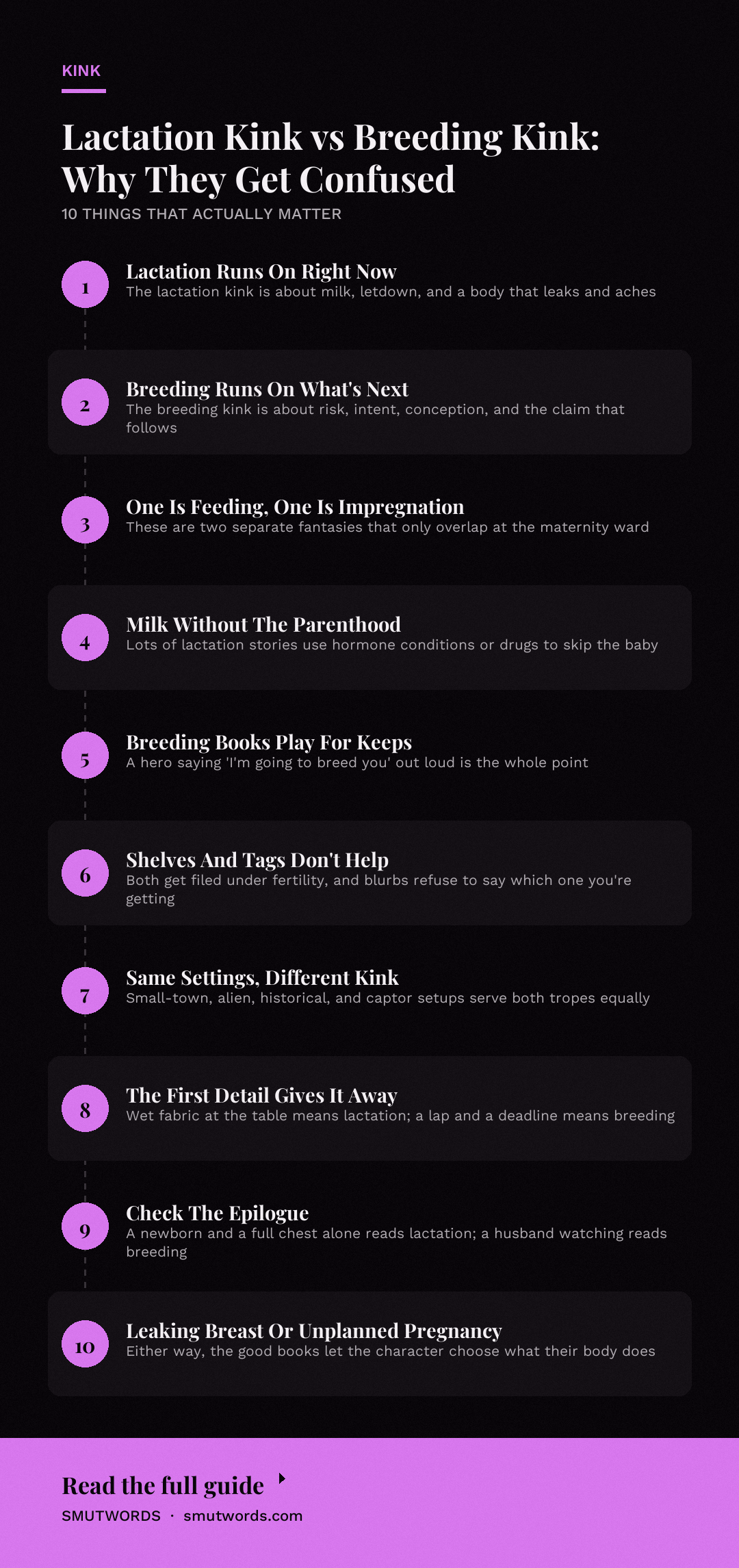
The lactation kink runs on what the body is doing right now: milk, letdown, a chest that aches and leaks through a shirt. The breeding kink runs on what the body might do next. The risk, the intent, the moment of conception and the claim that comes with it.
One is a feeding fantasy. The other is an impregnation fantasy. They overlap at the maternity ward and almost nowhere else, and once you can tell them apart, you stop wasting money on the wrong books.
What the lactation kink actually is
Strip out the pregnancy and the engine of this kink turns out to be a specific body change with a witness. Breasts that have grown heavy and functional, milk that comes without asking, a partner who notices and can't stop noticing.
The erotic charge sits in the visible evidence. Someone's body has been altered by hormones, and now that alteration is out in the open, leaking through fabric at inconvenient moments, and somebody else finds it unbearable in a good way.
That's why so many lactation scenes don't involve a baby at all. Plenty of readers want the anatomy without the parenthood. Authors get around it with a hormone condition, an experimental drug, a postpartum heroine whose husband has been avoiding the bedroom since the birth, or a fantasy setup where nursing is purely adult.
If a writer is good at this, the medical explanation takes two paragraphs and the rest of the book is a study in tactile detail: the first taste, the pressure before a feed, the wet patch, the noise a person makes when the letdown hits.
Ask a reader what they remember from their favorite version and watch how often nobody names the love interest's face. It's the sensation they recall first. The swallowing. The too-full ache. The vulnerability of a body that can't hide what it's producing.
What the breeding kink actually is
The breeding kink points its whole lens forward. The body change matters only as proof that the thing worked. What people are chasing in these books is intent: a partner who wants to put a baby in you, out loud, on purpose, with the vocabulary of ownership attached.
The risk of pregnancy is part of the charge, whether the characters are trying for a child or actively trying to avoid one and failing. Wording does a lot of work here, and readers know it. The same scene hits completely differently depending on whether the hero says "I'm going to breed you" or "we could be pregnant by morning."
Where the two kinks get mixed up is that breeding stories often end in exactly the physical state lactation stories begin with. A hero watching his partner nurse their newborn, breasts swollen and leaking, is dead center in breeding kink territory, but the sensation and the line of heat are different. The first fantasy was about the conception as a takeover. The second one, if the book keeps going there, is the aftermath.
There's a whole separate genre of books where the goal isn't conception at all. The breeding kink shows up with the risk still intact, protection that fails, the decision to stop being careful, and it closes on a scared glance at a drugstore test.
Those plots run on the same fertility arithmetic as a marriage in trouble story, where a husband and wife who've drifted halfway to divorce start using the bedroom as a repair project. Desperation and bodies, both at once.
Why the two get confused so often
Bookstores shelve both under "fertility" because the shelves are lazy, and blurbs refuse to say the quiet part. A cover with a pregnant silhouette and a possessive subtitle could be either one. Reader tag systems don't help. On a lot of sites, the tags "breeding" and "lactation" sit next to each other with no description, so people assume they're two doors into the same room.
The characters overlap too, and that's the biggest source of market confusion. Both tropes break into the exact same set of settings:
- Small-town alpha. She's the new girl, he's got land and opinions about her staying put, and the plot is either him watching her change or him trying to plant a kid.
- Aliens and monsters. The biology of the creature is the excuse for hormone changes, and the story decides between making her milk or making her carry.
- Historicals. Heirs, dynasties, "we need to know if she's fertile" arranged marriages. The lactation books in this category usually begin after the heir is born.
- Forced proximity and captor plots. The dynamic supplies the power imbalance, then the author picks a fertility consequence to go with it.
Notice that the setup never tells you which one you're getting. That's the whole problem. A book that skims the first three chapters in that list, then jumps to a hospital bed, could be a lactation read or a breeding read, and the blurb is never going to make it clear for you if the author wants the widest possible audience.
Signs you're reading a lactation kink book vs a breeding kink book
There's a checklist that resolves most of these in the first fifty pages. Take any title in question and see which column it lands in.
- The first physical detail. Sitting at a table in a too-thin shirt and noticing wet fabric is a lactation book. Being pulled onto a man's lap and told you're not leaving until the pregnancy is confirmed is a breeding book.
- What the love interest fixes his attention on. The chest that's changing, or the belly that's going to.
- When the sex happens relative to conception. Lactation stories set the sex after the change is already showing. Breeding stories put the conception sex at the center of the book, often as the climax.
- Whether the female lead gets to be hungry. There's a specific subgenre of lactation erotica where the central act is somebody being fed, and the mood is soft, sleepy, and a little embarrassing. A breeding kink scene that includes nursing is usually two characters taking a breather before round two, with the voraciousness pointed somewhere else.
- The epilogue. Cradling a newborn with a full chest and no husband in sight is the lactation book's usual ending. A wife bouncing a baby on her knee while her husband watches her too intently from the doorway is the breeding book's.
Both checklists assume you know what you came for. The honest answer for a lot of readers is that they don't. The two tropes get discussed so interchangeably in boards and hashtags that people have stopped expecting a difference.
The big overlap: wet nurses, historical settings, and power exchange
There's a specific plot where the two kinks coexist by necessity: the wet nurse. A woman in a household, hired or coerced into feeding an infant, and a master or husband who can't stop watching her do it.
That single setup can run either direction. If the book spends its chapters in the nursery, it's a lactation read. If it spends them scheming to get the father an heir out of her, it's a breeding read with extra steps.
Enjoyed this? Get a free book.
Join the list and we will send a complete free story straight to your inbox, plus new releases every week after that. No credit card, no catch.
Power dynamics blur them further. Submission and physical need tend to travel together, and you'll see the same vocabulary show up whether a partner is taking charge of a feeding schedule or laying down the law about pregnancy.
The difference sits in what's being controlled. One version controls access to a body that's already changed. The other controls whether that change ever happens.
Mummies, tents, and rope kinks produce the same kind of confusion, where two scenes look alike at the level of surface detail and nothing alike underneath. That's true of subspace and domspace as well: the reader sees the physical scene, but the headspace is doing the real work. Same with the setups in our comprehensive guide to caning. The objects don't explain the scene on their own.
What to read first if you think you want the lactation side
The entry point matters more than the subtitle, because the wrong first book can sell you off the trope. You want a title where the change is already on the page and the narrative voice is unhurried. Sensation and texture should carry the early chapters.
If you want the softer, more domestic register, look for lumberjack romance settings. That category's whole aesthetic of cabin isolation and domestic tenderness gives a lactation scene somewhere to live without a hospital or medical explanation intruding. Pair it with a pen pal romance setup and you get the same lonely, letter-paced intimacy that the best lactation kink books lean on. The slow grind of weeks passing, and a body quietly changing the whole time.
Some readers honestly come to lactation erotica through a different door entirely. What they liked in a hate to love book wasn't the enemies, it was the power imbalance and the moment one character's body betrayed them to the other.
That's a solid indicator you'll like lactation kink and be indifferent to breeding kink. Both use the body's own changes as leverage in the argument between two characters, but the breeding version usually wants that argument to end in a pregnancy and the lactation version wants it to end in surrender.
What to read first if you think you want the breeding side
For breeding kink, the best first read is one with a counting clock. The hero is trying, the heroine is either scared or all in, and the question of whether she's pregnant has a deadline attached. Nothing should feel contemplative. Say the word "breeding" on the page, in dialogue, and mean it.
Setting matters here too. Prince/princess romance hands a breeding plot a built-in dynasty problem: a line of succession and one wife expected to produce an heir, and the entire romance can be woven around that expectation.
Stalker romance moves the same fantasy from dynasty to fixation. The one watching from outside wants access to your body and to your future, in that order. The breeding kink hero in that setup doesn't need a palace. He needs a calendar and a spare key.
If you like the dynastic version's grittier cousin, a rags to riches romance will often give you the unwanted-fertility pressure of a poor heroine married up and down at the same time.
Readers with a taste for uniform and danger also get a strong breeding hook from the small-town conflict at the center of most firefighter romance books, where the hero is a rescuer with a save-the-girl reflex and the heroine's body is the one thing he can't prevent from changing.
When to grab one and when to grab the other
If the itch is a body you can see and taste and hear, one that leaks and aches and won't behave, you want lactation erotica. Reach for a scene with wet fabric, a sore chest, and someone pressing their palm flat and saying "let me."
If the itch is the intent, the danger, the sentence "put a baby in me," and the moment she says yes, reach for breeding erotica. Keep the biology off the page and the promise on it.
Both kinks reward readers who know the vocabulary going in. The writing in either category can get soft and repetitive if the author stops paying attention to what the body's doing. The good books, on both sides, keep returning to the same question. Does somebody want this?
A leaking breast and an unplanned pregnancy both mean the character's body got a say. The books that land let the character choose what their body is doing, and mean it.
Final Thoughts
If the confusion has been keeping you from buying anything at all, start with the simplest test: read the first two chapters of one book on each side and notice which one you're still thinking about at dinner.
If you want a title that gives the breeding fantasy a clean, clock-driven shape, our marriage in trouble tag is the most reliable shelf for it right now. It's a good first stop for anyone who wants the pregnancy pressure coming from inside the relationship rather than outside. Finish one, and the difference between the two kinks stops being a footnote and starts being a preference.





Loading comments…