Breathplay JOI is jerk-off instruction built around controlled breathing. A voice in your ear, or a wall of text on your screen, tells you when to pull air in, when to hold it, when to let it go, and how to sync that rhythm to your hand and to the edge you're trying not to fall over.
The listener gives up the one thing the body does without being asked, and the person giving instructions spends the whole session counting breaths alongside them. That combination, breath control plus the second-person pacing of JOI, is what the term means.
It sits in the overlap between two things erotica has always loved: a dominant voice running the show, and a physical sensation the reader can't fully control. Breathplay JOI takes the involuntary and hands the steering wheel to someone else. That's the whole engine.
What Breathplay JOI Actually Means
Break the phrase apart. Breathplay covers any erotic play that involves deliberately altering breathing: holding, slowing, tightening, the pressure of a hand at the throat, a countdown to the next inhale. JOI is jerk-off instruction, the format where someone narrates exactly what the listener should do, in what order, at what pace, usually with a countdown and a denial or a release at the end.
Put them together and you get a scenario where breath is one of the levers being pulled, right next to edging. The instruction voice says hold, and you hold. It says four more strokes while you hold, and you do four. It says let go, and the air comes back in a rush that makes everything else louder.
What counts as breathplay JOI: audio files with timed breath cues, written scripts with hold counts baked into the text, guided sessions where a partner talks you through it live, and video or interactive formats that build a breath rhythm into the edge-and-release structure. If breath is being directed and it's threaded into the JOI pacing, it's in the family.
What doesn't count: a scene where a character happens to be out of breath. Panting during sex, gasping at a climax, a fight scene where someone gets the wind knocked out of them. Those are just bodies doing body things. Breathplay JOI requires deliberate instruction, a voice setting the rhythm, and a listener following it.
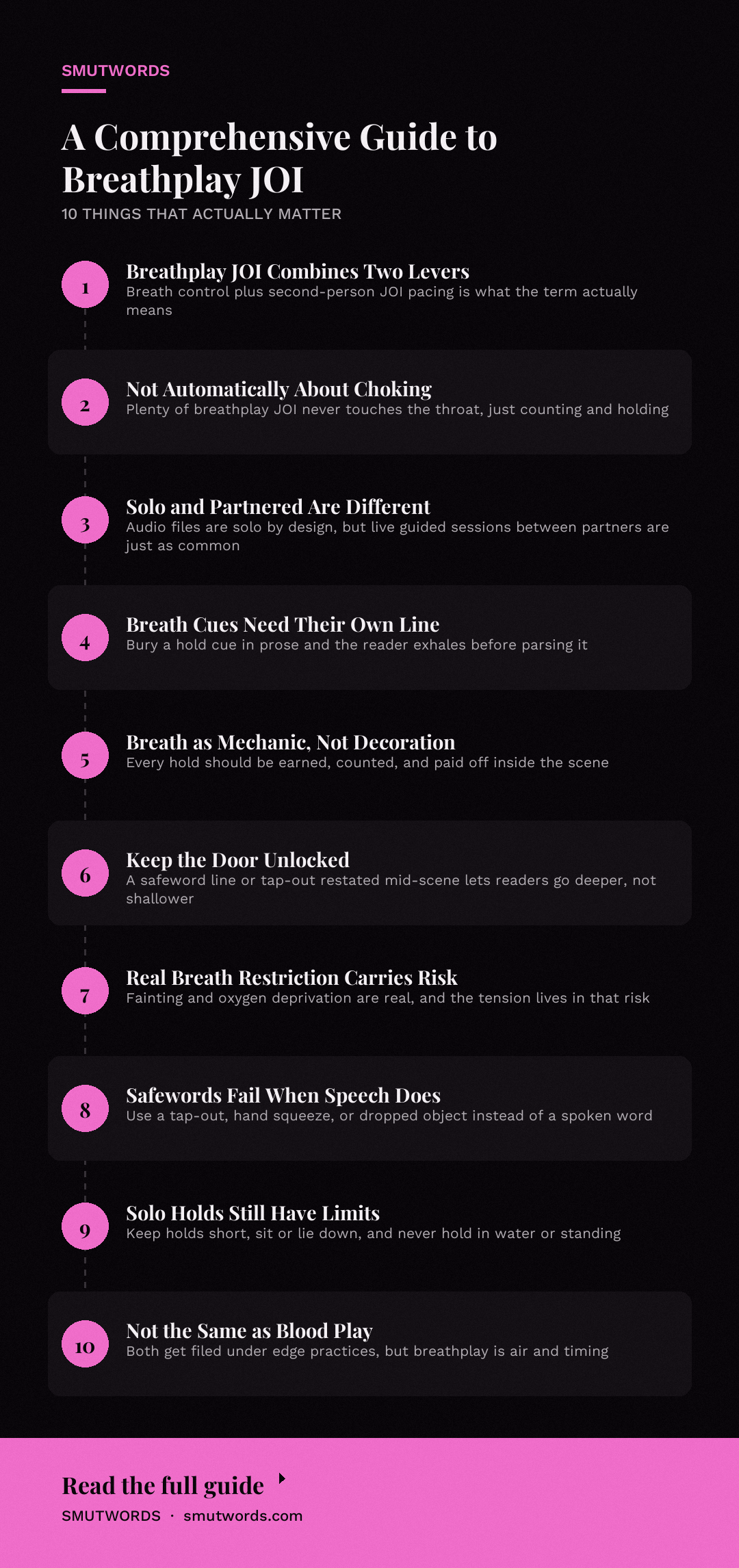
Two misconceptions come up constantly. The first is that breathplay JOI is automatically about choking. Choking is one variant, and a fairly intense one. Plenty of breathplay JOI never touches the throat at all; it's counting, holding, releasing, and the tension of waiting for the next cue.
The second is that it's purely a solo thing. The audio-file version is solo by design, but live guided breathplay between partners is just as common, and the two formats feel different enough to count as separate experiences.
Where Breathplay JOI Comes From
The honest history here is thin on documentation and rich in practice, so treat this as the story of a publishing and audio phenomenon rather than a neat lineage with dates.
Breathplay itself is old. Erotic writing has been putting hands at throats and counting breaths for as long as there's been erotic writing, and real-world kink communities have treated breath control as a known edge practice with known risks for decades. That history matters less here than what happened when JOI format content exploded online.
JOI as a genre grew out of audio erotica and early internet sex content, then hardened into its own category as creators figured out that direct second-person instruction, spoken or written, hits a nerve that a narrated scene doesn't. The listener isn't watching; they're being told. That shift from spectator to participant is the whole appeal of the format, and it's covered in more depth in the complete guide to interactive JOI games.
Once creators had a format built on pacing, countdowns, and denial, breath was an obvious next lever. Adding hold-and-release cues to a JOI script costs nothing, needs no equipment, and raises the intensity of every stroke. Breathplay JOI content started showing up as its own tagged category in audio erotica libraries and written JOI archives, and it's been growing since.
The evolution worth noting is one of precision. Early breathplay JOI content was looser, more about the vibe of breathlessness than about actual timed holds. The current standard is much more specific: hold counts in seconds, clear release cues, built-in safeword reminders, and a paced build that treats breath as the primary dial rather than a garnish. The genre got more careful as it got more popular, largely because creators who actually understand the practice started writing it.
How It Shows Up in Erotica
On the page, breathplay JOI is a craft problem before it's anything else. You're writing instructions the reader will follow with their body, and every count has to be clear enough to execute without stopping to parse a sentence. Any writer who's tried it knows the failure mode: a hold cue buried in three clauses of prose, so the reader is halfway through exhaling before they figure out they were supposed to keep it in.
Strong versions share a few habits. Breath cues land in their own short line, not folded into dialogue. The count is explicit. Release is its own beat, given room to be felt.
And the pacing ties breath to the hand, so the reader is holding air and holding off at the same time. That's where the intensity actually comes from.
Common variations authors build on:
- Audio-guided breath control with spoken hold counts and a voice that stays steady while the listener's pulse doesn't.
- Written JOI scripts that use line breaks as breath beats, so the format itself paces the reading.
- Breath-hold edging, where each hold is paired with a stroke count and the edge is approached on a held breath.
- Choking JOI, the more physically direct variant where a hand at the throat is written in, usually paired with a partner scene rather than solo audio.
- Live guided sessions between partners, where the instructions are improvised and the dominant is watching for the tap-out in real time.
- Denial structures where breath holds get longer as the session goes and release is only permitted after a final, hardest hold.
The difference between a flat breathplay JOI scene and one that works usually comes down to whether the writer treats breath as a mechanic or as decoration. Decoration looks like "she told him to hold his breath" as a throwaway beat. Mechanic looks like a session where every hold is earned, counted, and paid off, and the reader can feel the structure tightening around them.
Enjoyed this? Get a free book.
Join the list and we will send a complete free story straight to your inbox, plus new releases every week after that. No credit card, no catch.
The other mark of a strong version is attention to the person on the other end. The best breathplay JOI writing never lets the reader forget they can stop. A quick line about the safeword, a tap-out signal restated mid-scene, a pause offered without breaking the mood: these don't kill the tension. They're what lets a reader go all the way into it, because they know the door is unlocked.
Because breathplay JOI sits inside a scene, it inherits everything that makes scene play work: a clear start, a negotiated shape, a clean end. A well-written breathplay JOI scene usually has an aftercare beat built into the closing paragraphs, something that brings the reader back down instead of dropping them at the climax. That's covered properly under aftercare, and it's the difference between a scene that leaves the reader settled and one that leaves them wired.
The reality check every writer should keep in mind
Real breath restriction carries genuine risk of fainting and oxygen deprivation. In fiction, the writer is controlling the scene. In practice, a partner is controlling a body, and bodies don't read scripts.
Breathplay demands prior agreement, a clear safeword or tap-out signal that works when speech doesn't, and a partner who stays attentive the entire time. Nobody should be holding a breath with a dominant who has wandered off mentally.
Writers who understand this write better breathplay JOI, because the risk is where the tension lives. You can't get the reader's heart rate up by pretending breath holds are harmless. You get it up by making the care visible alongside the control.
Breathplay JOI vs Related Practices
Two comparisons actually trip people up.
The first is breathplay JOI versus ordinary scene play. Scene play is the general umbrella: any negotiated, structured kink encounter with a start, a middle, and an end. Breathplay JOI is a specific recipe inside that umbrella, defined by the instruction format and the breath cues.
All breathplay JOI is scene play. Most scene play is not breathplay JOI.
The second is breathplay JOI versus blood play. These get lumped together under "edge practices" and they shouldn't be. Blood play involves cutting or piercing and a whole separate set of hygiene and risk rules. Breathplay JOI involves air and timing.
They share a category label and almost nothing else. If you're researching one and land on the other, you're in the wrong neighborhood.
Frequently Asked Questions
Is breathplay JOI safe to try on your own?
Solo breath holds during masturbation are lower risk than partnered restriction because you control the release, but fainting is still possible and fainting alone is dangerous. Keep holds short, sit or lie down, and never hold while standing or in water. If you want to go further than short holds, do it with a partner who is watching.
What's the difference between breathplay JOI and choking JOI?
Choking JOI is one variant of breathplay JOI, focused on hands at the throat and pressure. Breathplay JOI is the broader category that also includes holding, counting, and timed release with no throat contact at all. If a scene has no hand on the neck, it can still be breathplay JOI.
How do you set a safeword when speech is part of the restriction?
Use a physical signal. A tap-out, a hand squeeze, or holding an object that gets dropped all work when the person can't speak or is short of breath. Agree on the signal before the scene starts, and check it at least once mid-session. Consent negotiation for breathplay should happen well before anyone is holding anything.
Why do people like breathplay JOI so much?
Because breath is the most involuntary thing the body does, and handing it over to a voice is a total surrender that doesn't need ropes or equipment. The denied air sharpens every other sensation, so the release hits harder. The JOI format makes it feel personal, like someone is counting breaths right there with you.
Can breathplay JOI work in a vanilla or mixed relationship?
Yes, and it's often a gentler entry point than other edge practices because it needs no gear and the "restriction" can be as mild as a three-second hold. A vanilla/kink mix relationship can build breathplay JOI into a JOI session without either partner having to adopt a full kink identity. Start with the audio version, where the risk is lowest.
Where do you find breathplay JOI content or a community to ask about it?
Audio erotica libraries and JOI archives tag it directly. For real-world questions, kink communities and local munches are where people talk frankly about what breathplay actually involves and where the real risks get discussed by people who practice it.
Final Thoughts
Breathplay JOI works because it takes the one rhythm nobody thinks about and hands it to someone else. Hold, count, release, edge, repeat, and the whole scene is built from a mechanic the reader's own body supplies.
If you want to watch a breath cue carry a whole scene, try the cock warming reader's guide next, or the breakdown of angry sex versus makeup sex. Different practices, same lesson: the most intense writing is often built on one simple physical rule the writer refuses to let the reader forget.




Loading comments…