A jerk off instruction stops being interesting the second you can predict the next sentence. That's the whole problem with most JOI content: it's a monologue wearing a costume, one voice telling you to go faster in a rhythm you mapped out by the second minute.
An interactive joi game fixes that by putting some of the control back on your side of the screen, even when the only thing in the room is your own hand and a phone propped against a pillow.
The word "interactive" gets thrown around loosely in this corner of the internet. A video where the performer asks rhetorical questions isn't a game. Neither is a list of instructions read in a stern voice.
What makes JOI interactive is that your choices, your timing, or your answers actually change what happens next. Here's how that works, why it matters, and a starter script you can run tonight.
What Makes a JOI Game Actually Interactive
The core difference is agency. In a one-way instruction, you're following orders. In a game, you're making decisions the other person (or the script, or the app) responds to. That response can be as simple as "you picked the harder option, so now you don't get to touch for thirty seconds."
Three mechanics do most of the work: pacing, choices, and escalation. Get all three right and even a text message exchange can feel hands-on. Get them wrong and you've just got a longer, bossier instructional video.
Pacing: The Clock You Can't See
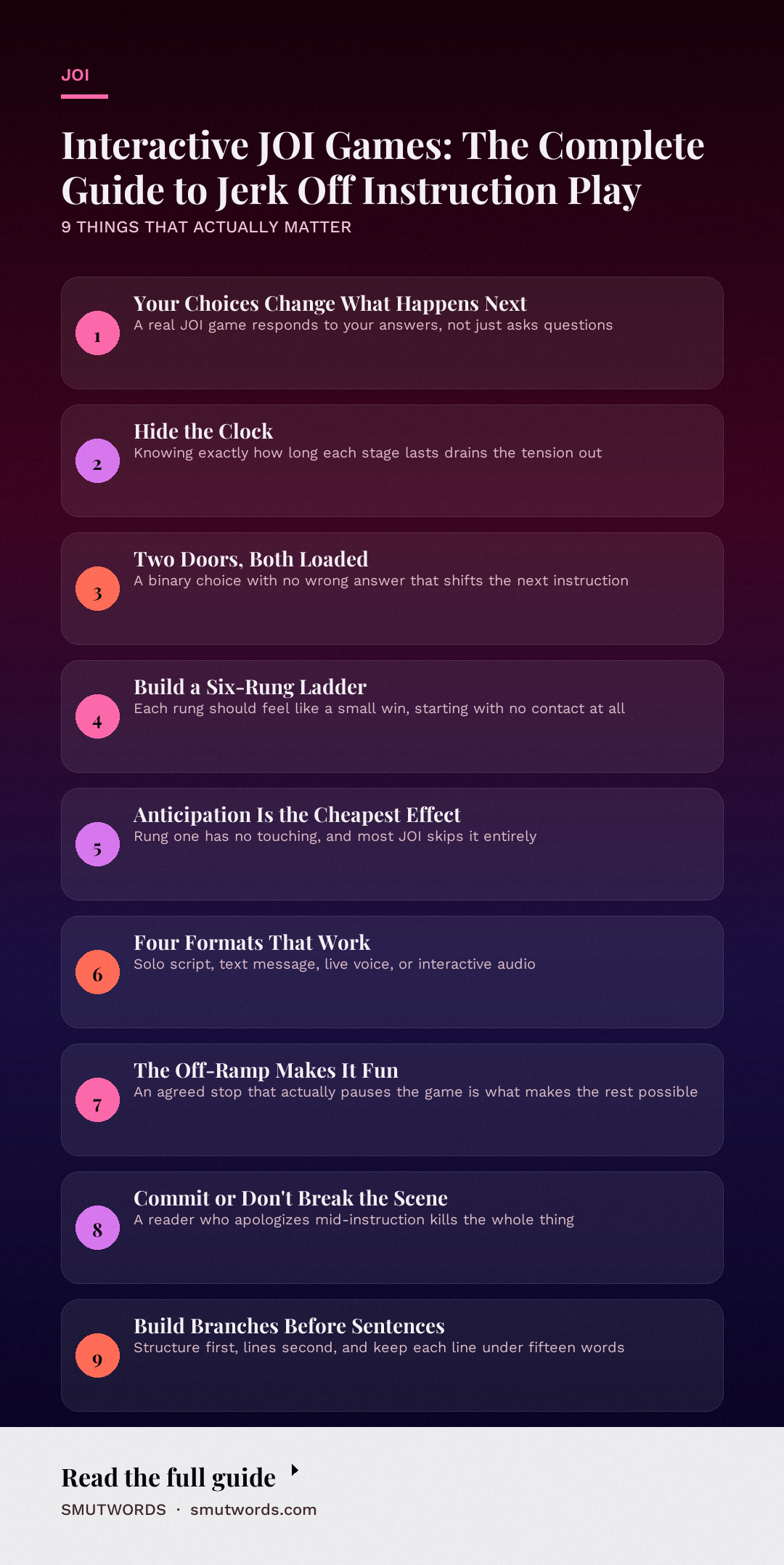
A good JOI game hides the clock. The moment you know exactly how long each stage lasts, your brain starts counting down and the tension leaks out. Interactive pacing works because you don't know when the next instruction lands or whether it's a slowdown or a push.
Roleplay tropes lean on the same trick. The slow burn in a good rockstar romance guide works for the same reason a drawn-out JOI game does: the delay is the point, and the payoff only lands because somebody refused to hurry.
Choices: Two Doors, Both Loaded
The simplest interactive mechanic is a binary choice where neither option is a punishment. "Left hand or right hand." "Slow or fast." "Lights on or lights off." What makes it a game is that the answer changes the next instruction, not just the current one.
You don't need software for this. A partner reading a script aloud can branch on your answers. A text-message game can too. Even a recorded audio file can be structured so that a "stop" command from you skips a track and picks up somewhere else.
Escalation: The Ladder, Not the Sprint
Escalation is where most JOI falls apart. The instruction goes from zero to full speed in under a minute and there's nowhere left to climb. A good game has five or six rungs on the ladder, and each one should feel like a small win to reach.
- Rung one: no contact, just breathing and attention
- Rung two: contact through fabric (this is where a nylon fetish enthusiast has a very good evening)
- Rung three: direct contact, slow
- Rung four: direct contact with a countdown or a hold
- Rung five: the edge, and permission to stay there
- Rung six: finish on command or hold off
Notice that rung one has no touching at all. That's deliberate. Anticipation is the cheapest special effect in the entire genre and most JOI skips it entirely.
Interactive JOI Game Formats: Solo, Partnered, and Everything Between
Not every reader has a partner in the room. That doesn't limit you as much as you'd think. Four formats actually work, and each one plays to a different strength.
1. The Solo Scripted Game
You read a script, follow the branch that matches your choice, and finish. The interaction is between you and the page. It sounds passive, but a well-written branch forces you to make a decision out loud, and saying it out loud changes the experience. Keep a physical timer nearby so you can't cheat the holds.
2. The Text-Message Game
A partner sends instructions on a delay. You reply with a single word to report status. The partner decides what comes next based on the reply. This format is sneaky because the delay between messages builds tension without anyone touching a script.
3. The Live Voice Game
Partner reads, you answer in real time. This is the most interactive version and the easiest to fumble if the reader is self-conscious. The fix is simple: the reader should never apologize between instructions. Commit or don't, but don't break the scene to check whether the scene is working.
4. The App and Audio Variant
Interactive audio tracks where saying "stop" or "harder" jumps to a different segment are the closest thing to a real game without a human on the other end. They're not perfect, but they scratch the itch when a partner isn't available.
The format you pick matters less than whether you commit to playing. A nervous solo script beats a half-hearted live session every time. And if you want a scene with more moving parts than a JOI can offer, the cock warming guide has a slower, more sustained version of the same tension.
The Starter Script: A Solo or Partnered JOI Game You Can Run Tonight
Read this aloud, or have your partner read it. Where it says BREAK, the person being instructed says one word out loud (slow, fast, stop, or more) and the reader takes that word into account before moving on. Total runtime is roughly fifteen to twenty minutes depending on the branches. Adjust as needed; nothing here is sacred.
Opening. "Put your phone face down. You won't need it. Kneel or lie back, whichever is more comfortable, and spend the first minute doing nothing except breathing. Don't touch. Just notice you want to."
Rung one. "Stay exactly where you are for another full minute. If you can hold your own hand still, you've earned the next step."
Enjoyed this? Get a free book.
Join the list and we will send a complete free story straight to your inbox, plus new releases every week after that. No credit card, no catch.
Rung two. "Contact through fabric only. Through the fabric, slow, no rush. BREAK." Wait for the word, then take it and adjust.
If you said "more," you get thirty more seconds. If you said "slow," you get a full minute.
Rung three. "Direct contact. Slow. Begin." Let this run for a minute and a half. Then: "Stop. Hold your hand still and count to twenty in your head. Don't move it and don't take it away."
Rung four. "Now escalate. Pick a countdown of ten. You can finish the countdown only if your pace matches the count exactly. If you rush, you start over at ten."
Rung five. "You're at the edge now. You get to stay there for one minute. No going over. BREAK." That word decides whether the last rung is finish on command or finish without permission.
Rung six. "Finish on my count or don't finish at all. Three. Two. One."
Why the Script Works
Four things are doing the heavy lifting. The opening minute with no contact builds anticipation. The fabric stage gives a slow, low-stakes entry point. The countdowns give the instructions an actual stake.
And the breaks give the person being instructed real influence over what happens next, which is the whole point of the format.
If you want the fictional version of this dynamic, the knotting kink article runs a different flavor of control through it, and the microphilia guide plays with scale and power in a way that pairs well with the "you have no say in this" register of a good JOI script.
What Separates a Good Interactive JOI Game From a Bad One
Most JOI content on the internet is bad for the same handful of reasons. Here's a short diagnostic list so you can spot a weak game before you've given it twenty minutes of your evening.
- Good: hides the clock. Bad: announces "this will take exactly twelve minutes."
- Good: asks you a question and actually uses the answer. Bad: asks a question and barrels on regardless.
- Good: has at least two branches. Bad: is a straight line with extra words.
- Good: treats the edge as a destination you earn. Bad: treats it as a starting point.
- Good: commits to its own tone. Bad: apologizes mid-scene or breaks to ask whether you're having fun.
- Good: has a real off-ramp you can take without wrecking the mood. Bad: has no way out, and the whole thing collapses if you need one.
That off-ramp matters more than any other item on the list. A safe word, a pause word, or an agreed "stop" that actually pauses the game is what makes everything else possible. It also makes it more fun, because the person being instructed doesn't have to hold back to stay safe.
How to Write Your Own JOI Game
Writing one is more forgiving than it looks. The main thing is to build the branches first and the sentences second, because the branch structure is what keeps the whole thing from becoming a lecture.
Start by choosing the ladder: how many rungs, and what does each rung require? Six is a good number. Then build three or four branch points where the player's word changes which rung comes next or how long it lasts. Then write the sentences that deliver each rung, and keep each line under fifteen words.
One last branch suggestion, since it fits the kink so cleanly: add a choice about whether the finisher repeats. A financial domination dynamic does the same thing with money that a good JOI does with time, and the double-or-nothing pacing of that kink works beautifully as a closing branch. If that's your flavor, steal the mechanic.
Common Questions About Interactive JOI Games
Most of the questions readers send in about this format fall into a handful of categories, so here are the answers.
Do I need a partner to play?
No. The solo scripted game is the most accessible entry point and requires nothing more than a printed page and a timer. A partner adds responsiveness, not requirement.
How long should a JOI game run?
Fifteen to thirty minutes is the sweet spot. Under ten and there's no room for the ladder. Over thirty and you need a stamina kink to match. Adjust for what you actually enjoy; some readers love the marathon version.
Can a text-only JOI game actually work?
Yes, and sometimes better than live audio. The delay between messages creates a natural anticipation loop, and it gives the reader time to think about the branch instead of blurting the first word out.
What if the game isn't working?
Use the off-ramp, talk for thirty seconds about why, and either reboot from the last rung or call it. A bad session isn't a failed session; it's information about what your next session should include.
Final Thoughts
If you want to see this tension done properly in long-form fiction, the ghostwriter romance entry in the glossary is a good place to start. The whole trope runs on one person writing words that someone else has to follow, and the scenes where those words land are the closest thing prose has to a well-built JOI game. Read one, then come back to the rung list above and build your own version for tonight.


Loading comments…