
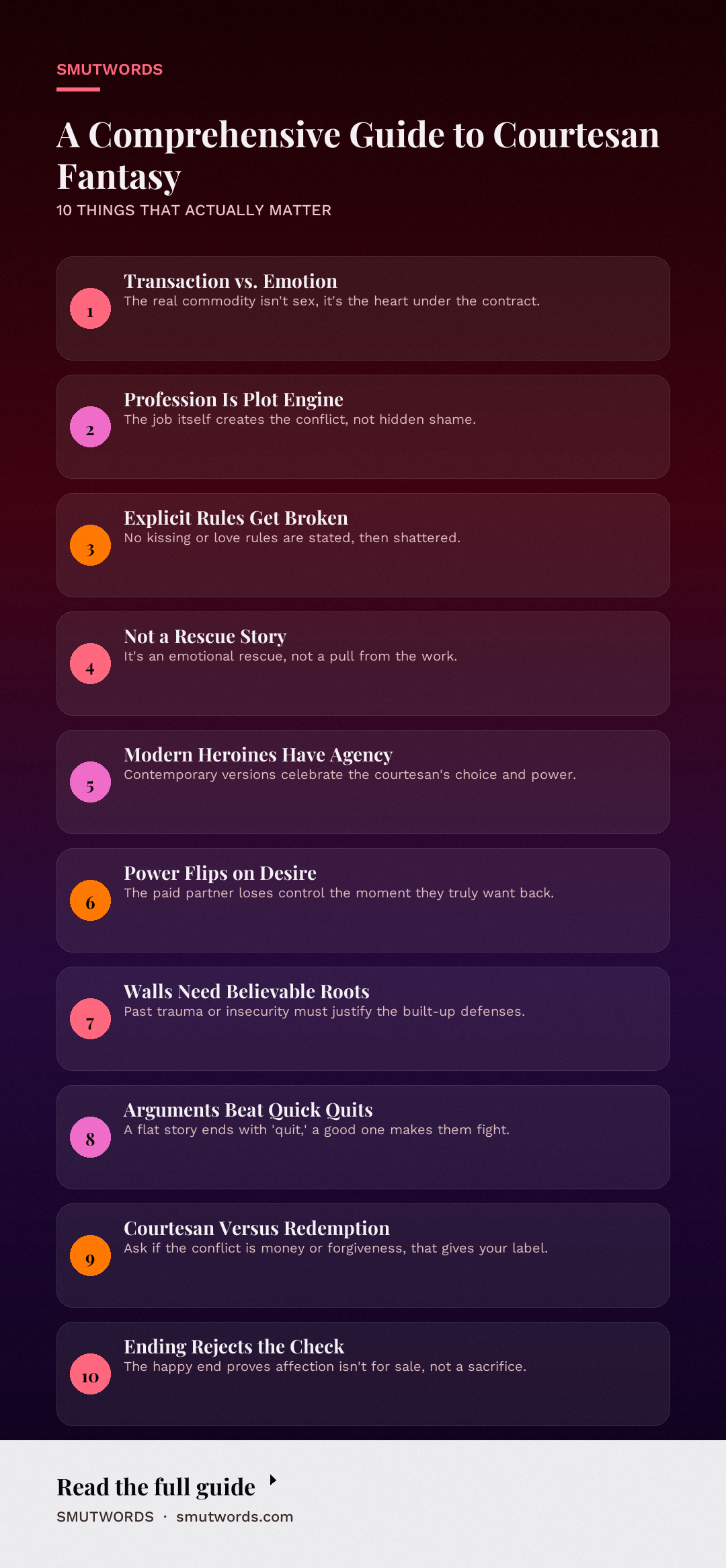
The courtesan fantasy is, at its core, a story where a protagonist sells sexual access to their body, but the real commodity on the table is their heart. It is a tale of transactional intimacy that collapses under the weight of genuine feeling, often setting a professional provider of pleasure against a client who refuses to keep things professional.
This trope thrives on the tension between the rules of business and the messy reality of attraction. It is a favorite for readers who want their smut served with a side of emotional devastation and a happy ending.
What makes this fantasy distinct is that the protagonist's profession is not a shameful secret to be hidden. It is the structural engine of the conflict.
The money, the boundaries, and the emotional walls are all part of the setup, ensuring that every kiss and caress is a negotiation as much as a surrender. In a genre built on wish fulfillment, this is the fantasy of being so desirable that someone is willing to pay for you, and then being so compelling that they are willing to tear up the check.
What a Courtesan Fantasy Actually Means
The term "courtesan fantasy" refers to a specific narrative trope in erotica and romance where one protagonist works as a high-end sex worker, escort, or historical companion, and the plot revolves around a relationship that forms with a specific client.
Unlike broader themes of prostitution, the courtesan fantasy typically centers on the selective, elite nature of the work. These characters are often the most sought-after in their field, possessing an almost artistic mastery over seduction and carnal pleasure.
The naming convention usually borrows from historical archetypes like the Japanese oiran, Indian tawaif, or European mistress, but the emotional beats are strikingly modern. At its heart, this is a story about the conflict between professional detachment and personal vulnerability. The protagonist enforces strict rules to protect their heart, and the love interest is the one who comes along and makes those rules impossible to keep.
Several elements distinguish this trope from simple workplace romances. The first is the explicit exchange of currency or patronage for intimacy, which is usually established early and revisited throughout the story. The second is the presence of a rulebook: no kissing, no sleeping over, no repeating clients, no falling in love.
A strong courtesan fantasy will state these rules explicitly and then have the narrative break every single one.
Third, the story often features a "rescuing" dynamic, but typically not a physical rescue from the profession. It is an emotional rescue from the loneliness the courtesan has built around themselves. The professional is rarely forced out of their work by the partner; instead, they choose to trade a life of controlled transactions for the risk of a real relationship.
Where the Courtesan Fantasy Comes From
As a specific genre phenomenon, the courtesan fantasy has roots that reach back to the earliest days of the romance novel. While Victorian erotica featured courtesans as tragic figures, the modern romance version began to calcify in the late 1970s and 1980s with the rise of the "bodice ripper" and historical romances. Authors like Kathleen Woodiwiss and Rosemary Rogers popularized heroines who were forced into situations of sexual bargaining, often with a powerful lord or pirate who purchases their favors.
The shift toward the professional courtesan as a heroine with agency happened in the 1990s and 2000s. The historical romance subgenre saw a boom in "courtesan" titles, where the heroine was a successful, independent operator rather than a victim. Susan Johnson and other authors began writing heroines who made a conscious choice to enter their profession, often as a means of survival but with a clear business acumen and a wry wit.
The genre shifted again with the indie publishing boom, where the trope found a comfortable home in contemporary settings. The historical "courtesan" became the modern escort or high-end call girl, and the stories began to focus less on societal transgression and more on internal conflict.
The evolution of the trope is also tied to shifting cultural attitudes about sex work itself. Early novels often framed the courtesan as a fallen woman in need of moral redemption from a good man. Contemporary versions, however, rarely moralize. The modern hero is far less likely to "save" the heroine by dragging her out of the brothel and more likely to respect her work while desperately wishing she would choose him over her bank account.
This change reflects a broader acceptance of the idea that emotional intimacy and professional sexuality are not mutually exclusive, but rather a complex territory worth exploring. The genre has moved from punishing the courtesan to celebrating her power, while still insisting that love is the one transaction that cannot be conducted in cash.
How It Shows Up in Erotica
When a courtesan fantasy is written well, the reader gets a front-row seat to the push-and-pull of a relationship that is doomed to fail as a business contract. The plot structure usually follows a predictable but deeply satisfying arc: the initial meeting, the establishment of the arrangement, the first crack in the professional facade, the inevitable fallout, and the grand romantic gesture that rejects the transactional nature of the relationship.
On the page, the erotica hinges on the dissonance between what the characters say and what their bodies communicate. The protagonist might perform a scripted routine of seduction, but the love interest notices the way their breath hitches when they are genuinely kissed.
Authors play with power dynamics here in a way that is unique to this trope. The courtesan holds power over their clients because they are being paid to be desired, but they lose that power the moment they desire someone back.
Here are some common variations authors employ within this framework:
- The Rule Breaker: The courtesan instantly breaks their own rules for the client, often within the first chapter. This speeds up the emotional intimacy but requires the author to create believable reasons why someone would be worth that risk so quickly.
- The Virgin Client: The love interest is a novice, purchasing their first experience with a professional. This sets up a mentor dynamic where the courtesan's expertise becomes the source of the client's awe and eventual infatuation.
- The High-Stakes Arrangement: The relationship with the paying client is a matter of life or debt or survival. This adds a desperation that makes the characters' initial denials of their feelings more poignant.
- The Long Game: The courtesan sees the same client repeatedly over a long period. The story is told in vignettes, showcasing how the relationship evolves from purely physical to deeply emotional.
- The Public Persona: The courtesan is also a celebrity or public figure in their social circle, adding a layer of risk to the secret relationship that goes beyond simple scandal.
A strong version of this fantasy relies on the courtesan's internal conflict being believable. The author needs to make the reader understand why these walls were built. Often, it stems from past trauma or a belief that their only value comes from their beauty and performance.
If the character's profession is treated as a purely titillating detail, the story feels hollow. But when the author ties the business arrangement to a core insecurity, the moment the love interest sees through it feels like a cathartic release.
Enjoyed this? Get a free book.
Join the list and we will send a complete free story straight to your inbox, plus new releases every week after that. No credit card, no catch.
Conversely, a flat version of this trope often sacrifices characterization for kink. If the courtesan is merely a vehicle for explicit scenes with different partners, the emotional core of the story is lost. The other pitfall is solving the problem too quickly. If the client simply says "I love you, quit your job" in the middle of the book and the courtesan immediately agrees to become monogamous, the inherent tension of the setup evaporates.
A strong story makes the character fight for their emotional safety. The best courtesan fantasies revel in the parley between the bedroom and the counting house, making the climax of the story not the physical act, but the moment one character says "I don't want your money anymore, I just want you."
Courtesan Fantasy vs. Redemption Arc Romance
A common point of confusion for newer readers is the difference between a courtesan fantasy and a redemption arc romance. While both tropes frequently feature protagonists who have been through the wringer, their goals are fundamentally distinct. A courtesan fantasy is centered on the protagonist's relationship to their work and their identity as a professional. The arc concerns their ability to separate physical intimacy from romantic love.
A redemption arc romance, on the other hand, is typically about atonement for a specific past sin or a pattern of destructive behavior. The focus is on the hero or heroine earning back their own self-worth and the trust of others.
While a courtesan might be seeking therapy and apologizing for past mistakes in a redemption arc, in the purest forms of the trope, they are not necessarily interested in being "forgiven" for their job. Instead, they are looking for someone who sees their desirability as a trait that belongs entirely to them, not to the clients who purchase it.
That said, the two tropes often overlap heavily in practice. A historical courtesan might regret the decisions that led her to her profession, creating a subplot of redemption. Similarly, a redemption arc often uses a courtesan-style situation as the crucible for change.
When reading a book, ask yourself if the primary conflict is "Will they choose love over income?" or "Can they be forgiven for who they used to be?" If the former, you are likely looking at a courtesan fantasy. If the latter, the redemption arc romance is the stronger label.
For readers seeking high-stakes emotional journeys where a character's self-worth is the battleground, both tropes deliver. The courtesan's journey is uniquely tied to the literal price of being wanted. If you enjoy the push-pull of professional distance collapsing into genuine intimacy, you might also appreciate how possessive sex plays with similar themes of control and surrender, or how the dynamics of a cuckold bull trope complicate who holds power in a sexual arrangement.
Frequently Asked Questions
Is a courtesan fantasy about sex work?
Yes and no. The protagonist's profession is sex work, and the story rarely shies away from erotic scenes that showcase their skills. However, the focus is on the emotional relationship with one specific partner who starts as a client.
The story is less about the day-to-day reality of the job and more about the romantic dilemma of choosing intimacy over a sterile professional arrangement. Consent and agency are usually foregrounded to keep the fantasy playful rather than harrowing.
Are the protagonists always women?
No, the trope works well with any gender combination. You will find Male/Male romance novels featuring male courtesans or escorts, and Female/Female variations as well. Some of the most popular indie titles feature a male courtesan in a straight relationship. The power dynamics are inherently flexible, which makes the trope adaptable to any pairing you prefer.
What is the typical happy ending?
The number one rule of a romance is a happy ending, and the courtesan fantasy is no exception. The happy ending generally involves the love interest making a grand gesture to prove that their affection is not a transaction.
This often means a proposal or a declaration of love that removes the exchange of money from the equation, symbolizing that the hero wants the person, not the service. The courtesan usually leaves their profession, not as a sacrifice, but as a step toward a future where they do not have to compartmentalize their heart.
How does this differ from a "kept woman" trope?
The "kept woman" trope often involves a protagonist who lives lavishly in exchange for sex and companionship, whereas a courtesan fantasy usually involves a more direct fee-for-service exchange. The courtesan is typically a working professional with autonomy, while a "kept woman" is often entirely financially dependent.
This distinction affects the power balance and the tone of the story. A courtesan can fire her client; a kept woman cannot.
Where can I find books with this trope?
Because this is a popular trope in indie publishing, you can search for it directly on ebook retailers. Keywords like "courtesan romance" or "escort romance" will pull up thousands of results. Many authors specialize in gritty contemporary erotica that features this dynamic, often pairing it with themes of obsession and wealth.
If you prefer historical settings, look for tags like "Regency courtesan" or "Victorian erotica" to narrow your search.
Is this trope considered dark romance?
It can be, but it does not have to be. If the story focuses on the courtesan's exploitation, coercion, or a dangerous client, it is probably a dark romance. If the story treats the character's work with respect and focuses on the emotional buildup between two consenting adults, it sits firmly in mainstream erotic romance. The darkness is a sliding scale, so reviewing content warnings is always a wise move before you start reading.
Final Thoughts
The courtesan fantasy endures because it exaggerates a universal fear: that we are more loved for what we provide than for who we are. Watching a character overcome that belief is the core appeal, and a well-executed story will make you feel the weight of every banknote exchanged as a barrier to real connection.
If you want a read that blends opulent settings with serious emotional stakes, look for a title featuring a high-end escort who has never been kissed or a historical mistress who finds her match in a client who sees the cracks in her armor. It is the fantasy of being pursued for what you hold back, not just for what you give.








Loading comments…