
The cuckold bull trope has a casting problem. For a trope that hinges on a third person, most fiction treats the bull like furniture with a pulse. A warm body whose only job is to show up, perform, and leave the emotional drama to the couple.
That undersells what he actually does. The bull is the mechanic who tunes the engine so the couple can drive off somewhere interesting. When he's written well, he matters as much as the two people in the marriage, and the story gets worse the second he stops being a character and starts being a prop.
Let's talk about what separates a bull who lands from a bull who fizzles, how to tell the difference when you're browsing, and why the good ones are never actually the point of the scene even when they're the center of it.
What Makes a Good Bull Character in Fiction
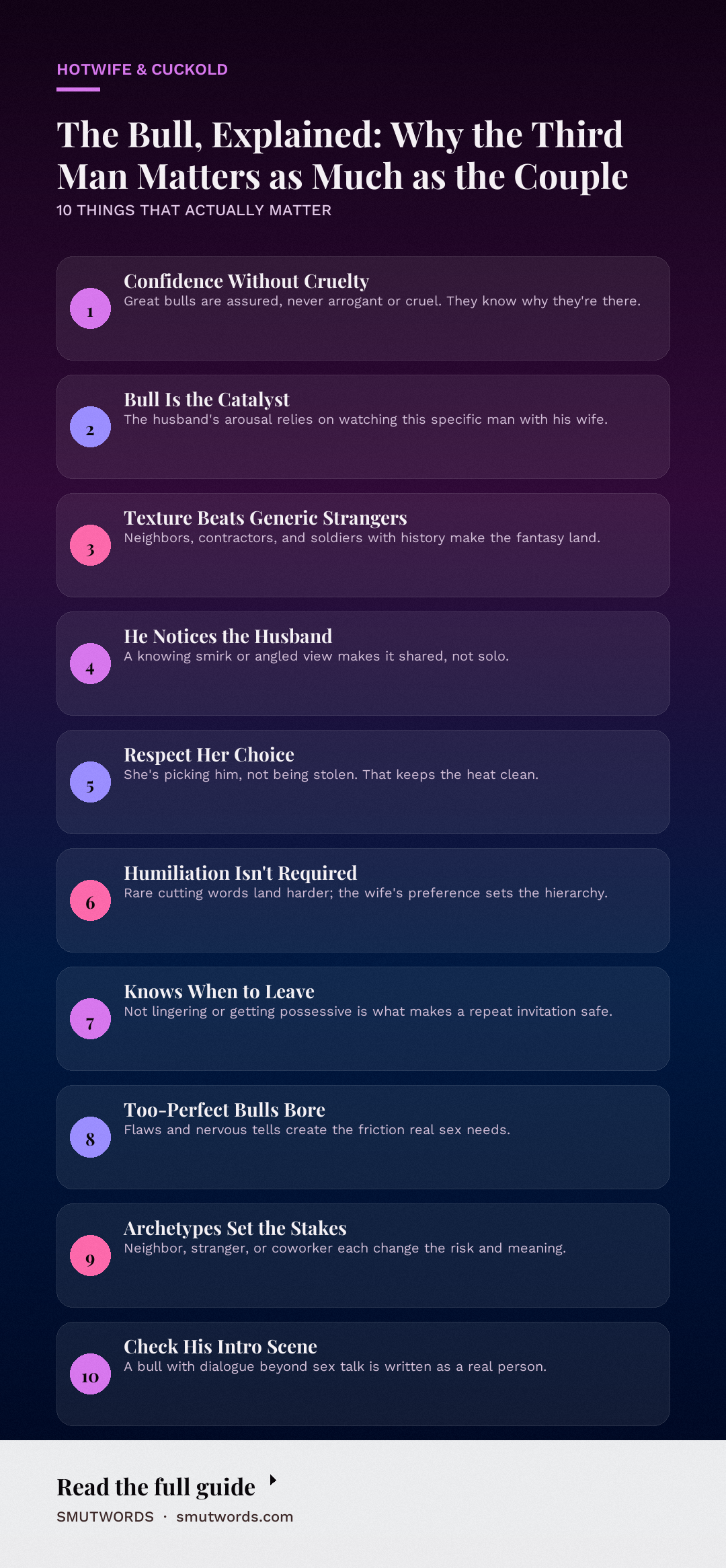
Confidence without cruelty. That's the line, and most writers miss it on one side or the other.
The bad bull is a sneer with a gym membership. He's written as a walking power fantasy who humiliates the husband for sport, talks about the wife like she's a prize he's winning, and generally acts like a villain who wandered in from a different genre. That version gets boring fast because there's no tension in it. If the bull is just an asshole and the husband is just a doormat, the story writes itself, and the fantasy dies.
The other failure mode is the apologetic bull. He spends half the scene checking in, asking if everyone's okay, and generally sucking all the heat out of the room by being too considerate to actually commit. He reads like a nice guy who accidentally ended up in a cuckold story and keeps hoping someone will explain the exit.
The right version sits between those. He's assured, not arrogant. He knows what he's there for and he does it without needing to prove anything to the husband, and without pretending he doesn't know exactly what's happening.
He can be playful, even warm, but there's an edge to him that says he's not there to make friends. He's there to fuck his partner, and the dynamic around that is the couple's business, not his insecurity.
Good bulls in fiction also tend to be specific about who they are. A generic handsome stranger works in a pinch, but the ones you remember have texture.
The neighbor who's been quietly fixing their fence for years. The contractor who shows up with calloused hands and a delivery that isn't just food. The soldier on leave who doesn't ask questions because he's seen enough of the world to know that what happens behind closed doors is rarely anyone else's business.
Why the Bull Matters to the Fantasy
Here's the thing about the cuckold bull trope: the couple is the relationship, but the bull is the catalyst. Without him, nothing happens. The husband's arousal comes from watching someone else do what he can't, or won't, or wants to see done differently. The wife's arousal comes from being wanted by a new person in a way that her marriage no longer provides, or provides differently.
The bull's job is to be the difference between the marriage and the affair. That's not a small role. He needs to feel like a genuine alternative, someone with his own appeal that isn't just "not the husband." If he's bland, the fantasy collapses because there's no reason the wife would pick him over the comfortable familiarity of home.
That's why the best bulls have a dimension beyond the bedroom. Maybe he's younger, or older. Maybe he's rougher in a way the husband can't be. Maybe he's a stranger who represents total anonymity.
The freedom of being wanted with zero strings. Each of those changes what the fantasy means.
A neighbor is a different kind of risk than a stranger. A stranger is a different kind of risk than a longtime friend. The bull's identity sets the stakes, and the stakes are most of what makes the trope work.
Signs of a Well-Written Bull
When you're looking for stories that get it right, a few patterns show up consistently. Here's what separates the good ones from the cardboard cutouts:
- He has his own reactions. The husband is watching, but the bull notices the husband watching. He might smirk. He might meet the husband's eyes. He might deliberately angle the wife so the husband gets a better view. That awareness of the audience is what makes the scene feel like a shared fantasy instead of a solo performance.
- He respects the wife's agency. He's not stealing her. She's choosing him, and he knows it. That choice is what makes the scene hot instead of skeevy.
- He doesn't need to humiliate the husband to feel dominant. The hierarchy is established by the wife's preference, not by the bull's trash talk. When he does say something cutting, it lands because it's rare.
- He has a life outside the bedroom. Even if we only see a hint of it, the story is better when the bull feels like a person with his own wants and history.
- He leaves when it's over. The mark of a good bull is knowing when the scene ends. He doesn't linger, doesn't try to turn it into a relationship, doesn't get possessive. That letting-go is part of what makes him safe enough to invite back.
When the Bull Goes Wrong
The flip side of all this is the bull who tanks a story. The most common mistake is making him a one-note villain, the kind of guy who exists to be cruel because the author thinks that's what dominance means. That version usually reads as the author's own insecurity bleeding through, a need to punish the husband character for being into something the author secretly finds shameful.
The other common miss is the bull who's too perfect. He's got the body of a god, the charm of a salesman, and the emotional intelligence of a therapist. He never stumbles, never has an off moment, and never feels like a real person. That's a fantasy in the worst way, because it removes all the texture that makes the scene feel possible.
Realistic bulls have tells. They get a little nervous. They have preferences that don't always align with what the wife wants. They might laugh at the wrong moment or need a restart.
The fiction version doesn't need full realism, but it needs enough friction to feel like two people are actually negotiating sex together. Not performing a script.
The Connection to Other Romance Tropes
The cuckold bull trope doesn't exist in a vacuum. It shares DNA with plenty of other dynamics that get the same treatment in romance fiction. The closest cousin is the hotwife story, which is basically the same setup with the humiliation dial turned down and the wife's freedom dial turned up. Our explainer on hotwife vs cuckold vs swinging walks through where those lines actually fall, because they're closer than most readers assume.
There's also something structurally similar in alien mate bond romance, where the third party isn't human and the dynamic gets rewritten by biology. And for pure fantasy flavor, fae romance books treat their love interests with the kind of otherworldly confidence that a good bull should have, minus the marriage drama.
Enjoyed this? Get a free book.
Join the list and we will send a complete free story straight to your inbox, plus new releases every week after that. No credit card, no catch.
Even enemies to lovers stories rely on the same core mechanic: a character who enters the existing dynamic and disrupts it. The antagonist becomes the love interest, or at least the catalyst. The bull is just a more direct version of that disruption.
How Different Bull Archetypes Change the Story
The bull's specific role shapes the entire narrative. A few archetypes show up often enough to be worth knowing by name:
The Neighbor. He's close, which means he's a repeating temptation. The risk of discovery is constant, and the story usually builds toward the husband inviting him in rather than catching them. The Man Next Door plays this exactly right, turning proximity into a slow burn instead of a one-off.
The Stranger. He's a one-night or one-weekend phenomenon. Total anonymity means the couple can try things without social consequences, which makes the fantasy feel safer even while it's riskier. Late Night Delivery starts with a married woman answering the door for a stranger, and the stranger's unknownness is the whole point.
The Friend or Colleague. This one carries the most emotional weight because the bull already has a relationship with the couple. There's trust, but there's also a lot to lose. The story usually hinges on whether this changes their friendships, and the bull's comfort with that risk tells you what kind of man he is.
The Professional. He's hired, which removes the social stakes. He's there to do a job, which means the couple can be more explicit about what they want without awkwardness. He's also the easiest archetype to write badly, because he can slip into pure service mode and stop being a character entirely.
What the Husband's Reaction Tells You About the Bull
A cuckold story has two audiences: the wife who's physically experiencing the scene, and the husband who's experiencing it through watching. The bull has to serve both, and his read on the husband is part of what makes him good.
The ideal bull is attentive to the husband's reaction without being subservient to it. He notices when the husband's breathing changes. He adjusts his pace or angle to give the husband what he wants to see. He might acknowledge the husband directly, a glance or a word, that confirms they're both in this together.
That acknowledgment is fragile. Too much and the bull looks like he's performing for the husband instead of fucking the wife. Too little and the husband becomes a ghost, and the scene loses its voyeuristic charge. Skilled authors thread that needle by keeping the husband's presence visible but not central, like a camera angle that knows where the audience is sitting.
Stories like He Left the Door Unlocked build the entire premise around the husband's deliberate absence, the invitation that turns watching into a willed act. The bull in that setup isn't just entering a house; he's entering a dynamic where the husband has already given permission, and his awareness of that permission changes how he acts.
Why Bad Bulls Are So Common
Part of it is that the trope is often written by people who are nervous about it. They want the heat without the moral weight, so they make the bull a cartoon villain to distance themselves from the fantasy. Or they're so worried about depicting anything that looks like coercion that they strip the bull of all personality and leave him as a shy service provider.
The cuckold bull trope is having a cultural moment, which means more writers are trying it and more of them are missing. The market is flooded with stories where the bull is a prop, and the actual dynamic between the couple gets skipped in favor of repetitive sex scenes that all feel the same.
That's why the stories that give the bull real interiority stand out. When he has his own arc, even a small one, the sex scenes gain weight because the reader cares about what's happening to him, not just what he's doing.
The best version of this might be Marked by the Bull, which takes the trope and gives the bull enough presence that the title itself signals his importance. He's not a shadow; he's the mark. The story treats him as someone who leaves an imprint, which is exactly what a good bull should do.
Finding the Right Bull for You
When you're browsing for stories, the way to tell if the bull is going to work is to look at how the author introduces him. If he gets a scene to himself before the first sexual encounter, that's a good sign. If he only appears when he's needed for sex, expect a prop.
Also check whether the bull has dialogue that isn't about the sex act itself. A bull who talks about his day, or makes a joke, or reveals a vulnerability is a bull who's being written as a person. A bull whose only lines are variations on "yeah, take it" is a cardboard cutout.
There's no wrong way to want a specific flavor of fantasy. If you like your bulls mean, there are stories that do that well. Just know that mean isn't the default, and it's not what most readers of the trope are actually after. What most readers want is a third person who arrives with confidence, takes what he's given without apology, and leaves the couple feeling more connected to each other than they did before.
She Brings Him Home and The Waiter Flirted First both handle the introduction differently, but each one gives you a reason to care about the man before he ever gets into bed. That's the test.
Final Thoughts
The cuckold bull trope lives and dies on the quality of its third character. When the bull is a person with his own edges and history, the fantasy becomes something the whole couple can share. When he's a prop, the story collapses into a series of repetitive scenes that never quite land.
If you're new to this flavor and want to see it done well, start with Marked by the Bull. It's a reminder that the third man isn't a threat to the couple. He's the guest who makes the party worth throwing.







Loading comments…