
Eldritch romance is a love story where at least one partner is a cosmic horror, an ancient god, or a being whose real shape breaks the human mind that tries to hold it. The book takes that problem seriously instead of filing it off.
The reader gets the full weight of the unknowable pressed up against the very human need to be held, chosen, and understood. The genre's central question is blunt: what does intimacy look like when the beloved has tentacles, a thousand eyes, or a consciousness that predates stars? And loves you anyway. Or loves you in a way that only resembles love from the outside.
If you have ever finished a monster romance and thought the beast was too tidy, too explainable, too eager to turn into a brooding man by chapter three, eldritch romance is the subgenre that refuses that exit. It keeps the horror switched on. The terror does not cancel the tenderness. Both run at once, and that double current is the whole appeal.
What Eldritch Romance Actually Means
The word "eldritch" is old Scots, meaning strange, unearthly, weird in a way that unsettles. It drifted into English weird fiction in the late nineteenth and early twentieth centuries, riding the pulps and the cosmic horror tradition that made it a genre label. Eldritch romance takes that adjective and bolts it to the front of a love story.
The mechanics are specific. In a standard romance, the obstacle between the leads is usually emotional, social, or situational: pride, distance, a family feud, a misunderstanding that two adults could fix with one honest conversation.
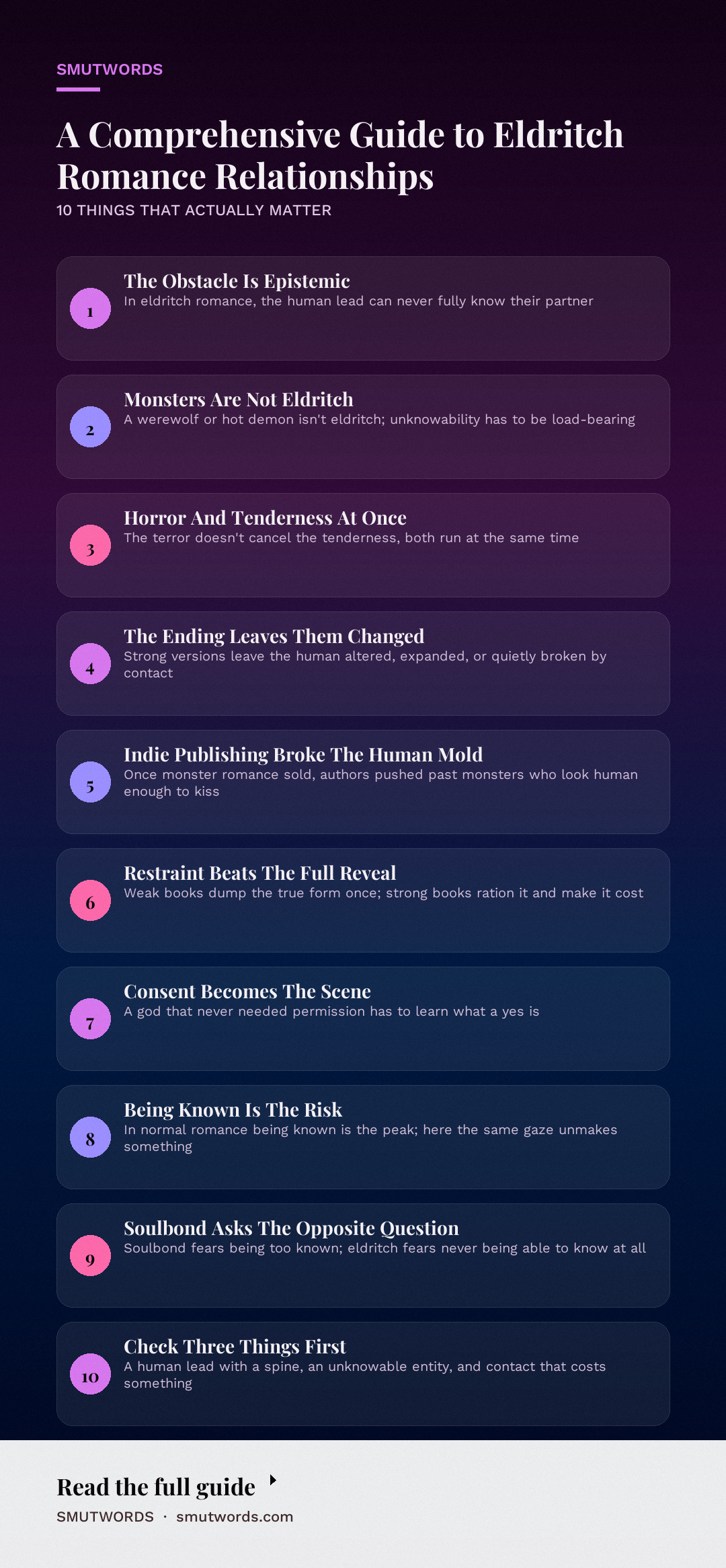
In eldritch romance, the obstacle is epistemic. The human lead cannot fully know their partner. The beloved's body may not fit in three dimensions. Their motives may operate on a timescale that makes human courtship look like the lifespan of a mayfly.
What counts as eldritch romance, and what does not:
- It counts when the otherness is metaphysical. A being that exists outside linear time, a god that dreams reality into being, an entity that speaks in colors and pressure changes rather than words.
- It counts when the horror is not fully resolved. If the book ends with the monster neatly humanized and domesticated, it has slid into standard paranormal romance territory.
- It counts when the human partner's perception itself changes. The strongest versions leave the human altered, expanded, or quietly broken by contact.
- It does not count just because the love interest is a monster. A werewolf with a temper problem is not eldritch. A demon who is basically a hot man with red eyes is not eldritch. The unknowability has to be load-bearing.
Common misconceptions run in both directions. Some readers assume eldritch romance means no heat, just atmospheric dread with a chaste hand-hold at the end. Wrong. Much of the subgenre is explicit, and the erotic charge comes directly from the scale and strangeness of the partner.
Other readers assume it means pure horror with a romance subplot bolted on. Also wrong. The love story is the spine. The dread is the weather.
The category overlaps with cosmic horror romance, and plenty of books can be shelved under both labels. The distinction people draw is one of emphasis: cosmic horror romance foregrounds the terror and the insignificance, while eldritch romance foregrounds the relationship and asks what the terror does to two beings who want each other anyway.
Where Eldritch Romance Comes From
The genre's DNA is in weird fiction, not in romance publishing. H.P. Lovecraft's work gave the twentieth century its vocabulary for vast, indifferent entities and the madness of encountering them, and his circle and successors built an entire mythos around gods that treat humanity as a rounding error.
For decades, that tradition and romance barely touched. Love and cosmic dread were considered opposites.
Romance publishing caught up slowly. Through the nineties and two thousands, paranormal romance made monsters into viable love interests at scale: vampires, werewolves, demons, angels. The genre proved that readers would happily fall for something with fangs.
But most of those monsters came pre-softened. They had human faces, human grudges, human hearts. The otherness was cosmetic.
The real shift came with the indie and self-publishing boom of the 2010s, when monster romance and tentacle romance found large, unembarrassed audiences and stopped needing to pass as anything else. Once readers proved they would buy books where the love interest is visibly, physically nonhuman, authors could push further. The question stopped being "can the monster look human enough to kiss" and became "what if the monster is a god with no interest in looking human at all."
A parallel evolution happened in fanfiction, where Lovecraftian and cosmic-horror source material got rewritten as romance on a massive scale. Fans took entities originally written as pure antagonists and rebuilt them as love interests without sanding off the incomprehensibility. That fandom habit bled back into original publishing, and by the early 2020s the subgenre had its own dedicated readership, its own cover conventions, and its own shelf in the monster romance aisle.
The most recent evolution is tonal range. Early entries leaned hard on dread and madness. Contemporary eldritch romance runs the full spectrum, from gothic and tragic to genuinely funny, with tentacle meet-cutes and gods who have to be taught how a dishwasher works. The subgenre stopped being a single mood and became a toolkit.
How It Shows Up in Erotica
On the page, eldritch romance lives or dies on the sensory problem. You cannot describe a thing with no describable shape, so authors solve it in different ways, and the solution they pick shapes the entire book.
The most common approaches:
- Perception translation. The human narrator experiences the beloved's true form as impressions the brain can file: pressure, temperature, gravity, the smell of ozone, a sound like a cathedral being tuned. The reader gets the dread without a literal inventory.
- Avatar and true form. The entity wears a workable body for day-to-day contact, and the story occasionally cracks it open to reveal what is underneath. The horror is in the ratio between the mask and the thing behind it.
- Direct description with wrong details. The author describes the body plainly but adds one detail that cannot be right: a joint that bends the wrong way, an eye where a palm should be, a shadow that does not match the light. One wrong note does more than ten paragraphs of purple fog.
- Human-coded gods. The entity speaks like a person and mostly behaves like one, and the horror comes from the reader slowly realizing the personhood is a performance the entity is running for the human's comfort.
The craft move that separates a strong eldritch romance from a flat one is restraint with the reveal. Weak versions dump the full description of the true form in the first sexual encounter and then never scare the reader again.
Strong versions ration it. The first time the human sees too much, the scene should cost them something: a nosebleed, a lost hour, a memory that will not come back. Contact has a price, and the price is the plot.
Sex is where the subgenre does its most interesting work, and it has to solve a real physical problem. A body that does not fit human anatomy cannot be written with standard choreography, so authors invent. Tendrils that are not tentacles but function like them. A partner who can be inside the human's mind during the act and feels the pleasure as a foreign object entering them.
Multiple contact points at once, which is where the genre borrows happily from size difference romance and pushes the proportions past anything a shifter book would attempt. The erotics of the subgenre come from the reader's inability to fully picture what is happening, paired with a vivid sense of what it feels like.
Enjoyed this? Get a free book.
Join the list and we will send a complete free story straight to your inbox, plus new releases every week after that. No credit card, no catch.
Consent becomes a formal puzzle rather than a checkbox. A god that has never needed permission for anything does not intuit human consent, so the negotiation itself becomes a scene, often a hot one. Some books make the negotiation the central courtship. The entity has to learn what a yes is, and the human has to learn that a yes given to this partner cannot be revoked or understood in the usual way.
The other engine is comprehension as intimacy. In a normal romance, being known is the emotional peak. In eldritch romance, being known is dangerous.
Several of the best books in the subgenre build the climax around the human partner choosing to let the beloved see all of them, knowing the same gaze that understands them will also unmake something. That trade is the genre's version of the grand romantic gesture.
Two craft pitfalls sink rookie attempts. The first is over-explaining the entity. Once you give the god a tidy metaphysics, a clear motivation set, and a species name, the dread evaporates and you are writing paranormal romance with extra eyes.
The second is a human lead with no interiority, reduced to a witness. The human has to want things, push back, and make choices, or the book becomes a tour of a monster instead of a love story.
For readers who want to study how physical strangeness gets written with this much specificity, the way the subgenre handles bodies is a close cousin to how body fluid kink gets handled: the detail work is where the heat lives, and vagueness kills it. The same is true of the weird sensory register some authors use, a kind of atmospheric scent and pressure language that echoes what makes scent and sensory fetish writing land.
Variation across the subgenre is wide, and it helps to know which flavor you are picking up:
- Lovecraftian romance. The closest tie to the source tradition, often with cults, forbidden texts, and a love interest who is explicitly one of the old gods.
- Godly or divine romance. Gods from any pantheon, ancient and overpowered, with worship language doing double duty as romantic language.
- Tentacle romance. Physical otherness foregrounded, often pulling from kraken romance or deep-sea horror imagery, sometimes with a lighter, more playful tone.
- Alien romance with eldritch leanings. Science fiction settings where the love interest's species is so advanced or so foreign that the difference stops being biological and becomes existential.
- Hybrid forms. Books that mix cosmic dread with shifter or fae material, which can work but risks diluting the unknowability. When it is done well, it usually borrows the body-logic of hybrid shifter romance and swaps the animal for something with no earthly analogue.
Eldritch Romance vs Soulbond
The comparison worth making is with soulbond, because the two get confused constantly and they scratch opposite itches.
A soulbond is a metaphysical tie that guarantees connection. Two people are joined, often against their will, and the bond is a fixed fact of the universe that both partners have to live inside. The tension is about what you do with a connection you did not choose and cannot sever.
Eldritch romance runs the other direction. Connection is not guaranteed. It is not even knowable.
The human partner cannot be certain the entity loves them in any sense a human would recognize, and the entity may not be able to confirm it in language the human can parse. Where soulbond asks "what do I do about a bond I cannot escape," eldritch romance asks "how do I love something I cannot understand, and how do I know it loves me back."
The two can coexist, and some books use an eldritch bond as the mechanism, but they are distinct tools. If a story's core fear is being too known, it is soulbond territory. If the core fear is never being able to know at all, it is eldritch.
Frequently Asked Questions
Is eldritch romance the same as monster romance?
No. Monster romance is the umbrella; eldritch romance is one branch of it. The difference is whether the love interest's otherness is physical or metaphysical. A minotaur or a werewolf is a monster.
A being that predates language and has no stable form is eldritch. Plenty of books blur the line, but the distinction matters when you are deciding what kind of read you want.
Does eldritch romance always have a happy ending?
Most of it does, because the romance genre's contract usually demands one, but the shape of that ending varies enormously. Some books close on a warm domestic scene with the god doing dishes. Others close on the human partner permanently changed, half-translated into something no longer entirely human, with the couple together but the cost fully paid. A smaller slice goes tragic on purpose.
Can eldritch romance be funny?
Yes, and some of the best entries are. The comedy usually comes from the collision between cosmic scale and mundane logistics: a god trying to understand why humans sleep, an immortal entity baffled by a phone, an ancient being deeply invested in a cooking show. The humor does not cancel the dread. It gives the reader somewhere to breathe between the heavy scenes.
How explicit does eldritch romance get?
It spans the full range from closed-door to very explicit, but the spicier end is well populated and often the point. The physical impossibility of the pairing is a feature, not an obstacle to writing sex. Authors invent anatomy, sensory channels, and forms of contact that do not exist, which is exactly the kind of detailed, specific writing that makes a scene land. If you like heat with your horror, this subgenre delivers.
Do I need to know Lovecraft to read it?
Not at all. Most contemporary eldritch romance uses the aesthetic and the mood rather than specific canon. You will recognize the vibe (old gods, vast indifference, madness on contact) without needing to catch any references. A handful of books are in explicit conversation with the source material, but they are the minority.
What should I look for in a good one?
Three things. A human lead with real wants and a spine. An entity that stays unknowable rather than getting humanized by the midpoint.
And at least one scene where contact with the beloved costs the human something concrete, whether that is a memory, a physical change, or a piece of their former self. If a book has all three, it is doing the work.
Final Thoughts
Eldritch romance is the subgenre for readers who want the monster to stay a monster and the love story to stay a love story, with no compromise between the two.
It asks the oldest question in romance, whether you can be truly known and truly loved, and then answers it with a partner who may not be able to know you at all. Start with a book where the human lead is allowed to be frightened, changed, and still wholly in love by the last page, and you will understand immediately why this corner of the genre has such a devoted readership.



Loading comments…