A fallen angel romance is a love story built around a celestial being who has been cast out of heaven, stripped of grace, or otherwise severed from the divine order, and the person (mortal, witch, demon, or another immortal) who becomes the reason the fall means something.
The fall is rarely the whole plot. It's the wound the romance has to work around, and the love interest is the one who gets close enough to touch it. If you came here wanting the full picture of what this subgenre is, why it wrecks people, and how to tell a strong fallen angel romance from a thin one, this is the deep version.
Fallen angel romance sits at a specific intersection: high divine stakes, low-down earthly desire, and a central character who has already lost everything that defined them. The appeal lives in that gap between what the angel was and what they are now. Love doesn't restore the old version. It builds something the angel can actually live in.
What Fallen Angel Romance Actually Means
The name comes from the theological idea of the fallen angel: a heavenly being who rebelled, sinned, or was cast down. In romance publishing, the term has loosened considerably. It now covers any central angel character who has lost divine status, whether by choice, punishment, or catastrophe, and whose arc is romantic.
The genre's defining feature is the fall as a romantic problem. The angel has lost grace, and the romance is the mechanism through which they either earn it back, reject it, or redefine what grace even means. Love becomes the force that reorders a broken identity.
What counts as fallen angel romance is broader than some readers expect. These all fit:
- Exiled angel: cast out by heavenly authority, often for a specific act of rebellion or mercy.
- Wing-clipped: the angel retains some celestial nature but has been physically or magically diminished, often unable to fly or fully access their power.
- Demon-adjacent angel: the character has crossed far enough that heaven and hell both disown them, living in the gray.
- Celestial bounty hunter: still employed by the divine apparatus but morally compromised, tracking down other fallen or hunting rogue supernatural beings.
- Angelic amnesia: the angel doesn't remember the fall or even being an angel, and the romance unspools alongside recovered memory.
Where readers get confused is the overlap with general angel romance. Not every angel love story involves a fall. An angel who stays in good standing with heaven, dates a human, and works out the logistics of immortality is an angel romance.
A fallen angel romance requires that something was lost. The character has already been through the rupture, or is going through it on the page.
The other common misconception: fallen angel romance is not automatically dark romance. Some of it is.
A lot of it sits comfortably in paranormal romance or urban fantasy romance with a romantic spine. The fall provides emotional weight, not necessarily non-consent, captivity, or villain-hero territory. Those elements show up in some books and not others.
Where Fallen Angel Romance Comes From
The trope has deep roots in Western literature, from Milton's Satan to Byron's brooding heroes, but its life as a romance publishing category is more recent and more specific. The fallen angel as a romantic lead took off in the late 2000s and early 2010s, riding the same paranormal romance wave that produced vampire and shifter booms.
The publishing moment matters. As vampire romance saturated the market, publishers and readers looked for the next immortal archetype, ideally one with a built-in tragic past and a serious power imbalance. Fallen angels fit perfectly. They arrived pre-wounded, pre-powerful, and pre-damned.
The arc of the subgenre since then has been a steady loosening of the theology. Early fallen angel romance leaned heavily on Christian cosmology, heavenly hierarchies, and redemption through divine forgiveness, with the love interest often functioning as a moral compass pointing the angel back toward heaven. Later books moved away from that framework.
Contemporary fallen angel romance often treats the fall as a rebellion worth honoring. The love interest isn't there to save the angel's soul from damnation. The angel is already rethinking whether damnation was the right word.
Over the same period, the trope absorbed influences from adjacent corners of paranormal romance. Fae romance contributed the amoral, glittering immortal who plays by court rules, and Alpha/Beta/Omega dynamics contributed tropes of instinct and claiming that got remixed into celestial bond language. The fallen angel of 2024 is a hybrid creature, more likely to run a supernatural detective agency than sit on a cloud.
How Fallen Angel Romance Shows Up in Erotica and Romance
On the page, fallen angel romance runs on a specific engine: the contrast between immense power and total exposure. The angel can smite things. The angel can also be undone by a mortal's hand on their back. A good scene exploits both registers at once, and a strong book knows when to let the celestial recede and the person underneath take over.
Editors see hundreds of these, and the strong ones share a few hallmarks:
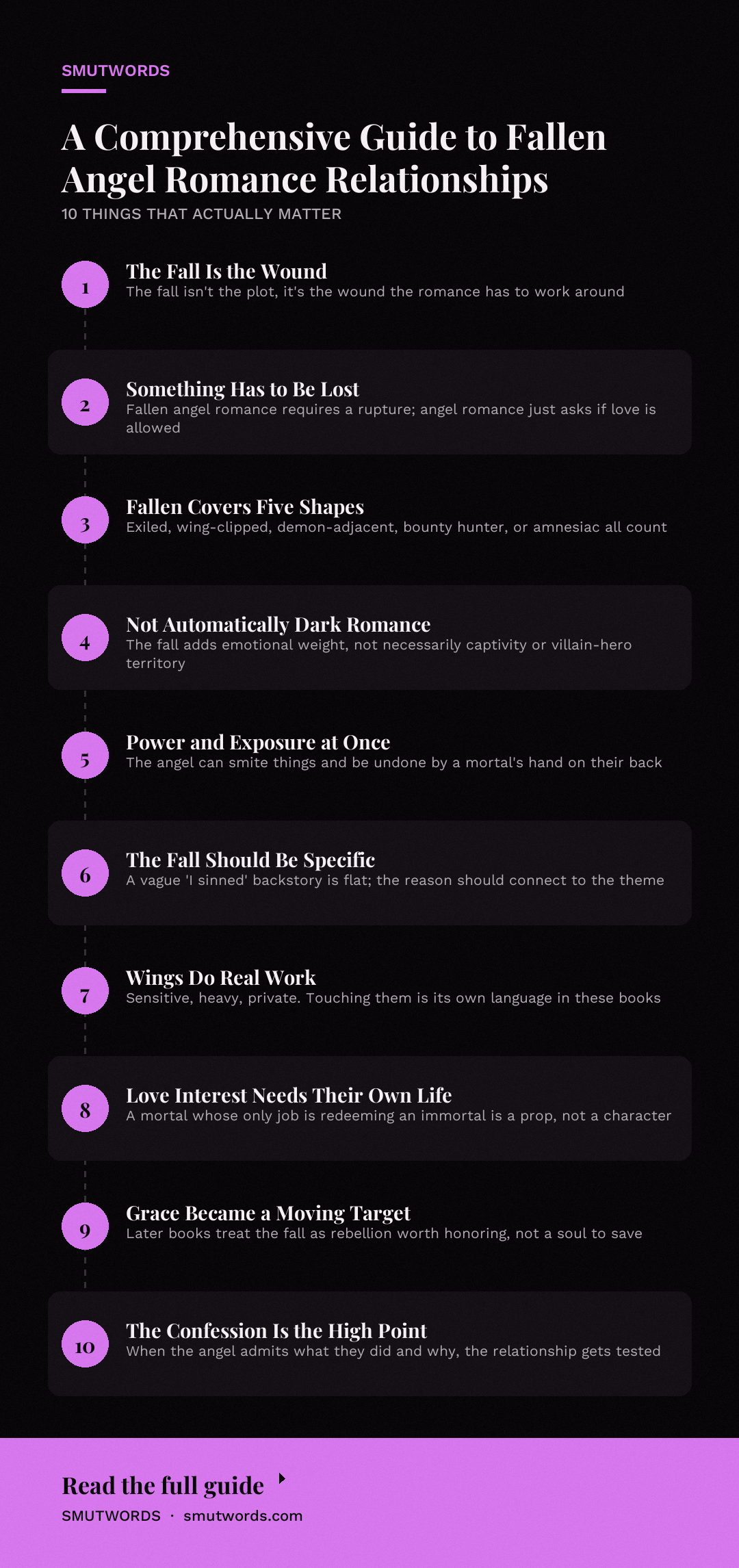
- The fall is specific. A vague "I sinned" backstory is flat. The best fallen angels fell for a particular reason, at a particular moment, and the reason connects to the romance's central theme. If the angel fell for loving the wrong being, the love interest is a live wire, not a coincidence.
- The power gap is played honestly. An angel who could destroy the love interest in an instant has to negotiate that difference. The interesting tension isn't whether the angel is dangerous. It's how two people with wildly unequal power treat each other anyway.
- The physical details are angelic and human at once. Wings that ache when clipped, feathers that grow back wrong, a body that runs hot or cold, senses that pick up a mortal's heartbeat across a room. Specificity does the work.
- Grace is a moving target. Whether the angel regains divine status, refuses it, or redefines it entirely, the book knows what's at stake at every turn.
- The love interest has their own life. A mortal whose entire function is to redeem an immortal is a prop. The strong version has goals, history, and a reason to want an angel beyond the obvious.
Variation matters for pacing. Some books front-load the fall as backstory and open with the angel already established in exile. Others walk the angel right up to the edge in chapter one and let the reader watch the drop.
Both work. The fallen angel who hasn't fallen yet offers suspense; the fallen angel already walking the earth offers a different tension around recovery and re-entry.
Enjoyed this? Get a free book.
Join the list and we will send a complete free story straight to your inbox, plus new releases every week after that. No credit card, no catch.
Wings are the most obvious site of erotic charge in this subgenre: sensitive, heavy, an intimacy the angel doesn't share with just anyone. A scene where a mortal touches wings for the first time does a lot of emotional work, and a strong book treats wing-touching as its own language. Clipped wings raise the stakes further, since the injury often maps to lost power or punishment.
The fall itself is frequently handled as a flashback, a confession, or a late reveal. When the angel confesses what they did and why, the scene is usually one of the emotional high points of the book, and it doubles as a test of the relationship. What the love interest does with that information determines where the romance goes next.
Celestial bond language (claiming, mating marks, marks that burn, bonds that damage both parties if broken) is common, particularly in books that lean on Omegaverse conventions. The bond raises the intensity and creates a formal structure around what's otherwise an internal emotional experience. It also gives the author ways to torture the characters in a controlled way, since the bond can break, be rejected, or demand things neither party is ready for.
Seldom is the subgenre rigid about tone. Some of it is philosophical, with scenes that feel like theological arguments punctuated by sex. Some of it is straight urban fantasy with a romantic spine.
Some of it is squarely smut-forward, where the fallen angel is a domineering, brooding figure with a tragic backstory and the wings are mostly an aesthetic. All of these live under the same label because the central dynamic is the same.
There's also frequent overlap with the trapped together trope, since authors love locking a fallen angel and a mortal into a shared space long enough that the tension has to break. The same tightness that makes an angelic bloodbond compelling applies here.
For readers who want a direct comparison to two unequal immortal powers negotiating a relationship, seeing how fae writers handle court politics and romantic chess is instructive. The fallen angel subgenre borrows heavily from it and often out-flanks it on stakes.
Fallen Angel Romance vs Angel Romance
This is the comparison readers most often get tangled up, and it's a real distinction worth spelling out. Angel romance centers an angel character (a guardian angel, a warrior of heaven, a heavenly messenger) usually in good standing or in some kind of duty-bound role. The conflict comes from whether love is allowed, not whether heaven has already disowned them.
Fallen angel romance requires a rupture. The character has lost divine status, been exiled, been punished, or chosen to walk away from heaven in a way heaven hasn't forgotten. The romance is built around that loss rather than around the question of whether the angel and the love interest are allowed to want each other.
In practice, some books blur the line. A guardian angel who questions heaven and gradually becomes compromised fits both categories. The distinction isn't a hard-border taxonomy; it's a way of knowing which engine is running the plot.
If the engine is "we shouldn't want each other but we do," you're reading angel romance. If the engine is "everything about me has already been destroyed and you're the only thing that feels real," you're reading fallen angel romance. Readers who like that second engine tend to have strong opinions about slow burn too, which is why our friends-to-lovers slow burn list keeps coming up in the same conversations.
Frequently Asked Questions
What makes a fallen angel romance different from a general paranormal romance?
Paranormal romance is a broad umbrella covering vampires, shifters, witches, demons, and immortals of every kind. Fallen angel romance is a narrower dynamic defined specifically by its central character's lost divine status and the way the romance engages with that loss. The divine-cosmic framing gives it a unique emotional register that distinguishes it from most other paranormal subgenres.
Do fallen angel romances always have a religious cosmology?
No. Early books leaned heavily on Christian heaven-and-hell architecture, but contemporary fallen angel romances often invent entirely their own sacred order. Some use Christian terminology, some build an original pantheon, and some treat the fall as basically a magical exile from an unspecified higher authority. The genre has room for all of these.
Is fallen angel romance usually dark romance?
Not necessarily. It often shades darker than the average paranormal romance because the central character carries grief, guilt, and the memory of a rupture, but the label is not tied to the dark romance category. Plenty of fallen angel books are emotionally intense while remaining fully consensual and low on villain-hero energy.
Are wings always part of the fallen angel romance trope?
Wings appear in most but not all of the subgenre. Some writers treat wings as the essential physical feature and build whole scenes around them, while others keep wings minimal or offscreen and lean into the celestial power, emotional weight, and immortal longevity instead. The wing-clipped variant almost always includes wings, but the broader category is flexible.
Can a fallen angel romance have a happy ending?
Yes, and many do. Part of the appeal is the catharsis of the angel finding something worth living for after the fall, whether that means redefining grace, rejecting the divine order that exiled them, or simply choosing a mortal life. The romance genre's happy-ending requirement is why the subgenre has such strong reader loyalty; the fall is painful, and the payoff is worth it.
How do I find fallen angel romances that aren't just a brooding immortal in wings?
Look for books with specific fall narratives in the blurb (an angel who chose rebellion, an angel whose wings are clipped because of a particular act), and check reviews for readers who loved the emotional work rather than just the aesthetic. Editors and reviewers who track the subgenre will often flag which books actually engage the fallenness as a theme versus which treat it as a costume.
Final Thoughts
If you want to see what a fallen angel romance looks like at full strength, start with something that treats the fall as real, specific, and consequential, not just a tragic accessory to a hot immortal. Check the ranked picks below and let the emotional weight of a character who has already lost everything steer your choice.





Loading comments…