The knotting dynamic is a fictional sexual tie in which one partner, almost always the nonhuman one, swells inside the other during sex and physically cannot withdraw until the swelling subsides. That swelling is the knot. In shifter and monster romance it functions as the body making a claim the mouth has already been saying out loud, and it is one of the most reliable engines the genre has for possessive, mate-bond intimacy.
If you have ever finished a book about a wolf who insists she is his and felt the ending needed more follow-through, the knot/knotting dynamic is the follow-through. It is biology as commitment, written to last longer than a sentence.
What Knotting Actually Means
Strictly: the knot is a bulbous swelling at the base of the penis (or the penis-adjacent anatomy of whatever the author has invented) that engages during intercourse and holds the two bodies physiologically joined until it relaxes. The word is borrowed from canid anatomy, where a real mating tie does occur in dogs and wolves, and from there it walked into werewolf fiction and refused to leave.
In the romance context, knotting means more than the physical event. It is a term of art for a specific scene beat and a specific flavor of intensity: the moment a partner realizes they are not going anywhere, and neither is the person inside them.
What counts as knotting, broadly:
- A swelling or locking event that prevents separation for a defined stretch of time
- The emotional reaction to being held there, usually shock, then surrender, then something warmer
- Language of claiming, breeding, mating, or finishing inside with no option to withdraw
- Aftermath: the quiet while they wait it out, often the tenderest scene in the book
What does not count, even though readers sometimes file it under the same name: general size-talk, being pinned by a partner's body weight, or a hand at the back of the neck. Those are possession-flavored but they are not a knot. The knot is anatomical, involuntary, and temporary, and the temporary part is load-bearing.
Common misconceptions worth clearing up. First, knotting is not only for wolf shifters. It shows up in hybrid shifter romance where the animal is an invented hybrid, in alien romance where the author simply borrows the mechanic, and even in elf romance and fae romance when the author wants a nonhuman body to do something human bodies do not.
Second, it is not a substitute for a mating bond. A knot can happen in a story with no fated-mate plot at all. Third, it is not inherently a breeding kink, though the two are frequent roommates.
Where Knotting Comes From
The honest history here is a publishing history. The fictional knot does not have a deep folkloric tradition; it has a biology footnote, a fanfiction pipeline, and a market that noticed what sold.
The biology footnote is real: canid mating ties are documented, and werewolf fiction has known about them for a long time. But the knot as a named, reader-recognized trope is a child of the internet. It grew up in fanfiction, particularly in spaces where authors were already writing nonhuman characters with animal instincts, and where tagging conventions let readers find exactly the flavor they wanted.
Once a trope gets a tag, it gets a fandom, and once it gets a fandom it gets imitators.
From there it crossed into original indie romance in the mid-2010s, riding the first big shifter wave. Early published versions were often coy about the anatomy, leaning on euphemism or treating the knot as a single shocking reveal. As the market matured and indie publishing rewarded directness, the knot moved from a late-book surprise to a selling point on the cover copy.
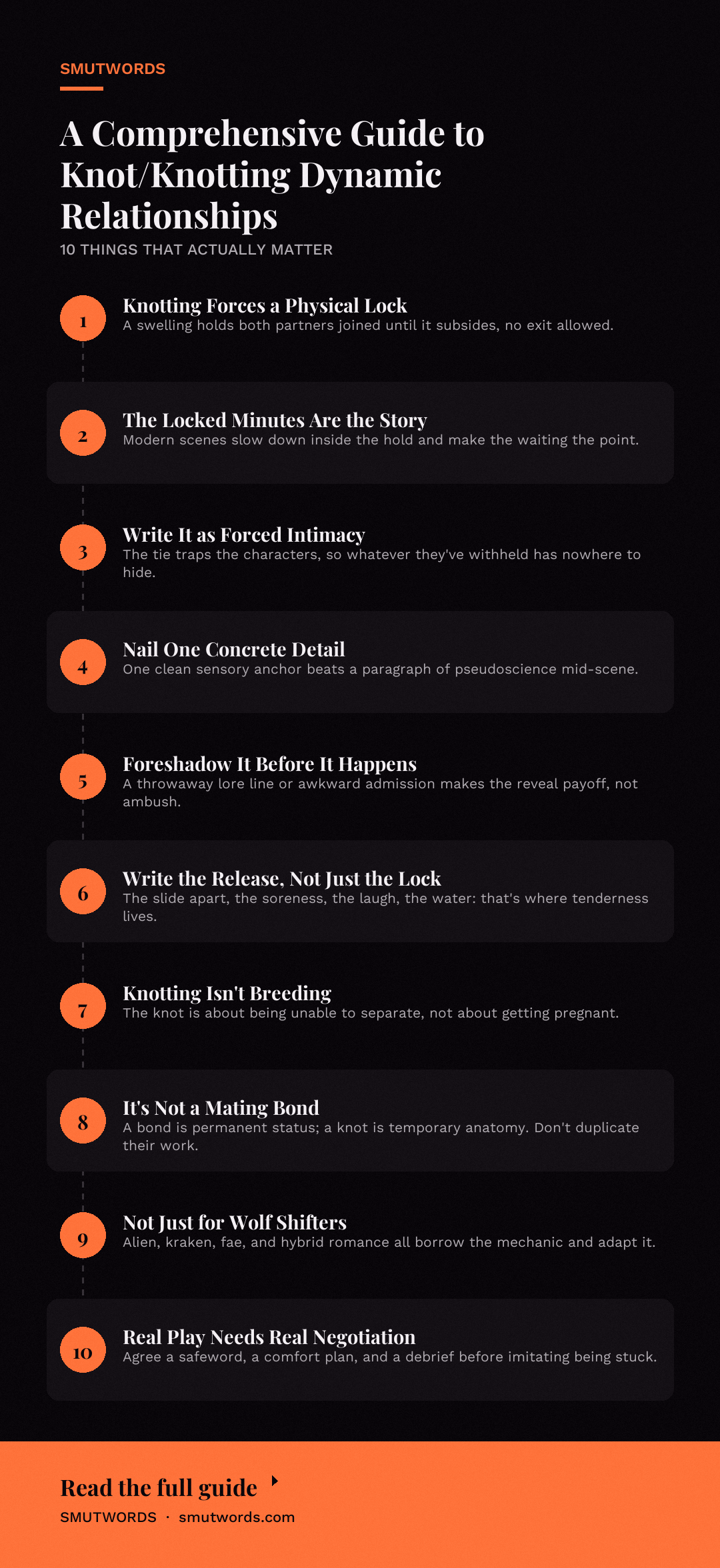
The most visible shift is in how authors treat the locked period itself. Earlier examples rushed it, using the tie as a climax beat and then cutting away. Contemporary knotting scenes slow down inside the lock and make the waiting the point: conversation, confession, the body forced into honesty because neither party can walk out of the room. That shift tracks with a broader change in the genre, where emotional aftermath sells as hard as the act does.
Two adjacent genres absorbed the mechanic and made it their own. Alien breeding stories use it as biological justification for the plot's central problem, and kraken romance and its cousins use it to make tentacles feel less like a gimmick and more like an anatomy the author thought through. The knot stopped being a wolf thing and became a general-purpose tool for any author writing a body that wants more than a human body does.
How It Shows Up in Erotica
Here is the craft truth from someone who has read a few hundred of these: a knotting scene is written twice. Once as a physical event, and once as a forced intimacy. The books that work do both. The books that fizzle write the swelling and forget the silence.
The physical event needs specificity. Where is the swelling? How fast does it engage? What does the partner feel first: pressure, heat, or the sudden sense of being too full?
Vague language kills it. So does over-explaining the biology in the middle of the act. One clean concrete detail beats a paragraph of pseudoscience.
The forced intimacy is where the drama lives. Once the characters are locked, the author has created a scene that cannot be exited, which is the same engine that powers the trapped together trope, and it runs just as hard at this scale. A bed becomes a room. Nine inches becomes a locked door.
Common variations authors use:
Enjoyed this? Get a free book.
Join the list and we will send a complete free story straight to your inbox, plus new releases every week after that. No credit card, no catch.
- The accidental knot. Neither party planned it, which lets the author mine panic, apology, and slow mutual reassurance.
- The deliberate knot. The nonhuman partner knew it would happen. Consent gets interesting here, and the best versions confront that directly.
- The breeding knot. The tie is explicitly about conception, often paired with a species-survival plot. Frequent in alien romance and spy romance and in books with an omega protagonist.
- The first-heat knot. Deployed at the peak of a heat or rut cycle, when the character's control is already gone, so the knot reads as biology winning.
- The punishment or claiming knot. A villain or rival uses the tie to assert ownership. This one needs careful handling, and the strongest examples make the aftermath about the protagonist's recovery, not the act itself.
- The medical or clinical framing. Rare, but shows up in science-fiction romance where a nonhuman mate's anatomy is treated as a fact to be managed, sometimes with humor.
Strong versions share three habits. They establish the possibility before the scene (a throwaway line of lore, another character's warning, the love interest's own awkward admission) so the reveal lands as payoff rather than ambush. They use the locked period for dialogue the characters would not otherwise have.
And they write the release: the slide apart, the soreness, the laugh, the water, the holding. The unlocking is where tenderness gets its budget.
Flat versions fail predictably. They treat the knot as a checkbox, present it with no foreshadowing, rush the aftermath to get to the next plot beat, and let the nonhuman partner stay in the same possessive register the entire time instead of shifting into care once the tie is set. The knot is a device for changing the emotional temperature of a scene. If nothing changes, the author wasted the seam.
One craft note on voice: the knot invites purple prose, and purple prose invites cringe. The most effective line work tends to be short and locked-down. Fewer adjectives, more sensory anchors: mouths gone dry, a hand flat on a stomach, the tick of a clock. The body is doing something extreme; the language around it can be plain and it will still read as intense.
Knotting also pairs naturally with the soulbond when the author wants the tie to echo a magical one. The physical lock and the metaphysical lock land better when they are not saying the exact same thing. Give one of them a problem the other cannot solve.
Knotting Dynamic vs Breeding Kink
These two get conflated constantly because they share real estate, and the confusion costs readers good recommendations. They are not the same trope, even when they appear in the same scene.
The breeding kink is a desire, usually verbal, around conception, potency, and being filled with the stated or implied goal of pregnancy. Its engine is the wish to be claimed by someone's future, and it does not require any anatomical locking at all. A breeding scene can happen with entirely human bodies on a perfectly ordinary bed.
The knot/knotting dynamic is a physical event that immobilizes the couple for a stretch of time. Its engine is the inability to separate, and it does not require any interest in conception. A knot can appear in a book with zero breeding talk, and some knotting scenes are strictly about possession and closeness.
Where they overlap is the word claiming. Both tropes reach for the same possessive vocabulary, both like the same aftercare language, and both show up in plots that keep putting nonhuman partners into the arms of human women. That shared vocabulary is why readers searching for one keep finding the other.
A quick test: if the scene's tension comes from what might happen nine months later, you are in breeding territory. If the tension comes from what happens in the next twenty minutes while nobody can move, you are in knotting territory. If both are true, you are reading a book that knows exactly what it is and is probably quite good.
Frequently Asked Questions
What is a knot in wolf shifter romance?
It is a fictional swelling at the base of the penis that engages during sex and holds the two partners joined until it subsides, usually ten to thirty minutes in-story. Authors borrow the concept from canid anatomy and then adapt it freely. Some versions treat it as instinctive and beyond the character's control; others treat it as a deliberate act of claiming.
Is the knotting dynamic the same as a mating bond?
No. A mating bond is a relationship status, often mystical and permanent. A knot is a temporary physical event. Plenty of books feature one without the other, and the best books with both make sure the bond and the knot are not simply duplicating each other's work.
Does knotting have to involve pregnancy or breeding?
Not at all. The knot is about being physically unable to separate, which is a different emotional proposition from wanting to conceive. Many knotting scenes are pure possession and intimacy, and some explicitly sidestep conception entirely.
Why do readers like the knotting dynamic so much?
The lock creates physical vulnerability that language cannot fake, and it forces honesty between characters who have been avoiding it for chapters. It also delivers a possessive fantasy of being claimed completely. The brief, contained, non-permanent nature of the tie makes it feel safe even at its most intense.
Can the knotting dynamic appear outside shifter romance?
Yes, and it increasingly does. Alien romance uses it as species biology, monster and kraken romance use it to justify nonhuman anatomy, and fae and elf stories borrow it whenever the author wants a body that behaves outside human norms. The mating knot has become a general-purpose mechanic across the entire speculative romance shelf.
Is knotting realistic?
The anatomical lock as written is a fictional device. Real canids do experience mating ties, but the human-scale version in romance is invented. Any real-world play that imitates being physically stuck needs explicit negotiation beforehand, an agreed safeword even when a character is "locked," a plan for staying comfortable during the hold, and a real aftercare conversation once it ends. A post-coital scene debrief is exactly the kind of check-in that makes the fantasy work in practice.
Final Thoughts
The knotting dynamic earns its popularity by doing something very few tropes can: it makes intimacy mandatory. Once the tie is set, the characters have to stay, and whatever they have been withholding has nowhere to hide. If you want to see the mechanic deployed at its most confident, look for the books on the shelf below, and start with the one that treats the locked minutes as the best part of the chapter.





Loading comments…