
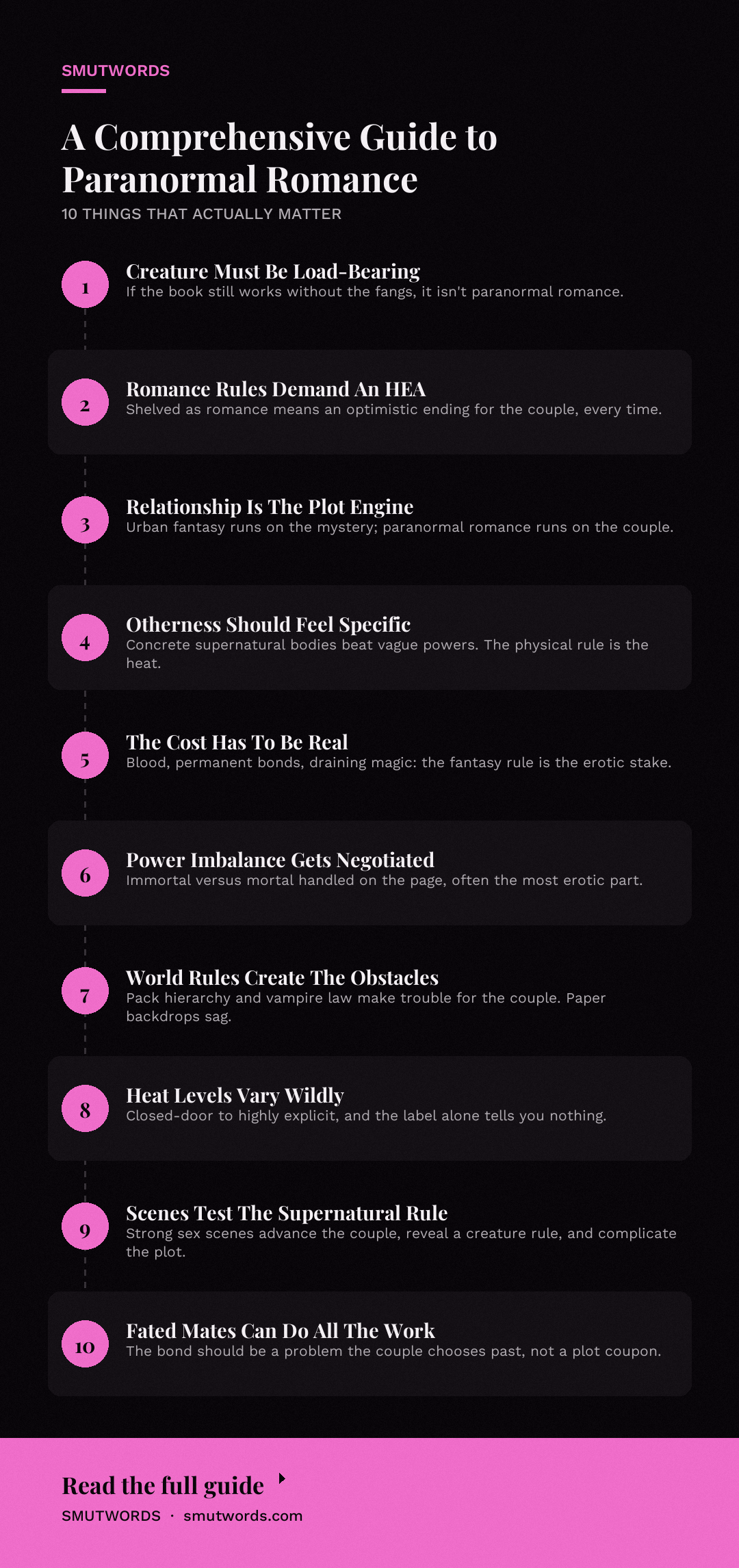
Paranormal romance is the corner of the romance genre where one or both leads aren't human, and the fantastical part of that isn't wallpaper. Vampires, werewolves, witches, demons, fae, ghosts, psychics: the creature or the magic is load-bearing in the relationship, not a costume the character wears between sex scenes. The love story and the supernatural plot run on the same engine.
If you strip the fangs out and the book still works exactly the same, it probably wasn't paranormal romance. It was a contemporary with a funny hat on.
That distinction matters more than it sounds, because paranormal romance is one of the biggest, oldest, most-shelved subgenres in the business, and also one of the most loosely defined by readers who use the label as a vibe. This guide is the thorough version: what the term actually covers, where it came from, how it works on the page, and what separates a strong paranormal romance from one that just stapled pointy ears onto a generic alpha.
What Paranormal Romance Actually Means
Start with the word. "Paranormal" in publishing is a shelf label for the supernatural-adjacent: creatures and powers that exist alongside the ordinary world rather than in a separate invented one. Vampires in a city that also has a Starbucks. That's the working definition readers and booksellers have used since the term took off in the mid-2000s.
"Romance" is the stricter half. Under genre rules, a romance requires a central love story and an emotionally satisfying, optimistic ending for the couple. A paranormal romance promises both the creature and the happily-ever-after. A paranormal novel with a love story that ends in tragedy or ambiguity is a dark fantasy, and it gets shelved there for a reason.
The romantic plot and the fantastical elements have to intertwine. The vampire's immortality should put genuine pressure on the relationship. The werewolf's pack politics should shape who the heroine can love and how.
The witch's magic should cost something the couple has to reckon with. When the supernatural premise drives the emotional stakes, you've got the real thing.
What counts, and what doesn't
A few clean rules of thumb:
- Counts: a human falling for a shifter whose pack law forbids the match. A witch bound to a demon in a bargain that turns into love. A ghost who can only touch the living under specific conditions. A psychic who hears a lover's thoughts and has to learn to live with what's in there.
- Doesn't count: a contemporary where a character has a quirky hobby involving tarot cards and nothing supernatural actually happens. A fantasy epic with a romance subplot three hundred pages deep. A thriller where the "monster" turns out to be a guy in a mask.
- Borderline: fae and angel romances, ghost romance, monster romance. These overlap with paranormal but sometimes get their own shelves. Readers argue about it constantly. The overlap is real, and most readers file them together anyway.
The most common misconception
The biggest one: that paranormal romance is interchangeable with urban fantasy. They share creatures and city settings, but urban fantasy is a fantasy genre that may or may not include a romance, and its plot engine is the mystery or the magic system. Paranormal romance's plot engine is the relationship. Same ingredients, different recipe.
Another misconception: that the characters are "basically human with powers." Strong paranormal romance does the opposite. The nonhuman lead should feel genuinely nonhuman in at least one way that the human lead has to negotiate. A vampire who's lived four hundred years and a vampire who's a twenty-five-year-old with a blood fetish are different books. The second one can work, but the age and the otherness need to mean something.
Where Paranormal Romance Comes From
The roots are old. Gothic fiction put vampires and ghosts next to romance as far back as the nineteenth century. Dracula is a horror novel with a strong erotic current underneath it. The tradition of the seductive, dangerous nonhuman lover has been around as long as the novel has.
But paranormal romance as a recognizable publishing category is much younger than that. The real formation happened in the 2000s, when a wave of vampire and werewolf series broke into mainstream bookstores and turned the label into a phenomenon.
The big inflection point was Laurell K. Hamilton's Anita Blake series, which started in the 1990s as a hard-boiled urban fantasy and pushed further into explicit erotic territory with each book. Then Charlaine Harris's Southern Vampire Mysteries, the Sookie Stackhouse books, which became the television show True Blood and made the vampire-human love triangle a household object. Around the same time, the Twilight books made the teen version of this ubiquitous.
By roughly 2006 to 2012, paranormal romance was one of the most commercially dominant things in romance publishing. Entire bookstore sections were wall-to-wall vampires and shifters. Then the wave crested, the shelves thinned out, and the subgenre didn't die; it moved, split, and reorganized into self-publishing, indie romance, and a bunch of newer subcategories (dark romance, monster romance, omegaverse, and others) that absorbed a lot of its readers and energy.
The genre's history is really a publishing story: how fast a label can go from niche to dominant to reformed, and how much of the current paranormal scene now lives in independent books rather than traditional publishing.
How It Shows Up in Erotica
This is where the editor gets picky. Paranormal romance and erotica have a long, intimate relationship, and the reason readers reach for this subgenre is that the premise gives them permission to write certain kinds of desire at a higher volume. The creature has sharper senses, longer history, deeper appetite, and higher stakes. So the scenes can push further and mean something different when they do.
Here's what actually distinguishes a strong paranormal romance from a flat one:
1. The creature's otherness is specific and physical
Vague supernatural power is boring. Specific supernatural bodies are not. The good ones give the reader something concrete to hold: how the vampire's metabolism responds to blood, how the werewolf's sense of smell reads a partner's arousal, how a demon's skin runs hotter.
Then there's the ghost, whose touch phases in and out at the worst moment. That's where the heat lives. The physical consequence of the otherness is the sex scene.
2. The cost is real
A love scene that happens with no consequence is a missed opportunity. Strong paranormal romance makes the creature's nature a problem to be solved. The vampire's bite draws blood, and blood means something. The bond is permanent, and permanence is terrifying.
The wolf has a mate bond that turns out to be involuntary. The magic drains a partner and the couple has to decide whether it's worth it. When the fantastical rule is also the erotic stake, the whole book clicks.
3. The power imbalance is handled on the page
Paranormal romance is loaded with imbalances: immortal vs mortal, predator vs prey, pack alpha vs newcomer, centuries of experience vs one human life. Strong versions don't ignore the imbalance or pretend it's not there. They write the negotiation on the page.
The immortal learns to slow down. The human learns what they can and can't consent to with something older and stronger. That conversation is often the most erotic part of the book, even when it happens fully clothed.
4. The world does actual work
A strong paranormal setting has rules, politics, and internal logic.
The pack has a hierarchy. The vampire council has a legal system. The witches have a lineage with historical feuds.
Those structures create obstacles to the couple, and the obstacles are the heightened stakes readers came for. When the world is just a paper backdrop, the book collapses into a contemporary with fangs and the reader can feel the sag.
Enjoyed this? Get a free book.
Join the list and we will send a complete free story straight to your inbox, plus new releases every week after that. No credit card, no catch.
5. Heat levels vary wildly, and the label doesn't tell you much
Some paranormal romance is sweet and chaste; some is explicit and dark. This is one reason the category confuses new readers. A few useful waypoints:
- Sweet or closed-door: the relationship is the tension, the fantastical obstacles are the story, the sex happens off-page. Common in YA-adjacent and some indie paranormal.
- Standard romance heat: explicit sex scenes but the plot stays the main event. Most traditionally published paranormal romance lives here.
- Dark or high-heat: explicit, often kinky, sometimes pushing into territory that overlaps with mind control kink, primal play, and bond-of-the-mind dynamics. Much of the current energy in the subgenre is in this level, usually self-published.
Common variations authors use
The variants readers will recognize by name:
- Vampire romance: blood, age, immortality, the classic seductive predator. Usually the original entry point for new readers.
- Shifter romance: werewolves, bears, dragons, big cats and increasingly anything else. Pack dynamics, fated mates, scent-based attraction, marking.
- Witch and warlock romance: magic, covens, family lines, curses. Tends to allow more humor and more domestic plotting than the vampire version.
- Demon and half-demon romance: bargains, contracts, brimstone. Frequently overlaps with dark romance because the predator flavor is strongest here.
- Ghost romance: the tragic and bittersweet corner of the subgenre, since the ghost has a body problem by definition.
- Urban fantasy romance: city setting, investigative plot, romance woven through a mystery. Closest relative to the spy and thriller shelf. If you like the cloak-and-dagger pacing that spy romance delivers, urban fantasy romance is the creature-themed sibling.
The chapter-level craft: scene construction
Here's a craft observation from having read hundreds of these. The sex scenes that work in paranormal romance usually do three things at once: they advance the emotional relationship, they reveal a specific rule of the creature's nature, and they complicate the plot. A scene that only does the first thing reads as a scene from any other subgenre. A scene that does all three is unmistakably paranormal.
Common technique: the sex scene is where the supernatural rule gets tested. Can the vampire feed without killing? Does the mate bond activate? Does the magic flare?
The scene is the experiment and the couple is the lab. Also worth noting: the recovery scene after the intensity (what the community now discusses as the post-coital scene debrief) is unusually load-bearing in paranormal romance, because the creature has to explain a rule of their body to a confused human partner. That conversation is where the intimacy actually lands. Skip it, and the scene reads as spectacle.
Variants that rewrite the trope
A few structural moves that keep the subgenre alive:
- The monster is the heroine. The witch, the wolf, the demon, the succubus is the lead, and the human (or lesser creature) is the love interest. This flips the usual predator-prey script and often produces the most interesting friction.
- Both nonhuman, different species. Two beings with incompatible biologies and cultures have to negotiate a relationship. Often more interesting than human-vs-creature because the rules collide on both sides.
- The bond is imposed. Fated mates, blood bonds, magical compacts, arranged pack alliances. Enormously popular; enormously easy to write badly. Works when the couple has to choose the bond on the page, not just get swept along by it.
- Second chance with an immortal. One partner has lived decades or centuries since the breakup. The time gap is the obstacle.
- Cursed love. The couple can only be together on certain terms, or magic intervenes whenever the relationship deepens. The trap is a long-standing tension in the genre, and if the setup appeals, the underlying mechanics get a full treatment in the guide to the trapped together trope.
Where it goes wrong
The most common failure modes, briefly:
- Creature is a costume. The vampire is just a hot guy with a dental quirk, and the reader notices by chapter three.
- Fated mate does all the work. The bond replaces character development, and the couple has no reason to love each other beyond the magic. The mate bond should be a problem to solve, not a plot coupon.
- Insta-love via smelling. A related failure. The partner catches the scent and is instantly committed, and there is no scene where the couple actually decides. Readers who hate insta-love tend to bounce hard on this. If you're one of them, the guide to best friends-to-lovers books for readers who hate insta-love is a good sideways entry into the genre's opposite extreme.
- World-building trivia dump. The book pauses to lecture about pack law before the couple has even met. The most common self-published flab.
- Power imbalance unexamined. The immortal is dominant, the human is "naturally submissive," nobody talks about it. Reads as lazy even when it's hot.
Paranormal Romance vs Urban Fantasy Romance
The two labels get used interchangeably, and the genuine difference is the plot engine. Urban fantasy is a fantasy genre: the mystery, the case, the big bad, or the magic system drives the story, and a romance may or may not be central. Its typical shape is a single hero or heroine solving supernatural problems in a contemporary city, with a romantic subplot running across a long series.
Paranormal romance is a romance genre. The relationship is the story, and the creature or magic exists to complicate it. Its typical shape is a couple at the center, the arc of their relationship flowing through the book, and a happily-ever-after (or at least a satisfying midpoint) that promises commitment.
That distinction matters because the two shelves read differently. Urban fantasy romance readers are often mystery readers first. Paranormal romance readers are often pure romance readers.
If you're never sure which one you're picking up, read the blurbs. If you can summarize the book in a "who did it," it's urban fantasy. If you can summarize it in a "who ends up with whom," it's paranormal romance.
Booksellers and readers confuse the two constantly, and some authors write across both. Not a problem. Just know what you're reaching for.
Frequently Asked Questions
Is paranormal romance the same as fantasy romance?
Not quite. Fantasy romance usually means the setting is a secondary world (an invented kingdom, a made-up continent) with a full magic system and non-human or non-modern cultures. Paranormal romance sets its creatures in the ordinary contemporary world. You meet the vampire at the corner bar, not in an invented kingdom.
The overlap is large and the terms are used loosely, but if the world needs a map, it's probably fantasy.
What is the most popular type of paranormal romance?
Vampire romance and shifter romance are the two giants, by sales and by shelf space. Shifter often edges out vampire in current self-published output because the fated-mate structure is easier to build a series around. Witch romance is a strong third, and demon romance has been growing fast.
Do paranormal romance books always have a happy ending?
If they're shelved as romance, yes: the genre requires an optimistic ending for the couple. Paranormal novels with tragic or ambiguous endings exist, but they're shelved as dark fantasy or dark romance, not romance. If you're reading for the HEA, know what you're picking up: check the subcategory, not just the creature on the cover.
Can the human be the main character?
Often, yes, especially in vampire romance and shifter romance where the human is the newcomer being introduced to the supernatural world. Both-nonhuman couples are increasingly common and tend to open up more interesting friction, since the couple has to negotiate two sets of rules. Hero-is-the-monster books also have a devoted readership.
Is paranormal romance always explicit?
No. Heat levels range from closed-door sweet to highly explicit dark romance. The cover and the subcategory are your best signals; indie paranormal romance in particular tends to run hotter than traditionally published versions. Check the content notes before you dive in if the heat level matters to you.
What is the difference between shifter romance and werewolf romance?
Werewolf romance is the older category, and shifter romance is the broader newer one. Shifters include wolves, bears, big cats, dragons and increasingly less conventional animals, and the systems are sometimes built around fated mates, sometimes around pack politics, sometimes both. Werewolf-specific books usually lean harder on the lunar cycle and pack hierarchy.
Why is fated mates so popular in paranormal romance?
It does the work of explaining why two people are drawn to each other without having to stage a long courtship. That's efficient, and it produces a specific kind of tension: the couple has to prove they're choosing each other, not just obeying the bond. Strong versions lean hard into that choice. Weak ones use the mate bond as an excuse for insta-love.
Where do the creature-feels meet the darker romance shelf?
The border between them is blurry. Demon romance, monster romance, and dark shifter books often shelve in both categories, and readers wander between the two. The main difference is that dark romance is a label about tone (taboo, morally gray, often with content warnings) while paranormal romance is a label about creature. A book can be both.
Final Thoughts
Paranormal romance at its best gives you what no other subgenre can: obstacles structurally bigger than human drama, an appetite with a physical shape, and an ending that has to earn its happily-ever-after against something genuinely strange.
New to the subgenre? Read one strong vampire romance and one strong shifter romance and see which flavor of otherness keeps you turning pages. The shelf is deep, the quality varies wildly, and the good ones are very good.
Pick up a recommended vampire romance and pay attention to the moment your creature tells their human the rule that's going to shape the whole book. That moment is the genre at its peak.


Loading comments…