The soulmate trope is the romance convention built on the premise that two people are fated to end up together, bound by something stronger than choice or circumstance. That binding might be a physical mark, a magical bond, a past life, or a simple narrative certainty the reader feels from page one.
Strip it down and the trope asks the reader to accept one thing: the attraction between two characters is inevitable before they've even met. The whole story is watching them catch up to a fate that's already decided.
It's one of the most durable engines in genre fiction because it solves a structural problem every romance faces: how do you make the central relationship feel important enough to carry a whole book? Fate answers that question in advance. Whether the story is contemporary or fantasy, the soulmate trope gives a romance a sense of weight that ordinary meet-cutes have to work much harder to earn.
What the Soulmate Trope Actually Means
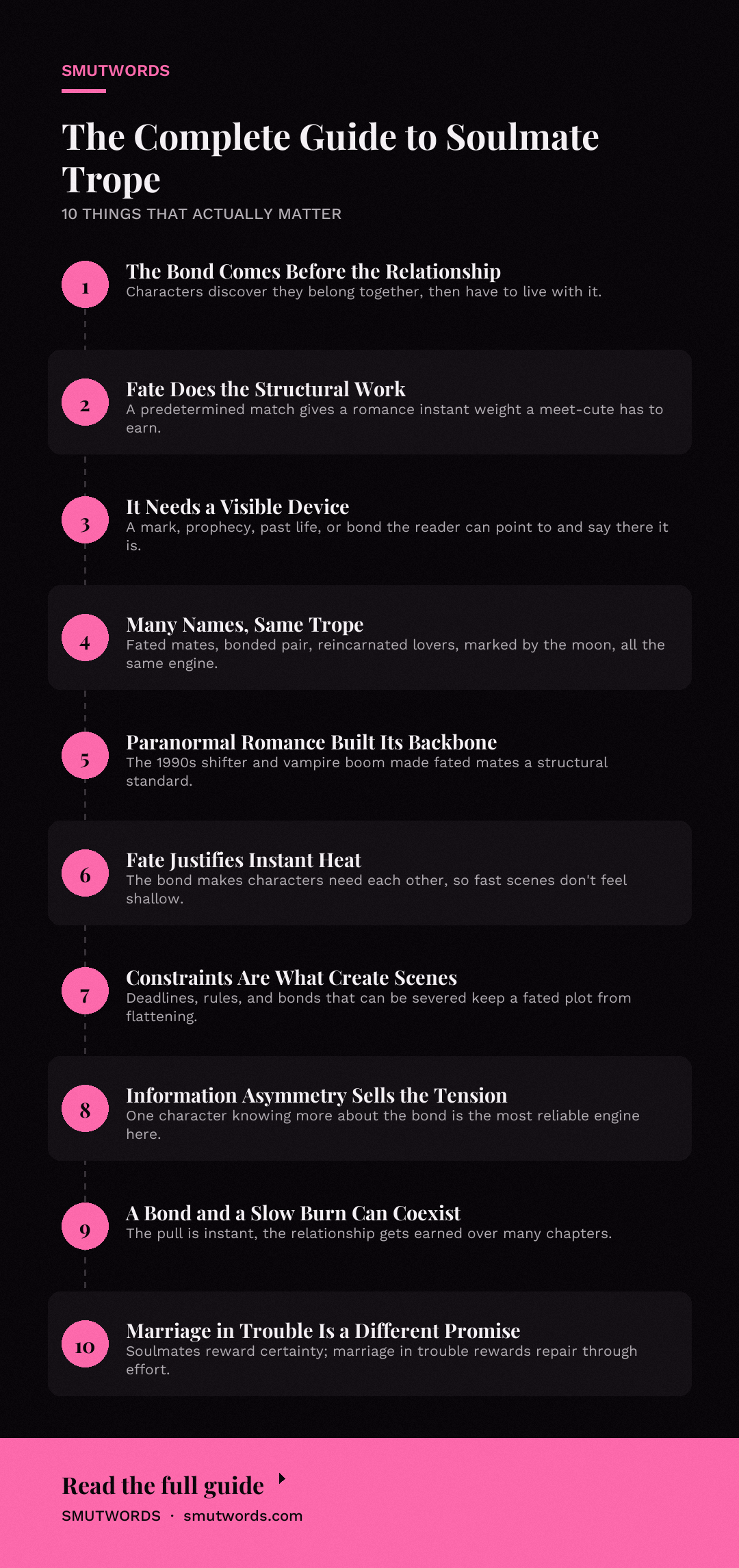
At its core, the soulmate trope asserts that two characters belong to each other by design. The design can be cosmic, magical, genetic, or simply plotted by an author who wants the reader to feel certainty. What separates it from romance in general is that the connection precedes the relationship.
The characters don't fall in love and then discover they're right for each other. They discover they're right for each other and then have to figure out how to live with that.
The naming conventions vary widely across subgenres. "Fated mates" dominates paranormal and shifter romance, where the bond is often physical and involuntary. "Bonded pair" shows up in fantasy and sci-fi, sometimes with literal magical tethers.
Then there's the death-and-return wing: "reincarnated lovers" and "second chance soulmates" describe stories where the bond survives death and comes back in a new life. "Marked by the moon" is a specific flavor within werewolf and lunar-magic settings.
All of these are the soulmate trope wearing different clothes.
What does not count as the soulmate trope: characters who are simply perfect for each other through compatibility and good writing. That's a believable romance, and it's a different thing. The soulmate trope requires an external force asserting the match. A reader should be able to point to the mark, the prophecy, the past life, the bond, and say "there it is." Without that artifice, the trope dissolves into regular attraction with a mystical marketing label.
A common misconception is that the soulmate trope removes all conflict. Newer readers sometimes assume that if two people are fated, there's nothing left to fight over, and the book must be boring. The opposite is true in practice. The strongest uses of the soulmate trope create conflict precisely because fate is so insistent, and the characters aren't yet ready for what fate demands.
Where the Soulmate Trope Comes From
The idea of destined love is older than the novel itself, but the soulmate trope as a recognized romance convention is a product of twentieth-century genre publishing. Early fantasy and gothic romance inherited a taste for prophecy and mystical bonds from folklore and mythology. Writers who wanted a love story to feel grander than ordinary courtship borrowed freely from those older traditions, and the destined-match plot slowly became a shorthand for very high stakes.
The modern version of the soulmate trope was sharpened by the rise of paranormal romance in the 1990s and 2000s. As vampire, werewolf, and witch romance moved from niche to bookstore mainstay, "fated mates" became a structural backbone.
It was efficient. A shifter romance could skip a long getting-to-know-you phase because the bond did the work. Readers accepted the premise and then wanted the complications that followed.
Indie and digital publishing accelerated the trope significantly. Writers discovered that fated mates could launch a series fast: introduce a bond, let readers feel the certainty, then watch the couple struggle against it. The "soulmate trope" label became a searchable tag, a promise in the book description, and a signal to readers that they'd get a guaranteed emotional payoff.
The trope has also shifted in how it's written. Earlier versions often portrayed the bond as pure magic, unquestioned and unexamined.
Contemporary versions are more likely to interrogate it. What does it mean to be told who you love? What happens if the bond is wrong? Who benefits from the idea that some people belong to each other and some don't?
That questioning doesn't kill the trope. It gives it range, and the best current examples operate in that tension.
How the Soulmate Trope Shows Up in Erotica
On the page, the soulmate trope does specific work. It creates instant intensity, so a scene can open at a pitch that would feel unearned in a non-fated romance. When two characters meet and their bond activates, the author skips months of courtship and gets straight to the pull: the magnetic attraction, the physical symptoms, the sense that resisting is a losing battle.
That intensity is why the trope pairs so naturally with high-heat subgenres. Paranormal, dark fantasy, and even cyberpunk romance use soulmate mechanics to justify immediate physical urgency. The bond doesn't just make characters want each other. It makes them need, which gives an author a clean way to write white-hot scenes without the characters seeming shallow for jumping into bed so fast.
Common variants authors reach for:
- The activation moment. A first touch, first kiss, or first locked gaze triggers the bond, and the book pivots on the resulting shock. This variant is popular because it gives a scene a built-in climax.
- The physical mark. A tattoo, sigil, or color change appears on one or both characters, and strangers can see that they're claimed. Mark-based stories generate jealousy, side-eye, and gorgeous descriptions.
- The dream bond. Characters share dreams or visions before they meet in person, building intimacy across distance and giving the author a way to write hot scenes that also plant plot.
- The reincarnation loop. The couple has loved and lost across lifetimes, and this time around they're trying to break the pattern. This one is emotionally heavy and lends itself to a sweeping second-act reveal.
- The involuntary mating. Common in shifter and omegaverse stories, this variation emphasizes that the bond isn't chosen. It creates consent complications that skilled authors use instead of avoid.
- The one-sided bond. One character feels it, the other doesn't. This variation produces some of the most delicious tension in the whole subgenre because it turns the trope inside out.
What separates a strong use of the soulmate trope from a flat one is how much the characters get to have opinions about it. In a flat version, the bond is a convenient plot device, and both people accept it immediately, so the rest of the book is filler. In a strong version, the bond is a character in its own right, with demands, consequences, and a cost.
Enjoyed this? Get a free book.
Join the list and we will send a complete free story straight to your inbox, plus new releases every week after that. No credit card, no catch.
Readers who love sharp, high-concept intensity have a lot of subgenre overlap here. The soulmate trope plays well in dark settings (a fate bond with a villain is a whole genre unto itself), in military and soldier romance where the stakes are already life-and-death, and in royal settings, where a fated match has political consequences. The prince/princess romance category is especially fertile ground, since a soulmate bond can either confirm a royal match or blow up a carefully arranged one.
The trope also weathers genre shifts well. Drop a fated bond into cyberpunk romance and it becomes a question about implanted emotion and engineered compatibility. Put it in eldritch futanari territory and the bond can be cosmological, disturbing, and very hot in equal measure. The trope's flexibility is part of why it hasn't faded.
One craft element that often gets overlooked is how the soulmate trope interacts with slow burn. It seems like a contradiction: how can a bond be instant and the romance be slow? But some of the best fated-mate books are slow burns in which the bond is felt immediately and the relationship is built over many chapters. The characters know they're meant for each other and still have to earn it.
That combination is the secret weapon of the subgenre. Readers who claim they hate insta-love often turn out to love best friends-to-lovers books for slow-burn readers for the same reason they love a well-built fated mate story: the payoff comes from the wait.
Tension-building tricks writers use to keep a soulmate plot from flattening out:
- Make the bond inconvenient. Give characters reasons to resist it. Enemies, rivals, people already promised to someone else, people who don't want to be owned by a fate they didn't choose.
- Give the bond a deadline or a rule. Bonds that must be completed by a certain moon, bonds that only work in proximity, bonds that can be severed at a cost. Constraints create scenes.
- Withhold information. One character knows more about the bond than the other. Information asymmetry is the single most reliable tension engine in this trope.
- Let the bond be violated. Something breaks it, or someone tries to. The fear of losing the bond is what makes the bond feel real to the reader.
- Show the aftermath, not just the activation. First-mate scenes are easy. What do two people do the morning after they've become fated? That's where the interesting writing happens.
If a scene involves mind-altering bonds or fate-pulls that blur into consent questions, the conversation afterward can carry the chapter. The post-coital scene debrief structure is a useful tool for soulmate stories where the bond did a lot of the deciding and characters need to sort out what they actually felt.
Readers who like the psychological side of bonds often follow the thread into related themes. A fate-bond with a character who can influence thoughts is a natural cousin of the mind control kink, and the two sometimes appear in the same book, with a bond that acts a bit like a compulsion. The tension there is powerful if it's handled with care.
Bonds also thrive in confined spaces. When fate literally won't let two people leave each other, the setup is a hair's breadth from the trapped together trope, and some of the best fated-mate books blur the line entirely: a magical bond keeps the couple in the same room, same house, same ship, and the forced proximity does the work.
The bond also gives redemption arc romance a reason to work. A character with a villainous past who's bound to someone who believes in them has a built-in moral engine. The fate bond says "you are still worth loving," and the rest of the plot is about earning the reader's agreement.
Soulmate Trope vs the Marriage in Trouble Trope
These two get confused more often than you'd expect, because both center on a relationship that already exists and is under pressure. The soulmate trope is about a bond that has always been there or has just arrived. Marriage in trouble is about a bond that has already been built by people and is now failing. Fate isn't the engine of a marriage in trouble story; the couple's history and effort are.
The confusion is worth clearing up because the payoff is different. Soulmate stories reward readers with certainty and the pleasure of watching two people admit what was always true. Marriage-in-trouble stories reward readers with repair, with two people choosing each other again after they've hurt each other. Both are satisfying, but they scratch different itches, and picking the wrong one for your mood can lead to disappointment.
Frequently Asked Questions
What makes the soulmate trope different from regular attraction?
The trope involves an external, usually supernatural force asserting the match. There's a mark, a bond, a prophecy, a past life, or a fate that the characters can point to. Regular attraction is just good chemistry; the soulmate trope adds a specific narrative device that declares the match as predetermined.
Does the soulmate trope always mean the characters end up together?
In the romance genre, almost always yes, because the genre promises a happy ending. Some literary and dark-fantasy uses of the soulmate trope subvert that and end in loss or separation, but those sit outside romance conventions. In contemporary romance, paranormal romance, and erotica, the trope almost always delivers a resolved bond by the last page.
Why do readers love the soulmate trope so much?
Because it offers certainty in a genre that's otherwise built on the fear of whether two people will choose each other. A fated bond delivers an emotional guarantee: these people belong together. For readers who find dating and courtship genuinely stressful, a book where the love is already decided can feel like a deep breath.
Is insta-love the same as the soulmate trope?
No. Insta-love is characters falling in love extremely fast for no reason the reader can see. The soulmate trope is characters being told they're fated for reasons the reader can track: the bond, the mark, the history. A well-written soulmate romance can also be a slow burn, since the characters can feel the pull immediately and still spend the whole book learning to accept it.
Are fated mates always non-consensual?
Not inherently, but the trope does have to work around that risk. Many contemporary authors make the bond a pull rather than a compulsion, or build explicit scenes of choice into the relationship so the characters get to consent to something fate already wanted. Skilled writers use the consent question as part of the tension, not as a plot hole.
What subgenres use the soulmate trope the most?
Paranormal romance is the biggest, especially shifter and vampire stories. Fantasy romance, omegaverse, and dark romance use it heavily. Contemporary romance borrows it more lightly, often with past-life or reincarnation variants, and it also shows up in sci-fi and cyberpunk romance as a question about engineered compatibility.
Final Thoughts
The soulmate trope endures because it answers a question romance readers are always asking in some form: is this love real and is it big enough to last? A fated bond says yes before the first chapter, and the rest of the story is about two people catching up to a truth the reader has known all along. Read one good fated-mate story and you'll recognize the pattern everywhere.
If you want a place to start that treats the bond as a real problem instead of a gift, look for books that put the trope under pressure, with characters who argue with fate before they surrender to it. The best version of this trope always has a character in it who isn't sure they want to be loved this much, and who changes their mind slowly enough that the reader believes it.





Loading comments…