Feet worship in erotica is the kind of trope that sounds niche until you realize how often it carries a scene's entire emotional weight. It involves making a character's feet the focal point of intense, reverent attention, whether through kissing, licking, massaging, or just adoring them as an act of devotion. But in practice, it functions as a narrative device first and a physical act second. It signals submission, establishes power dynamics, and zeroes in on sensory detail that most other scenes skip entirely. A well-executed feet worship scene slows the pace of a story to a crawl, forcing both characters and reader to fixate on a single overlooked body part with something close to religious intensity.
That last part is the secret. Anyone can write a toe-suck. The authors who make this trope sing understand that the scene is never actually about the foot.
What Feet Worship Actually Means
Feet worship is the deliberate, ritualized sexual attention paid to a partner's feet. It sits under the broader foot fetish umbrella, but the distinction matters. A general foot fetish might involve casual attraction to feet or footwear. Worship implies a specific posture of reverence. The worshipper isn't just touching feet. They're venerating them, often from a lower physical position, with obsessive focus on the arch, the sole, the toes, the heel.
The religious framing isn't accidental. In scenes, the act reads as a sacrament or a ritual of surrender. The feet are treated as objects of ultimate value, worthy of time, patience, and repeated attention. That's what separates worship from a quick foot rub during foreplay. The intent carries the weight.
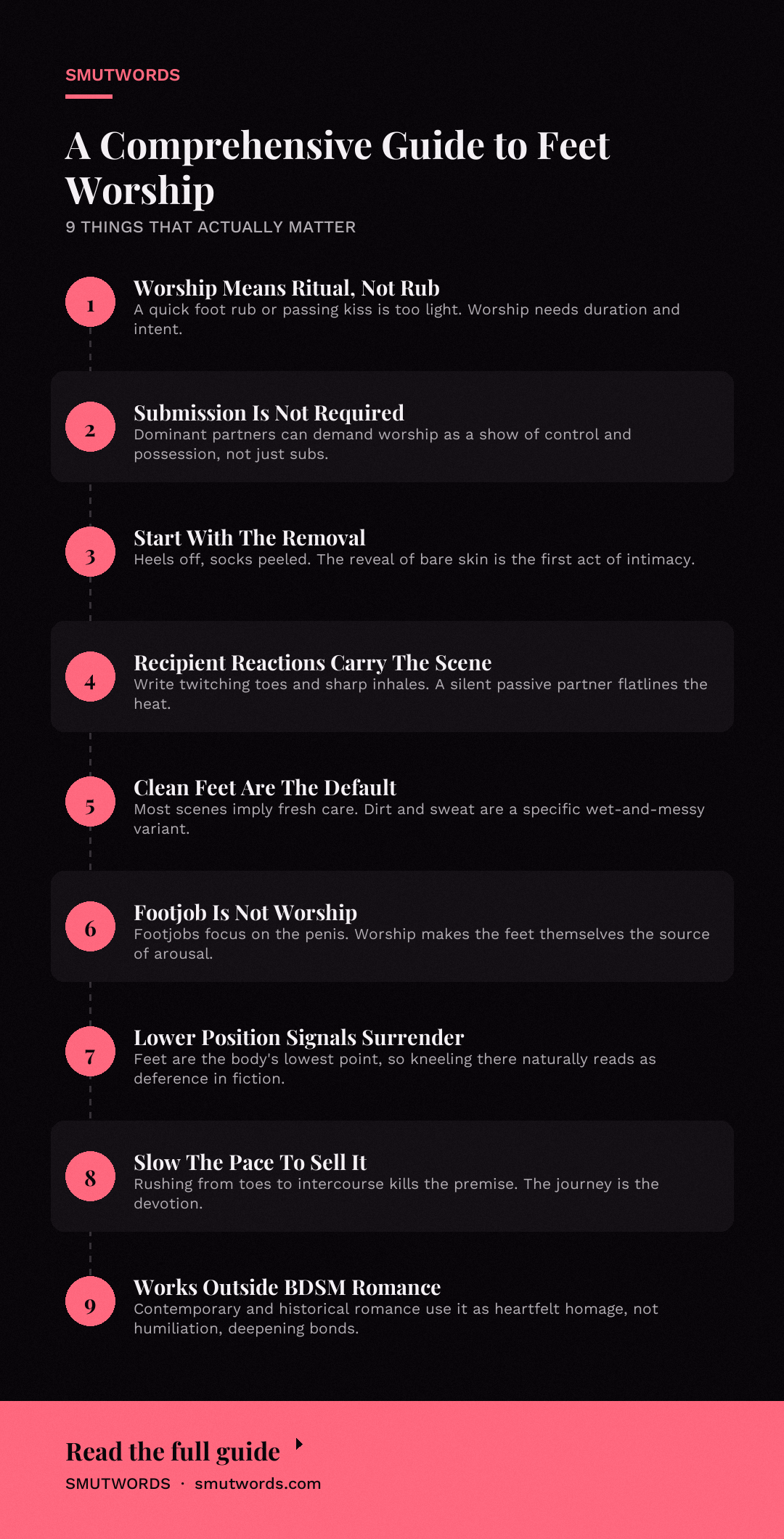
Common misconceptions muddle the trope. The first holds that feet worship is inherently about smell or dirt. That's narrow and often flat wrong. Many worship scenes are built around immaculate, pedicured feet, delicate skin, the visual appeal of arched soles and painted toenails.
The second misconception assumes the worshipper is always the submissive partner. That's the most common dynamic, sure. But the script flips depending on the relationship's power structure. A dominant character can demand worship as a form of control and reward, making the act about their ego and possession rather than their partner's submission.
What does not count as feet worship? A footjob uses the feet to stimulate a penis, which is related but distinct, centered on the giver's genitals rather than the feet themselves. A passing compliment about a pedicure? Too light. A brief kiss on the foot without ritualized context? Also too light. Worship requires duration, focus, and a clear emotional or power-based charge to earn the label in erotic fiction.
Where Feet Worship Comes From
The fixation on feet is not a modern invention. Anthropological and historical records show foot veneration across cultures, from ancient Egypt to China, where bound feet held bizarre cultural significance. But within erotica and romance specifically, the recognizable trope of foot worship as submission traces clearer roots to the power-exchange texts of the 20th century.
Mid-century underground publications that preceded the erotic novel boom frequently featured dominant female characters demanding foot worship from male supplicants. It was potent visual shorthand for inverted power structures, placing a traditionally masculine figure in prostration. As BDSM literature formalized its vocabulary in the late 20th century, feet worship found a permanent home in the submissive service manual, categorized as devotion rather than purely genital-focused activity.
Then the digital era hit. Self-published romance and erotica platforms normalized the fetish for a mainstream female readership. What was once coded as niche male obsession became a popular trope in billionaire romance and alpha-hero narratives. The powerful, commanding male lead makes an exception for his partner. He places her foot on his chest. He brings his lips to her arch. The gesture signals that his dominance is a facade that crumbles for her. That audience shift changed how feet worship gets written, emphasizing intimacy and emotional vulnerability over the older, more sterile presentation of the act as purely humiliating or degrading.
The genre now includes worship scenes across the full power spectrum, from total surrender of a kneeling supplicant to the tender, careful attention of a loving partner who just finds deep meaning in the act. The constant thread is elevation of a body part most narratives ignore, making it the centerpiece of arousal and connection.
How It Shows Up in Erotica
A well-constructed feet worship scene is a masterclass in pacing and sensory focus. The author has to slow down time to sell the devotion, using environmental detail and internal monologue to build the charge. The scene rarely starts with touch. It begins with anticipation, with the act of removal.
Consider the setup. A high heel comes off. A sock gets peeled away. A bare foot is presented by an outstretched leg. This reveal moment is critical. Authors often use the high heel fetish as a visual entry point, describing the curve of the arch against leather or the strap mark left behind. The removal is the first act of intimacy, a concession that physical barriers are coming down.
From there, the physical interaction follows a recognizable progression of intensity:
- Initial contact: A kiss to the top of the foot, often formal and gentle, setting a tone of reverence.
- Massage and pressure: Working the arches and balls of the feet, which grounds the scene in physical relief and care. The worshipper learns the body through touch.
- Oral attention: Sucking toes, licking the sole, tracing the ankle with the tongue. Sensory descriptions intensify here, focusing on taste, texture, and the recipient's reactions.
- Climax of devotion: The act moves upward, connecting feet to the rest of the body through kisses that trail up the calf or a guiding hand.
The strongest versions hinge on the recipient's reactions. If the character being worshipped stays passive and silent, the scene flatlines. The best authors write the subtle twitch of a toe, the sharp inhale when a tongue traces the arch, the shudder that runs up the leg. These micro-reactions validate the worshipper's effort and create a feedback loop of arousal.
Execution varies heavily with power structure. In a domme/sub dynamic, the dominant partner may issue commands for the sub to worship, turning the act into a test of obedience and sensory denial. In softer romance, it reads as profound service that makes the receiving partner feel uniquely precious. A third common variation connects feet worship to the wet and messy fetish, where lotions, oils, or other slick substances change the visual and textural stakes. The body part glistens. Strokes become slower, more deliberate.
Enjoyed this? Get a free book.
Join the list and we will send a complete free story straight to your inbox, plus new releases every week after that. No credit card, no catch.
The failure mode for writers is treating feet worship as generic insertable foreplay, skipping the ritual and rushing to the end. Authors who know the craft understand the scene is about the journey. The devotion is the point, not the destination. Cutting past worship to reach intercourse undermines the entire premise and reads as a missed opportunity for both character development and heat.
Feet Worship vs Foot Fetish
Readers use the two terms interchangeably, but they represent different degrees of intensity in fiction. A foot fetish is broad attraction. A character might have one and enjoy watching their partner's feet, asking for a footjob, or finding bare feet visually arousing. The focus is on feet as one erotic stimulus among many.
Feet worship is a specific behavioral expression of that fetish. It's the ritualized, often prolonged physical adoration of the feet, typically embedded in a power dynamic. A character could have a foot fetish and never engage in feet worship, preferring to fold feet into a standard sexual act. Conversely, a character might participate in worship scenes without identifying as having a foot fetish in daily life, instead enjoying the act for its symbolic value of submission.
The distinction matters for scene framing. Readers searching for feet worship expect a dedicated, slow-burn scene with heavy emotional or power-based context. Readers searching for foot fetish might be satisfied with faster, more casual mentions. Authors writing one term but delivering the other will disappoint their audience. Worship is ceremonial. Fetish is preference.
Frequently Asked Questions
Is feet worship always a submissive act in erotica?
No. While it frequently appears in submissive service arcs, it functions just as often as a dominant act of possession. A dominant partner can demand worship, framing the subordinate's mouth and hands as tools for their own pleasure and control.
How do writers make feet worship feel sensual and not awkward?
Strong writers anchor the scene in the worshipper's genuine desire and the recipient's positive reactions. Describing the beauty of the foot, the arch of the leg, and the character's emotional response removes the awkwardness by making it intentional and charged.
What is the difference between feet worship and a footjob?
A footjob uses the feet to stimulate the penis and focuses on the penis's pleasure. Feet worship is the adoration of the feet themselves as the primary source of arousal, potentially but not necessarily escalating to a footjob later.
Does cleanliness matter in written scenarios?
In fiction, cleanliness is usually implied or stylized. Most erotic writing depicts freshly showered or immaculately cared for feet, unless the scene explicitly intends to incorporate sweat or dirt, which is a specific variant that heavily overlaps with wet and messy fetish territory.
Can feet worship appear in non-BDSM romance novels?
Yes. It appears in contemporary romance and even historical settings as a sign of intense devotion. In these contexts, it rarely carries a humiliation charge. Instead, it is framed as a heartfelt homage to the partner's body, deepening romantic bonds.
Why is this act often tied to submission in popular fiction?
Physically, worshipping the feet puts the worshipper in a lower physical position, feet being the lowest point of the body. That spatial orientation naturally signals deference and surrender, making it an efficient symbolic act for authors writing submission dynamics.
Final Thoughts
Feet worship is a precision tool in an author's kit. It slows time, forces sensory detail, and makes a clear statement about the relationship's power geometry. Whether you're writing a brutal dominance scene or a tender romantic gesture, dedicating space to the feet delivers intensity that a standard kiss or caress can't match.
For a masterclass in how worship scenes service a larger power structure, look at how the theme appears in the cuckold bull trope. There, the act often publicly cements the husband's inferior status and the bull's superiority. A simple act of kissing a foot can change the entire balance of a scene.
If you're writing feet worship for the first time, steal a trick from possessive sex narratives: make the reverence possessive. The character isn't just appreciating the foot. They're claiming it. That single shift turns worship from an act into a statement.
And if you want to study pacing, contrast a worship scene against the frantic energy of car sex. One is built on concealment and urgency. The other demands exposure and stillness. Learning to toggle between those two speeds is what separates competent smut from the stuff readers bookmark.







Loading comments…