
Sharing partner kink is the erotic charge that comes from your partner being wanted, touched, or taken by someone else while you watch, arrange it, or hear about it afterward. The person with the kink usually stays in the picture. They chose this, sanctioned it, and often get off hardest on the fact that their partner came home.
That's the full picture of a fantasy that runs on trust, possessiveness, and a very specific kind of pride.
If you landed here from a search bar, you probably want more than the one-line definition. Where the term comes from, how authors actually write it, why some versions land and others fall flat, what separates the hot version from the cringe. That is what this guide covers.
What Sharing Partner Kink Actually Means
The name is blunt and describes the mechanism directly. One partner is shared, in fantasy or fact, with a third party. The person doing the sharing gets aroused by the arrangement itself: the sight of their partner desired, the knowledge that someone else wants what they have, the return.
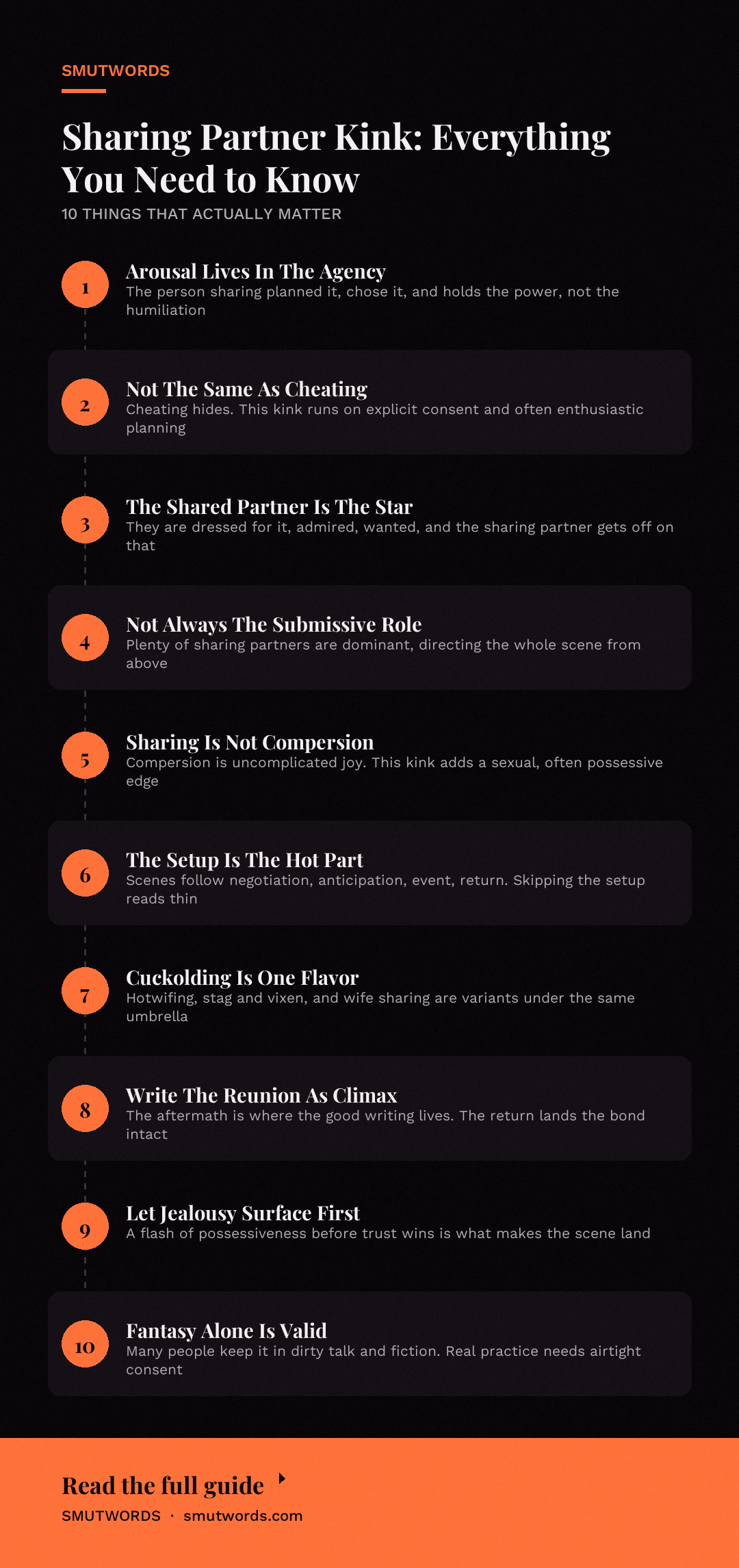
The definition hinges on consent and on who holds the power. A person who is genuinely distressed by their partner's infidelity is not practicing sharing partner kink. A person who planned the evening, picked the third, and is watching from the armchair absolutely is. The arousal lives in the agency.
That detail matters more than it looks: in most versions of this kink, the shared partner is the star. They are dressed for it, admired, wanted. The person sharing gets off on the reflected glory and on the trust that makes it possible.
Several things get confused with this kink and are not the same:
- Cheating. Infidelity involves deception. Sharing partner kink involves explicit consent, often enthusiastic planning. The difference is the entire point.
- Compersion. Compersion is the warm, uncomplicated happiness at a partner's pleasure. Sharing partner kink adds a sexual edge, often a possessive one. They can overlap, but they are not synonyms.
- Polyamory. Multiple loving relationships can include this dynamic, but the kink does not require romantic attachment to the third party. Many versions are strictly physical or one-time.
- Hotwifing, cuckolding, stag and vixen. These are specific flavors of the broader kink, not the whole category. More on the variants below.
One common misconception: readers assume the person sharing must be submissive. Many are. Plenty are dominant in the arrangement, directing the whole scene while their partner performs. The kink describes what turns someone on, not where they sit on a power exchange.
Where Sharing Partner Kink Comes From
Erotic writing about watching a partner with someone else is old, older than the modern labels. The specific vocabulary we use now, cuckolding, hotwifing, stag and vixen, is mostly a product of the internet era, when forums gave people words for a fantasy they had been writing around for generations.
The word cuckold predates the kink by centuries. It comes from the cuckoo bird, which lays its eggs in other birds' nests. The historical usage was an insult, a man whose wife strayed. Erotica spent a long time treating the cuckold as a figure of humiliation or comedy.
What changed in published romance and erotica is the reframing. Modern stories moved the cuckold from punchline to protagonist, and moved humiliation from the default to one option among several.
The stag and vixen dynamic did much of that work in the 2000s and 2010s. The stag is proud, present, and in charge; the vixen is desired and comes home. That reframe turned a dishonor into a flex.
Meanwhile, the reverse dynamic, husband sharing, picked up steam in reverse harem romance and other multi-partner subgenres, where a woman and her partners negotiate the arrival of someone new. That connects to broader publishing trends toward harem romance and group arrangements, which you can read about in the glossary if you want the full map.
The genre history matters more than any ancient origin story. For most of the twentieth century, sharing a partner in fiction was coded as tragedy or betrayal. The last few decades of romance publishing slowly legitimized the consensual version, first as a subplot, then as the central premise of entire series. That is a publishing shift, and it is the real history of this term.
How It Shows Up in Erotica
On the page, sharing partner kink is a craft problem before it is a kink problem. The writer has to make the reader feel the possessiveness, the generosity, and the trust all at once, without any of them canceling the others. When it works, it produces some of the most charged scenes in the genre.
Structurally, most scenes follow a recognizable arc: negotiation, anticipation, the event, the return. Erotica that skips straight to the event usually feels thin. The hot part is the setup, the conversation where a partner says the thing out loud and the other one says yes.
Authors use several common variations, and each has its own texture:
- Cuckolding. The partner watches while someone else has sex with their partner. Often includes a humiliation element, sometimes playful, sometimes sharp. The hottest versions keep the couple's bond intact and centered.
- Hotwifing. A wife plays with others with her husband's full permission and encouragement. He may watch, may hear about it, may stay home. The mood is usually celebratory, less humiliating, more proud.
- Stag and vixen. A close cousin of hotwifing where the man is explicitly dominant and proud, and the woman is explicitly desired and in charge of her pleasure. Overlap is large; the label signals the tone.
- Wife or husband sharing. Broader terms that cover scenarios with more structure, such as a regular third, an ongoing arrangement, or a formal event.
- Voyeur exhibitionism. The couple arranges for others to watch, either at a party or in public-adjacent settings. The third party may never touch anyone; the charge comes from being seen.
One of the more common entry points is a shared evening that starts with one night stand energy and then collapses the distance between the couple. A stranger, a hotel, a plan. The scene is often about how the couple reconnects afterward, which is why the return and the reunion sex get as much page time as the event.
That aftermath is where a lot of the actually good writing lives. The couple comes back together after the third leaves, and the scene turns on whether the bond survived, deepened, or shifted. Authors who understand this will write the reunion as the climax, not the anticlimax.
A strong version of the trope tends to do several things at once:
Enjoyed this? Get a free book.
Join the list and we will send a complete free story straight to your inbox, plus new releases every week after that. No credit card, no catch.
- Show the negotiation. The reader has to see that both people wanted this. Without the consent on page, the rest reads as betrayal.
- Give the shared partner interiority. The partner is not a prop. They chose this, they wanted it, they have their own reasons. Flat versions turn them into a mannequin.
- Keep the third a person. The best versions give the guest a personality and a reason to be there. Worse versions treat them as interchangeable.
- Let jealousy be real. The hottest scenes let a flash of possessiveness surface before the trust wins. Without that tension, the scene is just a threesome with extra steps.
- Land the return. The scene ends in the couple's bed, the couple's conversation, the couple's plan for what comes next. The reader needs the bond to be visibly intact.
A flat version usually fails on one of these and most often on the first. It skips the consent scene entirely, or it treats the partner's pleasure as incidental. When the author forgets that the person doing the sharing is the engine of the scene, everything deflates.
For readers who want the trust-building part in more detail, our guide to service submission covers a related dynamic where a partner's satisfaction comes from being useful to someone else's pleasure. The mechanics differ, but the emotional engine overlaps.
Some authors push the scene into rougher terrain. A party with several guests can shade into orgy territory, where the couple's pairing becomes the anchor in a larger room. That version needs even tighter authorial control so the reader does not lose track of who matters most.
Others go the opposite direction and write the scene as a slow, intimate three-way conversation, closer to friends with benefits than to a performance. The third is a trusted friend, the arrangement is ongoing, and the novel's tension comes from what happens when feelings start to complicate the plan.
The physical details matter, and authors handle them differently. Some lean into the sight of the partner: the dress, the blush, the way a stranger's hand lands. Others lean into the sound, the listening, the half-open door. Still others stage it as a verbal scene, a partner telling the story afterward to a possessive listener who needs every detail.
The kink can also fold into a larger power exchange. A dominant who arranges their submissive's evening with a stranger is running the scene from above, and the bondage crowd will recognize the control logic. For a deeper look at how rope and restraint structure a scene, our shibari glossary entry is a good companion piece.
There is also a public-facing version. The couple's arrangement can turn into a display: the shared partner dressed for other eyes, flirted with openly, maybe watched on a date. This overlaps with partner exhibitionism and is often the gentler entry point for a couple who are not ready for a third in their bed.
Sharing Partner Kink vs Primal Play
These two get confused because both involve intense trust and a strong physical charge. The difference is the social element. Primal play is a one-on-one dynamic built around chasing, wrestling, biting, and instinct, with the intensity coming from the two bodies in the room. Sharing partner kink is social by definition: there is a third party, even if they are off-page.
A scene can combine them, and some do. A third party can be invited into a primal chase, or the couple can return to each other with feral energy after the event. But the categories are separate, and readers who go looking for one often get the other.
If your sweet spot is the feral, physical, no-negotiation-just-teeth version, start with the primal entry. If it is the social negotiation and the watching, this page is the right one.
Frequently Asked Questions
Is sharing partner kink the same as cuckolding?
Cuckolding is one specific flavor of a broader category. Sharing partner kink covers cuckolding, hotwifing, stag and vixen dynamics, wife and husband sharing, and exhibitionist arrangements. The category is the umbrella; cuckolding sits under it.
Is this kink only for men?
No. The traditional framing is a man sharing his wife, but the reverse is common, and many women get off on watching their male partner be desired and touched by someone else. The label husband sharing exists for exactly that. Gender is not the deciding variable; the arousal from trust and possession is.
Do you have to actually do it in real life to enjoy this kink?
No. Most readers and many people in the kink community engage entirely in fantasy, dirty talk, or fiction. The fantasy version is safe, endlessly adjustable, and often enough.
Real-world practice needs airtight communication, explicit consent from every person involved, and a plan for aftercare to manage jealousy or emotional fallout. Many people decide after long negotiation that the fantasy is where they want to keep it, and that is a fully valid choice.
What does aftercare look like for this kink?
Aftercare in this context often involves a quiet reunion, reassurance about the couple's bond, and a long conversation about how each person felt during the event. The emotional labor is real. Some couples need a day to reset; others want the closing conversation to include a plan for next time, or a clear statement that there won't be one.
Why do some readers find this kink romantic?
Because the strongest versions center on trust. The couple chooses each other loudly, in front of a third party, with the shared partner returning home. When it is written well, the whole scene is a declaration of the bond. That's why so many of these books close with the couple's private reunion rather than the event itself.
Is there a difference between sharing partner kink and polyamory?
Yes. Polyamory involves multiple loving relationships, each with its own emotional weight. Sharing partner kink is often strictly sexual, often one-time, and does not require the third party to be loved or even in regular contact. The two can overlap, but a person can be fully polyamorous without this kink, or fully into this kink without being polyamorous.
Final Thoughts
The version of this kink that earns its heat is the one that keeps the couple's bond at the center of the scene. If you want to see how authors land the negotiation, the event, and the return, our guide to competition romance explores the same possessiveness channeled into a different structure. Pair it with a good starter title below and you have the full reading list.








Loading comments…