
Service submission gets filed under submission a lot, and technically that's right, but it misses what's actually happening. The submissive in a service dynamic isn't primarily chasing the whip or the restraints. They get off on being useful: the coffee made exactly right before anyone asked, the coat taken at the door, the calendar managed so well that the dominant never has to think about Thursday.
The obedience is the vehicle. The point is the pleasure of being needed in a specific, named, dependable way.
It's one of the quieter corners of kink, which means it gets less airtime than the dramatic stuff and more confusion from people who assume submission always means kneeling in silence. Here's the plain-English version: what service submission is, how it differs from other submissive styles, how to bring it up with a partner who's never heard the term, and how to build it into daily life without turning it into an unpaid internship or a slow resentment machine.
What Service Submission Actually Means
At its core, service submission is a dynamic where a submissive finds satisfaction, erotic or emotional or both, in performing tasks and offering care for a dominant partner, within a frame both people agreed to. The tasks can be mundane (laundry, driving, cooking, admin) or intimate (bathing, dress selection, ritualized attention) or explicitly erotic. The content of the chores matters less than the frame around them: who directs, who receives, and the understood fact that the doing is the point.
Two things separate it from just being helpful. First, consent and structure. A service sub and their dominant have talked about which acts count, when, and what happens if the sub is exhausted or sick.
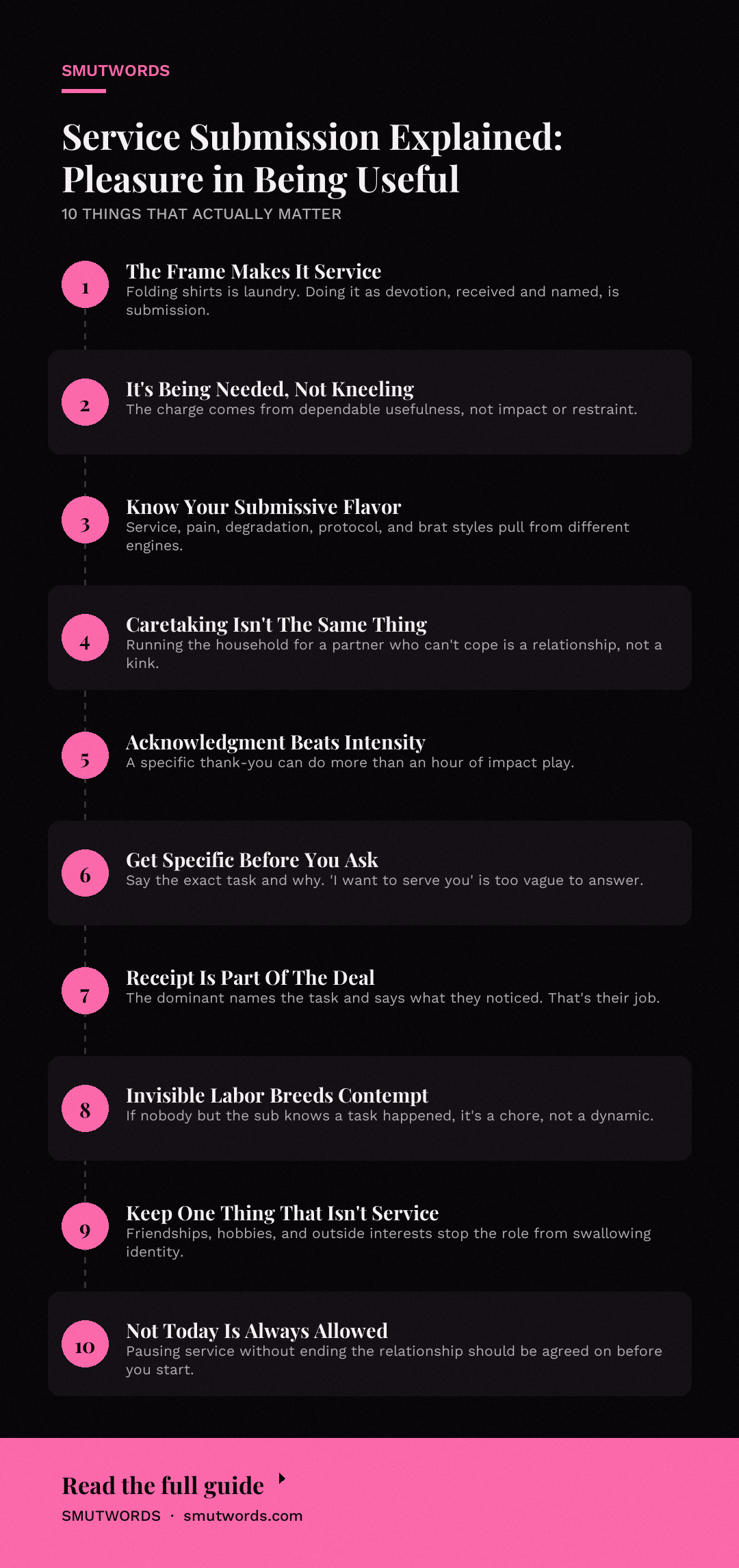
Second, the meaning assigned to the acts. Folding someone's shirts is laundry. Folding someone's shirts as an act of devotion, acknowledged and received, is service submission. The act is identical; the frame does the work.
This is also why service submission shows up in fiction as a slow-build dynamic rather than a single scene. If you want a version of that texture in a book, Absolute Surrender runs on the quiet accrual of small devotions long before anything loud happens.
How Service Submission Differs from Other Submissive Styles
Submissives are not a monolith, and figuring out your own flavor saves a lot of mismatched negotiation. Roughly, the common styles break down like this:
- Service submissive: satisfaction comes from doing, providing, anticipating needs, and being depended on. Erotic charge often lives in the gratitude and the noticing.
- Pain-oriented or masochist submissive: satisfaction comes primarily from receiving sensation, impact, restraint, or intensity. The dynamic may involve very little caretaking.
- Degradation or humiliation submissive: charge comes from being verbally cut down, demeaned, or put in a lower-status frame, with aftercare built to land it safely.
- Protocol or ritual submissive: charge comes from formal structure, titles, rules, and ceremony. Service tasks are often part of protocol, but the engine is the ritual itself.
- Brat or playful submissive: charge comes from resistance, teasing, and being put back in line. Service is often the last thing they want.
These overlap. Plenty of service subs also like protocol, and plenty of masochists love being useful.
But if you keep trying pain play and wondering why it feels like homework, or you keep trying service and feeling like a servant with no reward, you may simply be reading from the wrong menu. The free use kink guide covers a related question: how a dynamic built on access and availability gets negotiated in practice when the baseline is daily life rather than a scene.
The caretaking overlap
Service submission is not the same as caretaking a partner who can't care for themselves. That's a relationship, not a kink, and it needs to be available in the dynamic on purpose, not as a default. The distinction matters because it's the most common way service dynamics go sideways: the sub ends up functionally running the household while the dominant calls it their dynamic, and nobody remembers agreeing to that.
Why People Like It: The Actual Charge
Ask a service sub what they get out of it and you'll hear variations on a few themes. There's the erotic charge of being needed in a specific, identity-level way ("she can't run her week without me; I built that"). There's the relief of a role that gives clear permission to care, which many people raised to over-function can finally do openly instead of resentfully. There's the feedback loop: task, acknowledgment, more devotion.
For a lot of subs, the moment the dominant says "thank you, that was exactly what I needed" does more than an hour of impact play.
On the dominant side, the pleasure is often the inverse: receiving steady, reliable care without having to manage the person providing it. A dominant who has spent their life being the one who handles everything can find that enormously charged.
This is also why the trope lands in romance. The forced-obedience dynamic in Bound to the Galactic Alpha is fictional and nothing like a real service negotiation, but the fantasy engine underneath is familiar: a sub whose usefulness earns favor from a dominant with real power to grant it.
How to Bring It Up With a Partner
If you've never named this out loud, the safest move is not to spring it mid-scene. Try it in a calm moment, and lead with the observation rather than a script. Something like: "I've noticed I get more out of doing things for you than I do out of the formal scene stuff we've tried. Can I tell you what I think I want?"
From there, get specific about what tasks appeal to you and why. "I want to make your coffee in the morning" is testable. "I want to serve you" is too abstract for a partner to say yes or no to. Naming the erotic charge honestly helps too, because many partners assume service is unsexy housework and warm up fast once they know it's not.
What to ask before you start
Before any task goes into the rotation, both people need to answer some version of these:
- Which acts count as service, and which are just ordinary household labor neither of us wants to treat as kink?
- Is this a daily ritual, a scene, or a standing expectation? How often?
- How does the dominant signal receipt: a word, a look, a specific phrase?
- What happens if the sub is sick, exhausted, or simply doesn't feel like it? Is the task ever a hard obligation?
- What does the sub get in return, and when?
- How do we check in on this monthly without turning the check-in into an argument?
The last two are the ones people skip. Don't skip them. A service dynamic with no acknowledgment for the sub has a roughly zero chance of surviving a year.
Building It Into Daily Life Without Burning Out
The failure mode of daily service looks like a sub doing everything, a dominant noticing nothing, and a slow accumulation of resentment that eventually blows the dynamic up. The fix is treating service as a structured exchange rather than an open-ended obligation. A few practical shapes that work:
Enjoyed this? Get a free book.
Join the list and we will send a complete free story straight to your inbox, plus new releases every week after that. No credit card, no catch.
Named rituals over vague expectations. Pick two or three specific, repeatable acts. The morning coffee. The coat at the door.
A check-in text at a set time. Specific beats sweeping every time, because specific is measurable and measurable is sustainable.
Acknowledgment built into the act. The dominant has a job here too: saying thank you, naming the task, or setting aside a few minutes of attention after. The receipt is part of the scene, not a bonus.
Consent as a standing question. Service should be renegotiated when life changes: new job, illness, a baby, a move. A dynamic that was right in March can be a bad fit by October. The monthly check-in catches that before it curdles.
Withdrawal as a legitimate move. Any sub in any dynamic can say "not today" and pause service without ending the relationship. No service task should be a trap where stopping counts as failure.
If your version of service leans toward "available whenever the dominant wants," that's a different but related dynamic, and it needs its own rules and hard stops. The free use explainer linked above lays out that structure.
The difference between a service ritual and a chore
A useful test: when the task is done, does anyone besides the sub know it happened? If a task is invisible and unacknowledged, it's labor, and labor without reciprocity breeds contempt. If the dominant participates in marking it, whether with a word or a deliberate pause, the same task becomes dynamic material. That's the entire difference.
Real Risks and How to Lower Them
Service submission carries less physical risk than impact or restraint play. Its risks are relational and emotional, and they're real.
- Unpaid labor creep. The dynamic quietly expands until the sub is running the household. Lower it by writing down the tasks and reviewing them monthly.
- Resentment without acknowledgment. The sub does more, gets less, starts keeping score. Lower it by building acknowledgment into the ritual itself.
- Identity fusion. The sub's sense of worth becomes entirely built on being useful, and losing the role collapses them. Lower it by keeping friendships, hobbies, and at least one thing in their life that isn't service.
- The "not a real sub" trap. If a sub wants to stop for a week and is then told it means they weren't genuinely submissive. That's a control tactic, not a dynamic. Lower it by agreeing before you start that stopping is always allowed.
- Financial risk. Service that includes "manage your money for you" or "give me your income" carries real financial risk. Lower it by keeping the sub's own assets separate and never combining service with irreversible transfers.
None of this is exotic. These are the same failure modes as any relationship, just with erotic and structural chocolate on top. Notice them early and talk about them, and they stay small.
When to Stop
Stop, at minimum, when any of the following is true: the sub is experiencing physical or mental health symptoms they're ignoring to keep serving; the dominant is refusing to acknowledge the sub's effort after being asked; the sub is being told stopping counts as betrayal; the dynamic is bleeding into relationships or work in ways the sub didn't sign up for; or the sub simply no longer wants it.
Any one of these is enough. You don't need a full case file. A general sense that something's off is its own reason to hit pause.
The one habit that prevents most of this: a regular, low-stakes check-in where the sub can complain about a task without it being read as rejection. The dominant should want that check-in too. A dynamic that can't survive "I'm tired of doing your laundry" is not a stable dynamic.
If you want a fictional version of the dynamic's texture, Bull for the Weekend plays with the available-and-wanted frame; Free Use Airplane runs the same question through a closed, rule-bound setting. Neither is a how-to. Both get at why the fantasy of being useful is so charged.
For the dominant side
If you're the one being served, your job is harder than it looks. You have to receive without turning grateful into squeamish, and you have to acknowledge without flattening the dynamic into "good job, buddy."
Say what you noticed specifically. "The shirt you picked was perfect" lands. "Thanks for the stuff" doesn't. The difference is naming the task out loud.
And don't be the dominant who lets the sub do the work of building the dynamic too. The receipt is your side of the deal.
Final Thoughts
Service submission works when both people stay awake to the exchange: the sub does the specific thing, the dominant names it, and either of them can call a pause without it meaning the end. Start with one task, one acknowledgment, and one monthly check-in, and pay attention to whether the doing actually feels good or whether you're just relieved to be needed.
Other dynamics are worth reading up on before you commit to a label. Service pairs oddly well with protocol and poorly with degradation for many people. If some of what appeals to you is actually the structure of the scene rather than the care itself, the shibari guide covers a form of ritual where structure and restraint carry the whole charge.
And if you're drawn to a relationship where obligation and devotion are formally bound together rather than kink-negotiated, the undercover marriage guide covers that trope directly. For the fiction version of the quiet, daily, devoted service this guide is about, Absolute Surrender is the closest thing on the site.








Loading comments…