
Marriage in trouble is the romance trope where a couple who already said I do has to decide whether they still mean it. They are married, often for years, and something has cracked the foundation: an affair, a death, a secret, a slow freeze that neither of them knows how to thaw.
The marriage in trouble story puts the crisis on the page and makes the reader watch two people who know each other's worst habits try to find a reason to stay. It is the opposite of a meet-cute. The meet already happened, the cute has worn off, and what's left is the hard, intimate work of deciding whether a shared life is worth rebuilding.
What Marriage in Trouble Actually Means
The phrase describes a narrative situation, not a single plot. The couple is legally and emotionally entangled before the first page. The story's engine is the gap between the life they built and the life they are actually living now. Something has to force the reckoning: a separation, a confession, a near-miss, a therapist's office, a weekend away that was supposed to be a last attempt.
What counts as marriage in trouble is specific. The relationship must be established, not budding. The conflict must threaten the union itself rather than just adding friction to a happy couple.
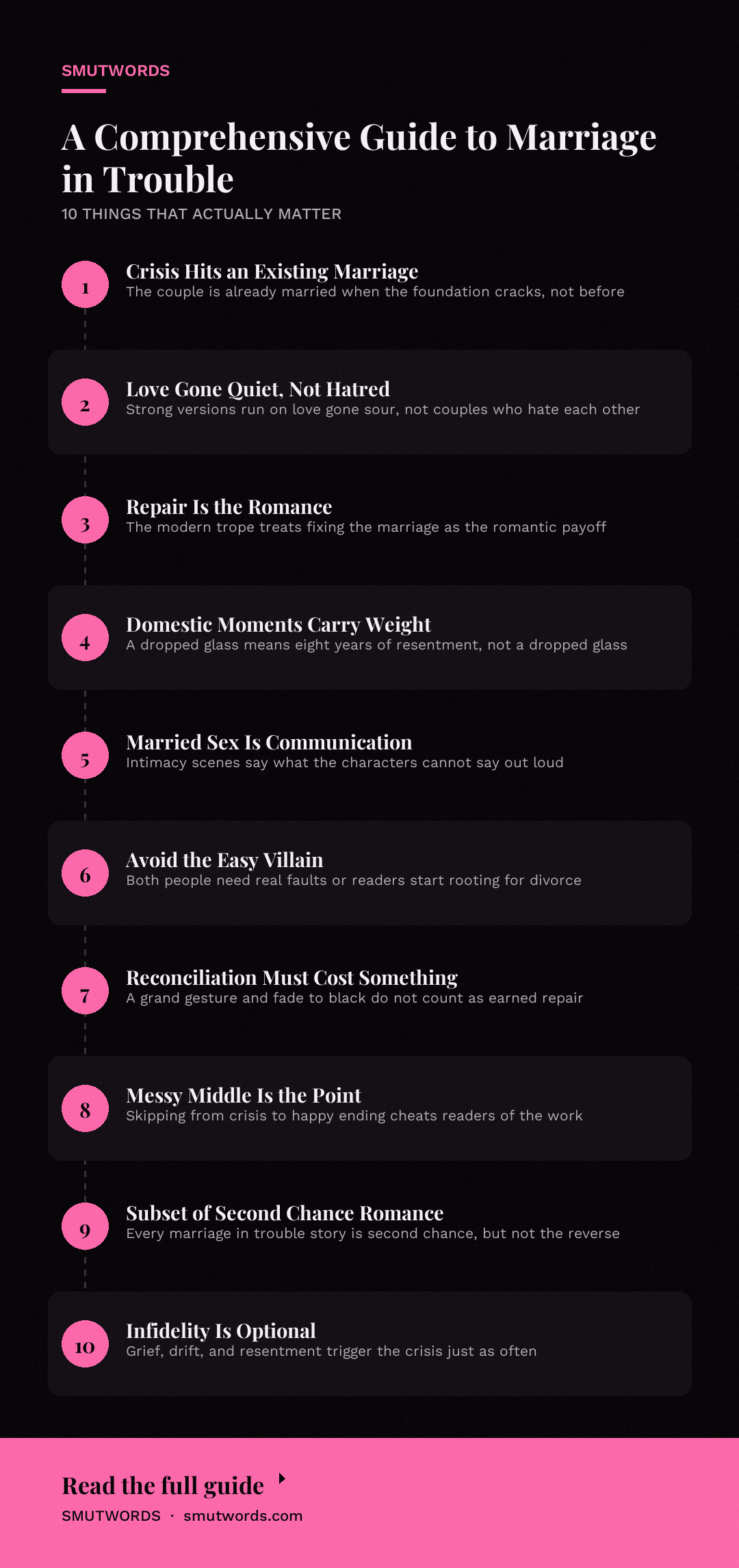
And the resolution has to be earned through confrontation. A grand gesture and a fade to black don't cut it.
What doesn't count matters just as much. A couple who bickers but never doubts the marriage is a domestic comedy. A fiancé cold feet storyline is a wedding story. And a couple who separates after two chapters of marriage because the author wants a second-chance romance with a quick divorce backstory is borrowing the label without doing the work.
The common misconception is that marriage in trouble means the couple hates each other. It rarely does. The strongest versions run on love that has gone sour or gone quiet, where both people still want it and neither knows how to reach the other. The cruelty in these books is usually accidental.
Where Marriage in Trouble Comes From
The trope is old in literature and relatively young as a labeled romance category. Nineteenth-century novels were full of miserable marriages, but they treated the union as a trap to escape or endure.
The shift that created the modern trope was the idea that a marriage could be repaired, and that the repair itself was romantic. That is a twentieth-century development. Erotic romance pushed it further by making the repair explicitly sexual.
In category romance, the troubled marriage plot has been a staple since at least the 1970s, when publishers discovered readers would follow a couple past the altar. Those early versions leaned on external villains and misunderstandings. The husband was distant because he was secretly protecting her. The wife was cold because she had misread a letter.
The conflicts were resolvable in a single conversation that the author withheld until the last chapter. Contemporary versions cut much closer to the bone.
The rise of the second-chance and separation subgenres in the 2000s and 2010s brought in infidelity fall-out, grief, addiction, career resentment, and the specific loneliness of sharing a bed with someone you no longer talk to. The internet era amplified the trope through fan fiction and indie publishing, where authors could write the messy, explicit, unsentimental versions that traditional publishers once softened.
Today the marriage in trouble story sits at the center of a whole cluster of related tags: strained marriage, cold distance, forced proximity to save the marriage, and the separation plot where the couple lives apart while they figure it out. The label has become a promise to the reader. You will get pain, you will get honesty, and you will get a resolution that costs something.
How It Shows Up in Erotica
On the page, marriage in trouble is a pressure cooker. The couple has history, so every scene carries weight. A dropped glass in the kitchen is not a dropped glass. It is the last eight years of resentment in ceramic form.
Good authors use that density deliberately, loading small domestic moments with the accumulated tension of a shared life.
The sex scenes are where the trope earns its place in erotica. First-time sex is discovery. Married sex in crisis is communication, confession, negotiation, and sometimes a battlefield.
The strongest scenes use physical intimacy to say what the characters cannot say out loud. A husband who has been sleeping in the guest room for months reaches for his wife, and the reader feels the whole weight of the silence he is breaking.
Enjoyed this? Get a free book.
Join the list and we will send a complete free story straight to your inbox, plus new releases every week after that. No credit card, no catch.
Common Variations Authors Use
- Infidelity fall-out: One partner cheated. The story is about the aftermath, the rebuilding, and whether forgiveness is possible or even deserved.
- Separation with a deadline: They agree to live apart for a set time before deciding on divorce, and the countdown creates structure and dread.
- Forced proximity to save the marriage: A cabin, a cruise, a family wedding, or a work trip traps them together long enough to talk. A lumberjack romance setting or a remote cabin is a favorite move here, and the cabin vs city setting question matters more in this trope than most.
- Cold distance: No single betrayal, just years of drift. The conflict is quieter and often harder to write.
- Public-facing marriage in crisis: A political marriage, a celebrity couple, or a royal pair whose private failure plays out under cameras. The prince/princess romance and rockstar romance corners of the genre do this constantly.
- Fake-it repair: They agree to pretend the marriage is fine for an event or a family obligation, and the performance becomes real. The celebrity romance guide covers how public performance and private fracture overlap.
What Makes a Strong Version Work
The best marriage in trouble books make the reader understand why the couple fell in love in the first place, and why that love is still there underneath the damage. That means flashbacks used sparingly and specific ones. Not a hazy montage of a happy wedding, but one scene that captures the exact dynamic the couple is now failing to recreate.
Strong versions also resist the easy villain. If one partner is simply a monster, the reader stops rooting and starts wishing for the divorce. The trope works when both people have real faults and the marriage has real value. The conflict has to be mutual, or at least mutual enough that the resolution feels like a win for two people rather than a rescue of one.
The weakest versions do three things. They resolve the crisis with a single conversation that should have happened fifty pages earlier. They turn the reconciliation into a grand gesture that substitutes spectacle for actual change. Or they skip the messy middle and jump from crisis to happy ending, which leaves the reader feeling cheated of the exact emotional work they came for.
A strong version, by contrast, shows the couple actually changing. They learn new ways to fight. They go to therapy.
They have the conversation they have been avoiding for a decade, and it goes badly before it goes well. The reconciliation feels like a decision rather than a plot convenience.
Marriage in Trouble vs Second Chance Romance
These two get confused constantly, because they overlap and share shelf space. Second chance romance is the broader category: any couple who had a relationship before, lost it, and comes back together. They might have been high school sweethearts, a fling that ended badly, or briefly engaged. Marriage in trouble is a specific subset where the prior relationship was a marriage, and the crisis happens inside the union rather than after a breakup.
The distinction matters for readers. A second chance romance can be light and playful, with the couple reconnecting over cocktails. Marriage in trouble promises weight: shared property, shared children, shared history, and the knowledge that undoing the relationship will cost more than walking away from a boyfriend. The emotional stakes are higher because the entanglement is deeper.
The overlap is real. A separation plot is both a second chance and a marriage in trouble. But if you are searching for one and get the other, you will feel the difference immediately. For a parallel case of a marriage born from circumstance rather than love, the green card marriage guide covers how the trope handles a union that starts as a contract and has to become real.
Frequently Asked Questions
Is marriage in trouble the same as second chance romance?
No. Marriage in trouble is a subset of second chance romance where the couple is already married when the crisis hits. Second chance romance can involve any prior relationship, including one that ended before marriage. Every marriage in trouble story is a second chance story, but not every second chance story is a marriage in trouble story.
Why do readers like marriage in trouble books so much?
The stakes are high and the history is deep. Readers get to watch two people who already know each other's flaws decide whether the relationship is worth the work. The reconciliation, when it lands, feels earned in a way that a first-time romance often cannot match.
Does marriage in trouble always involve infidelity?
No. Infidelity is one common trigger, but plenty of these books run on grief, career resentment, family pressure, mental health struggles, or simple long-term drift. The cold distance variant has no betrayal at all, just two people who stopped seeing each other. The trope is defined by the threat to the marriage, not the specific cause.
Is there always a happy ending?
In romance as a genre, yes. The marriage in trouble story resolves with reconciliation or, occasionally, a divorce that is treated as the happy ending if the marriage was genuinely destructive. The romance genre's contract promises an emotionally satisfying resolution, and that usually means the couple stays together.
What is forced proximity to save the marriage?
It is a plot device where the couple is trapped together in a setting that forces conversation and intimacy. Common versions include a shared cabin, a cruise, a family event, or a work trip. The proximity removes the escape routes that let the couple avoid the real conversation, which is why it appears in so many of these books.
Can marriage in trouble work in a shorter book or novella?
Yes, but it is harder. The trope needs room to show the history, the crisis, and the repair. Novellas usually focus on a single incident inside the crisis rather than the full arc, or they lean on a blind date romance style structure where the couple rediscovers each other through a series of forced encounters.
Final Thoughts
Marriage in trouble is the most honest trope in romance because it admits that love is a decision you make more than once. The couple already chose each other. The book is about whether they choose each other again, with full knowledge of the flaws and the history and the specific ways they hurt each other.
If you want to see the trope done at its best, start with a book that lets the reconciliation be messy and gradual rather than a single grand gesture. The one you want is the one where the couple has to sit in the discomfort of what broke before they get to the part where it's fixed.





Loading comments…