
The green card marriage is the marriage of convenience plot stripped to its sharpest edge: two people wed so one of them can stay in the country. The stakes are legal, the terms are negotiated, and the timeline has a deadline stamped on it by an immigration office. In romance and erotica, that bureaucratic clock becomes a pressure cooker.
It forces two people into a shared apartment, a shared bed, and a performance of love for anyone watching, until the performance starts to feel like the real thing.
The plot is the engine behind some of the genre's best slow burns. The lie at the center gives the characters a reason to be close before they have a reason to admit they want to be.
What a Green Card Marriage Actually Means
The term is shorthand for a marriage entered into, at least initially, to obtain immigration status for one partner. In real life the phrase is loaded, carrying implications of fraud and government scrutiny. In fiction it's a plot device, and a very reliable one.
The name comes from the colloquial American term for a lawful permanent resident card, which was green at various points in its history and stuck. The trope itself travels well beyond the United States, appearing in British settings as a visa or spousal settlement arrangement, and in Australian, Canadian, and European-set books under similar immigration frameworks. The core mechanism is the same wherever it's set: legal status is contingent on the marriage being real.
What counts as a green card marriage in the genre is specific. The relationship must begin as a transaction with a legal or logistical purpose. One party needs residency, citizenship, or a work permit; the other party has something to gain, whether that's money, a favor returned, or a problem solved. The marriage is contracted, often with terms discussed out loud, and the rest of the book is the unraveling of those terms.
What doesn't count is a marriage that begins for emotional reasons and later hits immigration trouble, which is closer to the territory of marriage in trouble. Nor does it count if the arrangement is purely for social or corporate gain with no legal necessity attached; that's a plain marriage of convenience or a fake engagement, and the urgency is softer.
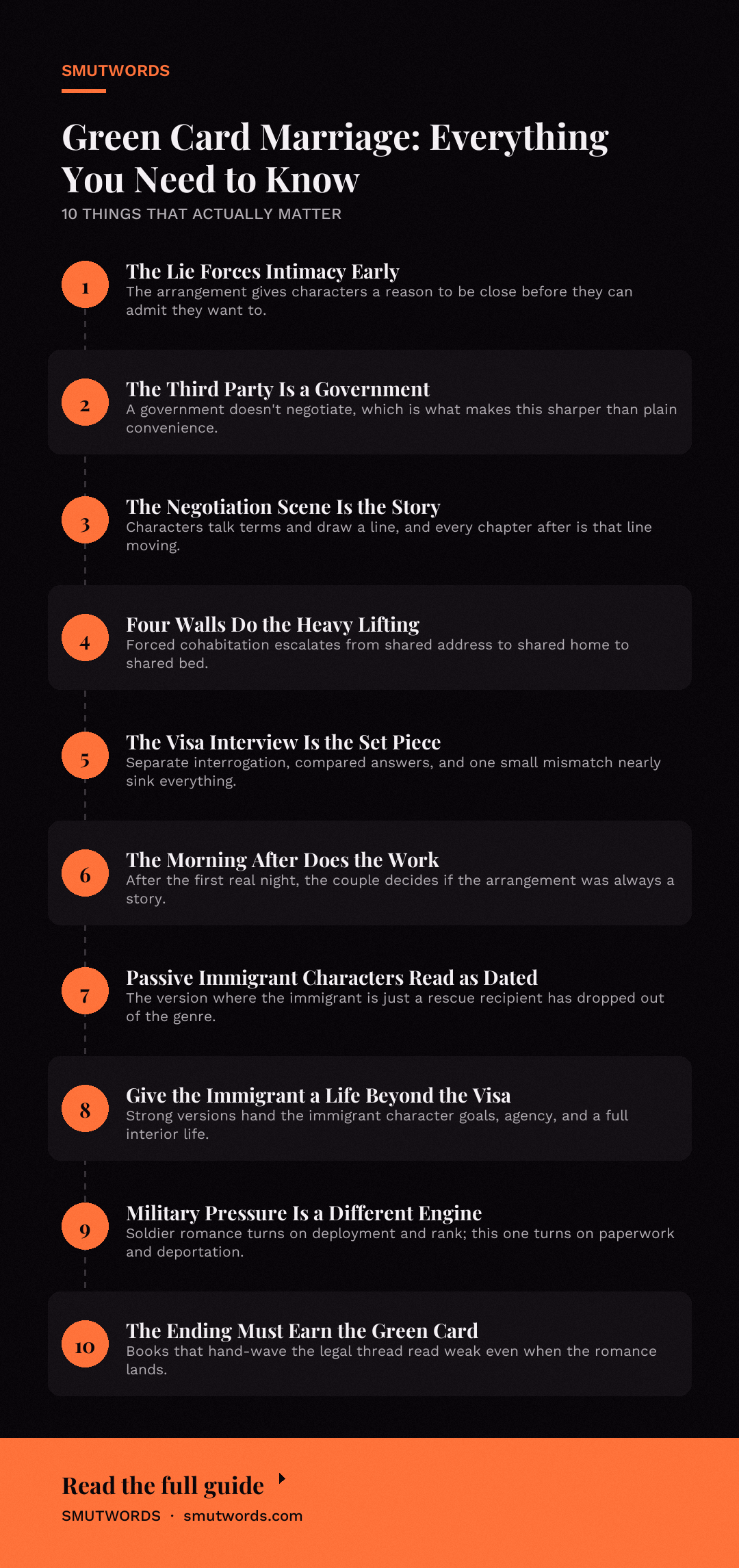
The green card variation earns its own entry because the third party in the arrangement is a government. A government doesn't negotiate.
A few common misconceptions are worth clearing up. The trope doesn't require either party to be a criminal or a villainous manipulator, though some books play it that way. It also doesn't require the transaction to stay cold; the best versions have the characters agree to the deal with clear eyes and then find themselves trapped by their own decency.
The couple may not have to actually live together in every rendition, but the forced-cohabitation version is the one readers return to again and again. Four walls do more work for the plot than any other device in the genre.
Where the Green Card Marriage Comes From
The trope has lived in American popular fiction since at least the mid-twentieth century, when immigration law tightened and the fraudulent marriage became a recognizable cultural story. The 1980s and 1990s brought a run of films and television episodes built on the premise, and the romance genre picked it up quickly. Once the language of immigration raids and marriage interviews entered the popular vocabulary, the plot machinery was already assembled for anyone writing a love story.
The publishing history is where it gets interesting. In category romance, the green card marriage was a staple of the 1990s and early 2000s, often set in New York or Los Angeles, with a wealthy or well-established love interest offering a deal to a struggling immigrant protagonist. Those books were usually short, sharply paced, and heavily invested in the visa interview scene as a climax.
The couple has to prove to a skeptical official that they're genuinely married, and the physical intimacy they fake for the interview becomes the moment the facade cracks.
Over the last fifteen years the trope has shifted in two clear directions. One is toward more careful attention to the immigrant protagonist's interior life, where the book engages seriously with the fear of deportation, the stakes of leaving family behind, and the humiliation of proving a relationship is real.
The other is toward a more playful, self-aware version where both parties know exactly what a bad idea this is and proceed anyway, with the legal risk treated as a pleasure-delay device. Both approaches sell.
What's dropped out is the version where the immigrant character is purely a passive recipient of a wealthy rescuer's charity. That now reads as dated.
The niche within niche, the green card marriage between two people who would never otherwise have met, has migrated into mafia romance, sports romance, and the kind of high-stakes contemporary that has one plane ticket standing between two people and the rest of their lives. It's also moved into queer romance in a way that older versions rarely allowed, with same-sex couples navigating the same legal gauntlet and often worse odds.
How Green Card Marriage Shows Up in Erotica and Romance
On the page, the green card marriage is a forced-proximity machine. The couple has to share an address, then a home, then, in many versions, a bed, because the lie requires it. That escalation is the craft. The writer's job is to make each step feel both necessary and erotic, so the reader understands the practical reason for every intimacy and also feels the heat of it.
Strong versions almost always foreground the negotiation. The two characters sit down, talk terms, and there is a moment where one of them draws a line. The line is where the story lives, because every chapter that follows is the line moving. A flat version skips the negotiation and just announces the arrangement, which robs the reader of the thrill of watching the rules get made and then broken.
Common variations authors use include:
- The visa deadline sprint. The couple has weeks to convince an interviewer they're real, so every scene has a clock on it. This is the most suspenseful version and the one that most cleanly borrows the pacing of a thriller.
- The slow-burn cohabitation. The legal pressure is stretched over months, and the book luxuriates in domesticity: shared groceries, one bathroom, a blanket that keeps migrating between bedrooms.
- The reluctant protector. One party has power and money, the other has vulnerability and pride, and the arrangement is offered as a favor that both of them resent. This version pairs naturally with opposites attract dynamics and with a redemption arc romance when the offering party has been cold or exploitative in the past.
- The meet-the-family performance. The couple has to convince parents, coworkers, and occasionally a very nosy grandmother. The performance is where the comedy and the tenderness live, and it's often where one character accidentally reveals something true.
- The return of the third party. An ex, a rival, or a suspicious family member threatens to expose the marriage, and the couple has to defend it publicly in a way that costs them emotionally.
What separates a strong version from a flat one usually comes down to a few craft decisions. The strong version gives the immigrant character a full interior life and a goal beyond the visa; they are not just a problem to be solved. It also keeps the legal stakes real: immigration officials, attorneys, and paperwork recur as genuine obstacles, so the reader never forgets what's actually at risk.
And the strong version treats the physical intimacy as a language the characters are learning. Each touch or kiss carries the unspoken question of whether it's for the camera or for them.
Enjoyed this? Get a free book.
Join the list and we will send a complete free story straight to your inbox, plus new releases every week after that. No credit card, no catch.
The sex scenes in the best versions lean on that ambiguity. A kiss in the kitchen for a visiting relative becomes a kiss in the kitchen when no one is watching. The first night they have sex because the lie has eroded the reason not to, and the morning after is where the book does its real work: the couple has to decide whether the arrangement was always a story they were telling themselves.
That morning scene is where the green card marriage either earns its ending or fumbles it.
Writers should also pay attention to the visa interview climax. It's the trope's signature set piece and it's easy to get wrong. In a strong version, the couple is interrogated separately, answers are compared, and the smallest mismatch, a childhood memory, a sibling's name, the color of a bedroom, becomes a near-fatal flaw that the couple has to survive.
The tension usually resolves when one of them, under oath, tells the truth about something they hadn't admitted to the other. The interviewer hears it first. So does the reader.
There's also a quieter version of the trope, more common in indie and literary-leaning romance, where the couple never has to perform for anyone and the drama is purely internal: the question of whether a marriage started for a visa can ever be a real one. Those books tend to run shorter on heat and longer on the slow accretion of domestic detail, and they attract a reader who wants the uncertainty more than the fallout.
One more craft note: the trope blends well. Pair it with ghostwriter romance for a closed-proximity professional arrangement where writing and marriage are both secret and both exposed at the worst moment. Pair it with reality TV romance for a version where the marriage is performed for a camera crew and the audience is the third party in the arrangement.
If the couple's relationship includes jealousy as part of the heat, a green card marriage forces public performance while private feelings escalate, and that pairs with the dynamic discussed in jealousy kink and non-monogamy. The trope is flexible enough to merge with most of the genre's other engines.
Green Card Marriage vs Soldier Romance
Readers occasionally confuse the green card marriage with soldier romance, and there's a real overlap. Both use external institutions as pressure sources, both run on strict timelines, and both often put a couple into fast, involuntary intimacy. The difference is what the institution is demanding.
In a soldier romance, the military controls the couple's time, distance, and danger. The plot turns on deployment, rank, or the chain of command. In a green card marriage, the government controls the couple's legal status, and the plot turns on paperwork, interviews, and the threat of deportation.
A soldier romance can include a marriage of convenience, and a green card marriage can involve military characters, but the structural engine is different, and the scenes the reader is waiting for are different. In one, the reader waits for the homecoming. In the other, the reader waits for the interview.
Frequently Asked Questions
What is a green card marriage in romance?
It's a plot where two characters marry primarily so one of them can obtain legal residency or citizenship, then fall in love as the arrangement forces them into close quarters. The legal stakes and the shared deadline supply the tension. The emotional arc is the collapse of the transaction into something real.
Is a green card marriage the same as a marriage of convenience?
A green card marriage is a specific kind of marriage of convenience with immigration status as the legal problem. Plain marriage of convenience plots can be motivated by money, family approval, or corporate reasons. The green card version is sharper because the third party is a government with real investigative power.
What are the best green card marriage book tropes?
The reliable crowd-pleasers are the forced cohabitation, the visa interview set piece, the meet-the-family performance, and the morning after the first real kiss. Readers also respond well to a protective dynamic where one character has leverage and the other has pride, provided the immigrant character is written with a full life and clear agency.
Why do readers love green card marriage books?
The arrangement strips away the usual excuses. Two people who would never have admitted attraction are suddenly sharing a bed and defending their marriage in public, and every small touch has a reason. That reason is also the lie, and the pleasure is in watching the lie get harder to tell.
Can a green card marriage novel include sex scenes without losing the slow burn?
Yes, and some of the best in the subgenre do. The intimacy escalates from performance to private, so each sex scene marks a stage in the lie's dissolution. The trick is keeping the question alive afterward: was that for the interview, or was it for them?
Do green card marriage romances have a guaranteed happy ending?
In romance, yes, in the sense that the couple ends up together and legally secure. The best versions make the ending earn itself by resolving the immigration problem through the couple's own effort, rather than through a convenient deus ex machina. Books that hand-wave the legal thread read as weak even when the romance is strong.
Final Thoughts
The green card marriage will keep working as long as the genre needs a reason for two people to get close before they're ready to admit they want to be. It's a plot device with teeth, because the lie has consequences, and a love story with a government breathing down its neck has no choice but to be urgent.
If you want a version that plays the trope with real heat and real attention to what's at stake, start with a book that takes the visa interview seriously. One that makes you feel every missed answer.
For more on the adjacent dynamics that make these books work, see our guides to lumberjack romance, where the forced proximity is literal and the weather does the rest, and to stalker romance, which shares the trope's interest in a third party watching the couple closely.
And if you're curious how other high-stakes arrangements handle the fall, the he falls first pattern is a strong companion read. The green card marriage is one of the genre's cleanest ways to make him fall first without anyone having to say so.





Loading comments…