
Celebrity romance is the subgenre where one half of the couple belongs to the world: a film star, a stadium-filling musician, a champion athlete, a royal, or a creator with eight million followers. The other half is usually ordinary. Sometimes a bodyguard, a chef, a publicist, a small-town nobody who gets discovered.
The story runs on the friction between a private person and a public life, with paparazzi, contracts, and the fear of being left behind supplying the tension. It is one of the most reliable, most exported, most borrowed tropes in modern erotic romance, and forty years of publishing has barely dented its appeal.
What Celebrity Romance Actually Means
The label describes a pairing where fame is a structural fact of the story rather than a character detail. A hero who happens to be a mid-list novelist is not a celebrity romance. A hero whose face is on a billboard and whose movements are tracked by strangers is.
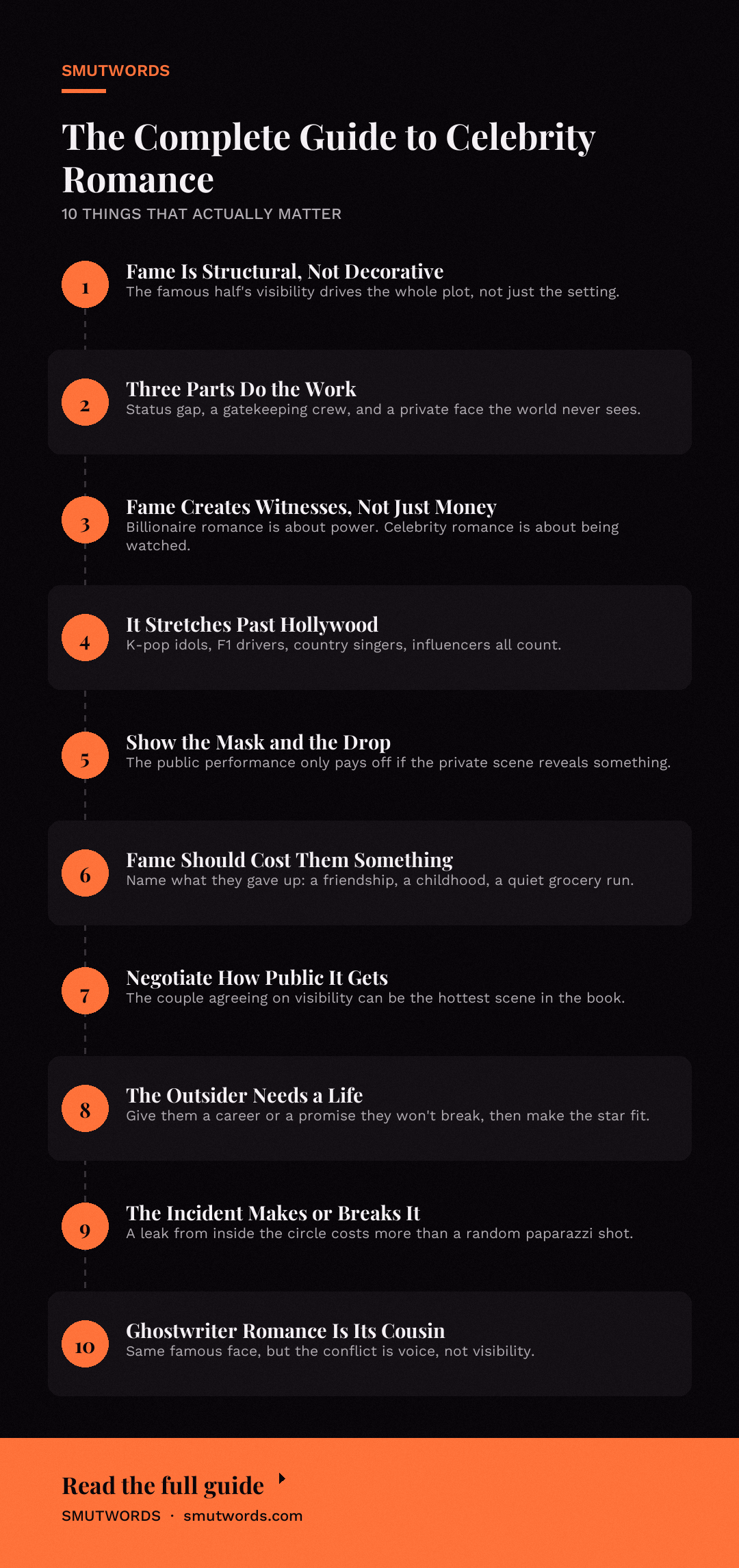
Three components do the real work. First, an asymmetry of status: one person has access, money, and visibility the other doesn't. Second, a gatekeeping apparatus: agents, managers, security teams, network contracts, royal protocol, all of whom have opinions about who gets to stand next to the famous one. Third, the private face: the version of the celebrity that only the love interest gets to see, usually messier, sadder, or softer than the polished one on the red carpet.
What does not count is useful to pin down. A story about two famous people who date casually is a romance, but it isn't usually shelved as celebrity romance unless one of them is positioned as the grounded outsider.
Nor is a story about a stalker who happens to be a fan, unless the fame itself is the engine of the relationship. Those books work differently and belong closer to stalker romance.
Nor is a billionaire romance automatically a celebrity romance, though the two overlap constantly. Money creates power imbalance. Fame creates witnesses.
Common misconceptions worth clearing up. Readers assume celebrity romance has to mean Hollywood, but the category stretches to K-pop idols, Formula One drivers, country singers, tech founders with a podcast, and TikTok stars.
Another assumption is that the famous character is always the man. Historically the trope leaned that way, and it still does in traditional publishing. Indie and queer romance have diversified the structure considerably, including plenty of books where the woman is the star and the man is the one who has to adjust.
Where Celebrity Romance Comes From
The trope's publishing history goes back further than most readers expect, but it is a history of genre economics more than a history of kink. The oldest recognizable ancestor is the fairy tale and the theatrical novel: the prince who marries the servant girl, the actress who catches the duke. Those stories establish the template of a public figure choosing an outsider, with the class gap standing in for the fame gap.
Modern celebrity romance as a category really arrived with the twentieth century and the birth of mass media. Studio-era Hollywood produced novels and films about stars and the people who loved them, and the gossip magazine gave readers a working knowledge of what fame cost.
By the 1950s and 1960s, the rock-and-roll novel was a recognizable thing: the band, the tour, the girl left behind in a hotel room. These books leaned on the same juicy contradiction readers still chase, that the most wanted person in the room can be the loneliest.
The paperback boom of the 1970s and 1980s pushed celebrity romance into the mass-market category romance, where it took two forms. The first was the jet-set glamour novel, all yachts and couture. The second was the humbler version, often called the star-and-the-nobody plot, where a small-town woman meets a famous man passing through and has to decide whether she can stand his world.
Both forms sold steadily for decades, and both seeded the specific beats that later writers still hit with their eyes closed.
The bigger shift came in the 2000s and 2010s, with three forces colliding. Online fandom made readers active participants in celebrity culture and gave them the vocabulary to read fiction about it. Indie publishing let writers push the sex, the mess, and the specific subcategories (rock star, athlete, royal) into dedicated series.
The royal romance exploded separately as its own shelf, thanks in part to real-world royal weddings that sent readers hunting; that subgenre now sits closely alongside celebrity romance and is often discussed as its cousin, which is why the prince/princess romance glossary entry is worth reading on its own.
Recently the category has absorbed social media fame as a legitimate form of celebrity. Influencer romance and content-creator romance treat followers as the new paparazzi and the ring light as the new red carpet. That's a real evolution in how the trope works: it turns fame from something inherited from a studio system into something built, managed, and monetizable by the character themselves.
How It Shows Up in Erotica
On the page, celebrity romance is a machine for generating scenes that everyday-girl romance can't produce. A private jet, a hotel suite the size of an apartment, a locked door that exists specifically to keep the public out. The heat comes from the contrast between the public persona and the private reality, and the best writers in the subgenre understand that the contrast is only satisfying if both versions get shown.
A strong celebrity romance usually alternates. The reader sees the celebrity performing at a press event or in front of the cameras, then sees them alone with the love interest: exhausted, sharp-tongued, or unexpectedly tender. The scene at the awards ceremony only earns its payoff if the scene in the bathroom afterward reveals something the ceremony hid.
Common variations authors run with include:
- Rock star romance: tour buses, green rooms, the afterparty, the specific exhaustion of being onstage every night. This variant leans hardest on sex, drugs, and the question of whether the star is going to self-destruct before the love interest can save them, or whether they even should.
- Movie star romance: on-set tension, co-stars, awards season politics, the fake-dating to real-dating arc. This variant also includes the very popular bodyguard subplot, where the person assigned to protect the star turns out to be the only person who sees them clearly.
- Athlete romance: a narrower world, with team schedules, injured careers, and a specific kind of physical confidence that writers love to exploit. Athlete romance usually runs shorter and more contemporary but hits many of the same beats.
- Royal romance: the closest cousin, and the one with the most public stakes. Unlike a movie star, a royal can't be quietly retired; the world, the family, and the country all want to weigh in. The prince/princess romance structure often borrows celebrity romance beats directly.
- Social media influencer romance: the newest variant. The fame is smaller, more intimate, and more aggressively monetized, and the conflict often runs through comment sections, brand deals, and the fear of being seen as a clout-chaser.
- Idol romance: popular in translated and indie books, with a specific tension around contract-driven image control, fan reaction, and the fear of scandal. The stakes are often more career-effective than emotional, which a good writer turns into heat.
What separates a strong version of this trope from a flat one is restraint on the fame. Weak celebrity romance treats fame as a set of props: the yacht, the sunglasses, the name-drops. Strong celebrity romance treats fame as an inward pressure, something that has cost the famous character something specific. The book is more interesting when it names what they gave up: a childhood, a friendship, a public relationship, the ability to walk into a grocery store unnoticed.
Enjoyed this? Get a free book.
Join the list and we will send a complete free story straight to your inbox, plus new releases every week after that. No credit card, no catch.
Another dividing line is consent and negotiation. The best books in this space show the couple actively agreeing on how much of their relationship is going to be public, and why. That conversation can be the sexiest scene in the book. When it's skipped, the writers tend to substitute jealousy and shouting, which wears thin fast.
If you want a companion read on how attraction is framed through power imbalance more generally, Opposites Attract 101 covers the psychological engine under a lot of this.
Two specific craft choices do a lot of work. First, the moment the celebrity drops the mask. Usually this is a sex scene, often the first one, where the polished voice gives way to something rawer. The best writers hold back a specific detail of the character's body or history and let the mask fall only when it matters.
Second, the incident: a photo, a leak, a tabloid story. The incident creates the third-act pressure, and its quality determines whether the book lands. A generic paparazzi photo feels cheap. A leaker inside the inner circle costs the character something specific.
Jealousy is a frequent tool in this subgenre, and it's worth reading up on how it's used deliberately rather than just as a plot device. The SmutWords piece on jealousy kink and non-monogamy speaks to the specific dynamic where a public-facing character's visibility creates possessive sparks, and how to keep those sparks ethically interesting.
The "he falls first" structure is also common here, more than readers realize. The celebrity is often the one who pursues, hard, while the ordinary half hesitates; that inversion of who has the upper hand is part of the appeal. If you like that pattern, the analysis in Why He Falls First Is the Secret Engine of Great Romance explains why it works.
One more craft note: the ordinary character has to want something besides the celebrity. Books that fail tend to make the outsider purely reactive, waiting to be chosen.
Books that succeed give the outsider a project, a career, a family, or a promise they're not willing to break for a partner, and then make the famous character work to fit into that life. This is where the deepest heat lives, because the reader gets to see the powerful person change their shape.
Celebrity Romance vs Ghostwriter Romance
These two get confused, and it's fair. Both involve a famous character, a less-known counterpart, and a lot of private time behind closed doors. The difference is what the story is about.
In celebrity romance, the fame is the visible problem. The conflict runs through public life: paparazzi, brand deals, tabloids, fan expectations.
In ghostwriter romance, the fame is background and the central problem is voice: who is allowed to speak for the famous person, who is telling their story, and what it costs to be the one holding the pen. The ghostwriter scenario usually involves a professional intimacy that turns personal, with the celebrity as subject and the ghostwriter as the one making them legible.
Many books blur the two, especially literary or memoir-adjacent romance, where a ghostwriter or biographer falls for a reclusive star. That variant hits both categories and is one of the more interesting hybrids available. If you like celebrity romance but want the quieter version, the ghostwriter shelf is a good place to look.
Frequently Asked Questions
What is celebrity romance as a book genre?
Celebrity romance is a romance subgenre in which one main character is a public figure (actor, musician, athlete, royal, influencer) and the other is usually not, and the relationship has to survive the pressure of public visibility. The fame is a structural engine for conflict, not just a decorative trait.
Does celebrity romance have to include paparazzi?
No. Paparazzi are the most familiar pressure device, but many books substitute fans, social media, contract clauses, or a controlling management team. The important element is that outside forces have a claim on the famous character's choices, including their love life.
Is royal romance the same as celebrity romance?
They're close cousins, but royal romance adds inherited duty, protocol, and national stakes that a movie star usually doesn't carry. Most readers treat them as separate shelves, though plenty of royal romances use identical beats: the outsider, the protective household staff, the public appearance that changes everything.
Why is celebrity romance so popular?
The wish-fulfillment is direct: being chosen by someone extraordinary while keeping your own life intact. The built-in conflict gives the story stakes without much setup, and the mask-drops beat delivers a specific emotional payoff, power fantasy plus intimacy, in a compact format.
What is an athlete romance?
Athlete romance is a specific variant of celebrity romance built around a sports star, usually with team dynamics, injury risk, and a shorter public career as built-in stakes. It sits comfortably under the celebrity umbrella even though the fame operates differently from a film or music career.
What's the difference between celebrity romance and influencer romance?
Influencer romance pushes the fame smaller and more intimate, with followers acting as the audience instead of paparazzi and brand deals standing in for studio contracts. The core trope is the same, but the tone is usually more contemporary and sometimes more comedic.
Final Thoughts
Celebrity romance has survived every decade since mass media invented the modern star, and its engine is the same thing it has always been: the fantasy of being chosen by someone the whole world wants, then discovering the version of them the whole world never gets. Read it for the red carpets if you like, but read it for the bathroom after the award show. That's where the good writing lives.
Pick up a rock star romance next. The tour bus, the afterparty, and the exhausted confession at 4 a.m. will show you everything this trope can do when a writer decides to use the fame as pressure instead of decoration.




Loading comments…