
Motorcycle club romance is a subgenre of contemporary romance in which the hero belongs to an outlaw motorcycle club, usually as president, enforcer, or sergeant-at-arms, and the heroine gets pulled into a world of patch law, club loyalty, and violence that does not negotiate. The motorcycles matter. The real engine is a closed brotherhood with its own rules, and a man inside it who decides the woman is his.
MC romance has grown from a niche corner of indie publishing into one of the most reliably bestselling tropes in the genre, with its own conventions, its own reader expectations, and its own particular craft problems.
What Motorcycle Club Romance Actually Means
The "MC" in MC romance stands for motorcycle club, and the term describes both the setting and the structure of the story. These are not weekend riders or hobbyists. The clubs in these books are outlaw organizations: they run legitimate fronts and illegitimate business, they answer to a national charter, and they enforce their own code.
That code is where the romance gets its tension. A club has a president, a vice president, a road captain, an enforcer, and a patch system that marks rank and status. Members wear a three-piece patch on the back of a cut (the sleeveless denim vest), and the patches mean something to the men wearing them.
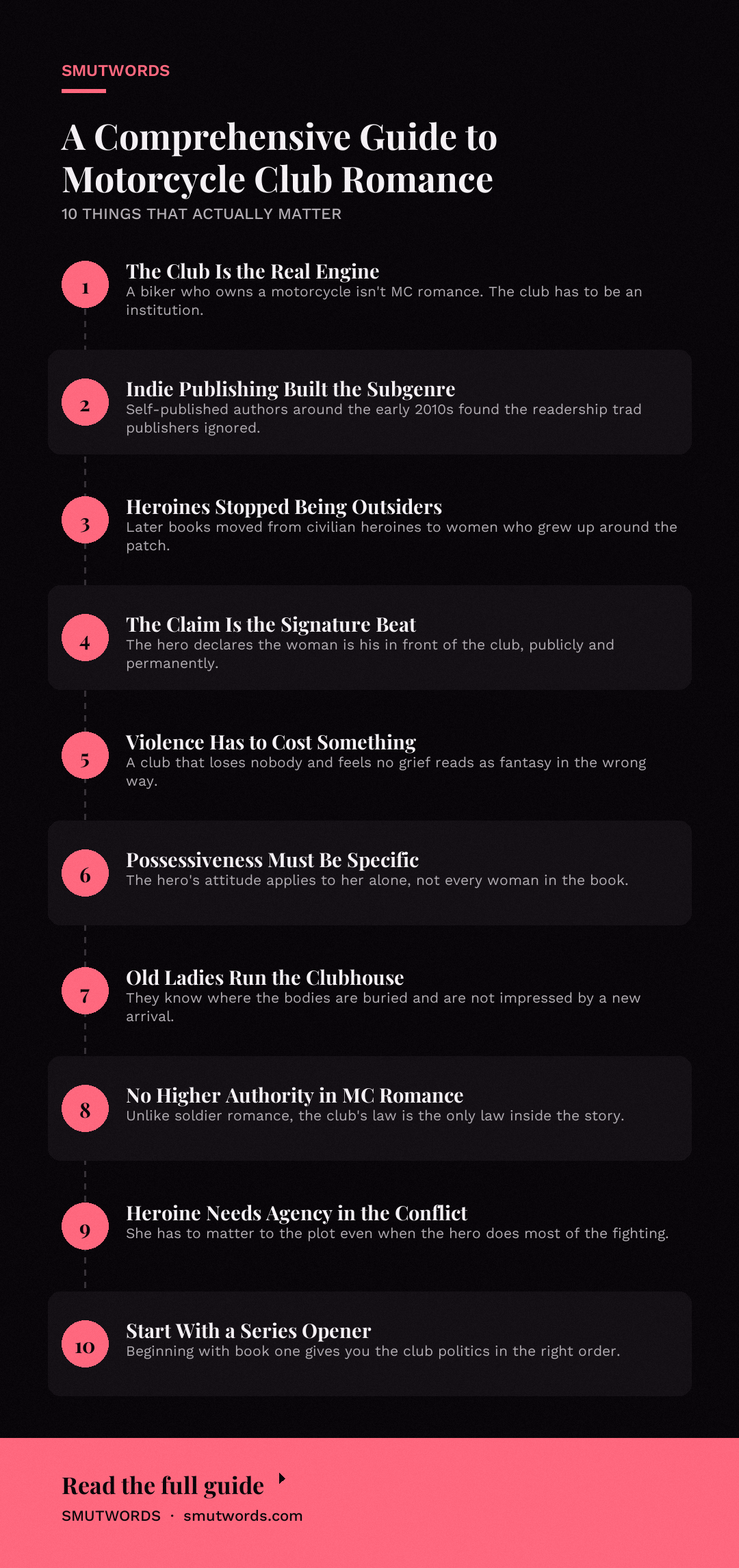
What counts as motorcycle club romance is narrower than "any book with a biker in it." A romance about a man who owns a motorcycle and falls for a schoolteacher is not MC romance, even if he wears leather. The club has to be an institution in the book, with members, hierarchy, and consequences for breaking ranks.
Several misconceptions follow the term around. One is that these books are pure grit with no emotional interiority. Plenty of them are as tender as any small-town romance once you get past the opening chapters.
Another is that the heroine is always a passive prize. The strongest entries in the subgenre give her her own agenda, her own skills, and a reason to stay that has nothing to do with being rescued.
Readers also confuse the mainstream biker romance with the darker club-girl variant. The two are related but distinct. A club girl (sometimes called an old lady in training, sometimes a sweet butt, depending on the book) is a woman attached to the club as a whole rather than to one man.
Some authors write her story. Most write the story of the woman who becomes one man's old lady, which is the specific claim-and-keep dynamic the subgenre runs on.
Where Motorcycle Club Romance Comes From
Outlaw bikers have been a fixture of American popular culture since the 1950s, when motorcycle clubs became a tabloid subject and a handful of exploitation films turned the image into a commodity. That cultural shorthand (the leather, the patch, the brotherhood, the violence) was already fully formed before anyone wrote a romance novel around it.
The romance subgenre itself is much younger. It built slowly through the 1990s and 2000s on the back of the broader outlaw-hero trend in romance: the mafia romance, the cartel romance, the street romance. Publishers were wary of MC books for a long time. The clubs are criminal organizations in most of these stories, the heroes are not reformed, and the moral center of the book sits somewhere other than the law.
Indie publishing is what made the subgenre. Around the early 2010s, self-published authors found a hungry readership that traditional publishers had been ignoring, and series built around a single club (each book following a different member) became the standard structure. The format rewarded binge reading. The readership rewarded authors who built out a whole charter of brothers.
The portrayal has shifted in a recognizable direction over the years. Early MC romance leaned hard on the danger and the outsider-heroine angle, with the woman as a civilian who stumbles into club business. Later books moved toward heroines who belong to the club world already: daughters of members, club attorneys, women who grew up around the patch.
The possessiveness has intensified as the subgenre matured, and so has the on-page heat. The "claiming" scene, where a member publicly declares a woman is under his protection and his alone, has become one of the genre's signature beats. So has the epilogue where she's wearing his last name and a property patch.
How It Shows Up in Erotica
Craft-wise, MC romance runs on a specific set of scenes, and a good author knows which ones the reader came for and how to make them land. The strongest books deliver the expected beats while making each one feel earned by the characters rather than checked off a list.
The first is the introduction to the club. The heroine walks into the clubhouse, the readers meet the brothers, and the author establishes hierarchy through action rather than exposition. Who sits where, who speaks first, who gets quiet when the president walks in.
This scene does the worldbuilding work. A flat version reads like a tour guide.
The second is the claim. A member decides the woman is his, and he says so in front of the club. The heat in this scene comes from the public nature of it: everyone watching, everyone understanding what it means, and the heroine having to decide whether she accepts the protection and the possession that come with it.
The third is the violence. Somebody threatens the club, the woman, or both, and the men handle it. The book has to decide how much of that violence happens on the page. Too much and the romance gets buried; too little and the stakes feel theoretical.
The fourth is the domestic aftermath. The clubhouse kitchen, the old ladies, the woman learning the rhythms of a world that was built before she arrived. These scenes are where the subgenre earns its emotional weight, and they're the ones readers quote back at authors.
Common variations on the formula:
Enjoyed this? Get a free book.
Join the list and we will send a complete free story straight to your inbox, plus new releases every week after that. No credit card, no catch.
- Civilian heroine. She's outside the club world when the book opens, often with a profession that puts her in contact with club business: nurse, attorney, social worker, journalist.
- Club-adjacent heroine. She grew up around motorcycles, or her father was a member, or she's a member's sister. The conflict comes from the club's rules about who is and isn't available.
- Enemy club heroine. She belongs to a rival charter or a rival organization, and the romance is a slow defection.
- Second-chance club romance. The hero and heroine have history, often a relationship that ended badly before he was patched in, and the book works through the reconciliation.
- Single-parent club romance. The heroine arrives with a child, and the hero has to prove he's safe around a kid before he's allowed to prove anything else.
- Reverse-claim club romance. Less common, but gaining ground: the heroine is the one with power in the club world, and the hero has to earn his place beside her.
What separates a strong MC romance from a flat one comes down to a few craft decisions. The club has to feel like an actual organization with history and internal politics, not a backdrop of leather and chrome. The hero's possessiveness has to be specific to the heroine, not a generic attitude he applies to every woman in the book.
The heroine has to have agency in the plot's central conflict, even if the hero does most of the fighting. And the violence has to cost something. A club that loses nobody and feels no grief reads as fantasy in the wrong way, and readers notice.
The heat level varies enormously across the subgenre, from slow-burn books with a couple of explicit scenes to full-on erotic romance where the claiming is the whole point. If you're new to the darker end of the possession dynamic, the same communication principles that make any power-exchange relationship work on the page apply here; there's a solid primer in how to start a D/s relationship that maps cleanly onto what a well-written claim scene is actually doing.
Readers who love the closed-brotherhood intensity of MC romance often come to it from other high-stakes hero tropes. The soldier romance shares the unit-as-family structure and the "he would die for his people, and now for her" emotional logic. The childhood friends to lovers backstory shows up often in second-chance club books, where the hero's patch came between him and the girl he grew up with.
What MC romance shares with mafia and cartel romance is the family-as-institution setup, and what it shares with small-town romance is the tight-knit community where everyone knows everyone's business. The motorcycle and the patch are the flavor. The community is the substance.
The old ladies (the wives and long-term partners of patched members) function as a kind of chorus in these books, and the strongest authors use them to give the heroine a peer group with its own hierarchy. The women who have been in the club for twenty years are not decorative. They run the clubhouse, they know where the bodies are buried, and they are not impressed by a new arrival.
Motorcycle Club Romance vs Soldier Romance
The comparison that actually confuses readers is soldier romance, and for good reason: both subgenres depend on a band of brothers with a code, a hierarchy, and a willingness to use violence in defense of their own. The difference is where the authority comes from.
A soldier romance hero answers to a chain of command that sits outside the story: the military, the government, the institution that trained him. His loyalty runs upward and outward. An MC romance hero answers to a club that is his own, run by men he rides beside, and the club's law is the only law that matters inside the story. There is no higher authority to appeal to.
That distinction changes what the romance has to solve. In a soldier romance, the conflict often involves the institution: deployment, orders, the military's claim on the hero versus the heroine's claim on him. In an MC romance, the conflict is usually internal: a rival charter, a betrayal within the club, a member who breaks the code.
The other comparison worth naming is lumberjack romance, which shares the rugged-outdoorsman appeal and the close-knit small-town setting but has none of the outlaw structure. A lumberjack hero is gruff and solitary. An MC hero is gruff and embedded, and the difference in his social world shapes everything about how the romance can proceed.
One more overlap worth noting: the old lady dynamic often runs into a marriage in trouble plotline in second-chance club books, where the hero and heroine are already married when the main story opens, and the conflict is whether the marriage survives the club. That's a different engine from the standard claim-and-court structure, and readers who want a heavier emotional register in their MC books tend to seek it out.
Frequently Asked Questions
What is motorcycle club romance?
It's a romance subgenre where the hero belongs to an outlaw motorcycle club and the heroine becomes entangled with him and the club's world. The books usually follow a specific club, with each installment pairing a different member with his heroine. The romance runs against a backdrop of club politics, rival charters, and the code that governs the members.
Is MC romance the same as biker romance?
Biker romance is the broader term and covers any romance with a motorcyclist hero, including hobbyists and weekend riders. MC romance specifically means the hero is a patched member of an outlaw club, and the club is an institution in the story. If the book has a patch system, a president, and a charter, it's MC romance.
Do I need to read MC romance series in order?
Most are written to be read in order within a series, because the club's ongoing conflicts and the fates of earlier couples carry through. Individual books often work as standalones, but starting with book one gives you the club politics in the right order. Series are frequently built so each book follows a different brother while advancing a larger club storyline.
Why is the "claiming" scene so important in motorcycle club romance?
It's the genre's signature beat because it makes the hero's possessiveness public. In one gesture, the club learns the heroine is under his protection, the reader gets the commitment her character has been waiting for, and the plot usually escalates because somebody feels threatened by the claim. The scene works when it's earned by the characters and flat when it's inserted to hit a quota.
Are motorcycle club romances dark romance?
Some are, some aren't. The subgenre runs the full heat and darkness spectrum, from lighter books where the club functions as a protective family to darker entries with on-page violence and morally gray heroes. Check the content warnings if you have specific lines you don't cross, because they vary a lot from author to author.
What is an "old lady" in MC romance?
An old lady is a patched member's long-term partner or wife, and the role carries status in the club world. She sits at the table, she's under the club's protection, and she's part of the clubhouse social structure. The transformation of a heroine from outsider to old lady is one of the genre's core arcs.
Final Thoughts
Motorcycle club romance rewards readers who want the thrill of a closed, dangerous world and the deep satisfaction of watching a hard man commit completely to one woman. If you're new to the subgenre, start with a book that introduces the whole club in its opening chapters rather than dropping you into the middle of one brother's story.
Pay attention to how the author handles the first claim scene. That's where the book's actual voice lives. Pick up a series opener from one of the ranked titles below and read the first fifty pages before you decide.





Loading comments…