
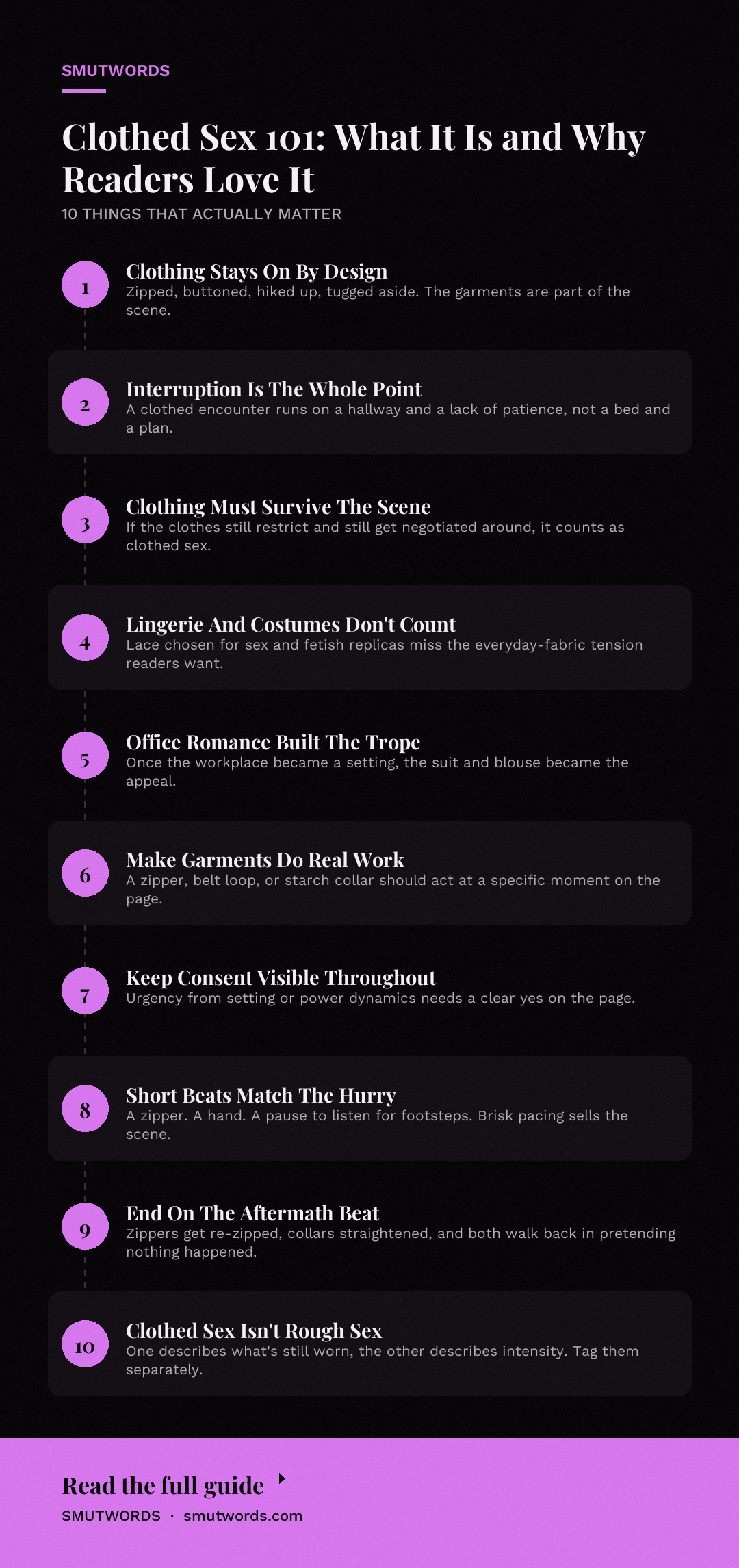
Clothed sex is sex where the clothes stay on, or mostly on: zipped, buttoned, hiked up, tugged aside, opened just far enough to make room. Nobody strips. Nobody folds anything neatly over a chair. The garments are part of the scene, and the friction, the fabric, and the hurry are the whole point.
You'll find it tagged as fully clothed sex, half-undressed, clothing pulled aside, or a quickie in clothes. It turns up everywhere from elevator encounters to ballroom stalls to the back seat of a car with the engine still running.
What makes it distinctive as a trope is the interruption it implies. A planned encounter involves a bed and a decision. A clothed encounter involves a hallway and a lack of patience. In romance and erotica, that distinction does most of the emotional work, and it's why the tag keeps showing up in books where the characters are supposedly too professional, too married, too busy, or too publicly visible to be doing any of this at all.
What Clothed Sex Actually Means
The plain definition covers any sexual contact where at least one partner keeps most of their clothing on. The range is wide. At one end you have a completely dressed quickie against a locked office door, every button still fastened. At the other you have formalwear sex where a gown is bunched at the waist and a tuxedo shirt is open two buttons, which counts as clothed even though a fair amount of skin is showing.
Where the label gets fuzzy is the middle ground. A shirt unbuttoned to the navel and nothing else removed reads as clothed sex to most readers. Trousers around the ankles with the shirt still on usually reads as half-undressed, and some readers file it as a separate tag.
The line isn't anatomical. It's about which garments survive the encounter. If the clothing is still a presence in the scene, still restricting, still being negotiated around, the scene belongs here.
Three things commonly get miscategorized as clothed sex when they aren't quite:
- Lingerie scenes. A full set of matching lace is technically clothing, but it's clothing chosen for sex and removed for sex. The tension of everyday fabric surviving a stolen moment isn't there.
- Costume and roleplay outfits. A nurse's uniform worn as a costume is a different animal from a nurse's uniform worn because someone is actually on shift. The illicit charge comes from the real-world garment, not a fetish replica.
- Public sex with full nudity. Getting naked in a parked car is exhibitionism with a logistical headache. Clothed sex in a parked car is a different pleasure entirely, and the distinction matters to readers searching for it.
The name itself is descriptive rather than historical. Unlike Primal Play or Shibari, clothed sex doesn't carry a named tradition or a formal protocol. It's a reader tag, a search term, and a scene type, which tells you something about how it functions in the genre: it's a mood and a mechanism, not a discipline.
Where Clothed Sex Comes From
Strip the term down and the practice is older than any publishing category. People have been having sex without undressing for as long as clothing has existed, for reasons of cold, privacy, time, and risk. The trope version has a shorter and more traceable history, and it tracks the genre's relationship with urgency.
In twentieth-century category romance, the clothing stayed on because the books demanded it. Editorial standards meant the scene often stopped at the threshold, and authors learned to write around the constraint with a coat half off and a hand at a waistband.
That habit of implying without undoing never fully left the genre. When explicit sex became mainstream in romance publishing from the late nineties onward, writers brought the half-dressed vocabulary with them and started using it deliberately rather than as a workaround.
The bigger shift happened with the rise of workplace and contemporary romance as commercial categories in their own right. Once the office became a setting rather than a backdrop, the office became a location, and the location came with clothes.
The forbidden boss romance is the clearest example: the entire premise is a woman in professional attire and a man in a suit, and the power imbalance is partly a wardrobe imbalance. The genre noticed that a blouse is more erotic when it's the blouse the character wore to a meeting ninety minutes earlier.
Uniforms followed. Historical romance had done a version of this for decades with military redcoats and riding habits, but contemporary settings expanded the roster: scrubs, flight attendant uniforms, police dress blues, chef's whites. The food-and-romance tradition gave the genre a whole class of scenes where an apron and a hairnet stay on because there's a commercial kitchen twenty feet outside the walk-in freezer.
Formalwear has its own lineage, mostly tied to wedding season. The groomsman-and-bridesmaid hookup is a genre staple because the clothing is expensive, borrowed, and almost impossible to remove. A tuxedo shirt with the studs undone is a very specific erotics, and erotic romance has spent thirty years learning to exploit it.
The last decade has split the tag into more granular variants, which is usually the sign that a trope has a real readership. Book retail search data made it obvious that readers wanted "fully clothed office" and "formalwear quickie" as separate things. Authors and publishers now tag accordingly, and the category has gotten sharper as a result.
How It Shows Up in Erotica
The craft question with clothed sex is: what does the clothing do on the page? A strong scene makes the garments active participants, with everything from a zipper to a belt loop to a starched collar doing specific work at specific moments. A flat scene treats clothes as something happening in the general vicinity of the sex.
Consider the difference. In a flat version, she's still in her dress. In the strong one, the silk creases across the back where he grabs. He has to figure out how a wrap dress ties, and the tie comes loose, and that's the access point, and three paragraphs later it's still tied.
The reader feels the fabric. The reader feels the hurry. The scene has texture.
Writers working this material tend to reach for one of several variations:
- Workplace clothed sex. Suits, pencil skirts, hosiery, everything opened just enough. Common in corporate settings, and often paired with workplace rivals who finally stop arguing.
- Formalwear sex. Weddings, galas, awards dinners. The clothing is expensive and socially loaded, and the scene usually takes place within earshot of two hundred important guests.
- Uniform sex. Military, medical, service industry, first responders. The uniform does symbolic labor: it means someone is on duty, and on-duty people should be doing other things.
- Quickie in clothes. The purest version. No setting dressing, no power dynamics; just two people with a shared problem and a locked room, four minutes, and a coat still on.
- Half-undressed. The bridge variant. Shirt pushed up, bra pulled down, pants at mid-thigh. Isolates the garments that matter and discards the rest.
- Partially clothed in public. A bar bathroom, a coat check alcove, a parking garage. Often overlaps with the forbidden stepbrother or sibling-adjacent forbidden-romance formulas where proximity is baked into the setting and privacy is impossible.
What elevates a clothed sex scene above the tag is granular attention to logistics. The author has to solve a real problem: how do these two people actually manage this, given what they're wearing? A surprise-backless-dress solution is more satisfying than a dress that somehow loses a back. A three-piece suit with a waistcoat underneath is an actual puzzle, and watching a character solve it is part of the entertainment.
Enjoyed this? Get a free book.
Join the list and we will send a complete free story straight to your inbox, plus new releases every week after that. No credit card, no catch.
Specificity in the wardrobe helps. "A skirt" is generic; a structured wool skirt with a hidden zip is a scene. "A dress shirt" is generic; a dress shirt with a collar that will leave a mark if it isn't loosened in time is a scene. The sturdier the garment, the more it can be ruined, and the threat of ruin is half the engine.
Pacing matters more here than in most sex scenes. The clothing creates friction, literal and narrative. A clothed scene that runs at the same tempo as an undressed one reads as though the author forgot what everyone was wearing.
The scene usually wants short beats. A zipper. A hand. A pause where someone listens for footsteps. The hurry is the subject.
Consent in these scenes has to stay visible. When the urgency comes from a setting or a power dynamic, an author should show clear agreement: a line of dialogue, an unmistakable yes, a character explicitly slowing down to check in. This matters most when a supervisor, a person on duty, or a partner in a formal power relationship is involved, where assumed consent is a risky place to leave the reader.
Practical negotiation matters too. Talking about what can be moved, unbuttoned, or pulled aside before the scene kicks off makes the choreography legible. The guides on starting a D/s relationship cover the same principle, and it applies even in a three-minute closet scene.
The best versions also keep the aftermath in frame. Zippers get re-zipped. Collars get straightened. A lipstick smudge gets wiped off with a thumb, and both characters walk back into the room pretending the last ten minutes didn't happen.
That return-to-life beat is where the trope pays its emotional debt. Without it, the scene is just an encounter. With it, the scene reaches forward and casts a shadow over everything that follows.
Clothed Sex vs Rough Sex
These two get conflated because a lot of clothed sex scenes are also rough sex scenes: fast, breathless, pressed against a wall. But they're separate axes. A scene can be clothed and tender, or naked and brutal, and the overlap isn't required.
Rough Sex describes intensity, force, and physical aggression. Clothed sex describes what's still on the body.
The distinction matters when you're searching for what you actually want. If you want the fabric and the hurry, the tag to look for is clothed sex. If you want force, hair-pulling, and a wall, you want rough sex, and the clothing is a bonus rather than the appeal.
Where they combine, they combine well. A uniform-rough-sex scene is one of the most reliable formulas in the genre. But keep them mentally separate when searching, and authors should keep them separate when tagging.
Frequently Asked Questions
What is clothed sex?
Sex where one or both partners stay partially or fully dressed, with clothing moved aside, opened, or bunched rather than removed. It appears as a reader tag on romance and erotica titles where the scene is improvised, urgent, or takes place somewhere undressing isn't feasible.
Is clothed sex a kink?
It functions as one for many readers and writers, and it's categorized under kink tags on most romance platforms. The appeal is texture, urgency, and the risk of a public or semi-public setting. Some readers treat it as a staple of contemporary romance rather than a kink, and both readings are fair.
Why do readers like fully clothed sex scenes?
The clothing keeps the everyday world intact, so the encounter reads as an interruption rather than an event. That tension is strongest with formalwear, uniforms, and office clothes, where the garment signals a role and the sex violates it.
Does clothed sex work in public places?
In fiction, yes, and it's one of the most common settings for the trope. In real life, public sex carries legal risk, and consent has to be explicit and ongoing for everyone involved. The genre convention is that both partners are fully agreed on the location before anything happens.
What's the difference between clothed sex and a quickie?
A quickie is about duration. Clothed sex is about what's worn. Many quickies are clothed and many clothed scenes are not quick, though the two tend to overlap because removing everything is time-consuming. Stories tagged both usually feature a short, urgent encounter with garments mostly intact.
How do you write clothed sex well?
Give the clothing specific jobs. A belt, a zip, a collar, or a tie should do something at a specific moment, and the scene should spend real attention on the small decisions involved in getting around all that fabric. Keep the pace brisk. Return the characters to the room for an aftermath beat where they fix their clothes.
Final Thoughts
Clothed sex is one of the most reliable tension machines the genre has, because it refuses to let the scene be separate from the rest of the characters' lives. The buttoned shirt in the morning and the crooked collar after lunch are the same garment, and the reader feels the connection.
For a book that runs this trope with total commitment to the wardrobe and the setting, start with a workplace romance where the boss is in a suit and the heroine is in a dress she'll be seen in again in forty minutes. The harem romance shelf has a few versions of this, and the why choose romance corner of the catalog has a handful more.
If you like your clothed scenes with a side of public risk, the voyeur husband trope pairs naturally with the tag. Pick the one with a cover that shows a suit. That's the reliable indicator.







Loading comments…