
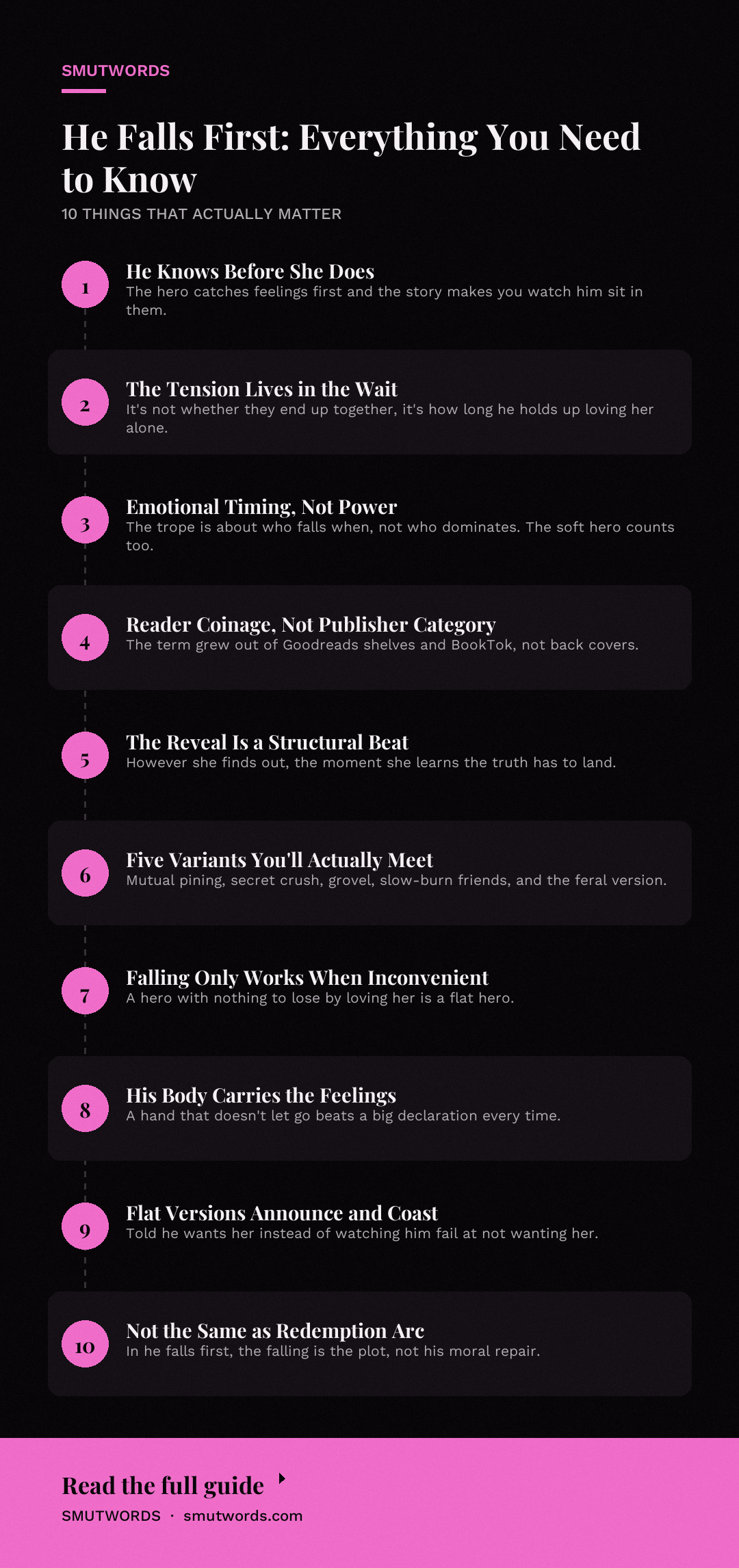
He falls first is the romance trope where the male lead catches feelings before the heroine does, and the story makes you watch him sit in them. He knows. She doesn't. Or she does and doesn't believe it, or doesn't want it, or is too busy surviving her own plot to notice the man quietly rearranging his entire life around her schedule.
The tension isn't whether they'll end up together, it's how long he can hold the weight of loving her alone before something gives. And it's one of the most reliably popular configurations in modern romance publishing, the default engine of a huge share of contemporary releases. If you've picked up a book in the last five years and the blurb mentions a brooding man, a stubborn woman, and a slow unraveling, there's a strong chance you're holding a he-falls-first story.
What He Falls First Actually Means
The term names the emotional asymmetry at the center of the plot. The hero's arc runs from resistant, oblivious, or playfully detached to fully, sometimes desperately invested, and the reader gets a front-row seat to that conversion. The heroine's arc is usually slower: she has to catch up, trust him, or get out of her own way.
The name itself is a reader coinage, not a publishing-industry category with an official registry. It grew out of the online romance community's habit of tagging books by the emotional mechanics rather than the setting. You'll see it in Goodreads shelves, BookTok captions, and fan rec lists long before you'll see it on a back cover, which is exactly how most trope vocabulary works now.
What counts as he falls first
- The hero's romantic interest is established before the heroine's, and the narrative makes that gap visible to the reader.
- He does something about it, or visibly suffers from not doing something about it. Pining, pursuit, waiting, jealousy, and self-denial all count.
- The reveal matters. Whether she finds out through a confession, a slip, a third party, or his own cracked composure, the moment she learns the truth is a structural beat.
- The imbalance resolves. By the end, she has fallen too, and the falling is shown, not just announced.
What doesn't count
A book where both leads are equally smitten from chapter one is mutual attraction, not this trope. A book where he's simply the more emotionally open partner in an otherwise even dynamic is a different flavor of story. And a book where he pursues her without ever being emotionally invested (pure chase, no interiority) doesn't qualify either. The pining has to cost him something.
The most common misconception is that he falls first means he's the aggressor or the dominant party. It frequently overlaps with that, but the trope is about emotional timing, not power exchange. A gentle, soft-spoken hero who realizes he's in love by page forty and spends three hundred pages patiently waiting is squarely in this category.
Where He Falls First Comes From
The honest answer: this is a genre phenomenon more than a historical one. The emotional configuration is ancient. Darcy's first proposal to Elizabeth is a he-falls-first scene by any reasonable definition, and plenty of nineteenth-century novels run on a proud man undone by a woman who won't have him yet. But the trope as a named, tagged, reader-circulated category is a product of the last few decades of romance publishing.
Category romance in the 1980s and 1990s ran heavily on the alpha hero who resisted love until the final act. The emotional reveal was his. He was the one who had to be brought to his knees, and the heroine's job was to crack him open. That's adjacent to he falls first, but the sequencing was different: the reader often got his attraction early and his love late, with the heroine's feelings reliably present throughout.
The shift toward what readers now call he falls first accelerated in the 2010s as contemporary romance, new adult, and indie publishing started rewarding interiority in male leads. First-person dual POV became standard, and putting the hero's voice on the page meant his feelings had to be legible to the reader from the start, even while the heroine remained in the dark. Wattpad, fanfiction, and self-publishing fed the vocabulary, and BookTok industrialized it.
The other thing that changed was the trope's shelf life. What used to be a slow burn across an entire book now frequently gets compressed into a first act, with the rest of the novel devoted to what happens after she catches up. That structural move is recent, and it's reshaped what readers expect from the tag.
How It Shows Up in Erotica
On the page, he falls first is a machine for producing a specific kind of tension: the reader knows something the heroine doesn't, and every scene between them hums with that asymmetry. The craft question isn't whether he loves her. It's how long the writer can make the reader wait before the dam breaks, and what they build in the meantime.
Strong versions of this trope do three things well. They show the falling in action rather than announcing it. They give the hero interiority that isn't just a mood. And they make the heroine's eventual realization feel earned rather than convenient.
The variants you'll actually encounter
- Mutual pining, one-sided start. Both leads are into each other, but he knows first and she's convinced it's hopeless or invisible. The drama lives in the near-misses and the moment she realizes he's been gone for her this whole time.
- Secret crush revealed. He's been wanting her for years and she had no idea. The reveal is the emotional climax, and it often comes via a confession, a caught glance, or a slip of the tongue. Works best when there's a small, specific piece of evidence he kept.
- Grovel after he falls. He falls, he messes up, and the back half of the book is him making it right. The falling is the setup and the apology is the engine. The hero has to actually change, not just say the right thing.
- Slow-burn friends to lovers with him falling first. He's been in love with his best friend for years and she's been treating him like furniture. The pining lives in the small domestic details: the way he remembers how she takes her coffee, the way he's always there first.
- He falls before he even knows her name. Common in stalker romance and the darker end of the genre, where obsession arrives before courtship. The trope goes feral. Handle with the usual genre cautions.
What makes the strong versions work
The best he-falls-first heroes have a specific reason to be bad at wanting her. Maybe he's her boss and knows it's a terrible idea, which is the whole engine of a forbidden boss romance. Maybe he's a rival who's been fighting her professionally for years and can't figure out when the fighting stopped being the point, which is the territory covered in the workplace rivals piece.
The falling is only interesting when it's inconvenient. A hero who has nothing to lose by loving her is a flat hero. A hero who would lose his job, his family's respect, his friendship, or his own self-image if he's wrong is a hero worth reading about.
Physicality does a lot of work in this trope. The hero's body is where the reader reads his feelings: a hand that doesn't quite let go, a gaze held too long, a jaw that tightens when she mentions another man. Small, specific, repeated gestures beat big declarations, and the best writers plant them early so the payoff lands.
Dual POV is the trope's natural habitat. It lets the writer give the reader direct access to his interior while preserving the heroine's ignorance. Single-POV he-falls-first is harder, and it's a pleasure to find because it forces the writer to convey his feelings entirely through observable behavior. That constraint is where a lot of the best writing in the genre happens.
The flat versions (and how to tell)
A weak he-falls-first novel announces the falling in one paragraph and then coasts. He's in love because the author decided he was, and the rest of the book is a sentence repeated in different outfits. The reader gets told he wants her instead of watching him fail at not wanting her.
The other common flat version is the hero who falls so fast and so easily that there's no tension left in the wait. If he's fully committed and secure by chapter three and she just hasn't noticed yet, you need something else to pull the plot forward, usually a plot. Otherwise the middle sags.
Enjoyed this? Get a free book.
Join the list and we will send a complete free story straight to your inbox, plus new releases every week after that. No credit card, no catch.
The best versions let him be a little wrong about her, or about himself, or about what love is going to cost. He's heartsick, sure. He's also learning.
He Falls First vs Redemption Arc Romance
The closest genuine point of confusion is between he-falls-first and redemption arc romance, because the grovel variant sits right at the overlap. The distinction is about what the story is actually about. In a redemption arc romance, the hero's moral repair is the central plot: he did something wrong, and the book is about whether and how he earns his way back.
In he falls first, the falling is the plot. If he needs to be redeemed, that's usually in service of the falling rather than the other way around. A redemption arc can exist without him falling first, and he-falls-first can happen with a hero who has nothing to redeem except his own pride.
That's the edge case worth knowing. If a reader asks for "a grovel book where he falls first," they're usually asking for a redemption arc with this emotional shape layered on top, and that's a different rec than a plain he-falls-first contemporary.
Frequently Asked Questions
What does he falls first mean in romance books?
He falls first is a romance trope where the male lead develops romantic feelings for the heroine before she develops them for him. The story makes the reader watch him pine, pursue, or wait while she catches up, and the tension comes from his vulnerability and the eventual reveal.
Why is he falls first so popular?
It's a fantasy about being wanted more than the other person wants, and about a man who's chosen to be emotionally invested without any guarantee it'll be returned. It also reverses the old alpha-hero dynamic, putting the most powerful character in the book in the most emotionally exposed position. Readers get a front seat to the unraveling.
Is he falls first the same as mutual pining?
Not quite. Mutual pining means both leads secretly want each other and neither is saying it. He falls first is a wider category that can include mutual pining as one variant, but it also covers stories where she genuinely isn't interested yet and has to be won over.
Does he falls first always mean dual POV?
No, but dual POV is the most common way to write it. A skilled single-POV version can land hard by keeping his feelings entirely in subtext for the reader to read through her eyes. It's rarer, and when it's done well it's often the better book.
Can he falls first work in dark romance?
Yes, and it's common in monster breeding romance and darker subgenres where attraction arrives early in a way the heroine doesn't trust yet. The trope sharpens when his obsession precedes his understanding of his own feelings, which is why it pairs so well with dark dynamics.
What's the difference between he falls first and insta-love?
Insta-love usually applies to both leads at once, and it resolves the tension immediately. He falls first keeps the falling one-sided for most of the book, which is where the tension lives. The point of the trope is the wait.
What if she never falls?
That's a different book. In romance-genre terms, he-falls-first requires a resolution where both leads are in love by the ending. Dramas and litfic can run on one-sided longing. Romance can't, and that's worth being clear about when a reader's sampling outside the genre.
Final Thoughts
The trap most readers worry about with he falls first is repetition. The way out is specificity. A hero who falls first should have a reason to be bad at showing it, and a heroine who takes a while to come around should have a reason she couldn't see him.
When those two reasons are specific enough, the trope reads fresh even after you've read fifty of them, which is a number most readers of this genre have passed without noticing.
The trope also overlaps productively with setups that add real friction to the falling: forbidden dynamics, social class gaps, professional rivalry, stubborn history. If you like he falls first layered on top of another engine, the forbidden stepbrother and forbidden boss shapes are the most reliably loaded versions going right now.
If you're curious how the same emotional rhythm plays out when the couple is trying to build something formal instead of drift into it, the D/s relationship guide is a useful companion read. The power exchange is different, but the pining is the same.
Start with a book where the hero's fall is inconvenient, specific, and visible in his hands. The ranked list below this article does the hard part for you.







Loading comments…