
Puppy play is a form of power exchange where one partner takes on the persona of a dog: playful, needy, loyal, sometimes dumb and eager to please. The other partner acts as handler or owner, giving commands, rewards, and affection. The puppy might wear a collar, a hood or mask, mitts, a tail, or knee pads. They might bark, fetch, sit, and roll over.
What makes it puppy play rather than a costume party is the headspace: the deliberate slide into a simpler self that wants approval more than it wants to think. It is one of the most affectionate corners of kink writing, and also one of the most misunderstood.
If you have landed here from a scene in a book where someone clipped a leash onto a collar and called their partner good boy, and you want to know what that actually means on and off the page, this guide covers it in full: the definition, the history, the craft of writing it well, the variants, and the real-world safety basics that good fiction tends to gloss over.
What Puppy Play Actually Means
The name tells you most of what you need. Puppy play is pet play with a dog as the animal. Pet play is the broader category: one person takes on an animal persona while another takes on a caretaking or ownership role. Kitten play, pony play, and other animal variants sit alongside it under the same umbrella.
What counts as puppy play is surprisingly flexible. The essentials are a human-animal roleplay, a handler or owner dynamic, and a shared agreement about what the puppy is allowed to do and be. The puppy might be verbal or non-verbal, trained or feral, bratty or perfectly obedient, sexual or entirely non-sexual.
A scene where someone curls up at their partner's feet and gets their hair scratched for an hour is puppy play. So is a full scene with commands, a leash, and a reward system.
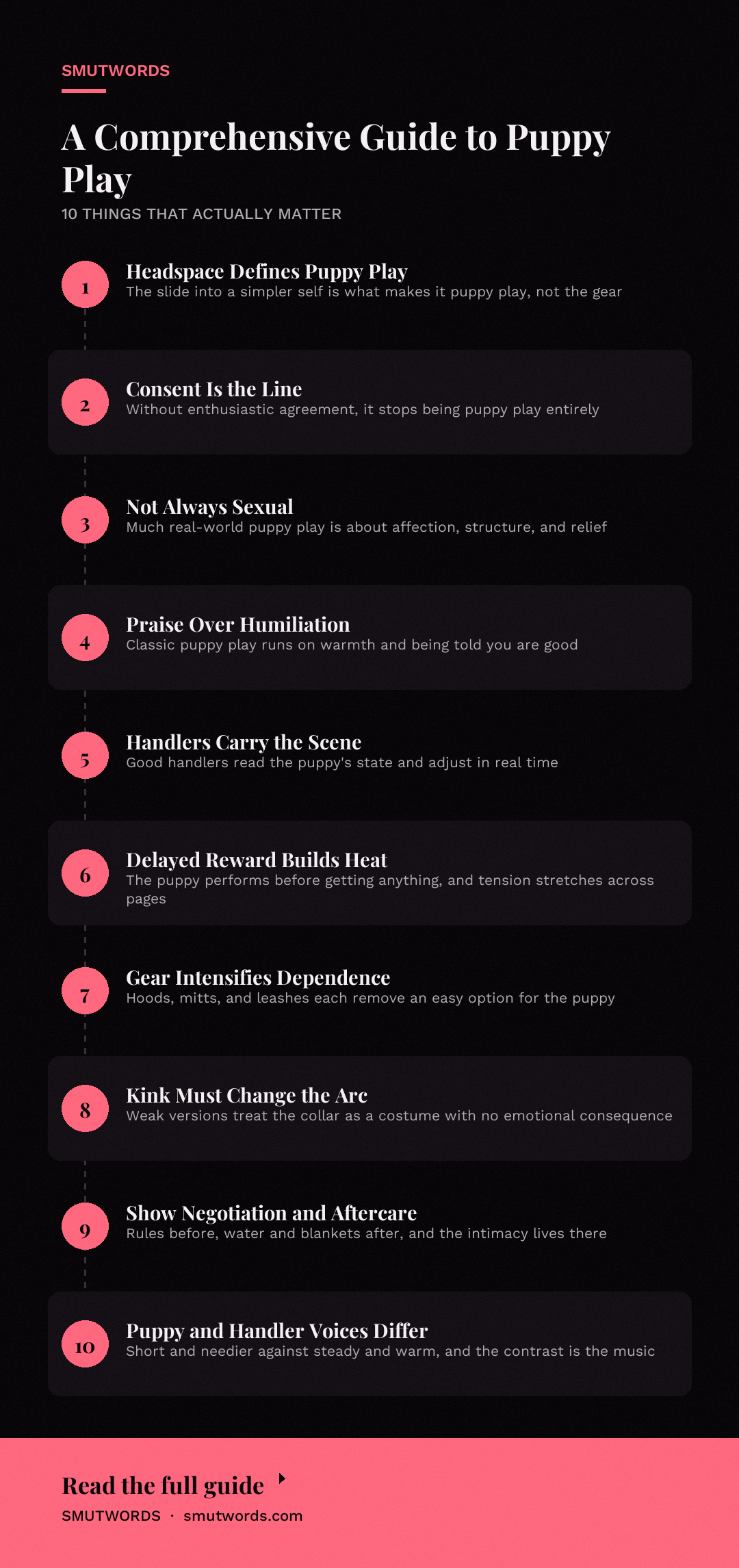
What does not count is anything the participants have not agreed to. Puppy play is a consensual power exchange, and the handler role is a responsibility, not a license. The moment a scene involves someone being made to feel small or animal-like without their enthusiastic consent, it stops being puppy play and becomes something else entirely.
Common misconceptions about puppy play
It is not zoophilia. The puppy persona is a headspace, a costume, and a set of behaviors. Nobody involved believes they are an actual dog, and the appeal has nothing to do with animals. It is about the human on the other end of the leash.
It is not always sexual. A large portion of puppy play in real life is non-sexual: it is about affection, structure, and the relief of a simpler role. In erotica the sexual element is usually present, but even there the heat comes from the dynamic more than the gear.
It is not humiliation, by default. Some players enjoy a humiliation angle, and that overlaps with a degradation kink. Classic puppy play runs the other direction: praise, warmth, being told you are good. The vulnerability is the point, and the handler's job is to make that vulnerability feel safe.
It is not a lesser form of submission. The puppy role asks for a specific kind of surrender: giving up complex thought, language, and adult responsibility for the length of a scene. That is not a softer ask than a formal D/s protocol. It is a different one, and for some submissives it is harder.
The plural phrasing matters too. Puppy play describes the kink; puppy play dynamics describes the negotiated relationship structure around it. A single scene at a party and a live-in handler arrangement are both puppy play, but they are not the same thing, and good writing knows the difference.
Where Puppy Play Comes From
Pet play as a recognizable practice has roots in mid-twentieth-century leather culture, where animal roleplay appeared alongside other structured power-exchange practices. Pony play has the longest documented history of the animal variants, largely because of its elaborate tack and training protocols. Puppy play developed in the same current and borrowed from it, but with a lighter, more domestic flavor.
The publishing history is more interesting than the origin story. Puppy play entered erotic fiction as a niche curiosity in the 2000s and 2010s, usually as a single scene in a BDSM club novel or a short story in a themed anthology. It was treated as an exotic kink, deployed for shock value or comic relief, and rarely written with any interest in the headspace itself.
Two shifts changed that. First, the rise of self-publishing let authors write directly for readers who wanted specific kinks treated with care rather than as set dressing, and pet play found a dedicated audience. Second, the broader romance market's move toward kink-forward series (the kind of books that also gave us the forbidden boss romance and its many cousins) created room for books where the power exchange was the central relationship rather than a spicy detour in chapter twelve.
By the late 2010s and into the 2020s, puppy play had a stable readership and recognizable conventions. The current era is defined by three things: more emotional realism in the headspace, more attention to negotiation and aftercare on the page, and a widening range of tones from fluffy comfort reads to dark, intense power-exchange novels. The genre has stopped treating the collar as a punchline.
How It Shows Up in Erotica
Puppy play is one of the most emotionally versatile kinks in the romance toolbox, which is why editors love it and why readers keep coming back. The same structure can carry a tender comfort read, a high-heat power-exchange novel, or a story about a character learning to accept care for the first time. Here is what separates a scene that works from one that just name-drops a collar.
The headspace is the engine
A flat puppy play scene describes the gear, the commands, and the sex in that order. A strong one spends its energy on the slide. The best writers show the puppy character's thoughts getting simpler, their sentences shortening, their need for approval sharpening. The collar is what triggers the change, but the change itself is the scene.
One reliable technique: render the puppy's interiority in shorter, more concrete sentences once the headspace takes hold. Abstract worry fades. Simple wants take over (warmth, praise, a full belly, the handler's hand). Readers feel the drop into the role through the prose itself, not through an explicit statement that it happened.
The handler carries the weight
Handlers in strong puppy play writing are not passive. They read as competent, attentive, slightly amused, and firmly in control of the scene's emotional weather. The handler notices when the puppy is getting too deep, eases off, brings them back. That attentiveness is a large part of the appeal for readers who want the submissive character cared for.
Weak handlers fall into two traps. The first is the drill sergeant: all commands, no warmth, which kills the appeal of the kink. The second is the pushover, who lets the puppy run the scene, which removes the power exchange entirely. The good handler lives between those poles, giving structure with affection.
Common variations authors use
- Domestic pet play. A live-in or long-term arrangement with morning routines, feeding rituals, and rewards built into daily life. Low conflict, high comfort, popular in series where the couple is already established.
- Training arcs. A new puppy learning the rules under a patient handler. The structure provides natural scene beats and lets the writer show progression, praise earned, mistakes corrected.
- Feral play. The puppy resists training, bites, refuses commands. This pairs with a more assertive handler and leans hotter and rougher, closer in tone to feral play in general. Good fit for enemies-to-lovers arcs where the surrender has to be won.
- Public or semi-public scenes. Puppy play in a club, at a party, or in front of others (often with a voyeur husband trope shaping the watcher's role) adds exposure and performance pressure.
- Emotional rescue arcs. A character who has never been allowed to be soft, or who has never felt taken care of, finds relief in the puppy role. This is the variant with the most emotional range and the one that produces the strongest reader reviews.
- Harem or group dynamics. Multiple partners sharing one pup, which can shade into why choose romance territory if the book follows that structure, or a full orgy scene if the story calls for it.
What makes the heat work
The hottest puppy play scenes usually involve delayed gratification and earned reward. The handler sets the terms, and the puppy has to perform (sit, wait, fetch, speak) before getting anything. That structure is a textbook tease-and-denial engine, and it lets the writer build tension across several pages without a single explicit act.
Enjoyed this? Get a free book.
Join the list and we will send a complete free story straight to your inbox, plus new releases every week after that. No credit card, no catch.
The gear amplifies this. A hood or mask that limits sight and blocks speech, mitts that take away the hands, a leash that tethers the puppy within a few feet of the handler: each one removes an easy option and intensifies the dependence. This is close in spirit to keyholding, where someone else holds access to something the submissive wants. Puppy play often adds a collar with a lock, and the key stays with the handler.
Where strong versions go wrong and weak versions fail
Strong versions integrate the kink with the romantic arc. The puppy's need for praise echoes a wound the character has been carrying since chapter one. The handler's care mirrors the kind of love the book is arguing for. When the collar comes off, something in the relationship has changed.
Weak versions treat puppy play as a costume change with no emotional consequence. The characters put on the gear, do the scene, take it off, and nothing about them is different. Readers who came for the kink notice immediately, and the book loses them.
Weak versions also skip the negotiation and aftercare, which turns an affectionate kink into something reckless. A strong writer shows the conversation before the scene (rules, limits, safewords) and the transition after (water, blankets, soft talk, a return to the adult self). That structure creates intimacy, and it's where some of the most heart-stopping moments in the genre live.
Craft notes on dialogue and voice
Puppy dialogue in a scene splits into two registers: the puppy's (shorter, simpler, needier, sometimes wordless) and the handler's (steady, warm, in command). The contrast is the music of the scene. Writers who blur the two lose the pleasure of the dynamic.
Command phrasing is another small craft point that separates good scenes from bad. Specific, physical commands (sit, down, heel, wait, speak) read more convincingly than vague ones. A handler who offers the same few commands in the same order with small variations builds a ritual, and ritual is what makes a puppy play scene feel lived-in.
Puppy Play vs Other Kinks
Puppy play often gets confused with related kinks, and the confusion usually costs a reader a scene they would have loved. Here are the distinctions that matter.
Puppy play vs pet play
Pet play is the umbrella; puppy play is one animal inside it. Kitten play substitutes a cat persona (independent, aloof, demanding), pony play (disciplined, protocol-heavy, tack-intensive), and other animal variants sit in the same family. If a book calls a character a pet without specifying a species, you're usually in the broad pet play category. A book that uses puppy or pup specifically is doing puppy play.
Writers and readers also use human pet and handler dynamics as broader labels that don't lock down the species. These are useful when the story wants the emotional structure without committing to dog behaviors on the page.
Puppy play vs feral play
Puppy play is usually framed around training, obedience, and affection. The puppy wants to be good, and the handler's job is to help.
Feral play drops the training structure and leans into the animal's wildness: instinct, defiance, teeth. There's overlap in gear and headspace, and many scenes use both, but the emotional register is different. Puppy play rewards; feral play resists.
Puppy play vs age play
Both involve a regression to a simpler, less-complicated self and both can be non-sexual, so the two sometimes get lumped together. The headspaces are not the same. Age play slides the character toward a younger self; puppy play slides them toward an animal self. Different rituals, different language, different emotional logic.
Frequently Asked Questions
What is puppy play in a relationship?
It's a consensual power exchange where one partner takes on a puppy persona and the other takes the handler or owner role. The structure can be a single scene or an ongoing part of a relationship. It centers on obedience, affection, rituals, and reward rather than literal animal behavior.
Is puppy play the same as pet play?
No. Pet play is the broader category covering all animal-roleplay dynamics, including kitten play and pony play. Puppy play is one specific variant inside it. You can think of puppy play as pet play with a dog persona and the particular tone that comes with it: eager, affectionate, praise-driven.
Do you have to wear gear to do puppy play?
No. A collar, hood, tail, and mitts amplify the headspace for many players, but the kink works without any of it. Plenty of scenes involve only behaviors, commands, and voice. Some couples start with nothing but a collar and build from there.
Can puppy play be non-sexual?
Yes, and for many players in the real world it often is. The appeal can be entirely about affection, structure, and the relief of a simpler role. In erotica the sexual element is usually present, but the heat tends to come from the power exchange rather than the gear itself.
What does a handler do in puppy play?
The handler sets the rules, gives commands, rewards good behavior, and keeps an eye on the puppy's headspace and safety. A good handler is attentive and warm, not just bossy. The role requires reading the puppy's state in real time and adjusting the scene to keep them safe and connected.
How do you start puppy play safely?
Talk about limits and rules before any scene, agree on a safeword that works even if the puppy is non-verbal (a hand signal or a squeeze works well), and plan aftercare in advance. Start slow with a single behavior or ritual, and check in during the scene. If you want the broader relationship groundwork, our guide to starting a D/s relationship covers negotiation, communication, and aftercare in detail.
Final Thoughts
Puppy play rewards readers who want submission with warmth, a handler who earns their title, and a central character allowed to want something as uncomplicated as praise.
The genre is full of it now, and one of the best places to start is Good Boy by Kate Hawthorne, a short, tightly built novel that treats the headspace with real care and never once makes the collar a joke. When you finish it, you'll know exactly what to look for in the next one.






Loading comments…