
Primal instinct kink is the erotic charge that comes from stripping sex down to something older than language: a chase, a catch, a body pinned and breathing hard before a single word gets spoken. The term covers roleplay where one partner hunts and the other flees, or where both wrestle and snap and bite their way to who ends up on top, trading manners for animal appetite. It's one of the fastest-growing corners of dark and rough erotic romance.
Why it reads the way it does: the fantasy is pointed and physical rather than verbal. Primal instinct kink runs on pursuit, capture, and surrender, and the best writing in the subgenre makes you feel the ground under your back.
What Primal Instinct Kink Actually Means
The name comes from the oldest idea in the kink dictionary: underneath the suits, the small talk, and the careful negotiation sits a creature whose instincts do not care about any of it. Primal play dramatizes that creature. The "instinct" half is literal. Characters respond to scent, to movement, to the sound of someone running, before they respond to reason or conversation.
The pacing follows that logic. A primal scene frequently has almost no dialogue once it starts. Bodies communicate: a hand at the back of the neck, teeth at a shoulder, a weight that will not move off. That speechless quality is central to the appeal and is what separates a primal scene from an argument that turns physical.
What counts as primal instinct kink:
- Predator and prey dynamics: one partner hunts, the other runs or hides, and the capture is the point.
- Animalistic roleplay: growling, biting, marking, circling, sniffing, the whole vocabulary of a creature that has not been housebroken.
- Wrestling and physical struggle: a genuine contest of strength where the fight itself is foreplay.
- Claiming without negotiation on the page: the fantasy that desire overrides polite conversation, even though the negotiation happened offstage and in advance.
What doesn't count is just as useful to name. Rough sex with dirty talk through every minute is rough sex; the words keep the human furniture in the room. A scene built on humiliation and verbal cutting is degradation kink, and the power there lives in language. Primal instinct kink lives in the body and goes quiet.
The biggest misconception is that primal means uncontrolled. In fiction and in practice, the fantasy of losing control is best served by people who planned carefully beforehand. A primal scene that actually reads as uncontrolled tends to read as dangerous in the wrong way and stops being hot.
Where Primal Instinct Kink Comes From
Primal play has a real footprint in the leather and kink communities going back decades, where it was often described as animal play or prey play and ran alongside other body-first dynamics. In erotica and romance specifically, though, the trope's history is a publishing story. It grew out of the 1990s and 2000s explosion of paranormal romance, where shifters, vampires, and were-creatures gave writers a narratively legitimate reason for a love interest to lose the human script.
Those books made "he caught her scent" and "the beast rose in him" into genre furniture. Readers who had grown up on that language started asking what it looked like without the fur and fangs, and dark romance answered. The 2010s dark romance boom cut the supernatural excuse and kept the chase. Hunters became possessive billionaires and enforcers and rivals, and "prey" became the heroine running through a forest in the opening chapter.
Self-publishing accelerated this. Primal and predator/prey tags became searchable categories on every storefront, and authors who wrote the trope well built dedicated readerships fast. The terminology standardized over the last fifteen years: primal play, predator/prey, hunter/hunted, animalistic roleplay, feral submission all now describe closely overlapping territory, and readers use them almost interchangeably.
The shift in portrayal is worth noting. Earlier paranormal romance often framed the animal side as a curse to be tamed by love. Contemporary primal romance frames it as a truth to be claimed.
The beast doesn't need fixing; the heroine needs to stop pretending she isn't prey who wants to be caught. That reversal is the genre's signature move right now.
How It Shows Up in Erotica
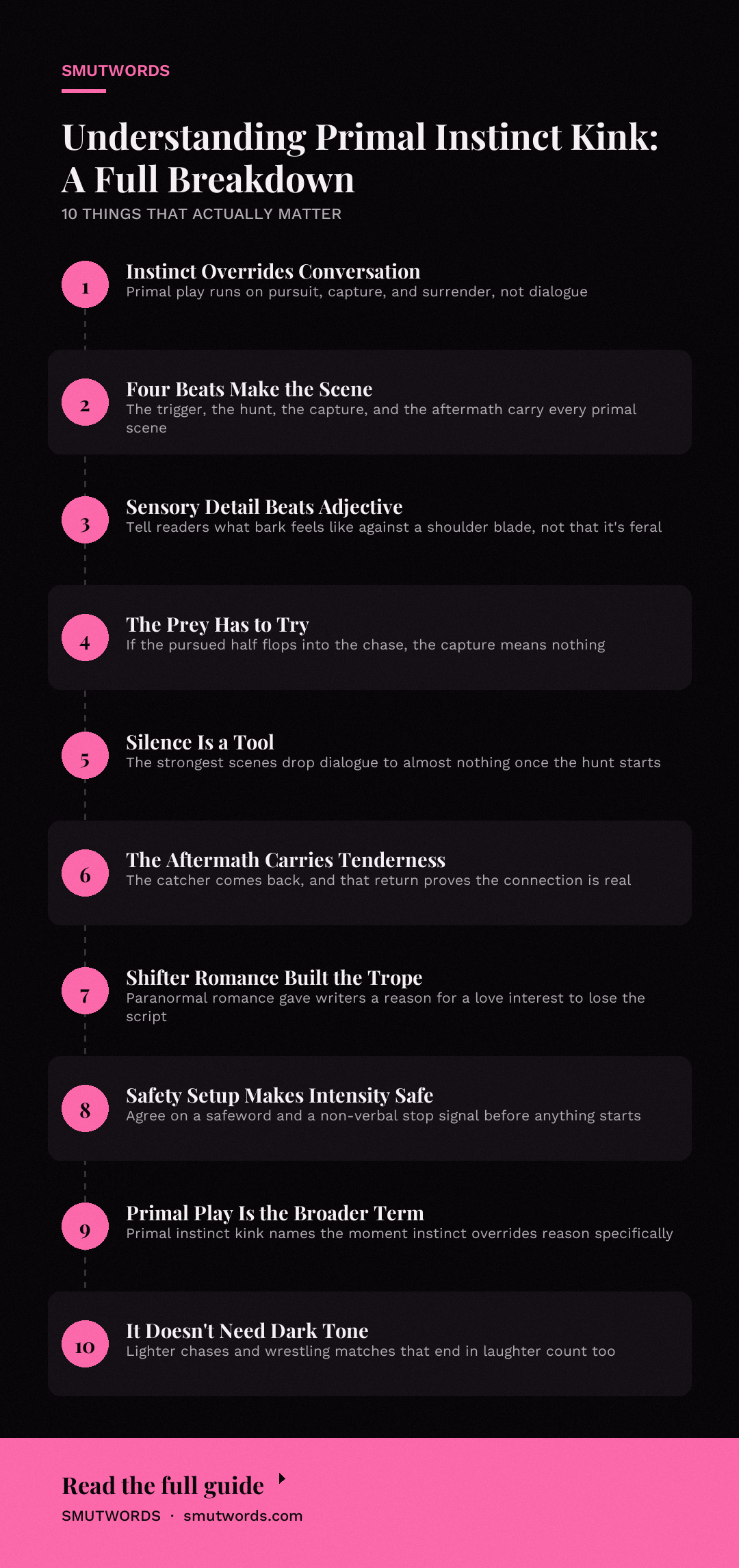
On the page, primal instinct kink is a scene-shape more than a plot. It has four beats, and strong writers know all four: the trigger, the hunt, the capture, the aftermath. The trigger is usually sensory: a scent, a look held too long, a chase that starts as a joke.
The hunt is the long middle and is where most books succeed or fail. The capture is the payoff. The aftermath, when done well, is where the tenderness lives, and it's often the most memorable page in the book.
What makes a strong version work:
- Sensory specificity. Sound, smell, texture, temperature. Primal scenes fail when they lean on adjectives like "feral" and succeed when the writer tells you what bark feels like against a shoulder blade.
- Real physical contest. The prey has to genuinely try to get away, or the capture means nothing. Writers who let the pursued half flop into the chase out of horniness drain the scene of its voltage.
- Silence as a tool. The strongest primal scenes drop dialogue to almost nothing once the hunt starts. A single word at the wrong moment breaks the spell.
- A true aftermath. The character who did the catching comes back. The tenderness after the tackle is the evidence that the connection is real.
Common variations authors use:
- The woods chase. A cabin, a forest, a run that ends against a tree or on the ground. This is the most common version and the most literal one.
- Indoor stalking. A house or a mansion with many rooms and one pursuer who knows the floor plan better than the heroine does. Tension comes from architecture.
- The animal shifter, played straight or subverted. A werewolf romance that treats the "beast" as genuinely uncontrolled, or one that plays the shift as a metaphor for a more conventional possessive dynamic.
- The feral submission arc. A heroine who insists on her composure until the first real chase teaches her body something about herself she didn't want to know.
- The contest between equals. Two people who both want to be the predator, and the fight decides it in the moment. Some writers let them swap halfway through.
There's a craft trap here that fewer writers handle well than you'd expect: primal scenes need a believable reason for the speechless part. If the leading man is a controlled corporate type, the book has to explain what flips the switch. The best writers make the trigger specific and small, a scent on a sweater or a hand that pushes him once too many times. The chase has to start from a cause.
Writers also borrow from adjacent tools carefully. A primal scene with restraint in it is one thing, and shibari is a different skill set entirely; a rope-heavy primal scene can read as two kinks stapled together if neither is developed. Where primal and rough sex overlap, the primal scene needs its own texture. It should feel driven by a body's hunger rather than by a couple deciding to get physical tonight.
Enjoyed this? Get a free book.
Join the list and we will send a complete free story straight to your inbox, plus new releases every week after that. No credit card, no catch.
Where the trope shades into obsession and possession, the use kink is a nearby neighbor, and some writers mix them. Where it shades into the pleasure of being watched during the capture, the voyeur husband trope can put a useful third set of eyes on the scene. Handled well, the mixing thickens the scenario. Handled badly, it becomes a checklist of kinks with no single center of gravity.
A note on consent in primal scenes, because that is where the real-world stakes are highest. The whole appeal is the illusion of unchecked pursuit, and the illusion works best when safety is firmly established first. Before any chase, the people involved should agree on a safeword (and ideally a non-verbal signal, since running and wrestling can make speech hard), plus physical boundaries: hair-pulling, biting, restraint, how hard is too hard.
A dropped word or a tapped hand has to stop everything. Instantly, no matter how deep into the scene it lands.
Fiction can show the negotiation or skip it, but it should show the safety net somewhere. The books that handle this best give their characters a pre-scene conversation so brief it almost slips by, or a word that appears once and carries enormous weight. Readers who actually practice primal play will tell you the safeword is the sexiest thing in the room, because it's the reason everything else can happen.
Primal Instinct Kink vs Related Terms
The term readers most often confuse with primal instinct kink is plain primal play. The honest answer is that they overlap almost entirely. Primal play is the broader practice: any consensual scene built on animalistic dynamics, chasing, wrestling, or feral roleplay. Primal instinct kink is the term this subgenre of erotica tends to use when the focus lands specifically on the moment where instinct overrides reason: the chase, the catch, the hunger that outruns conversation.
The practical difference in romance is tagging. A book labeled primal play might be gentle, playful, or mostly about a power exchange dressed in primal language. A book defined by the instinct side is usually interested in the physical, wordless, chase-forward scene itself. In practice, if you like one you like the other, and the subgenre's readers treat them as a family.
Where the comparison gets muddier is with makeup sex. The surface is similar: roughness, a fight in the air, bodies communicating. The engine is completely different. Primal scenes run on pursuit and instinct; makeup sex runs on reconciliation and unresolved conflict, and the roughness is an outcome rather than the point.
A chase scene also gets confused with a one night stand that happens to get physical, which is not a dynamic at all, just a duration.
Frequently Asked Questions
What is primal instinct kink in simple terms?
It's roleplay built on animalistic pursuit and capture, where one partner chases or hunts the other and the scene runs on physical instinct rather than conversation. The chase, the tackle, the bite, and the silence are the point. It often appears in dark romance and paranormal romance, especially shifter books.
Is primal instinct kink the same as BDSM?
It can be part of a BDSM dynamic, and it often shares the same consent culture: safewords, pre-scene negotiation, agreed boundaries. But it doesn't require a formal Dominant/submissive structure or any equipment. Some people practice primal play with almost no D/s language at all, which is why the term stays distinct in kink communities.
How do you keep a primal scene safe in real life?
Agree on a safeword and a non-verbal stop signal before any chasing or wrestling starts, since people running or pinned can struggle to speak. Discuss physical boundaries in advance, especially around biting, scratching, restraint, and how hard is too hard. Then stop the second the signal comes. The intensity is what makes it work, and the safety setup is what makes the intensity safe.
Why is predator/prey such a popular trope in romance books?
It delivers the thrill of being wanted so badly that a person abandons their composure. The pursued partner gets chased, caught, and claimed without having to argue for it, and the pursuer gets to act on hunger instead of manners. For readers, that's a clean fantasy with a built-in dramatic engine and almost no need for dialogue.
What are common variants of the primal instinct kink?
Primal play, predator/prey, hunter/hunted, animalistic roleplay, and feral submission are the standard names, and they describe overlapping territory. Shifter romance is the fantasy version; contemporary dark romance is the version without fur or fangs. Woods chases, indoor stalking scenes, and contests between two people who both want to be the hunter are the common scene shapes.
Can primal instinct kink work without a dark or violent tone?
Yes. Primal play doesn't have to be dark. Plenty of writers play it lighter, as a playful chase or a wrestling contest that ends in laughter. The intensity lives in the body and the surrender, and that's available at any heat level, from a weekend-hike chase to something much harsher.
Final Thoughts
Primal instinct kink works because it takes away the thing romance usually relies on: talk. What's left is bodies, pursuit, and a surrender you can't argue your way out of, which is why readers keep coming back. If you want a place to start, look for a shifter or dark romance whose opening chapter has someone running.
The pre-scene negotiation, when a book bothers to include one, is worth paying attention to. That's where the genre shows whether it actually understands the fantasy. And if a primal scene turns out to be your entry point into a deeper power exchange, our guide to how to start a D/s relationship covers the groundwork: negotiation, safewords, and pacing, all of which make the chase hotter because everyone can let go.








Loading comments…