
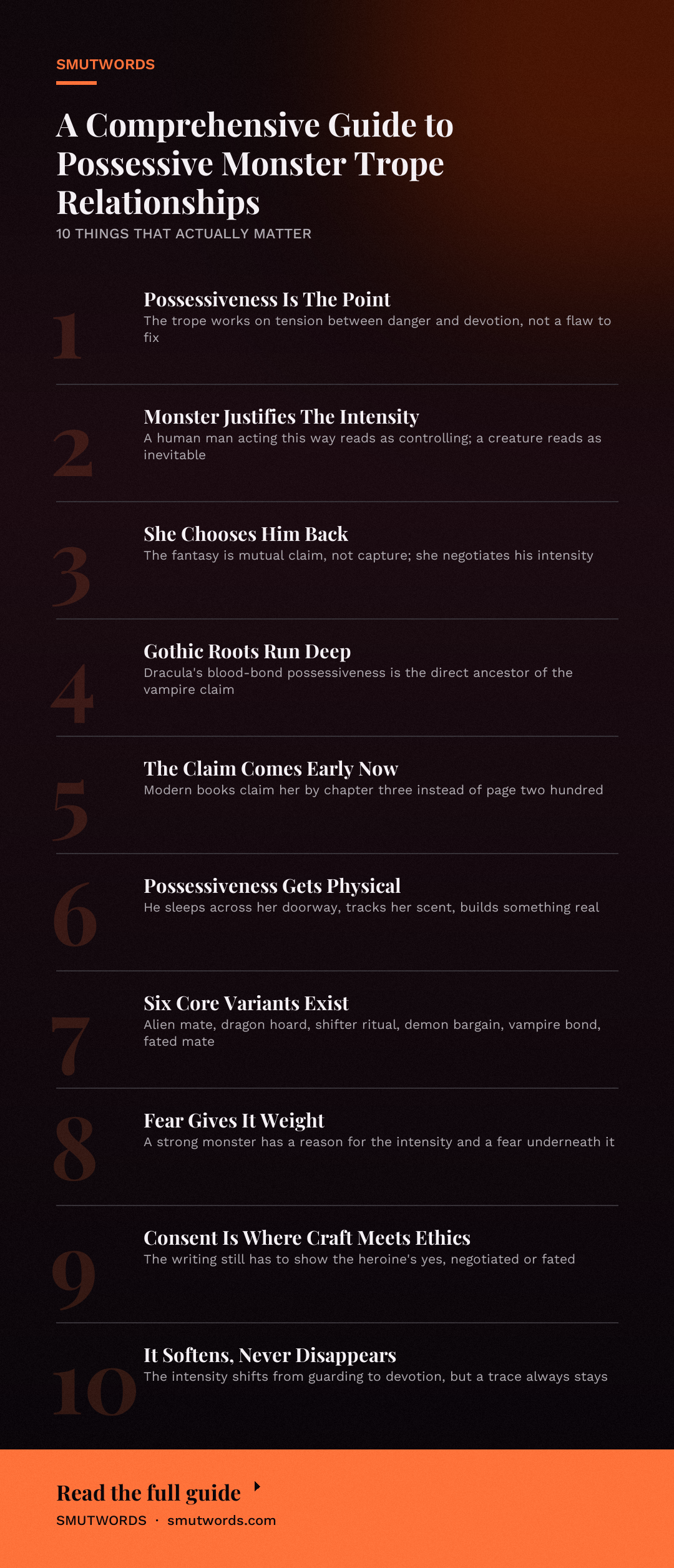
The possessive monster trope is a story dynamic where a monstrous or inhuman love interest claims their human partner with fierce, territorial intensity, driven by instinct, fate, or something older than either of them. He does not ask for her. He decides she is his, and the rest of the book is everyone else learning to live with that.
The possessiveness is the point, not a flaw the heroine has to fix. What makes the possessive monster trope work is the tension between danger and devotion. This creature could destroy her, and instead he builds his entire existence around keeping her.
What Possessive Monster Trope Actually Means
The word "possessive" is doing precise work here. It does not mean jealous in the petty, suspicious way a human love interest might be. It means territorial, declarative, and total.
The monster marks, claims, guards, and hoards. His language runs toward mine, ours, and no one touches her. The heroine is not a conquest he loses interest in. She is the single organizing principle of his life.
"Monster" is equally specific. The love interest is not a brooding human with a dark past. He is something with claws, fangs, scales, wings, or a body that does not obey human anatomy.
The monster part matters because it justifies the intensity. A human man acting this way reads as controlling. A creature operating on instinct or an ancient bond reads as inevitable. The genre leans hard on that distinction.
What counts: a love interest who is visibly nonhuman or supernatural, a claim that is stated or enacted rather than merely implied, and a possessive drive that persists through the whole arc rather than dissolving once the couple gets together.
What does not count: a human alpha type with a bad attitude, a monster who is possessive for one scene and then becomes a normal boyfriend, or a dynamic where the possessiveness is framed purely as abuse to be escaped. That last one is a different story entirely, and it belongs to a different shelf.
A common misconception is that the heroine has no agency. In strong versions of this trope, she chooses him back. The monster's possessiveness is a force she negotiates with, and ultimately wants. The fantasy is mutual claim, not capture.
Where Possessive Monster Trope Comes From
The roots run through gothic fiction, where the monster has always been a stand-in for forbidden desire. Dracula does not just bite. He takes, binds, and returns. That blood-bond possessiveness is the direct ancestor of the modern vampire claim, and the erotic charge was there from the first page.
Beauty and the Beast supplies the other half of the DNA. A terrifying creature, a woman who sees past the exterior, a bond that civilizes him just enough to be livable without ever making him safe. Romance has been rewriting that story for two centuries, and the possessiveness is what each version turns up or down.
The genre-specific history is more recent and more instructive. In the 1990s and 2000s, paranormal romance built an entire market on fated mates and shifter claims. The possessiveness was there but often softened, framed as protectiveness with a growl.
Around the 2010s, indie publishing and monster romance pushed the creature further from human. Tentacles, horns, knots, and true nonhuman anatomy stopped being a novelty and became a category.
The most recent shift is in how the possessiveness itself is portrayed. Earlier books treated it as a problem the heroine had to tame. Current books treat it as the fantasy delivered upfront.
Readers are not waiting two hundred pages to find out if he will claim her. He claims her in chapter three, and the book explores what that means. This is the same appetite for explicit, unapologetic dynamics that drives the dark romance vs taboo romance split, where readers increasingly want the intensity stated rather than hinted.
Publishing also deserves credit for the trope's current shape. Series culture rewards a monster who can be possessive across five books without becoming boring. Authors solved this by giving him a pack, a hoard, a bond, or a territory that keeps generating new stakes. The possessiveness becomes a world, not a mood.
How It Shows Up in Erotica
On the page, this trope is a machine for generating specific scenes. The claim scene. The territorial confrontation. The moment he realizes someone else looked at her. The first time he admits, in his own inhuman vocabulary, that she is his and he will not survive losing her. Editors can spot the beats immediately, which is why the good versions differentiate themselves on texture rather than structure.
The strongest books make the possessiveness physical and particular. He does not just feel protective. He sleeps across her doorway. He tracks her scent. He keeps a piece of her clothing in his nest. He builds something.
The instinct has a material expression, and that expression is what readers remember. Here is how the trope usually breaks down by variant:
- Alien possessive mate: The claim runs through biology or a bond ceremony. Often includes a marking bite, a shared psychic link, or a mating gland. The alien's homeworld may have laws about claims, which supplies external conflict.
- Dragon hoard mentality: The monster treats the heroine as the most valuable thing he owns. Expect literal treasure, a lair, and fury when anyone approaches his collection.
- Shifter claiming ritual: Pack law structures the claim. A bite, a ceremony, or a public declaration, and the whole community witnesses it. See pack dynamics for how hierarchies shape who is allowed to claim whom.
- Demon bargain obsession: The possessiveness grows out of a contract. He owns her soul, her time, or her firstborn, and the terms blur until neither of them can tell obligation from want.
- Vampire blood-bond possessiveness: Feeding creates the bond. He can feel her, find her, and know when she is afraid. The addiction runs both directions.
- Monster fated mate: Fate does the claiming, and the monster spends the book convincing the heroine to accept what the universe already decided.
What separates a strong version from a flat one is usually the monster's interiority. A flat possessive monster has one note: mine. A strong one has a reason for the intensity and a fear underneath it.
He is possessive because he has lost something before, or because his kind bonds once, or because the bond has a cost if it breaks. That fear gives the possessiveness weight.
The heroine's side of the equation matters just as much. In a weak book, she is a passive recipient of all that intensity. In a good one, she has her own wants and her own limits, and she uses them.
Enjoyed this? Get a free book.
Join the list and we will send a complete free story straight to your inbox, plus new releases every week after that. No credit card, no catch.
The best claim scenes involve her claiming him back, even if the language of the book keeps the monster's ownership in the foreground. That reciprocity is also what separates these books from the power imbalance you get in hotwife fiction about ethical non-monogamy, where the charge comes from sharing rather than owning.
Consent is where craft and ethics meet. The fantasy can run on ambivalence and force of instinct, but the writing still has to show the heroine's yes.
Some authors handle this with an explicit negotiation. Others use the fated mate structure so the desire is mutual from the start. Either works. What does not work is a heroine who is purely acted upon across an entire book, because the reader stops rooting for the bond and starts worrying about her.
A related craft note: possessive monster books often run on a breeding or claiming kink for the biological stakes. If that is the register you are writing in, the breeding kink explained breakdown is the companion piece, because the two dynamics share a lot of machinery around instinct, bodies, and permanence.
Genre blending is where the trope gets interesting. Put the possessive monster in space and you get alien mate romance. Put him in the deep water and you get a creature whose claim is genuinely inescapable.
Drop the whole dynamic into a universe where the monster's existence breaks human comprehension, and you land in cosmic horror romance, where the possessiveness carries an extra charge because the thing that wants her is beyond her ability to understand or name. The trope scales in every direction, and the strongest recent books pick a subgenre and commit to its specific monster.
Possessive Monster Trope vs Pack Mates Romance
These two get confused constantly because so many shifter books use both. The difference is where the intensity is aimed. In pack mates romance, the bond is one thread inside a larger web of pack relationships. The mate bond matters, but so do the alpha, the pack hierarchy, and the group's survival.
The possessiveness is distributed across a community. Possessive monster romance keeps the focus on the pair. The monster's claim on the heroine is the whole engine.
If there is a pack, it usually exists to either threaten the bond or enforce it. The monster's jealousy is not about pack politics. It is about her, specifically, being his.
So a shifter book can be pack mates romance without being possessive monster romance, and a possessive monster book can have no pack at all. When a story uses both, the possessive dynamic typically dominates the emotional plot while the pack structure supplies the external plot.
If you are trying to place a specific book, ask where the central tension lives. If it lives in the couple's claim on each other, it is possessive monster territory.
Frequently Asked Questions
Is the possessive monster trope the same as dark romance?
They overlap but are not the same. Dark romance refers to morally gray characters and transgressive content overall. The possessive monster trope is one specific dynamic that fits comfortably inside dark romance without requiring it. Many possessive monster books are surprisingly warm, with a monster who is dangerous to everyone except the heroine.
Why do readers like possessive monster romance so much?
Because it delivers a fantasy of being utterly prioritized by something powerful enough that ordinary rules do not apply. The possessiveness lets a reader explore jealousy, obsession, and raw need inside a fictional container where nothing carries real consequences. The singular focus is the appeal: being the only thing a formidable being cares about.
Where should a new reader start with this trope?
Start with a subgenre you already like and find the possessive monster book inside it. If you read sci-fi, try an alien mate story. If you like shifters, start with a claiming ritual book. If you like things eerie, go for cryptid romance, where the monster comes wrapped in local legend and the possessiveness has a folkloric edge.
How do authors keep possessive monsters from reading as abusive?
They give the heroine active desire and clear limits, and they show the monster respecting those limits even when his instinct pushes against them. The possessiveness stays in the fantasy register when the reader can see that she wants him too. Real-world possessiveness is a different subject entirely, which is why strong books separate the fantasy from the reality on the page.
Does the possessiveness ever get resolved?
Usually it softens rather than disappears. The monster learns to trust that she is staying, and the intensity shifts from guarding to devotion. Books that erase the possessiveness entirely in the last act often feel like a different story. The ones that keep a trace of it, even after the couple is settled, tend to satisfy readers more.
What about non-mammalian or non-humanoid monsters?
The trope has expanded well past wolves and vampires. Tentacled creatures, insectoids, and even extinct reptiles get the possessive treatment, and the anatomy does real work in those books. Dinosaur romance is a good example of how far the monster half of this trope can stretch while the possessive dynamic stays completely intact.
Final Thoughts
The possessive monster trope endures because it takes the oldest promise in romance, that someone will choose you and keep choosing you, and gives it a body that cannot lie about it. The monster does not need to be convinced. He does not need to be reassured.
He says mine and means it down to the bone, and the book is about what happens when someone that certain turns out to be right for you. If you want one specific place to start, pick up a book built on the fated mate variant in a subgenre you already love: sci-fi, shifter, or folklore.
The hybrid shifter romance shelf is a strong entry point, and it is the version of the trope most readers mean when they say they want a monster who will not share.






Loading comments…