
Nobody in a good hotwife story is being lied to. That's the whole engine. The husband knows, the wife knows, and usually the third man was chosen together over a drink on a Tuesday night. If you've been avoiding the genre because the premise sounds like an affair with better lighting, you're reading the wrong books, or you're reading the right books and missing what's actually on the page. Hotwife fiction built on ethical non-monogamy runs on agreement, and the agreement is what makes it hot.
Affair fiction has its own appeal. The secrecy, the lie, the phone face-down on the table. But that's a different fantasy doing a different job, and confusing the two ruins both. So here's the split, why it matters, and how to spot which one you're holding before you're forty pages in.
What "Hotwife" Actually Means in Fiction
A hotwife is a married woman who sleeps with other men, with her husband's knowledge and encouragement. That's it. That's the term. It doesn't require him to watch, doesn't require humiliation, doesn't require him to sit in a chair in the corner while it happens. Some couples in these books do it that way. Plenty don't.
The ethical non-monogamy part is baked into the definition, not bolted on as a moral fig leaf. Remove the husband's consent and you're not writing a hotwife story anymore. You're writing Unfaithful, which is a fine film and a lousy hotwife novel.
This trips up new readers constantly. They open something marketed as hotwife, find the husband picking out her lingerie for the date, and get confused about who the villain is. There isn't one. That's the genre working as intended.
The three people in the room
Every hotwife story has a triangle, and every point on it is doing a job:
- The wife — the center of the story. Her desire is the plot. If she's passive, dragged along, or doing it only to please him, you're reading a resentful marriage, not a hotwife fantasy.
- The husband — present, informed, and getting something real out of it. Compersion, arousal, a specific kink, sometimes all three at once.
- The third man — chosen. Interviewed, vetted, sometimes literally picked out of a lineup by the husband. There's a whole craft to writing him well, which is why the bull matters as much as the couple in the stories that actually work.
Notice what's missing from that list. Deception. Nobody in it is being played.
Cheating Fiction vs. Hotwife Fiction: The Actual Difference
Strip both genres down and the mechanics are identical. Married woman. Another man. Sex the husband isn't part of, or is only partly part of. Same furniture, different house.
The difference lives entirely in the informational state of the husband.
Where the tension comes from
In an affair story, the tension is discovery. Will he find out? What happens when he does? The reader is complicit in a lie and the pleasure is the dread of the lie collapsing.
In a hotwife story, the tension is anticipation. She's getting ready in the bathroom. He's on the bed pretending to read. The doorbell is going to ring at eight. The reader knows exactly what everyone knows, and the charge comes from watching three people walk toward a thing they all agreed to do.
One is suspense. The other is ritual. Completely different reading experiences even though the surface details rhyme.
The husband is a participant, not a victim
This is where bad hotwife writing gives itself away. If the husband is humiliated against his will, blindsided, or written as a pathetic obstacle, the author has slid back into affair logic without noticing. He can be humiliated consensually. He can crave it. That's a real kink with real readers. But the against his will part is the tell.
Plenty of couples in these books negotiate the humiliation explicitly beforehand, agree on the language, agree on what's off the table, and then play inside those lines. Where that line sits between hot and genuinely cruel is its own whole conversation, and it's covered well in this breakdown of cuckold humiliation if you want the fine print. Short version: agreed-upon degradation hits different than actual contempt, and readers can feel the difference from the first page.
Why Consent Is the Kink, Not the Paperwork
Here's the thing readers of this genre figure out fast and outsiders never seem to get: the permission is the erotic object.
Not the sex. The sex is fine, there's a lot of it, it's usually well written. But the scene that makes people reread a chapter is the moment he says yes, go. Or the moment she asks and he doesn't hesitate. Or the two hours before, when they're both pretending to be normal at dinner and failing.
An affair can't do that. The whole structure forbids it. That specific charge, the one where a husband looks at his wife across a room and knows exactly where she's going tonight and gave her his blessing, only exists inside the consent frame.
The permission slip as a scene
Which is why so many of these stories stage the agreement itself as a set piece. A conversation. A text sent from a work trip. A physical object, sometimes literally a note or a garment or a set of rules.
Enjoyed this? Get a free book.
Join the list and we will send a complete free story straight to your inbox, plus new releases every week after that. No credit card, no catch.
Permission Slip does this in the title. The whole story hangs on the document, the moment of signing off, and what it costs and gives both people. He Chose Her Outfit runs the same engine through a different machine: the husband selecting what she wears out, which only works because she's agreed in advance to wear it, and he's agreed in advance not to follow her.
Neither plot functions if someone's being lied to. The lingerie doesn't mean anything if he doesn't know about the date.
Common Misconceptions About the Genre
Most of the eye-rolling about hotwife fiction comes from people who've never read one and are guessing from the cover. The guesses are usually wrong in the same five ways.
- "It's just cheating with extra steps." No. Cheating requires a lie. This requires a conversation. Different story, different feeling, different ending.
- "The husband must be a doormat." Some are written that way by lazy authors. Most aren't. The good ones write him with a spine, preferences, and veto power he actually uses.
- "It's always about humiliation." Humiliation is one flavor. Sharing without it, compersion, exhibition, the simple fact of watching his wife be desired, all get written. Shared Without Shame works the exhibition angle hard and nobody in it is degraded.
- "She's doing it for him." If she is, it's a bad story. Her wanting it is the point. She Made the First Move is titled that way for a reason.
- "There's no conflict without the affair." There's plenty. Jealousy that gets handled. Nerves before a first date. Rules that turn out to be wrong and get renegotiated at 2 a.m. Conflict doesn't require betrayal.
The rules thing deserves its own note. Fictional couples in this genre spend an absurd amount of page time negotiating limits, and readers eat it up, which tells you something about what the audience is actually there for. There's a whole piece on how these couples draw the lines in Hotwife Rules, and it's worth reading if the negotiation scenes are your favorite part, because you're not alone in that.
How the Consent Frame Changes the Sex Scenes
A sex scene in an affair story is stolen. It has a countdown built in, and the reader feels the husband's ignorance pressing on it like a hand on the back of the neck.
A sex scene in a hotwife story is given. Frequently it's reported back. Sometimes the husband is in the room. Sometimes he's texting her during. Sometimes he's at home, awake, waiting for her to walk in the door at one in the morning, which is the entire premise of She Brings Him Home.
That last structure is doing something an affair story structurally cannot. The wife comes home to a husband who stayed up. She tells him. He listens. What happens after that conversation is the payoff, and it only exists because nothing was hidden.
Voyeur and non-voyeur versions
Even inside the genre there are two big branches. In one, the husband watches. In the other, he doesn't, and the story lives on what he imagines and what she tells him later. Both are legitimate, both have devoted readers, and if you're figuring out which one you like, the split between watching and not-watching is the fastest way to sort yourself. The non-watching version is arguably more suspenseful. The watching version is more visual. Neither is more or less consensual than the other, and that's the point I keep coming back to.
What Ethical Non-Monogamy Actually Looks Like on the Page
Real-world ENM is mostly logistics and check-ins, which is why fiction trims it. Nobody wants four pages of calendar coordination. But the good books keep enough of the texture to make the arrangement feel lived-in rather than convenient.
That texture usually shows up as:
- A specific rule the couple made, stated in dialogue, then tested by the plot.
- One person having a bad moment and saying so out loud, followed by the other person adjusting.
- A third man who respects the arrangement and gets written as a person with his own wants rather than a prop.
- At least one scene of aftercare, debriefing, or whatever you want to call the part where they're both in bed and talking.
- The wife having a life, a job, opinions, and a reason of her own for wanting this.
When a story skips all five, it tends to read like cheating fiction wearing a hotwife jacket, and readers notice within two chapters. It's the same way readers notice when a femdom story forgets to write the domme as a person. The tropes overlap more than people expect; there's a solid piece on where femdom and hotwife share ground if you want to see how much of the dynamic is a power exchange rather than a betrayal.
The third man has to be chosen
Worth restating because it's the most common fumble. If he shows up uninvited, if he overwhelms her, if he takes without being offered, the story has left the genre. He's selected. He's often vetted by both of them. Bull for the Weekend is built entirely on that selection process, the choosing, the arranging, the weekend that follows because everyone planned it.
An affair partner is discovered. A bull is hired. That's the difference in a sentence.
Where to Start If You've Been Avoiding the Genre
If the affair association is what's kept you away, the fix is to start with something where the agreement is on page one, unmissable, so you can't mistake what you're reading. Pick a book where the husband has a hand in setting things up. Pick one where the wife is the one pushing for it. Give it fifty pages.
The whole catalog is browsable if you want to poke around, and the big roundup of hotwife and cuckold books sorts them by vibe, which saves you digging. If you lean toward the wife running the show, there's plenty there. If you want the slow-burn negotiation version, that's there too.
One more thing worth saying plainly. Reading this genre doesn't mean anything about your marriage, your politics, or your character. It's a fantasy about trust, mostly. Three adults who trust each other enough to do something risky on purpose is a much rarer premise than three adults lying to each other, and if you've been avoiding it because it looked like the second thing, look again.
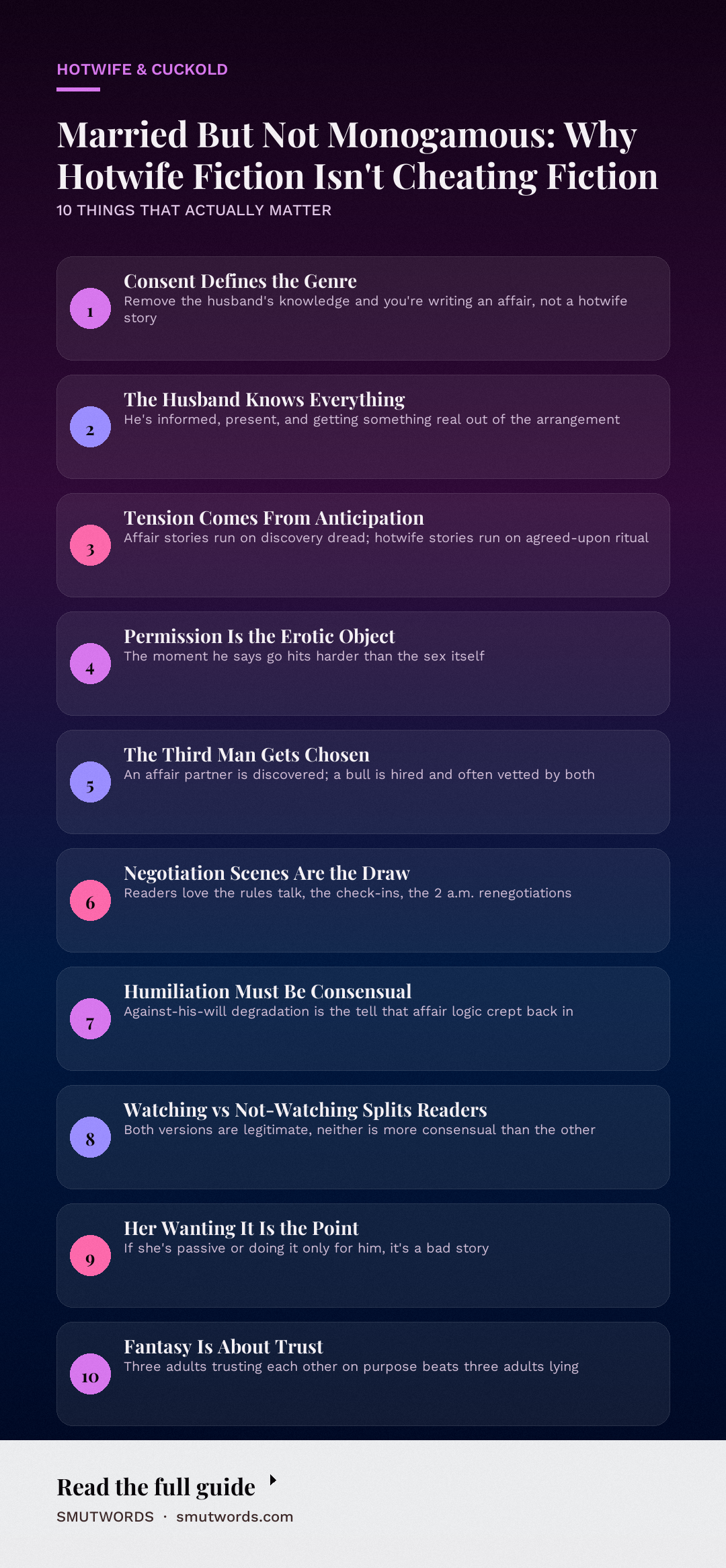
Final Thoughts
Start with Permission Slip. It's short, the agreement is the whole spine of it, and there's no way to read it as an affair story, which makes it the cleanest possible test of whether the genre works for you. If it does, you'll know inside twenty pages that the consent is the part you came for.








Loading comments…