Most breathplay JOI content floating around is either one breathless paragraph of "hold it until I say" with no safety net, or a clinical essay that strips every bit of heat out of the kink. Neither is much use if you actually want to try the thing.
Breathplay JOI, done well, uses breath as a pacing device. A countdown that syncs your inhale to the next instruction. A held breath standing in for the held-back edge.
A voice in your ear telling you exactly when to let go. The people writing it well know the difference between a fantasy that runs on air and a fantasy that runs on fear, and they structure the file accordingly.
What Breathplay JOI Actually Is
The term covers two related things that get bundled together. The first is breath-holding: the audio or the written instruction tells you to take a slow breath, hold it for a count, and release on command.
The second is breath-syncing, which is subtler. The instruction set asks you to time your strokes to your breathing rather than the other way round: inhale during the slow pull, exhale on the upstroke, don't speed up until you've done three full cycles. A session built this way runs on a slower clock than a standard file.
Most JOI content builds tension through edge-and-release mechanics alone. Breathplay JOI adds a second dial. You're managing air and arousal at once, and the fact that you can't power through means the session has a built-in brake.
That's the appeal for a certain kind of listener. If the standard interactive JOI game structure has gotten too familiar, breath work is one of the few changes that actually shifts how the scene feels instead of just how fast it moves.
The Two Styles, Side by Side
- Breath-hold JOI: a countdown-based instruction that asks you to hold a breath for a fixed number of beats, timed to specific strokes or actions, with a clear release cue. The hold is the event.
- Breath-sync JOI: a continuous instruction to match your breathing rhythm to a prescribed stroke pattern for the whole session. There's no discrete hold; the breath is the metronome.
Good writing combines them: breath-sync through the opening and the edging section, breath-hold as a peak tool near the end, plenty of recovery space in between.
Why Breathwork Slows the Whole Session Down
Standard JOI can tip into a sprint if you let it. The instructions get faster, your hand follows, and the session is over before the good part. Breathwork makes that impossible.
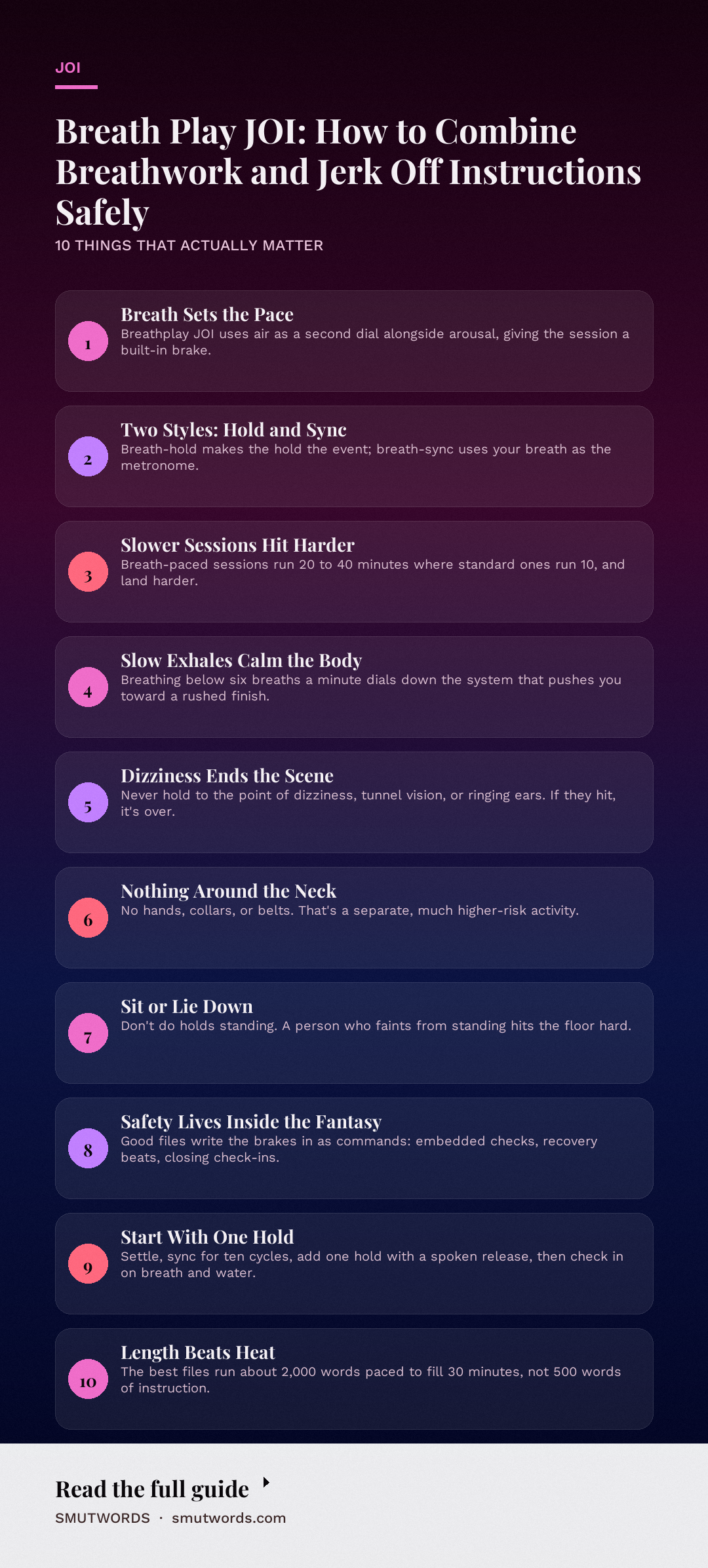
If the file wants three slow exhales between edges, there's no shortcut. Most people find a breath-paced session runs 20 to 40 minutes where a standard one runs 10, and the eventual release lands noticeably harder because of the length.
There's also a physiological reason readers keep coming back to this. Slow exhales below about six breaths a minute dial down the sympathetic nervous system, the same system that pushes you toward a rushed finish. Breath-syncing exploits that. It's the difference between "tell me not to come yet" and "tell me to breathe until I genuinely can't come yet."
Where the Fantasy Structure Comes From
Most printed versions borrow their pacing from guided meditation more than from standard erotica. A typical file runs a script like this: settle, breathe in for a four count, out for a six count, stroke on the out-breath, repeat five times, then a hold on the sixth inhale, a stroke count during the hold, release. The voice does the work.
That voice is why so many readers migrate here from other formats. The audio-forward style in the JOI game for women scene has the same rhythm: someone in the room, or in your headphones, giving you a number and a body part and a count. Add breath to that and the counting has something to hang off.
The Safety Section (Read This Before the Fantasy Does)
Breathplay is one of the few kinks where the bad version is dangerous, not just disappointing. A few hard rules that any published file should make explicit before the scene starts:
- Never hold your breath to the point of dizziness, tunnel vision, or ringing ears. If any of those hit, the scene is already over.
- Never combine breath-hold instructions with anything around the neck or chest. No hands, no collars, no belts, no constrictive clothing. A hold with a hand on your throat is a separate, much higher-risk activity and not what breathplay JOI usually means.
- Don't do this standing up. Sit or lie down. A person who faints from a standing position hits the floor hard, and the file doesn't know you're on tile.
- Take the entire recovery breath before the next instruction. No exceptions. Every competent file has recovery built in; if it doesn't, don't run it.
- Have a real stop word, and have someone in the room or on the phone if this is a solo scene with holds. A recorded voice can't check on you. A friend who knows what you're doing can.
For anyone newer to power-exchange frameworks, borrowing the safety scaffolding from other high-intensity kinks is smart. The consent conventions that hold in mummification play, where the body is fully restricted and negotiation has to be airtight beforehand, translate directly here: negotiate the holds, the length of holds, and the stop signal before the scene starts.
Enjoyed this? Get a free book.
Join the list and we will send a complete free story straight to your inbox, plus new releases every week after that. No credit card, no catch.
And never let a recorded voice or a written instruction override the stop signal. A file that tells you "keep going even if you feel dizzy" is a bad file, no matter how good the prose is.
How Authors Signal Limits Inside the Fantasy
The trickiest part of writing breathplay JOI is keeping the tension without writing a scene that could actually harm someone. The writers who manage it use a set of signals that live inside the fiction and still telegraph the safety rails:
- The embedded check. A line like "if your head is spinning, you're already done, this is your cue to sit down and drink water" appears mid-scene as a command, not as a footnote. It reads as part of the power dynamic: the voice has decided it will not allow you to go further.
- The built-in recovery beat. Every hold is followed by a recovery count that is also an instruction: "inhale deeply for four. Now hold the air in your chest for four. Now exhale for eight. Do that three times. Do not touch yourself during recovery." Recovery doubles as a control beat.
- The no-belt, no-collar rule as a character line. In good files, the voice says plainly that there's nothing around your throat and there never will be, and makes that part of the fantasy. "I want your breath, not your windpipe." It reads as dominance; it functions as a safety bulletin.
- A closing check-in. The end of the file asks you to report your breath rate, your heart, and whether you're drinking water. The check-in is written as aftercare, which it is.
- A published hard limit. Anything published under breathplay JOI should list the limits in plain text before the scene begins: no hands on neck, no collars, no standing, no holds beyond a stated count. The list is part of the fantasy's world-building.
If you're drafting your own for a partner, follow the same structure. Write the holds into the body of the scene as commands, and write the brakes into it as commands too. A dominant voice that says "stop" is still the dominant voice.
Writing Breathwork Into Your Own JOI File
If you're putting a file together for a partner or for an online audience, here's the structure that lands best:
- Start with a settle. Two minutes of plain spoken instruction to breathe normally. Don't rush this. The scene hasn't started until the listener's breathing has visibly changed.
- Introduce the sync. Assign breath and stroke to the same count. Four in, six out, one stroke per full cycle. Do it for at least ten cycles before adding anything.
- Add one hold. Not three. One, with a clear release count spoken out loud and a full recovery sequence after.
- Insert the embedded check. Say the safety line in the same voice as the rest, one sentence long, then move on without breaking the scene.
- Close with the check-in. Breath, water, sit still for five minutes.
Length matters more than heat in the drafting stage. The best files run about 2,000 words and are paced to fill 30 minutes. If your first draft runs 500 words, you've written an instruction, not a scene.
Where to Borrow Structure
Long-form interactive JOI formats are a good model for pacing because they build in pauses and check-ins as a matter of course. The structured format of a vibrator training programme is a natural cousin: escalating intensities, scripted check-ins, and a clear end state. Breathwork slots into that framework more easily than it slots into freeform audio. Anything with a count in it works with a breath count attached.
For the scene-writing itself, the power-dynamic beats in financial domination are worth studying. The dominant voice in those scenes has to sound like the person in charge even while issuing instructions that protect the submissive. Same trick applies here. The paragraph where the voice says "now breathe" is doing work on both the fantasy and the safety side at once.
What Breathplay JOI Is Not
The label sometimes gets stretched to cover scenes involving actual restriction, hands on the throat, or belts and ties. Those belong in a different category with far stricter safety requirements, in-person supervision, and a level of experience breathplay JOI typically doesn't need. If a piece of content you're reading drifts into that territory without an explicit, well-written safety frame, close the tab. Plenty of good files get the pacing right without ever going there.
Say it plainly too: this isn't a gateway to anything more intense. Most readers who love breathplay JOI love it for the rhythm and the length, not because they want to graduate to something riskier. The breath-syncing that makes the scene work sits on the slow, controlling end of the scale. Kink socials and munches are consistently good places to ask about breathwork files other people have tried, because community word-of-mouth filters the dangerous ones out fast.
The Appeal, Stated Plainly
What makes the best breathplay JOI files work is that they treat breathing as another body part to be controlled. The same headspace that makes a well-built JOI scene work (someone else is setting the pace, the count is out of your hands, your body is being run on a schedule) applies here at a slower tempo.
Most listeners end up more present in their own body, not less. The eventual release tends to land harder because the session got longer. A body managed for 30 minutes at half its usual pace is very ready by the time the file releases it.
Final Thoughts
If you want a single file to test the waters, start with something short, well-paced, and openly safety-framed rather than the most intense thing you can find. Read the first two paragraphs carefully. A good breathplay JOI file will tell you in the opening minute that it will keep you safe, then spend the next thirty proving it while running your breath like a metronome.
If it starts with "hold until I say," that isn't a file. It's a warning.


Loading comments…