
Most people buy their first restraints in a hurry and regret it the moment the key sticks. The metal handcuffs from the novelty shop look serious. They cost nine dollars, and they will pinch a wrist hard enough to leave a bruise before the night is over. Rope looks like the answer until you realize you don't know a single knot that releases under tension.
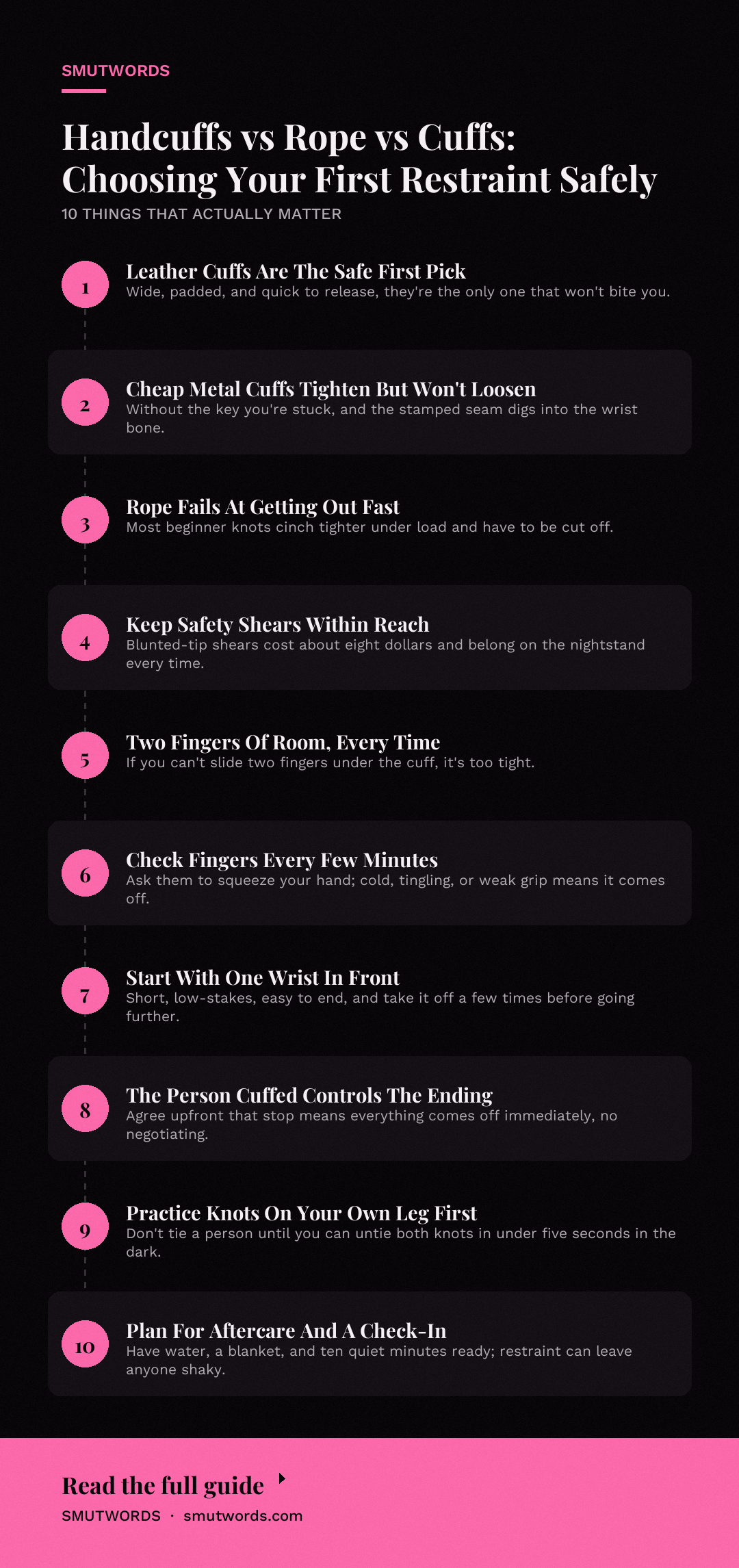
Leather cuffs look expensive and slightly unserious right up until you wear a pair and find out they're the only one of the three that won't bite you.
This guide compares those three options on the things that actually matter for a beginner: safety, circulation, quick release, comfort, and which one to buy first. If you're shopping for first restraints, the short answer is leather cuffs with a proper quick-release clasp or buckle. The long answer is worth reading, because the wrong choice can turn a fun evening into a numb hand and a trip to the hardware store for bolt cutters.
The three options, and what they actually are
Cheap metal handcuffs are the hinged or chain-linked steel cuffs sold as costume accessories. They have a ratcheting mechanism that tightens but doesn't loosen without the key, and the key is a tiny pin that gets lost. Leather cuffs are wide, padded straps that buckle or snap around the wrist or ankle, usually with a D-ring for clipping to something else. Rope is exactly what it sounds like: some kind of cord or rope you tie knots in.
Each one fails at a different thing. Metal cuffs fail at comfort and circulation. Rope fails at quick release. Leather cuffs fail at nothing important, which is why they win for a first purchase.
Cheap metal handcuffs: the worst first choice
The problems with novelty handcuffs are specific. The ratchet lets you tighten but not loosen without the key, so if the key is on the nightstand and your partner's hands are behind their back, you're stuck. The edges are stamped steel with a seam that digs into the wrist bone.
The hinge on hinged cuffs puts pressure on the side of the wrist where the radial nerve runs. A few minutes of that is enough to make fingers tingle.
They also have no give. If someone rolls over or pulls, the steel doesn't flex, so the pressure goes straight into the skin. And the double-lock feature that real police cuffs have, the one that stops them tightening further, is usually missing on the cheap versions. So the cuff can keep ratcheting tighter with every struggle.
People still buy them. They look like the thing in the movies, they're cheap, and the click of the ratchet is its own little thrill. If that's the appeal, buy a pair and use them as a prop you don't actually lock, or spend the money on real double-locking cuffs with a safety release. The novelty version belongs in a costume box.
Leather cuffs: the beginner's default
Leather cuffs (or good vegan leather, which is fine) solve almost every problem the metal ones create. They're wide, so the pressure spreads over two inches of wrist instead of a steel edge. They buckle or snap, so you can get them off yourself in a second. The D-ring lets you clip them to a bed frame, a strap, or each other with a carabiner or a small lock.
Circulation stays fine because the cuff is wide and you can fit two fingers under the strap. Quick release is a buckle you can reach or a snap you can pop. Comfort is a padded interior that doesn't leave a mark unless you want it to. The only real downside is price, and even that isn't much: a decent pair of leather wrist cuffs runs twenty to forty dollars.
Check the hardware when you buy. Cheap cuffs have buckles that bend and D-rings that pull out of the leather. Look for riveted or stitched D-rings, not glued, and buckles with real prongs. A pair that fits snug but not tight, with two fingers of room, will serve you for years.
Rope: the one that punishes enthusiasm
Rope is the most versatile and the most dangerous of the three for a beginner. It can go around a wrist, a bedpost, a whole body. It's cheap and quiet and it photographs well. It also requires knots, and the knots you learn first are usually the wrong ones.
The classic beginner mistake is tying a knot that tightens under load. A square knot or a granny knot will cinch down as the person pulls, and then you can't get it off without cutting it. The right knot for restraint is a quick-release knot, like a slip knot with a tail you can pull, or a bowline you can untie even under tension. If you don't know the difference, you're not ready to tie someone up with rope.
Rope also concentrates pressure. A single loop around a wrist is a thin line of force, and it's easy to tie too tight without noticing. The fix is a wide wrap (several loops side by side) and a finger's width of slack, plus scissors within arm's reach at all times.
That last part is non-negotiable. Safety shears, the kind with a blunted tip that slides under the rope without cutting skin, cost about eight dollars and belong on the nightstand every single time.
The comparison, side by side
Here's the same information in the format that's easier to scan before you buy.
- Safety: Leather cuffs are safest for beginners. Rope is safe only if you know a quick-release knot and keep shears nearby. Cheap metal cuffs are the least safe because they tighten without loosening and dig into nerves.
- Circulation: Leather cuffs win because the wide band spreads pressure and you can check for two fingers of room. Rope is fine if wrapped wide and checked often. Metal cuffs are the worst; the rigid edge can cut off circulation in minutes.
- Quick release: Leather cuffs release with a buckle or snap in under a second. Cheap metal cuffs need the key, which is the whole problem. Rope needs a knot you can untie or a pair of shears.
- Comfort: Leather cuffs are padded and forgiving. Rope is scratchy and leaves marks. Metal cuffs are cold, hard, and pinch.
- Cost: Metal cuffs are cheapest, rope is next, leather cuffs cost more but last longer and work better.
- Learning curve: Leather cuffs need none. Metal cuffs need you to keep track of a tiny key. Rope needs actual knot practice before you use it on a person.
If you read that list and thought "leather cuffs, obviously," you're right. Buy those. If you're still drawn to rope because it's cheap and you like the look, that's fine too, but practice the knots on your own ankle first, and keep the shears on the nightstand.
How to start safely, whichever you pick
The first time you use restraints, the goal is not to have a great scene. The goal is to find out whether you both like the feeling of being restrained at all. That means short, low-stakes, and easy to end.
Enjoyed this? Get a free book.
Join the list and we will send a complete free story straight to your inbox, plus new releases every week after that. No credit card, no catch.
Start with one wrist, or both wrists in front, not behind the back. Have the person being restrained test the range of motion, then take the cuff off. Do that a few times until the click of the buckle stops being a surprise.
Then try both wrists to a bed frame with a quick-release clip, and leave them there for two minutes while you check in. If the answer to "how's that" is anything other than an easy yes, stop and reset.
Consent is part of the mechanics here, not a separate lecture. Before anything goes on a wrist, you both say what you're trying and what would make you stop. A safe word is fine, but for a first time the clearer agreement is "if either of us says stop, everything comes off immediately, no negotiating." That's the rule. The person in the cuffs is in charge of when it ends, always.
Checking circulation and nerves
Every few minutes, ask the person in the cuffs to wiggle their fingers, then squeeze your hand. If the fingers are cold, tingling, or can't squeeze, the cuff is too tight or pressing a nerve, and it comes off right then. Don't wait for them to complain. Numbness doesn't always hurt, and that's what makes it dangerous.
The same check applies to rope, where it's easier to miss because the wrap looks loose. Run a finger under every loop. If it won't go in, it's too tight. Check the color of the skin past the cuff: pale or bluish means circulation is compromised.
Talking to a partner about trying restraints
Bring it up outside the bedroom, in a low-stakes moment, and be specific about what you want to try. "I read about leather cuffs and I'm curious about having my hands held" lands better than a vague "I want to try kinky stuff." The specificity gives them something to say yes or no to.
If they're nervous, the answer is smaller, not more. One wrist. In front. For thirty seconds.
The point is to build a yes. If the answer is no, that's a full sentence.
Restraint isn't the only thing on the menu, either. There's a whole world of sensation play, and a lot of couples start with a blindfold and a feather before they ever touch a cuff.
If you want to read about the kind of dynamic that restraint plays into before you try it, the site has plenty. The power-exchange angle shows up hard in The Caregiver's Covenant, and the "held in place" fantasy gets a full workout in Free Use Beach Resort. Those are fiction, not instruction, but they're good for figuring out what specifically appeals to you before you describe it to a partner.
What to buy first, and what to skip
The first purchase is a pair of leather wrist cuffs with a quick-release buckle or snap and a D-ring. Add a carabiner or two so you can clip them together or to a bed frame. Add safety shears even if you're not using rope yet, because they cost eight dollars and belong in the drawer. Skip the metal handcuffs entirely unless you're buying real double-locking cuffs with a safety release.
If you want to try rope, buy a 30-foot length of soft cotton or nylon rope (not jute, which is scratchy and stiff for a first time) and practice two knots on your own leg: a quick-release slip knot and a bowline. Don't tie a person until you can untie both in under five seconds in the dark. That's the bar.
For the wider kink-curious reader, the complete guide to munch (kink social) is worth a read if you want to meet people who've done this before and ask them in person what worked. And if you like the sensory side of restraint more than the power side, vibrator training covers the adjacent skill of building up tolerance slowly rather than jumping to the intense version.
When to stop
Stop when the person in the cuffs says stop, full stop. But also stop when you notice any of these: fingers going cold or numb, skin past the cuff turning pale or blue, the person going quiet in a way that's different from relaxed, or your own hands shaking too much to work the buckle. Any one of those is a reason to end the scene and check in.
Aftercare matters here too. Restraint can leave a person shaky or emotional even when they liked it. Have water, a blanket, and ten minutes of quiet together afterward.
If either of you feels off, talk about it then, not the next morning. For scripts on how to check in mid-scene without breaking the mood, how to check in during a scene without killing the mood is a useful read.
Final Thoughts
Buy leather cuffs first. They're the only one of the three that gets out of its own way and lets you focus on the person wearing them instead of the knot, the key, or the pinched nerve. If you want a story that gets the "held in place" feeling right, Billionaire's Breeding Toy is the one to start with. Then put the safety shears in the drawer and leave them there.





Loading comments…