
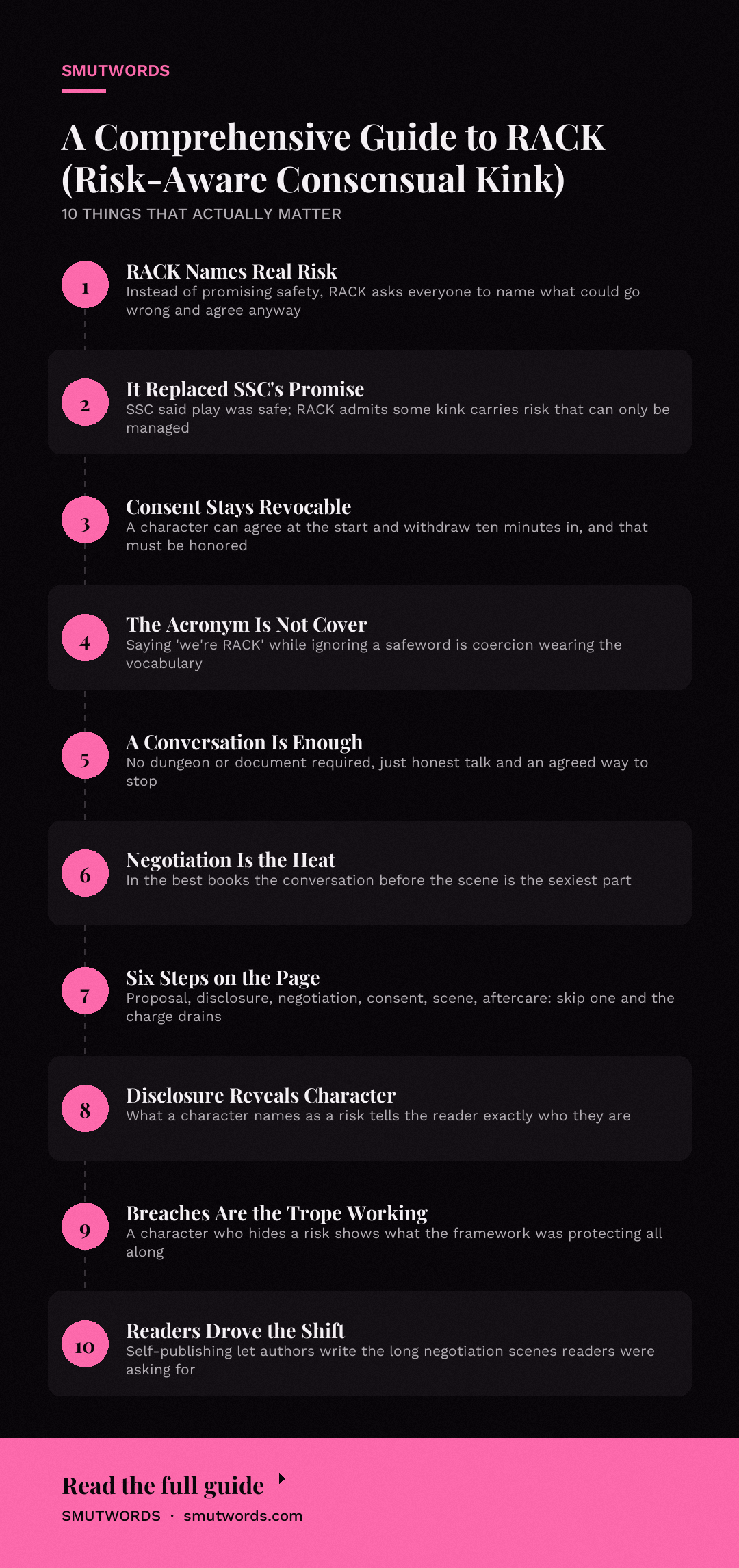
RACK stands for Risk-Aware Consensual Kink. It is the negotiation framework that treats kink as an adult activity with real, nameable consequences that everyone involved agrees to on purpose. Instead of promising that a scene will be safe, RACK asks the people in it to say out loud what could go wrong, decide together that the reward is worth the risk, and consent to that specific risk with full information.
In erotica, RACK (risk-aware consensual kink) shows up as the conversation before the rope comes out, the safeword chosen in advance, and the aftercare that follows a scene the characters chose with their eyes open. It is the difference between a story where kink happens to someone and a story where kink is chosen by everyone in the room.
If you have read enough kink romance to notice that the best books spend real page time on negotiation, limits, and check-ins, you have already met RACK in fiction. This guide covers what the term actually means, where it came from, how authors use it on the page, and what separates a RACK-based scene that crackles from one that reads like a consent checklist stapled to a sex scene.
What RACK (Risk-Aware Consensual Kink) Actually Means
The acronym is doing specific work. Risk-Aware means the participants have discussed and understood the actual hazards of what they are about to do, whether physical or emotional. Consensual means every person involved has agreed, freely and with full information. Kink is the umbrella for the activity itself: bondage, impact, power exchange, edgeplay, sensory play, whatever the scene involves.
The framework emerged as a corrective to SSC, Safe, Sane, and Consensual, which had been the dominant BDSM motto since the 1980s. SSC is a solid baseline, and plenty of people still use it.
The critique is that "safe" is not always honest. Some kink carries inherent risk that cannot be eliminated, only managed: breath play, knife play, heavy impact, rope suspension. Calling those things "safe" can lull people into skipping the harder conversations.
RACK replaces the promise of safety with a promise of honesty. The question shifts from "is this safe?" to "what are the risks, and does everyone understand and accept them?" That sounds like a small tweak. In practice it changes how negotiation works, because it forces the people involved to name specifics rather than wave at a vague idea of caution.
What counts as RACK
A scene fits under RACK when the people in it have had an explicit conversation about the risks involved, agreed to those specific risks, established safewords and a way to stop, and planned for what happens after. The disclosure has to be real: not "we talked about it once" but a genuine back-and-forth where anyone can raise a concern and the scene adjusts if needed.
In fiction, this often appears as a negotiation scene before a new kind of scene play begins, especially when the characters are trying something one of them has not done before. The conversation itself becomes part of the erotic tension, because it shows trust being built in real time.
What does not count
RACK is not a magic word that makes anything permissible. A character who says "we're RACK" and then ignores a safeword, hides a known risk, or pressures a partner into agreeing is not practicing RACK; they are using the vocabulary as cover. That distinction matters enormously in erotica, because the difference between a dominant character who is RACK-fluent and one who is simply coercive is the whole moral architecture of the story.
RACK also is not the same as blanket consent or a contract signed once and never revisited. Consent under RACK is ongoing, specific, and revocable. A character can agree to something at the start of a scene and withdraw that agreement ten minutes in. The framework only works if that withdrawal is honored without punishment or sulking.
Common misconceptions
People often assume RACK requires a formal document, a dungeon, or a community membership. It requires a conversation. Two people in a bedroom can practice RACK with nothing more than honest talk and an agreed safeword. The formality is optional; the honesty is not.
Another frequent misunderstanding is that RACK means the risks are minor. Some RACK-based play involves genuinely serious risk, which is exactly why the disclosure matters. The framework does not minimize danger; it makes danger visible so adults can decide about it together.
A third misconception, common among readers new to kink fiction, is that RACK and romance are in tension. They are not. Plenty of the best kink romance treats negotiation as a form of intimacy, sometimes the most intimate thing the characters do.
Where RACK Comes From
The acronym was coined in the early 2000s within real-world BDSM communities, as a response to the limits of SSC. The exact origin is usually credited to conversations among kink educators and writers who wanted language that could hold edgeplay, the kind of play where "safe" was never an honest label. Gary Switch is often named in connection with the term, though the idea circulated through community discussion before any single attribution stuck.
From there, RACK moved into educational writing, kink workshops, and eventually the vocabulary of erotica. The timeline matters: SSC had a two-decade head start in fiction, so early BDSM romance is full of characters reciting "safe, sane, and consensual" like a password. RACK arrived later and gave authors a more precise tool for the specific kind of story they were trying to tell.
How the trope evolved in romance publishing
In the 1990s and 2000s, kink romance and erotica often treated consent as a single scene: the hero asks, the heroine says yes, and the story moves on. The negotiation was brief, sometimes a paragraph. That reflected both the publishing norms of the era and the dominance of SSC in community language.
As self-publishing expanded the genre in the 2010s, authors had more room to write the conversations readers were asking for. Long negotiation scenes became a recognizable feature of the genre, sometimes a full chapter. The rise of dark romance pushed the conversation in two directions: some books used RACK language to earn the intensity of their scenarios, while others deliberately wrote characters who fail at RACK and have to learn.
The most recent shift is toward specificity. Readers who know the vocabulary can tell when an author is name-dropping RACK versus actually building the framework into the plot. Books that get it right tend to be the ones readers recommend to each other in group chats, because the rigor is part of the appeal.
A publishing phenomenon as much as a practice
Worth saying plainly: RACK's history in erotica is a history of reader demand. The framework existed in kink communities first, but its prominence in fiction tracks the growth of a readership that wanted kink depicted with adult accountability rather than as pure fantasy of loss of control. Authors who understood that readership wrote to it, and the standard rose.
The term now appears in author's notes, content warnings, and reader guides, not just in the prose. That is a small marker of how thoroughly the framework has been absorbed into the genre's infrastructure. RACK is part of how kink romance talks about itself, alongside safewords and aftercare.
How RACK Shows Up in Erotica
The craft question is this: how does an author put risk-aware negotiation on the page without killing the heat? The answer, in the books that do it well, is that the conversation is where the heat lives. Negotiation is a scene, with its own tension, pacing, and intimacy. Two characters naming their limits and agreeing to try something anyway can be more charged than the act itself.
The strongest versions of this trope treat the negotiation as characterization. What a character discloses about their own risk tolerance tells you who they are. A dominant who insists on naming every hazard before a scene is revealing caution, control, and care.
A submissive who asks for the hard version and explains why is revealing self-knowledge. The reader learns the characters through what they agree to.
Enjoyed this? Get a free book.
Join the list and we will send a complete free story straight to your inbox, plus new releases every week after that. No credit card, no catch.
The structure of a RACK scene on the page
Most well-executed RACK scenes in fiction follow a recognizable shape:
- The proposal. One character suggests the new thing: a heavier wooden paddle scene, a longer restraint, a scenario that involves real emotional exposure.
- The disclosure. The other character or characters spell out the risks, physical and emotional. This is where the book earns its credibility, because the risks have to be specific to the scenario.
- The negotiation. Safewords, limits, how to signal a stop, how far is allowed to go, what happens after.
- The consent moment. An explicit yes, given with full information. The moment lands harder than it would if the characters skipped the first three steps.
- The scene itself. Now the intensity has weight, because the reader knows exactly what was agreed to and why.
- Aftercare and debrief. The check-in afterward can be as intimate as anything that came before. For a thorough look at why this step matters, see What Is Impact Play Aftercare? A Reader's Complete Guide.
When this structure is compressed or skipped, the scene still works as a sex scene, but it loses the specific charge that RACK readers are chasing. The negotiation is not a prelude to the good part. In the best books it is the good part, or at least one of them.
Common variations
The teaching version. One character is experienced with RACK, the other is new or has only read about it. The negotiation doubles as education, and the reader learns alongside the newer character. This is one of the most popular variations, because it lets the book explain the framework naturally.
The renegotiation. A couple who has been playing for a while needs to update their agreement, either because one of them has changed or because they want to go further. This version has extra richness because it involves established history, sometimes including a previous failure of the framework that they are now correcting.
The mixed-experience negotiation. A kink character pairs with a vanilla partner, and the RACK conversation becomes a broader conversation about how to share a life. If that dynamic interests you, When One Partner Is Kinky and the Other Is Vanilla: Negotiating a Mixed-Desire Relationship covers the broader relationship mechanics, and our glossary entry on the vanilla/kink mix relationship handles the genre-specific side.
The high-stakes negotiation. The scene involves edgeplay where the risks are genuine and serious. Here RACK disclosure has to be detailed, and the negotiation becomes the moral center of the book. A lot of dark romance uses this shape to justify scenarios that would otherwise be unreadable.
What separates a strong RACK scene from a flat one
A strong version names specific risks and shows characters responding to them with real reasoning. A flat version recites the acronym and treats it like a password. Readers can tell the difference within a page.
A strong version lets the negotiation change something. Maybe a limit gets discovered, or a character admits a fear, or the plan shifts because of what came up. A flat version treats negotiation as a box to check before the actual scene begins.
A strong version puts the negotiation in the characters' voices. The dominant character's version of a risk disclosure reads differently than the submissive's, and the book knows that. A flat version has every character speak the same consent-education paragraph.
Finally, a strong version lets the framework have a cost. RACK requires honesty, and honesty is hard. Characters who withhold information about a risk and get caught are not breaking the trope; they are the trope working as intended, because the book uses the breach to show how much the framework was protecting.
A note on real-world practice
In real BDSM communities, RACK requires upfront discussion of potential physical and emotional harms, including the ones that cannot be fully mitigated. Practitioners agree on safewords and stopping protocols before play begins, and plan aftercare to manage unintended consequences. For the real-world safety side of bondage specifically, our bondage safety entry covers the practical basics. Fiction is fiction, but the stories that earn their intensity tend to be the ones grounded in how the practice actually works.
RACK vs SSC and Aftercare: Related Terms, No Real Confusion
RACK gets compared to SSC, Safe, Sane, and Consensual, often and legitimately. SSC is the more conservative cousin: it emphasizes eliminating risk rather than honestly disclosing it. The two frameworks agree on the importance of consent and differ on how to talk about safety. Plenty of communities use both, and authors can use either in fiction as long as they are consistent.
The other term readers sometimes mix up with RACK is aftercare, which is not a framework but a component. Aftercare is what happens after a scene: the physical care, emotional processing, and reconnection that RACK-based negotiation typically includes as part of its plan. Our glossary entry on impact play aftercare covers the specifics, and it is worth reading alongside this guide because the two concepts only make full sense together.
Frequently Asked Questions
What does RACK stand for in BDSM?
RACK stands for Risk-Aware Consensual Kink. It is a negotiation framework that asks participants to disclose the specific risks of a scene, agree to those risks with full information, and plan for safewords and aftercare. It emerged as an alternative to SSC, the older safe, sane, and consensual motto.
Is RACK the same as SSC?
No. SSC emphasizes that play should be safe, while RACK acknowledges that some kink carries risk that cannot be eliminated and asks participants to be honest about it. RACK treats safety as something to be managed and disclosed rather than guaranteed. Many practitioners use elements of both frameworks.
Why do readers like RACK-based erotica?
Readers drawn to RACK-based stories appreciate the rigor and mutual accountability it brings to kink. Characters engage in play with a clear-eyed respect for each other's limits and the real stakes involved, which can make the scenes feel more intimate and more emotionally serious. The negotiation itself often becomes the sexiest part of the book.
Can a RACK scene go wrong in fiction?
Yes, and some of the best books are about exactly that. A character withholding information, ignoring a safeword, or treating the framework as a password creates real conflict. The breach is not a failure of the trope; it is the trope doing its job, because it shows what the framework was protecting against.
Does RACK always require a formal safeword?
RACK requires an agreed way to stop, but the form is flexible. Some couples use a formal safeword, some use a traffic-light system, some use a plain English "stop." The important part is that everyone knows the mechanism in advance and trusts that it will be honored without consequences.
How much negotiation is too much for a novel?
There is no fixed number, but the books that do this best tie the negotiation to character. Every line of disclosure should teach the reader something about who these people are. When the negotiation starts to feel like an education pamphlet, it has gone too far; when it feels like two people finding out what they can trust each other with, it is working.
Final Thoughts
RACK gives authors a way to write intensity without pretending it comes free, and it gives characters a reason to talk to each other that is as charged as anything they do with their hands. The framework rewards readers who want kink written like it happens between adults.
If you want to see the full structure of one of these scenes on the page, start with anticipation play as a companion concept. The two work together more often than you might expect, since the most successful RACK negotiations build tension deliberately before anything is agreed to.
The best next read is whichever kink romance you have been putting off because the negotiation seemed like homework. Read it for the conversation. That is where the good stuff is.





Loading comments…