
Most couples never have the conversation. They get three years in, one of them finally says the thing out loud, and the other one goes quiet in a way that makes the whole room feel smaller. That silence is where the real damage happens.
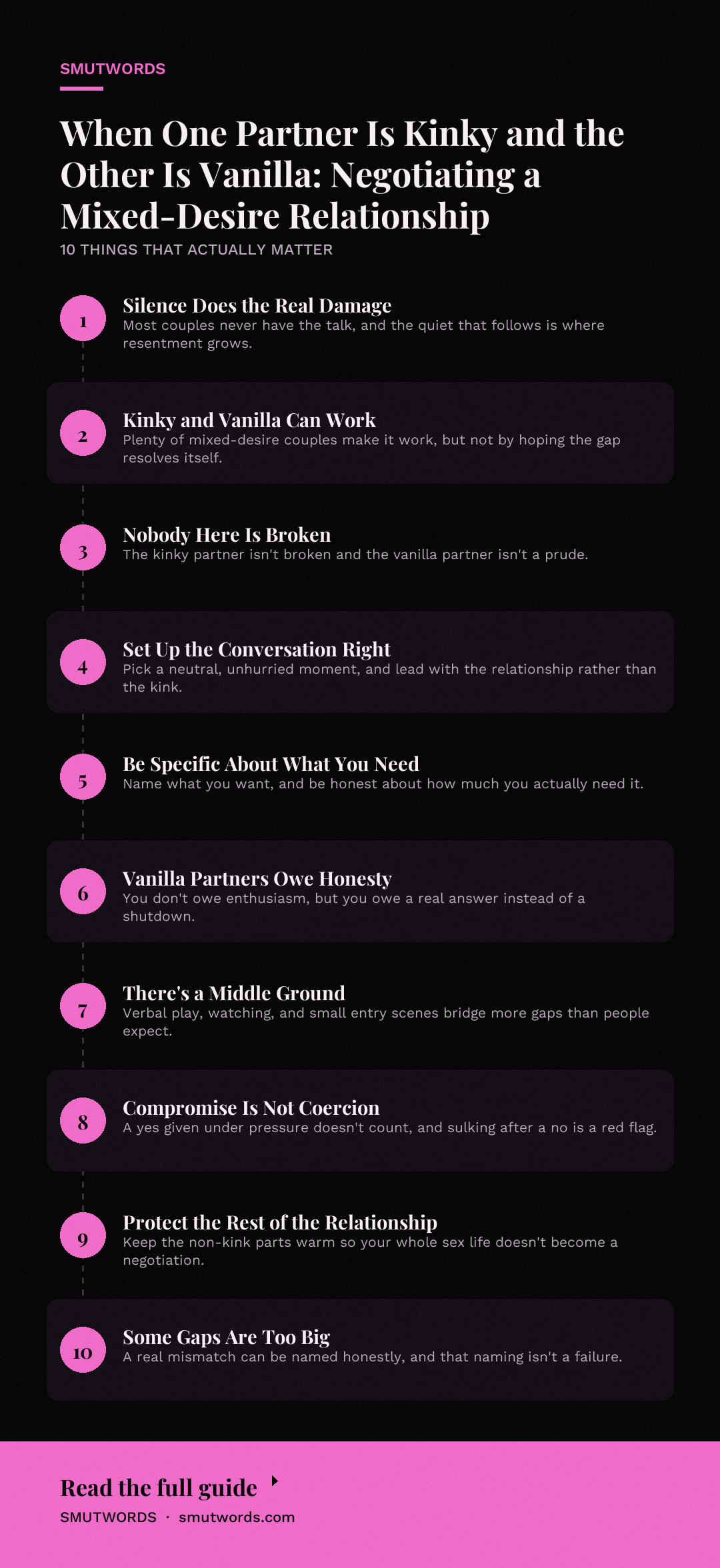
A kinky and vanilla relationship can work. It can work well, in fact, and plenty of them do, but not by hoping the mismatch resolves itself.
This guide is for the person who has a specific thing they want and a partner who doesn't share it, or for the partner who just heard the request and isn't sure what to do with their face right now. Both of you are welcome here. The goal isn't to convert anyone. It's to figure out what's actually possible before resentment does the deciding for you.
What "Kinky and Vanilla" Actually Means in Practice
Vanilla isn't an insult and it isn't a fixed state. It means a person's erotic map doesn't include power exchange, pain, restraint, specific fetishes, or whatever else the kinky partner is drawn to.
Some vanilla people have zero interest in changing that. Some are curious but nervous. Some are kinky and just haven't named it yet.
The kink itself can be almost anything. A uniform fetish, a breeding fantasy, a craving to be watched, a desire for financial domination where one partner controls the money. The shape matters less than the intensity of the gap. A couple where one person wants light spanking once a month is having a very different conversation than a couple where one person needs total power exchange to get off.
Here's the part people skip: the kinky partner is not broken and the vanilla partner is not a prude. Mismatched desire is common enough that most couples therapists have a version of this conversation in their notes. What kills relationships isn't the mismatch. It's the shame spiral on one side and the pressure campaign on the other.
Why Mixed-Desire Couples Struggle (And Where It Goes Wrong)
The pattern usually follows a predictable script. The kinky partner drops a hint, gets a lukewarm response, retreats, and starts building a private fantasy life that doesn't include their partner. The vanilla partner senses something is being withheld and assumes the worst. Both people end up feeling rejected by someone who actually loves them.
There's a specific cruelty in this dynamic when it involves kinks that carry a shame charge. A breeding kink, a cuckold scenario, a bully cuck dynamic. These are the ones people sit on for a decade because they're terrified of the reaction.
The longer the silence runs, the bigger the fantasy gets in the kinky partner's head, and the harder it becomes to say out loud without it sounding like a confession of something shameful.
The other failure mode is worse. One partner agrees to things they don't want in order to keep the relationship.
They perform. They tolerate. They do the scene and then lie in bed feeling used.
The kinky partner can tell something is off but doesn't want to ask, because the answer might end it. That's not compromise. That's a slow leak, and it always eventually floods.
How to Bring It Up Without Blowing Up the Relationship
Timing and framing do most of the work here. Don't bring it up during sex, right after sex, or during an argument. Don't bring it up at 11pm when you're both tired. Pick a neutral moment when nobody is hungry and nobody has to leave in twenty minutes.
Lead with the relationship, not the kink. Something like "I want to talk about something that's been on my mind and I need you to hear the whole thing before you respond" gives your partner a chance to put their defenses down instead of bracing for a request they think is a threat.
Be specific about what you want and honest about how much you need it. "I'd like to try being tied up sometimes" is a request. "I can't stay in a relationship where this never happens" is information the other person deserves.
Neither one is manipulative on its own. Hiding both and hoping your partner magically figures it out is where things get ugly.
What to say if you're the vanilla partner
You don't owe enthusiasm. You owe honesty. A few responses that land better than "what is wrong with you":
- "I don't think I want to do that, but I want to understand why it matters to you before I say no."
- "Some of that scares me and I need to figure out which parts and why."
- "I might be open to trying something small, and I need to be able to stop and have that be okay."
- "I don't think I can give you what you're describing, and I need us to talk about what that means for us."
That last one is the hardest sentence in this entire article. If you say it, say it like you mean it, and then sit with the conversation your partner wants to have rather than shutting it down.
The Compromise Ladder: What Actually Works
Most couples who make this work well land somewhere that neither partner would have predicted at the start. The kinky partner doesn't get everything. The vanilla partner doesn't get to pretend the request was never made. The relationship survives because both people find something they can genuinely say yes to.
Here's the ladder, roughly from least to most intimate gap-bridging:
- Verbal participation. The vanilla partner talks about the fantasy during sex, tells a story, asks questions. No action required, and for a lot of kinky people this covers 60% of the need.
- Bystander role. The vanilla partner watches or supervises while the kinky partner plays alone, directs, or narrates. Common in cuckold and exhibitionist dynamics.
- Low-stakes entry scenes. A blindfold, a rope wrapped loosely around the wrists, one bossy sentence. The vanilla partner gives a taste without committing to a whole identity.
- Structured roleplay. The partner isn't in the kink headspace but is in the role. Many couples who read things like Watched and Whispered or Officer's Orders: Breed Her find that fiction gives them a script to borrow from without having to invent one from scratch.
- Open or hall-pass arrangements. A real option for some couples and a detonation for others. This one only works when it's offered freely and both people genuinely want it, which means it should never be the first thing on the table.
- Full kink compatibility. Occasionally the vanilla partner turns out to be the kinky partner in disguise and everything clicks into place. Rare but real.
The ladder isn't a progression you're supposed to climb. Plenty of couples live happily on rung two for years. The point is that there are options in between "you do everything I want" and "we break up over this."
Enjoyed this? Get a free book.
Join the list and we will send a complete free story straight to your inbox, plus new releases every week after that. No credit card, no catch.
What Compromise Is Not
Compromise is not coercion with a relationship soundtrack. If your partner says yes to something under pressure, that yes doesn't count. The kinky partner needs to know how to hear a no, and the vanilla partner needs to know how to give one without apologizing for it.
Red flags that a mixed-desire negotiation has gone sideways:
- The kinky partner sulks, goes cold, or punishes the vanilla partner for a no.
- The vanilla partner agrees to scenes they don't want and then finds excuses to avoid them.
- Kink gets weaponized in arguments. "You never do anything for me" is a fight, not a negotiation.
- One partner starts keeping secrets about what they actually want instead of speaking up.
- Someone in the relationship is reading fiction that describes their exact dynamic and hiding it from their partner out of embarrassment.
If you're the kinky partner and you find yourself checking whether you can pressure your partner into it, stop and look at that. The fantasy of being wanted is not the same as the fantasy of being the one who wears your partner down. Consent you had to extract isn't the thing you actually wanted.
Protecting the Relationship While You Figure It Out
The relationship itself needs ground rules for the conversation, not just the kink. Agree in advance that you can pause the discussion, that neither of you gets to make a permanent decision during a hard conversation, and that you'll come back to it on a specific day rather than letting it hang for months.
Weekly check-ins help more than couples therapy in the early stage, and therapy helps more than check-ins later. Find a sex-positive couples therapist if you can. A regular therapist who's never talked to a kink couple before can do more harm than good by treating the kink as the problem.
Keep the non-kink parts of your relationship warm. If your entire sex life becomes a negotiation, you'll both start dreading it. Protect the vanilla sex that works. Have it on purpose.
Kink and vanilla can coexist in the same week, and a lot of couples find the vanilla acts as a pressure valve that makes the kink conversations easier.
If you're a couple who reads together, use that. Shared reading is one of the easiest low-pressure ways to talk about desire without it being about you specifically. You can point at a passage and say "this part is interesting to me" without committing to anything. It's a leading question disguised as book club, and it works.
If you want to go further with the structure side of this, building rituals in a power-exchange relationship covers small rules that hold up over time, including for the low-stakes end of the ladder.
When Kink Goes Outside the Relationship
Some couples eventually open up. The kinky partner gets a play partner who shares the kink and a relationship that stays intact for everything else. This can work beautifully and it can be a disaster, and the difference is almost never how kinky the third party is.
Prerequisites, in no particular order:
- Both partners genuinely want the arrangement, not one partner wearing down the other.
- Ground rules are written down and specific. Who, where, when, what's on the table, what's off, and who tells whom afterward.
- The vanilla partner gets something out of it, even if that something is just more of a happy partner.
- Jealousy is allowed to happen and is managed with communication rather than dismissed.
- There's an agreement about renegotiation. Any partner gets to say "this isn't working" and be taken seriously.
If you're the vanilla partner who's considering this and your primary feeling is dread with a chaser of guilt, the answer is not yet. Maybe not ever. An open relationship with a reluctant participant is just a long goodbye with extra steps.
Couples who read things like He's Not Jealous often find it gives them a vocabulary for this that they didn't have before. The book dramatizes the jealousy question rather than resolving it for you, which is what you want. You need to feel the sharp edges of it before you decide where your own line is.
When the Gap Is Too Big
Sometimes the honest answer is that the mismatch is not bridgeable. A person who needs power exchange to feel erotic and a person who finds it actively aversive are looking at a real incompatibility. Naming that is not a failure.
Marriages in trouble often operate for years under the assumption that love can substitute for compatible desire. It can't, entirely, and pretending otherwise eventually costs both people.
That doesn't mean the relationship has to end. It means the honest conversation is "this is a real limitation, what do we both want to do about it?" rather than "if you loved me you'd try harder." A couple can decide that the relationship is worth more than the missing kink, and live with the gap consciously. That's a legitimate choice. It just has to be a chosen one, not a resentful one.
Some couples find their way into roleplay that borrows from fiction without being fully their own kink. Books like Free Use Wedding: A Free-Use Bride Fantasy or darker material like The Crimson Breeding Chambers give the kinky partner language to describe the fantasy and give the vanilla partner a structured rehearsal space.
It's fiction, and it works as fiction. But a lot of couples find the fiction opens a conversation the direct ask couldn't. That's the same move as a vampire romance giving two people a safe frame to talk about wanting something they'd never say plainly.
Final Thoughts
The book to hand your partner if they're the one who's confused and scared by the request is Free Use Wedding: A Free-Use Bride Fantasy. It's a bounded, contained fantasy, so it gives the vanilla partner something to react to that doesn't require them to participate yet. Read it together, or let them read it alone first. If they come back with questions, that's the conversation starting.
A mixed-desire relationship is not a doomed one. It's a relationship that has to do more talking about sex than most couples ever do.
That's a real burden. It's also a real opportunity. The couples who come out the other side aren't the ones who had matching kinks. They're the ones who figured out how to hear each other without either person's desire getting buried.





Loading comments…