
Seduction roleplay is a consensual erotic scenario where partners act out a chase. One person pursues. The other resists, or plays hard to get, and the tension of that pursuit becomes the entire point.
The frame turns ordinary flirtation into theater, letting couples rehearse the thrill of being wanted, caught, and gradually won over without the real-world uncertainty that makes actual courtship so nerve-racking. It is one of the most popular setups in erotic fiction and in the bedroom for the same reason: anticipation is a drug, and this kink lets you mainline it on purpose.
If you have ever read a scene where a stranger buys a woman a drink and refuses to take no for an answer until she changes her mind, or a boss who calls an employee into his office after hours and closes the door, you have already met this trope. It shows up everywhere from classic category romance to contemporary erotica.
The pleasure lives in the gap between what a character says and what she actually wants. The reader knows the resistance is theater, and that knowledge is what makes the scene work.
What Seduction Roleplay Actually Means
The word seduction carries a specific weight. It implies a campaign, a slow wearing-down, a deliberate effort to make someone want you who did not want you a moment ago. That is different from mutual attraction that simply gets acted on. Seduction roleplay takes that dynamic and makes it explicit, often with agreed-upon roles: the pursuer and the pursued, the seducer and the reluctant prize, the hunter and the thing worth hunting.
What counts as seduction roleplay is broader than people assume. It does not require costumes or a full script. A couple who agree that she will pretend to be a stranger at a bar and he will try to pick her up is doing it. So is a pair who decide that one of them will spend the evening pretending indifference while the other works to earn a yes.
The defining feature is the performance of pursuit and the performance of resistance. Both consensual, both deliberate.
What does not count is anything where the resistance is real. This is the single most important distinction in the entire kink. Consensual non-consent play can overlap with seduction roleplay, but they are not the same thing, and the difference matters. Seduction roleplay is a game both people agreed to play.
If one person is genuinely uncomfortable, genuinely pressured, or genuinely unsure, the scene has stopped being roleplay. It has become something else, and not a good something else.
Common misconceptions pile up here. Newcomers sometimes think seduction roleplay means one person does all the work while the other lies there. It does not. Playing the pursued role is active, demanding, and creative.
You have to decide how long to hold out, when to soften, what small signals to give that keep the pursuer interested without collapsing the tension too early. It is a two-hander, and the person saying no is often working harder than the person saying please.
Others assume the kink is inherently gendered, that the man must pursue and the woman must resist. The trope has a long history in that shape, mostly because publishing conventions pushed it there for decades, but the dynamic works in any configuration. Two women, two men, nonbinary partners, any mix at all. The pursuit-and-resistance structure is about energy and timing, not about who has which body parts.
Where Seduction Roleplay Comes From
The "chase" is one of the oldest structures in erotic storytelling, going back well past the novel. What changed is how it got packaged.
In nineteenth-century fiction, seduction was usually a warning, a moral catastrophe dressed up in thrilling prose. The reader was supposed to be scandalized while secretly enjoying every page. That tension between permission and pleasure never really went away.
Twentieth-century category romance rebuilt the seduction into something more sympathetic. The pursuer became a romantic hero rather than a villain, and the resistance became a test of his worthiness. Harlequin and its competitors published thousands of books where a strong-willed woman holds out and a determined man earns her. The formula worked so well it dominated the market for decades.
The shift that matters for modern readers came when authors started letting the pursued character want it from the beginning. Once the resistance became openly theatrical, the genre could have fun with it. You got heroines who were playing hard to get on purpose, seducers who knew exactly how the game worked, and scenes where both people were in on the joke. That is the version that shows up in erotica now.
Digital publishing accelerated everything. When indie authors could write exactly the seduction scenes they wanted without a publisher's approval, the trope exploded into subcategories: boss and employee, stranger at the bar, arranged marriage where the spouses seduce each other, forbidden scenarios of every shape. The chase got faster, dirtier, and more openly consensual, and readers ate it up. The category is now one of the most reliably popular in erotic romance.
Costumed variants, period-set seductions, and role reversals all grew from that same soil. The trope is durable because it is flexible. You can set it in a Regency ballroom, a corporate boardroom, or a dive bar at 2 a.m. and it still works, as long as the chase has stakes.
How It Shows Up in Erotica
On the page, seduction roleplay is a pacing machine. Authors use it to delay gratification for as long as possible, because the delay is what makes the payoff hit. A strong seduction scene stretches the moment of almost-yes across chapters, letting the reader ache along with the pursuer and feel the pursued character's resolve thinning by degrees.
The craft problem is that if the resistance feels arbitrary, the reader gets bored, and if the pursuit feels coercive, the reader gets uncomfortable. The best authors solve this by giving the pursued character a real inner life. She has a reason to hold out, whether it is pride, self-protection, professional rules, or just the desire to be properly chased. And she gives small tells, so the reader knows she is close to surrendering even when the pursuer does not.
Authors also build the seducer's campaign out of escalating beats. A glance becomes a conversation, a conversation becomes a touch, a touch becomes a question.
Enjoyed this? Get a free book.
Join the list and we will send a complete free story straight to your inbox, plus new releases every week after that. No credit card, no catch.
Each beat has to earn the next one. If the pursuer skips steps, the payoff feels cheap. The accumulation is what makes the consummation feel earned and explosive, exactly as readers hope for.
Common variations on the page include:
- Stranger roleplay, where two established partners pretend not to know each other. The scene has a bar, a pickup attempt, and the thrill of being seduced by someone familiar playing unfamiliar.
- Boss and employee, where workplace hierarchies create instant friction. The power differential is fake, agreed upon, and often abandoned the moment the scene ends.
- Forbidden seduction, where social rules (marriage, family, profession) make the resistance credible without requiring either character to be dishonest about wanting it.
- Fake reluctance, where the pursued character says no but behaves yes. This one is the tightest rope to walk because it edges closest to the line with real consent.
- Costumed seducer, where a mask, a uniform, or a period outfit signals the theatrical frame from the jump, making it easy for the reader to relax into the game.
Strong scenes share a few traits. Both characters know what is happening. The resistance is playful rather than cruel. There is always a signal, verbal or physical, that means the scene can slow down or stop.
And the seducer pays attention, adjusting in real time rather than pushing through.
A praise kink often enters here, because the pursued character wants to hear that she is worth chasing, and the seducer is happy to say it.
Weaker versions lean on the same beats without doing the underlying work. The resistance is a placeholder, the seduction is a checklist, and the payoff lands flat because no one invested in the delay. An editor reading a hundred of these can spot the flat ones within a page. The texture is missing; the two people are not really watching each other.
Where seduction roleplay intersects with familiar tropes, it often amplifies them. A scene between two people in a friends with benefits arrangement can escalate through a seduction game that neither admits is real. A storyline that begins as a one night stand can use seduction beats to delay the sex past the first chapter, creating a slow burn where the reader did not expect one.
Even a crowded scene works: seduction roleplay inside an orgy often runs as a side plot between two guests while everything else happens around them.
Costume and setting do a lot of lifting here. Writers often use an audience-free but public-feeling setting to add a whiff of the thrill that makes exhibitionism in erotica so effective. That is not the same kink, but the two often layer. A seduction that could be seen becomes more charged for both characters.
And the line between consensual roleplay and something darker is one authors have to handle with care, which is why the conversation around dubcon in romance keeps circling back to seduction scenes.
Seduction Roleplay vs Rough Sex
These two get tangled constantly, and the confusion is worth untangling. Seduction roleplay is about the chase: the tension of pursuit, the slow softening of resistance, the buildup toward a yes. Rough sex is about intensity during the act itself: speed, force, marks, the physical sensations of being handled hard. A scene can use both, and many do, but they are separate skills and separate agreements.
The tell is where the energy lives. If the heat comes from whether she will say yes, you are in seduction roleplay territory. If the heat comes from how hard he takes her once she has, that is rough sex. Dramatic scripts often move from one into the other, which is why readers conflate them.
When planning a scene, talk about each separately. Agree on the seduction beats and agree on the roughness level, because one set of limits does not automatically cover the other.
Frequently Asked Questions
Is seduction roleplay the same as consensual non-consent?
They overlap but are not identical. Consensual non-consent play frames the scene as if consent were absent, while seduction roleplay keeps the no playful and the yes inevitable. The pursuit-and-resistance structure can slide into CNC territory if partners push the resistance hard, which is why agreeing on boundaries and a safeword up front matters.
What do you say to a partner before trying it?
Be direct about what you want to play out and why it excites you. Name the roles, the setting, and any specific beats you are picturing, then ask what your partner wants to add or avoid. The conversation itself often builds anticipation, so treat it as part of the fun rather than a hurdle before the fun.
How do you make the resistance feel playful instead of mean?
Keep it light and active. A pursued character who teases, smiles, or gives small physical tells keeps the game legible. Cruelty, coldness, or genuine anger kills the energy fast. A quick check-in mid-scene (a raised eyebrow, a squeeze of the hand, a whispered "still good?") resets the frame without breaking it.
What if the resistance starts to feel too real during a scene?
Stop and check in. If either person feels pressured, unsafe, or genuinely upset, the scene has left the agreed-upon frame. Pause, talk, and either reset the intensity or end the scene. The whole point is that both people are in on the game, which means the moment it stops being a game, you stop.
Does seduction roleplay require costumes or props?
No. Costumes and props add flavor and can help signal the theatrical frame, but the kink runs on the pursuit dynamic itself. Many couples play it out in everyday clothes, in their own living room, with nothing more than an agreement about who is chasing and who is being chased.
Which scenarios are most popular in erotica?
Boss and employee, stranger at a bar, forbidden love (married, related-by-marriage, or socially off-limits), and arranged marriage setups where the spouses seduce each other after the wedding. These get the most play because each one supplies a built-in reason for the resistance that the reader accepts without question.
Final Thoughts
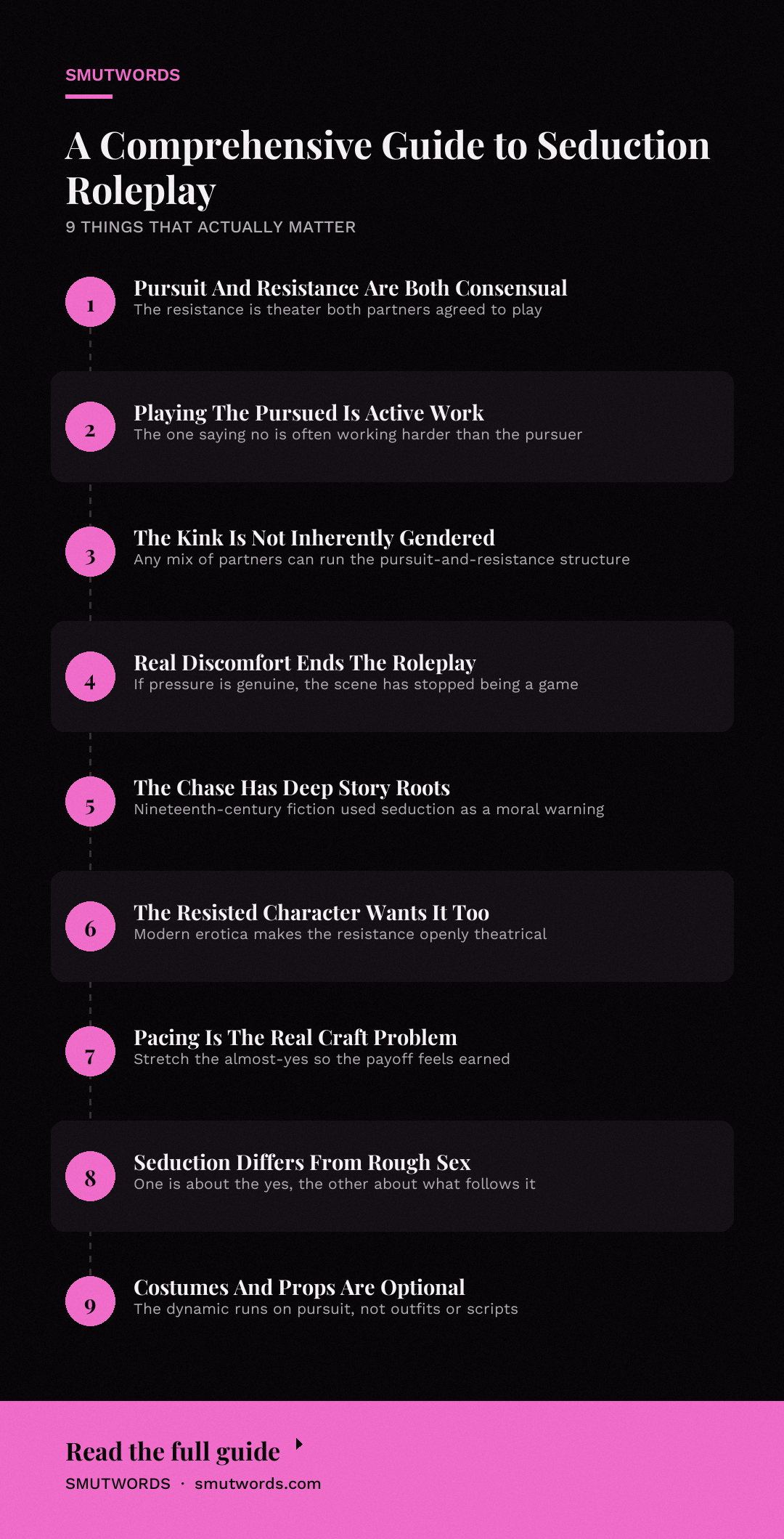
Seduction roleplay works because it turns the most nerve-racking part of courtship into something safe enough to enjoy. The chase, the almost-yes, the slow collapse of resolve: all of it becomes a game you and a partner agree to play, with signals and stop points built in. If you are writing it, the same logic applies on the page. Earn the delay, keep one eye on what each character actually wants, and the payoff takes care of itself.






Loading comments…