A soulbond is a paranormal or fantasy romance device in which two characters become psychically or magically linked, sharing emotions, sensations, thoughts, or pain, and usually ending up as romantic partners whether they planned to or not. The bond is the plot engine and the relationship at once. It removes the guessing game of early courtship and replaces it with something louder: a connection neither character can switch off, ignore, or fake.
If you have ever read a book where one lover flinches and the other feels it three kingdoms away, you have read a soulbond. This guide covers what the term actually means, where it came from in the genre, how it gets written on the page, and where authors succeed or fall flat with it. It is the long version, because the short glossary definition leaves out everything interesting.
What Soulbond Actually Means
At its core, a soulbond is an involuntary metaphysical connection between two people. The specifics vary wildly by author, but the shared traits are consistent. The link is established by something outside the characters' conscious control: fate, magic, a ritual, a god, biology, a near-death moment, or mutual trauma. Once it forms, it does not politely wait for consent or good timing.
What the bond transmits is where authors make their choices. Some bonds carry emotion only, so each character feels the other's fear, arousal, grief, or joy. Some carry physical sensation, meaning a wound on one body aches on both. Some carry full telepathy, which is the hardest version to write well because it kills most dialogue-based conflict.
The strongest versions usually mix two channels. Not all four.
The word itself is a modern genre coinage rather than an ancient term. "Soul" supplies the fated, spiritual weight. "Bond" supplies the mechanism, the tether, the thing that cannot be cut.
Mate bond, fated bond, heartmate, tether, and blood bond are the most common alt names, and each one signals a slightly different flavor. A heartmate suggests tenderness and destiny. A blood bond suggests something darker, transactional, possibly forged in violence.
What does not count matters too. A soulbond is not the same as two people simply being in love, no matter how intense. It is not a marriage of convenience, an arranged match, or a relationship that grows deep over time through ordinary means. A slow burn that eventually produces devotion is not a soulbond, even if the devotion is total.
The bond has to be a mechanism, and it has to arrive with a force that neither party chose. You can read more about the deliberate, patient alternative in our breakdown of slow burn coworker romance, which is the structural opposite of this trope.
Common misconceptions
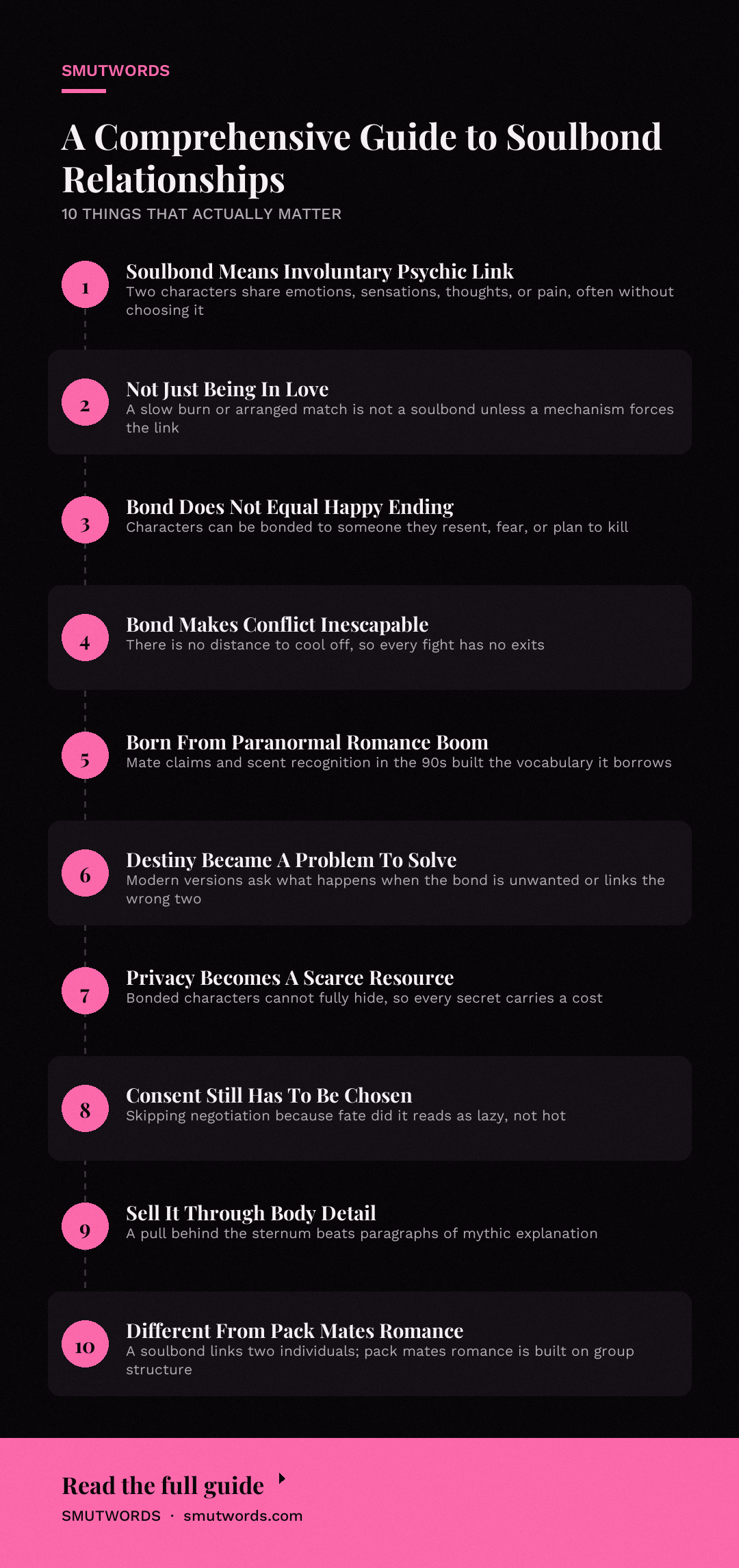
The biggest one is that a soulbond equals a happy ending. Plenty of books use the bond as a trap. A character can be bonded to someone they resent, fear, or have sworn to kill, and the bond becomes a cage with a heartbeat.
The second misconception is that the bond eliminates conflict. It does the reverse. It makes every conflict internal and inescapable, because the characters cannot get distance from each other to cool off. A bonded pair fighting is a fight with no exits.
The third is that a soulbond automatically means mind reading. Emotional transmission and full thought-sharing are different devices, and authors who treat them as the same thing usually write themselves into corners.
Where Soulbond Comes From
The honest answer is that the soulbond is a publishing phenomenon more than it is an inherited folklore tradition. The idea of fated lovers runs through centuries of literature. The specific trope as readers recognize it today grew up inside genre romance, and specifically inside paranormal romance during its commercial boom.
Through the 1990s and into the 2000s, vampire and shapeshifter romance established the vocabulary that the soulbond later borrowed: mate claims, scent recognition, possessive instincts, a biological or mystical pull that overrides social niceties. That period is where the mate bond solidified as a recognizable device. Our glossary entry on the territorial shifter trope covers a close cousin, where the bond expresses itself through guarding, marking, and aggressively staking claims on a person and a place.
The 2010s pushed the trope into new categories. Fae and elf romance made it ceremonial and ancient, with courts and oaths and binding rituals. Science fiction romance translated it into neural links, shared implants, and matched biology, which is where it overlaps heavily with alien romance and its tendency toward fated, biologically mandated pairings. Digital and constructed minds gave the trope another route entirely, explored in AI romance, where the link is engineered rather than decreed by fate.
The most visible evolution is in how much agency the characters get. Early versions treated the bond as a verdict: it exists, therefore the couple belongs together, and the story is mostly about the couple accepting that.
Contemporary versions interrogate it instead, turning the bond into a question the plot has to answer.
What if the bond is unwanted? What if it links the wrong two people? What if one partner can feel the other and chooses to lie anyway?
That shift from destiny-as-answer to destiny-as-problem is the single biggest change in how the trope reads.
The rise of self-publishing also changed the trope's texture. Shorter books, serialized releases, and reader demand for fast emotional payoff pushed the bond earlier in the story. A bond that used to be revealed two-thirds of the way in now frequently lands in the first fifty pages, because it is the hook, not the payoff.
How It Shows Up in Erotica
On the page, a soulbond does specific mechanical work that authors rely on. It creates instant emotional stakes, it justifies intense physical chemistry without a long courtship, and it gives every conflict a nerve ending. Here is what a strong scene or book actually does with it.
Enjoyed this? Get a free book.
Join the list and we will send a complete free story straight to your inbox, plus new releases every week after that. No credit card, no catch.
- It makes one person's reaction into two people's problem. If one character is turned on, the other feels it and has to decide what to do about it. That decision is the scene.
- It turns privacy into a resource. Bonded characters cannot fully hide. Every attempt at secrecy has a cost, and that cost is where tension lives.
- It weaponizes proximity. Being near the other person intensifies everything and being far away causes genuine distress, so distance becomes a punishment.
- It gives consent a sharper edge. If desire is transmitted involuntarily, then choosing to act on that desire is a meaningful act, and one worth writing carefully. If you want to think through how consent, negotiation, and power exchange are written in explicit fiction, our guide to the four letters of BDSM is a useful companion.
- It forces vulnerability in physical form. A character cannot fake composure if their partner can feel their heart rate spike.
Common variations authors reach for:
- Full emotional bond. A clean channel of feelings. Best for slow, aching intimacy and for making conflict unbearable.
- One-way bond. One partner feels everything, the other feels nothing. This is the most reliable engine for pining, jealousy, and dramatic irony.
- Partial blood bond. Forged through a ritual or an exchange, and frequently breakable at a price. This version lets you build a plot around severing it.
- Pack or group bond. The link extends beyond two people, which folds in hierarchy and group obligation. Our piece on pack dynamics goes deep on how those structures work in shifter and omegaverse fiction.
- Unwanted or enemy bond. The link arrives between two people on opposite sides. This one carries the highest stakes because neither can afford to feel what they feel.
What makes the strong versions work
Strong soulbond writing treats the bond as a constraint, not a solution. The bond should make the characters' lives harder in at least one concrete way and easier in exactly one way. If the bond only ever delivers comfort and reassurance, the tension evaporates and the book drifts into wish fulfillment with no edge.
The best versions also decide early what the bond can and cannot do, then never break the rule for convenience. If the link stops working during the one scene where breaking it would solve everything, that is a cheat, and readers feel it. Consistency is what makes the constraint feel real enough to generate heat.
Physical details sell the trope harder than exposition. A bond is best communicated through sensation: a pull behind the sternum, warmth that arrives without permission, sudden shared nausea, the unmistakable awareness of someone else's presence in a crowded room. Naming the body part and the texture of the feeling does more work than paragraphs of mythic explanation.
Finally, strong versions give the characters something to do besides the bond. A soulbond plot still needs a problem outside the relationship, because the bond alone cannot generate a full arc. The bond raises the temperature of that external problem, which is its actual job in the story.
What makes flat versions fail
The most common failure is using the bond as a substitute for character work. If neither character has a personality beyond their longing for the other, the bond amplifies nothing, and the reader has no reason to root for the pairing. The link magnifies existing chemistry. It cannot manufacture it from nothing.
The second failure is the consent skip. Some books use "fate did it" to vault past all negotiation, and it reads as lazy rather than hot. Readers who love this trope want the moment a character chooses to lean into the bond, because that choice is what makes the resulting scenes land. Without it, you get inevitability without arousal.
The third is over-explaining. Long lore lectures about how bonds form, who administers them, and what the ancient prophecy says can bury a scene that should have been about two people in a dark room feeling each other's pulse. Deliver the rules through the characters' experience, not through a lecture.
Soulbond vs Pack Mates Romance
These two get conflated constantly, and the distinction is worth making because the terms are not interchangeable. A soulbond links two individuals through a specific, often mystical mechanism. It can exist entirely outside any group structure. Two people on opposite sides of a war, alone, can carry a soulbond with no pack and no shifter biology involved.
Pack mates romance is built on group structure. The bond there is usually biological and collective, tied to a hierarchy of leaders and subordinates, with the mate relationship embedded in obligations to the whole group. You can read the full breakdown in our entry on pack mates romance, which covers how status, claiming, and group loyalty shape those pairings.
The practical difference for readers: a soulbond novel is usually about two people and the link between them. A pack mates novel is about two people and the world that has opinions about them. Some books run both, with a private bond nested inside a group structure, and when that is done well the individual link becomes the one place the characters can be honest.
Frequently Asked Questions
Is a soulbond the same as a mate bond?
They overlap heavily and many authors use them interchangeably. The working distinction is that a mate bond tends to carry biological or shifter framing, with scent, claiming, and heats, while a soulbond tends to carry mystical or magical framing, with rituals, fate, and gods. Plenty of books mix both without causing readers any trouble.
Can a soulbond be broken?
It depends entirely on the rules the author establishes. Some bonds are permanent, and the entire plot is about living inside something you cannot escape. Others can be severed by ritual, distance, death, or sacrifice, and severing becomes the central conflict. What matters is that the rules stay consistent once stated.
Why do readers love fated bonds so much?
Because they skip the exhausting part of courtship and go straight to emotional intensity. The connection is already undeniable, so every scene has weight. Conflict becomes more painful rather than less, and every touch carries the charge of something the characters did not choose but cannot refuse.
What is a one-way or unrequited soulbond?
One character feels the link fully while the other feels nothing or only a faint echo. It is a favorite variation because it produces pining, jealousy, and dramatic irony in the same breath, and it lets an author write a character who is desperate without being pathetic.
Does the soulbond trope only appear in paranormal romance?
No. It shows up in fantasy romance, science fiction romance, and even contemporary and urban fantasy settings where a witch or psychic mechanism supplies the link. Angel romance and elf romance use it with ceremonial and immortal framing, while speculative subgenres like kraken romance often rebuild it as a deep, almost oceanic empathic pull. The required ingredient is a fantasy or paranormal mechanism, not a specific creature.
How much of the bond should be explained to the reader?
Enough to establish the rules and no more. Readers need to know what the bond does, what it costs, and what it cannot do. They do not need a full cosmology. The strongest books deliver the mechanics through a character's body and choices, and let the mythology stay mostly in the background.
Final Thoughts
The soulbond is one of the most versatile devices in fantasy and paranormal romance because it does two jobs at once: it creates the relationship and it creates the pressure. Written as a constraint rather than a free pass, it produces some of the most intense emotional and physical scenes the genre has to offer. Written as an excuse to skip the hard parts, it flattens into inevitability with nothing behind it.
If you want to see the trope at full strength, start with a book that puts the bond between two people who have real reasons to resist it. The friction is where the heat comes from.







Loading comments…