
A slow burn coworker romance is a workplace love story where two people who see each other every single day spend months, sometimes years, wanting each other before anything happens. The tension comes from proximity and professionalism pulling in opposite directions: they share a conference room, a break room, a Slack channel, and a deadline, and none of it allows for the messy, honest thing they both want.
The slow burn coworker romance is the genre's most reliable engine for sustained sexual tension because the characters cannot simply avoid each other the way a stranger or a one-night stand can.
Every stolen glance across a meeting table has a cost. Every late night finishing a project together has a witness. That pressure is the whole point. Readers keep coming back because the payoff, when it finally lands, feels like it was paid for in installments.
What Slow Burn Coworker Romance Actually Means
The term comes from two ideas stitched together. "Slow burn" is borrowed from film and TV criticism to describe a story that withholds its central payoff while building heat underneath. "Coworker romance" locks the two leads into a shared professional space.
The combination is specific. A slow burn between neighbors or childhood friends is a different machine entirely, because neither of those settings forces eight hours of eye contact and small talk five days a week.
The defining trait is forced proximity with a professional alibi. Two colleagues can justify a coffee run, a carpool, a working dinner, a shared hotel room on a business trip, and every one of those moments is plausible as work.
That plausible deniability is what separates a coworker slow burn from other slow builds. The characters are not avoiding each other out of pride or fear alone; they are avoiding each other because HR exists, because a promotion is on the line, because the wrong move at the office Christmas party could end a career.
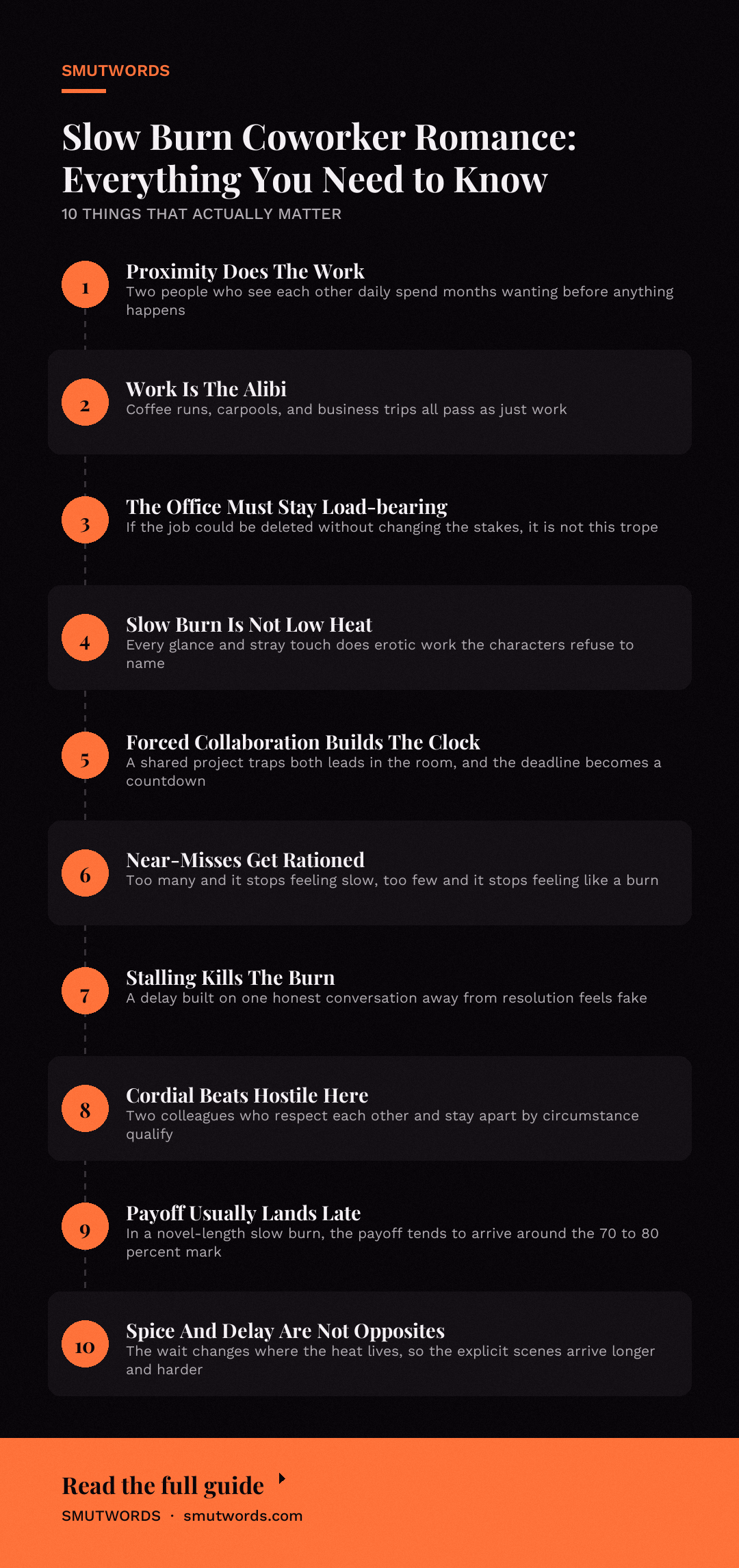
What does not count: a story where the two leads meet at work once and then the office vanishes for two hundred pages. A true slow burn coworker romance keeps the workplace present and load-bearing throughout. If the job could be deleted from the manuscript without changing the emotional stakes, it is not really this trope, no matter how slowly the characters move toward each other.
Another common misconception is that slow burn means low heat. It does not. A well-built slow burn is often filthier in its subtext than a fast-burn romance is in its explicit scenes, because every glance and stray touch is doing erotic work that the characters refuse to name out loud. The delay is the kink.
Where Slow Burn Coworker Romance Comes From
The trope's publishing history runs through two overlapping traditions: the office romance novel and the fanfiction slow burn. Workplace romance has been a staple of category romance since at least the mid-twentieth century, when Harlequin and Mills & Boon built entire lines around doctors, secretaries, and the men who employed them. Those early office romances were rarely slow; the tension resolved fast, often within a hundred pages.
The slow burn itself matured online. Fanfiction communities in the 2000s and 2010s turned "slow burn" into a tag with real weight, sometimes signaling a hundred thousand words before a first kiss. When those readers and writers moved into original romance publishing through the 2010s and 2020s, they brought the pacing with them, and the coworker setting became one of the most natural places to deploy it.
The pairing makes sense. Fanfiction slow burns often rely on a shared world (a school, a ship, a war) that keeps two characters in constant contact without letting them touch. The modern office does the same job with fewer explosions. Add the rise of remote and hybrid work in the 2020s, and the office itself became a more charged setting, since physical presence at work now carries more weight than it used to.
There has been a real shift in how the trope portrays power, too. Older office romances leaned hard on boss-employee dynamics with the boss holding all the cards and the heroine grateful for the attention.
Contemporary slow burn coworker romance has moved toward peer dynamics, rival teams, and mutual professional jeopardy. Part of that is readers getting tired of the imbalance. Part of it is that two people who are genuinely equals are simply more interesting to watch circle each other.
How It Shows Up in Erotica
On the page, this trope lives and dies in the small stuff. A slow burn coworker romance that works spends its first half building a vocabulary of stolen moments: the elevator that holds both of them for eleven floors, the shared umbrella in the parking lot, the moment one of them notices the other has changed their perfume. None of these are sex scenes. All of them are foreplay.
The strongest versions use the workplace as a pressure system, not a backdrop. What makes a scene land is the specific, mundane detail: a shared spreadsheet, a client dinner, a performance review that turns into something else entirely. The reader should feel the fluorescent lighting and the smell of break room coffee, and then feel how badly these two people want to get out of it together.
Authors working this trope tend to lean on a handful of recurring mechanics:
- Forced collaboration: a project, a pitch, or a merger that traps both leads in the same room for weeks. The deadline becomes a countdown clock for the tension itself.
- The after-hours scene: the office empties, one light stays on, and something is said that cannot be unsaid. Almost every slow burn coworker romance has at least one of these, and the best ones are not the first.
- The near-miss: a hand almost touches a hand, a sentence almost confesses everything, a door almost opens. These are rationed carefully; too many and the burn stops feeling slow, too few and it stops feeling like a burn.
- Rival colleagues: the office enemies to lovers variant takes a page from enemies to lovers and puts two people who openly dislike each other on the same team, then lets respect arrive before desire does.
- Outside interference: a workplace policy, an ex who works one floor down, or a boss who is watching too closely. These obstacles keep the two leads from simply resolving things in chapter four.
The flat version of this trope is easy to spot. If the delay comes only from a misunderstanding that could be solved by one honest conversation, the burn is fake; the author is stalling rather than building.
Enjoyed this? Get a free book.
Join the list and we will send a complete free story straight to your inbox, plus new releases every week after that. No credit card, no catch.
If the characters have no real reason to stay apart, the reader starts to resent the wasted time instead of savoring it. The genuine reason they do not act is almost always structural: their jobs, their ambition, their pride, or the fact that one of them is technically still someone else's boss.
Language matters here too. The best slow burn coworker romances are written in a register that matches the setting: clipped and professional on the surface, hungry underneath. Dialogue that starts as a status update and turns into something else within the same paragraph is the signature move. So is the repeated, specific detail, the same gesture or phrase that reappears with more weight each time.
Readers who love the ache of a slow build often respond to the same thing that draws people to a praise kink: being seen and wanted by someone whose approval matters. In the office setting, the reader gets both tension and validation in the same glance, and the combination is addictive.
Slow Burn Coworker Romance vs Enemies to Lovers
These two overlap often enough that readers confuse them, and the difference matters for how a story is paced. Enemies to lovers requires a genuine conflict of values, not just friction: the two leads are opposed on something real, and the romance is partly about one or both of them changing their mind. The hostility is the point.
A slow burn coworker romance can exist without any real antagonism at all. Two colleagues who genuinely like and respect each other from the start, but who have a job, a policy, and a mortgage between them, still qualify. The obstacle is the situation, not a grudge.
That is why the office enemies to lovers variant is best understood as a fusion: it borrows the hostile dynamic from enemies to lovers and then puts it under the same fluorescent office lighting that makes any silence feel too long.
If the two leads are only bickering to create tension, that is enemies to lovers with a weak motive. If they are cordial colleagues trapped by circumstance and their own restraint, that is the pure slow burn, and it is often harder to write well because there is less conflict to hide behind.
Frequently Asked Questions
What makes a slow burn coworker romance different from a regular office romance?
Pacing. A standard office romance can get both characters into bed by chapter five and still be a fine book; a slow burn coworker romance builds its erotic charge over a much longer stretch, using restraint and repeated near-misses as the primary source of heat. The office setting stays active the whole time rather than dissolving once the relationship starts.
How long does a slow burn usually take to payoff?
There is no fixed rule, but the payoff in a novel-length slow burn coworker romance usually lands somewhere past the midpoint, often closer to the 70 or 80 percent mark. Fanfiction versions can run much longer. What matters more than the word count is whether the delay feels motivated rather than arbitrary.
Is boss-employee slow burn still popular?
It remains popular but has shifted. Contemporary versions tend to make the power imbalance part of the story rather than an unexamined detail, either by having the boss step back from authority over the employee or by building the tension directly around the difference in rank. Readers who want the imbalance served straight still find plenty of it, especially in shorter category romance.
Can a slow burn coworker romance be spicy?
Yes, and many of the best ones are. Spice and slow burn are not opposites; the delay simply changes where the heat lives. When the explicit scenes do arrive, they tend to be longer and more intense because the reader has been waiting, sometimes for three hundred pages.
Why do readers love the workplace setting specifically?
Daily proximity. Two colleagues cannot avoid each other after an awkward moment the way friends or exes can; they have to sit through the Monday meeting anyway.
That forced contact turns every small interaction into a live wire, and it gives the author a natural rhythm of five workdays a week to build on. If you want a version of that dynamic with the volume turned all the way up, try bully romance, which runs on the same forced contact with none of the professional manners.
What ruins a slow burn coworker romance for readers?
Stalling. If the two leads have no real reason to stay apart and the delay is manufactured from misunderstandings or miscommunication, the burn feels artificial and readers disengage. The fix is almost always structural: give them a reason rooted in their jobs, their ambitions, or a rule that actually applies to them.
Final Thoughts
The slow burn coworker romance works because it turns the most ordinary setting in adult life into a pressure cooker. Everyone has sat through a meeting while wanting someone across the table, and that is the trick the genre pulls. It hands you a feeling you already recognize and then refuses to let it resolve for three hundred pages.
If you want a book that understands how much can happen in a single shared elevator ride, the catalog has options worth your time. Start with one that keeps the office alive and lets the heat build until it cannot stay professional anymore.








Loading comments…