
Most people asking what is BDSM already have a vague shape of it in their heads: whips, leather, someone kneeling. That shape is not wrong, exactly, but it's about ten percent of the picture.
The missing ninety percent is the part that actually explains why anyone does this. BDSM is an umbrella term covering a specific kind of consensual erotic exchange. The letters stand for three paired concepts, and understanding those pairs is most of the work.
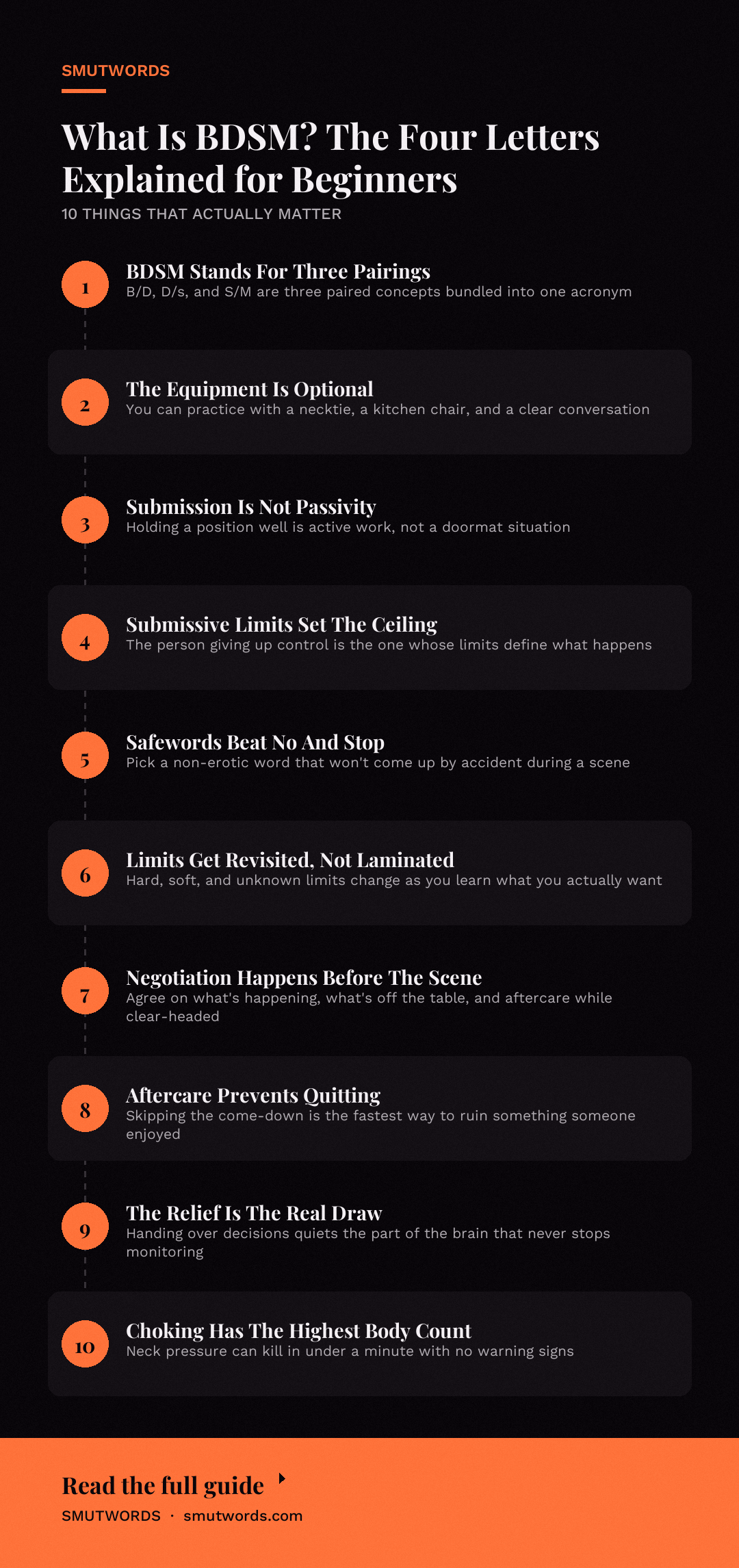
It's worth saying up front that you don't need to buy anything, join anything, or own a single piece of black clothing to practice it. Plenty of people do this with a necktie, a kitchen chair, and a clear conversation. Plenty of people do it with nothing but words.
The equipment is optional. The negotiation is not.
What Do the Letters in BDSM Actually Stand For?
Three pairings, bundled into one acronym because they overlap so heavily in practice.
B/D: Bondage and Discipline. Bondage covers restraint of any kind, from handcuffs to rope to simply being told to keep your hands above your head. Discipline covers rules, structure, and punishment for breaking them. The two sit together because they feed the same appetite: one person setting the terms, the other living inside them.
D/s: Dominance and Submission. This is the power exchange itself, the engine underneath everything else. A dominant takes charge of a scene or a relationship. A submissive hands over control, on purpose and by agreement.
Notice the direction of that trade. The submissive is the one giving something up, which means the submissive is the one whose limits set the ceiling on what happens.
S/M: Sadism and Masochism. Sadism is getting off on causing sensation or pain. Masochism is getting off on receiving it.
This is the pair that scares newcomers, and it's the pair most often misunderstood. In practice, a lot of S/M has nothing to do with pain at all, or uses pain as one ingredient among many.
A flogger used slowly on a back is closer to a deep-tissue massage than to violence.
How the Roles Actually Work in Practice
Dominant, submissive, and switch are the three broad labels. A switch enjoys both sides depending on mood and partner. None of these are personality types or permanent identities you have to pick for life. People shift, and the shift is normal.
What matters more than the label is the arrangement. Some couples play for an evening and then go back to splitting the dishes evenly. Some live inside a 24/7 dynamic where certain rules apply all the time. Most land somewhere in the middle, with a standing dynamic that switches on for scenes and off for the school run.
There's no hierarchy where the 24/7 crowd is more serious about it. They just picked a different container.
One correction that trips up beginners: submission is not passivity. A submissive who's told to hold a position and hold it well is doing active work.
And a dominant who's just doing whatever they feel like, with no attention to what their partner is actually experiencing, is not a dominant. They're a bad time. The whole thing runs on attention in both directions.
If you want to see what a well-written power exchange feels like on the page before you try one in a bedroom, that's what half the fiction on this site is for. Wetware Slave is a good place to watch a dynamic get negotiated and then tested, and Free Use Ice Cream Shop plays with a specific arrangement where access is the whole point. Reading it is a low-stakes way to notice what you react to.
Why People Like This: The Honest Version
The most common reason people give, once they trust you enough to answer honestly, is relief. For a submissive, handing over decisions for a defined stretch of time means the part of the brain that's always planning and monitoring gets to go quiet. For a dominant, being handed real authority without having to apologize for wanting it is its own kind of relief, especially for people who spend the rest of their lives being careful and agreeable.
The other big driver is intensity. Adrenaline, endorphins, and sustained physical attention produce a headspace that's hard to reach any other way. Submissives call the deep version subspace. Dominants have their own version, sometimes called top space, and it can be just as disorienting.
There's a third thing that people don't say out loud as often: being wanted specifically for this. Not tolerated, not accommodated, but actively desired at the exact register you operate on. A praise kink and a power exchange dynamic often live in the same person for precisely this reason, and the SmutWords guide to praise kink gets into why being told you're good hits differently when someone has actual authority to say it.
Consent and Communication: How It Actually Works
Consent in BDSM is not a yes you get once at the start. It's an ongoing practice with specific mechanics, and the mechanics are the useful part.
Safewords. Everyone needs at least one word that means stop immediately, no discussion, no negotiation in the moment. "No" and "stop" are unreliable during a scene, because some people like saying them and some dynamics involve saying them. So you pick a word that isn't erotic and won't come up by accident.
Traffic light systems are popular because they carry more information than a single word: green means keep going, yellow means slow down or check in, red means everything stops right now.
Limits. Three categories worth naming separately.
- Hard limits: things you will not do, ever, and that shouldn't be brought up again as a suggestion.
- Soft limits: things you're unsure about, might try under specific conditions, or want to talk about first.
- Unknown territory: things you haven't thought about yet. This category is why limits get revisited rather than set once at the beginning of a relationship and laminated.
Negotiation. Before a scene, not during. What's happening, what's off the table, what safeword you're using, what aftercare looks like, and roughly how long.
It doesn't have to be a formal meeting. It does have to happen while both people are clear-headed and not in the middle of anything.
Aftercare. The period after a scene where both people come down. Water, food, blankets, quiet, talking, or all of the above.
Some people crash hard an hour later, some the next morning. Skipping this step is the fastest way to make someone quit something they actually enjoyed.
Enjoyed this? Get a free book.
Join the list and we will send a complete free story straight to your inbox, plus new releases every week after that. No credit card, no catch.
If this sounds like a lot of talking, it is. That's the actual cost of the thing, and the people who skip it are the ones who end up with bad stories.
How to Bring It Up With a Partner
The single most useful framing: ask about their fantasies before you announce yours. Sit down somewhere neutral, not in bed at midnight, and ask what they think about when they're alone. Then listen without flinching.
When it's your turn, be specific rather than abstract. "I'd like to try tying your wrists to the headboard and taking my time" is a real request someone can respond to. "I'm into BDSM" is a genre label that invites panic.
A few things that make this conversation go better:
- Frame it as something you want to explore together, not something you need them to perform for you.
- Offer a small first step they can say yes to without committing to anything bigger.
- Make it easy to say no. If they can't decline without a fight, you didn't get consent, you got compliance.
- Give them time. A first conversation is often a no that becomes a maybe three weeks later, once they've had room to think about it privately.
If your partner's answer is a hard no, that's information, and you have to decide what you do with it. What you don't get to do is pressure, spring it on them mid-scene, or treat their no as a negotiation opening.
What Can Go Wrong, and How to Lower the Risk
BDSM carries real physical and emotional risks, and the honest thing to do is name them instead of pretending the safeword handles everything.
Physical risks. Nerve damage from rope or cuffs that are too tight or in the wrong spot. Joint injuries from positions held too long. Bruising and welts that are expected.
Neck and windpipe pressure is not expected, and it can kill someone in under a minute with no warning signs. Strangulation and breath restriction are the practices with the highest body count in this space. They're also the ones where "we know what we're doing" is not a safety measure. Don't learn those from a blog post.
Emotional risks. Drop after a scene, which can look like depression for a day or two. Power exchange that bleeds into areas of the relationship nobody agreed to. A dominant who pushes past a limit and calls it a mistake.
A submissive who agrees to things they don't want because they're afraid of disappointing someone. That last one is more common than the others, and harder to catch, because it looks like enthusiasm from the outside.
The risk reducers are unglamorous: learn the technique from someone qualified before you use it, keep safety shears within reach any time rope is involved, never restrain someone in a way they can't be released from quickly, check in during the scene rather than assuming silence means fine, and never play while drunk or high. And take new physical things slowly. A first flogging should be a fraction of what you think you can handle.
There's a whole genre of kink that lives on gear and specific physical detail, and if you want to see how it reads before you buy anything, the SmutWords guide to leather catsuit fetish and the breakdown of collar and leash play both cover the equipment side without pretending it's risk-free.
When to Stop
The safeword is the obvious answer and the incomplete one. There are other stop signals worth knowing.
Stop if someone dissociates and can't answer a check-in. Stop if a limit gets crossed, even accidentally, and don't resume that night. Stop if you're doing it to manage someone's mood or keep a relationship from ending.
Stop if you notice you're saying yes because you're scared of what happens if you say no. That last one is the line where this stops being BDSM and starts being something else entirely.
A dominant stopping a scene because something felt off, even with no safeword called, is doing the job correctly. That call is part of the role, not a failure of it.
Common Myths, Corrected
"BDSM is just abuse with nicer furniture." Abuse is not negotiated, doesn't have safewords, and doesn't stop when someone asks. If those three things aren't present, what you're looking at isn't BDSM regardless of what the people involved call it.
"Submissives are doormats." Most of the submissives with any experience are extremely clear about what they will and won't accept. The role attracts people who know their own limits precisely because the whole structure depends on them.
"Dominants are just people who like hurting others." Good ones spend most of their energy on reading their partner, adjusting in real time, and managing the aftermath. It's closer to hosting than to taking.
"It's always about pain." Bondage, service, rules, denial, praise, and ritual all fall under this umbrella and involve no pain at all.
"You need to be experienced to start." You need to be honest, willing to talk, and willing to go slowly. Everyone starts somewhere, and the people who go slowest tend to stay longest. If you want to trace how those power shapes show up in ordinary fiction, take a look at undercover romance or slow burn coworker romance, both of which run on the same tension between who has the upper hand and who wants to give it up.
"Once you start, you can't change your mind." You can stop mid-scene, mid-relationship, or mid-sentence. Anyone who tells you otherwise is telling you what they want, not how this works.
Where to Start, Concretely
Pick one thing. Not a list. One.
Talk about it outside the bedroom. Agree on a safeword even if you think you won't need it.
Set a time limit for the first attempt, twenty minutes is plenty. Do the thing, then stop and talk about it while it's fresh. Then do the aftercare part, which for a lot of couples is just lying around eating something and being normal with each other for a while.
Repeat with adjustments. That's the whole method. Everything else is gear, terminology, and confidence you pick up along the way. If you want a fictional version of a dynamic that starts careful and gets less careful as trust builds, Bull for the Weekend and The Embassy Breeding Pact both run on negotiated arrangements where the terms matter as much as the payoff.
Final Thoughts
If you're going to read one thing next, read Cabo Vacation Escort. It's a clean example of how a power dynamic gets set up, agreed to, and then complicated by the people inside it, which is the part beginners consistently underestimate. The negotiation is the fantasy. Get that right and the rest follows.








Loading comments…