
Rope safety is the set of practices, tools, and habits that keep a rope bondage scene from turning into an injury: knowing where the nerves run, checking circulation and sensation on a schedule, keeping shears within arm's reach, and communicating in plain language the whole way through.
It covers everything from how you lay out your rope before a partner walks in the room to how you handle the ten minutes after you cut them loose. In fiction, rope safety is also a characterization device. A rigger who checks fingertips mid-scene is telling the reader something about who they are.
That combination of vulnerability and visible competence is exactly why readers keep coming back to it.
What Rope Safety Actually Means
The short definition covers the basics: protocols, tools, and awareness that prevent lasting physical harm during consensual rope bondage. The expanded version has more moving parts, and each one matters for different reasons in different scenes.
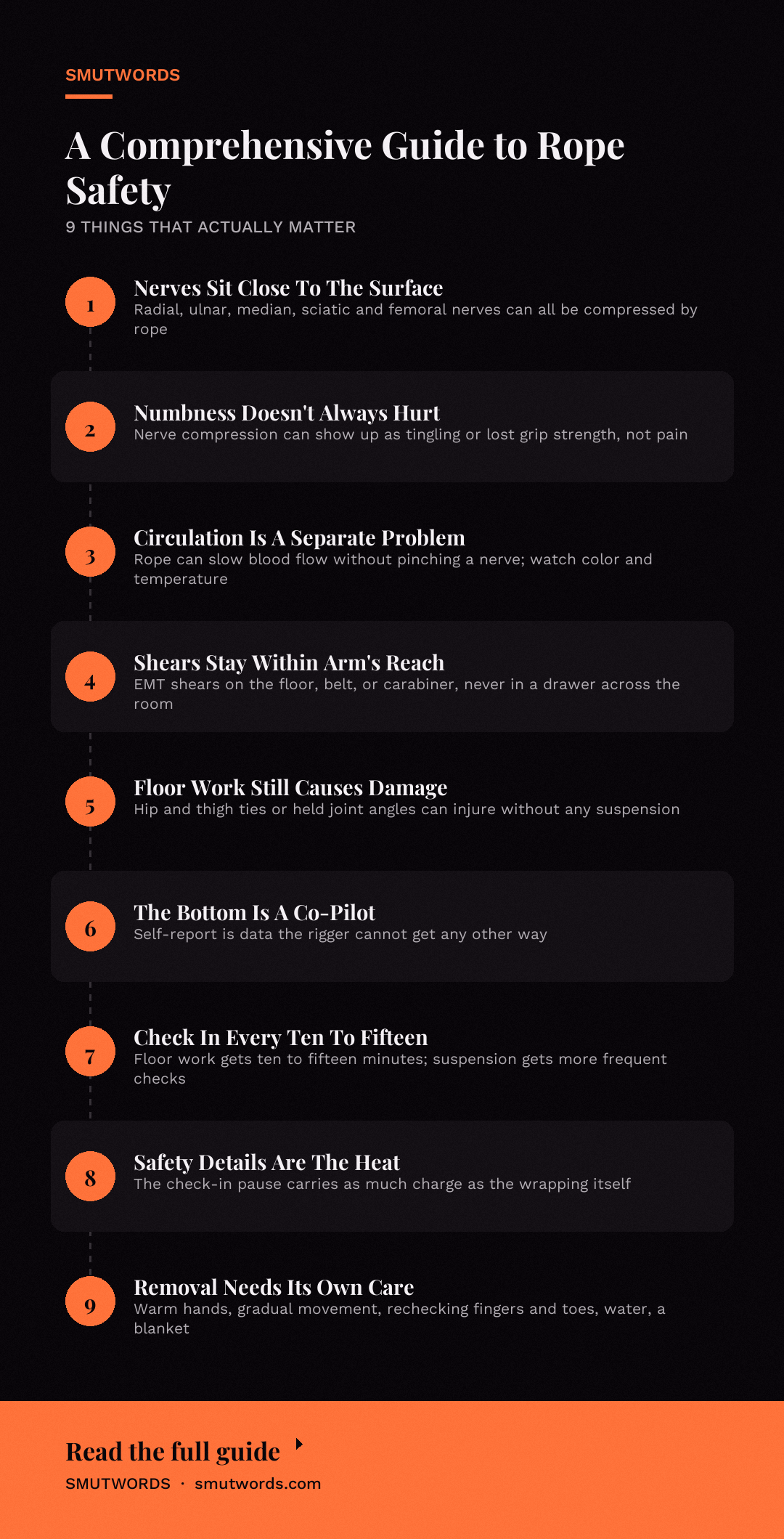
Start with nerve awareness. The human body has several peripheral nerves that sit close enough to the skin and bone to get compressed by rope. The radial nerve in the upper arm, the ulnar nerve near the elbow, the median nerve at the wrist, the sciatic and femoral nerves in the thigh and hip. A rope that looks aesthetically perfect can be sitting directly on one of these.
Nerve compression doesn't always hurt at first. It can present as numbness, tingling, a strange buzzing feeling, or a loss of grip strength the bottom doesn't notice until they try to hold something.
That last detail is why rope safety is not just about the rigger's eyes. It's about the bottom's ongoing self-report and the rigger's ongoing check-ins.
Asking someone to wiggle their fingers or make a fist every fifteen minutes is not a mood killer. It's the mood. Or it can be, if you write it that way.
Circulation is a separate concern from nerve compression. A rope can be tight enough to slow blood flow without pinching a nerve, and the signs show up in color and temperature. Fingers or toes going pale, then blue, then cold. A limb that feels like it's falling asleep in a way that doesn't resolve when the position shifts slightly.
The solution is not always to cut everything immediately, but it is always to act, not wait and hope.
Quick-release shears are the third pillar. EMT shears, safety shears, whatever you call them, they need to be within reach of the rigger's hand at all times during any suspension or floor tie. Not in a drawer across the room. Not in a bag under the bed.
On the floor next to the rigger's knee, or clipped to their belt, or hanging from a carabiner within arm's reach.
If a scene goes wrong, the difference between a scare and a hospital visit is often thirty seconds and a sharp pair of scissors.
What rope safety is not: it is not a vibe, not a formality, and not something you mention once during negotiation and then forget. It is not incompatible with intensity.
Some of the most intense scenes in erotic fiction are intense precisely because the rigger is meticulous. The care is not the opposite of the heat. The care is often what makes the heat possible.
Common misconceptions worth clearing up. First, that rope safety is only relevant for suspension. Floor work can absolutely cause nerve damage, especially hip and thigh ties or any position that holds a joint at an angle for a long stretch.
Second, that experience makes you immune. Experienced riggers still check. Especially experienced riggers check, because they've seen what happens when someone doesn't.
Third, that rope safety is the rigger's job alone. The bottom is a co-pilot. Their self-report is data the rigger cannot get any other way.
Where Rope Safety Comes From
Rope bondage as an erotic practice has roots in Japanese kinbaku and shibari traditions that stretch back centuries, but the codified safety language that English-speaking kink communities use now is much more recent. It emerged alongside the broader kink education movement of the 1990s and 2000s, when workshops, conventions, and online forums started treating rope as a skill set rather than a single trick you learned from a friend.
Before that, rope knowledge traveled informally. Someone showed you a tie, you practiced it on a partner, you figured out the rest by trial and error. That worked for some people and injured others.
The shift toward formalized rope safety happened because enough people got hurt that the community started writing things down. Emergency room visits from nerve compression. Wrists that lost sensation for weeks. Shoulder injuries from poorly planned suspensions.
The tools changed too. EMT shears became standard kit. So did the habit of carrying a small cutting tool on your person during any tie. Community standards around check-ins, which used to be an informal "you good?" every so often, became more structured: specific intervals, specific questions, specific physical tests.
In erotica and romance publishing specifically, the history is different and worth separating out. Rope bondage appeared in published fiction long before the safety language caught up. Older books often treated rope as pure atmosphere, with the tie existing to look good and the aftermath skipped entirely.
What changed over the last fifteen or twenty years is that readers started asking questions the old books didn't answer. How did the bottom's hands feel afterward? Did anyone check on them? What happened when the rope came off?
The result is a genre that now rewards visible competence. A rope bondage scene in a contemporary romance where the rigger never checks in reads as thin to a modern audience. The safety details have become part of the erotic charge, not a tax paid on top of it. That's a publishing shift, and it's a real one.
How It Shows Up in Erotica
On the page, rope safety does three jobs at once. It establishes the rigger's competence, it gives the bottom a reason to trust, and it creates a rhythm the scene can move through. The rhythm part is what separates a scene that works from one that just describes knots.
Think about pacing. A well-written rope scene has beats: the negotiation, the laying out of rope, the first wrap, the first check-in, the deepening, the longer check-ins, the climax, the removal, the aftermath. The safety moments are not interruptions to that structure. They are the structure.
Enjoyed this? Get a free book.
Join the list and we will send a complete free story straight to your inbox, plus new releases every week after that. No credit card, no catch.
A rigger who pauses to ask "can you feel me touching your thumb?" is doing something to the bottom's nervous system that has nothing to do with the rope and everything to do with being seen.
Common variations authors use:
- Floor work first. The scene stays low, often on a bed or mat, and safety concerns are mostly about position duration and limb angle. This is where most beginner-friendly rope content lives.
- Suspension. Higher stakes, higher visual drama. Suspension requires anchor points rated for the load, a planned line of sight to the shears, and more frequent check-ins. Nerve risk goes up because the body's weight does some of the compression work.
- Partial suspension. One point of contact, something else still touching the ground. Less risk than full suspension, more visual interest than floor work.
- Self-suspension. Rare in romance but present in some literary erotica. Higher risk profile because there's no second person to check in or cut.
- Predicament ties. The drama comes from the position itself, and safety language around duration and fatigue becomes central to the scene's tension.
- Decoration and harnesses. Rope as visual and sensory, not restrictive. Safety concerns are mostly about tension and skin sensitivity.
What makes a strong version of this on the page versus a flat one comes down to specificity. Vague safety language ("he checked on her") does nothing. Specific safety language does everything.
The rigger asking the bottom to make a fist, then open it, then count backward from five with each finger. The bottom noticing their pinky feels weird and saying so. The rigger's immediate response, which tells the reader what kind of person they are.
The other thing strong rope scenes do is refuse to make safety a one-way street. The bottom has knowledge too. They know their own body, they know when something feels wrong, and a scene where they speak up and get taken seriously is a scene that's doing work.
Compare that to a scene where the bottom never says anything and the rigger assumes everything is fine. The second version is thinner and reads as older.
Safety also plays differently depending on the relationship register of the book. In a scene between established partners, the check-ins can be shorthand, almost wordless, because the two people already have a language. In a scene between new partners, the check-ins are longer, more explicit, and that length is itself part of the tension. A consent negotiation before the rope comes out sets the rules; the rope safety during the scene is the negotiation continuing in real time.
One more craft note: rope safety pairs naturally with anticipation play. The check-in pause, the deliberate slowness of the rigger's hands moving to a new section of rope, the audible sound of shears being placed where they can be reached. All of that builds tension. None of it is filler.
And the removal matters as much as the tie. Rope coming off is not an afterthought. The bottom's body has been held in a position, sometimes for a long time, and the transition back needs its own care: warm hands, gradual movement, checking fingers and toes again, water, a blanket.
That transition is often where the emotional weight of the scene lands, and where aftercare begins.
Rope Safety vs Related Practices
Rope safety gets lumped in with other kinds of scene safety, and it's worth pulling apart where it genuinely differs. The comparison that actually matters for readers is rope safety versus general scene play safety.
Scene play safety covers a broad set of concerns: safewords, physical and emotional check-ins, hygiene, consent, the general architecture of a negotiated encounter. Rope safety is a specialized subset of that, with its own specific physical risks that don't apply to every scene. A flogging scene doesn't have nerve compression concerns. A rope scene does.
The tools are different, the check-in questions are different, and the failure modes are different.
That's why rope bondage rewards more preparation than a lot of other kinks. The physical stakes are specific and asymmetric. Mistakes in rope can cause injuries that outlast the scene by weeks or longer, and the bottom might not notice for hours. So the pre-scene checklist is longer and the mid-scene monitoring is more structured.
The comparison with impact play aftercare is useful too, because the aftercare needs diverge. Impact play aftercare focuses on skin, bruising, and emotional processing. Rope aftercare focuses on restoring circulation, checking sensation, and letting the nervous system come down from a very different kind of restraint.
If you're writing one of these scenes and not sure which register you're in, ask what actually has to be watched. If the answer is marks on skin, you're in impact territory. If the answer is fingers going numb, you're in rope territory.
Frequently Asked Questions
What are the most common rope safety mistakes?
Wrapping too tight around a joint, leaving rope on a nerve for too long without checking, and keeping shears out of reach. Less obvious is failing to check in at intervals. The bottom often doesn't notice numbness creeping in until it's been there for a while, so the rigger's scheduled check is what catches it early.
How often should you check in during a rope scene?
Every ten to fifteen minutes for floor work, more often for suspension. The check should include a physical test (can you make a fist, wiggle your toes) and a verbal one (any tingling, numbness, or pain). If something feels off, the rope comes off and you reassess before continuing.
Can rope bondage cause permanent nerve damage?
Yes, and that's the entire reason rope safety exists. Nerve compression that goes unnoticed for too long can cause lasting numbness, weakness, or loss of sensation. The damage is usually preventable with timely check-ins and immediate removal when something feels wrong. That's why shears on hand are non-negotiable.
What tools should a rigger have on hand?
EMT shears within arm's reach, always. Some riggers also carry a small backup cutter on a belt or lanyard. Beyond cutting tools: a soft mat or blanket to protect the bottom's landing if they come down unexpectedly, water, and a way to communicate a safeword if the bottom's mouth is restricted. The mummification glossary page covers similar tool concerns for full-body restriction, and the logic carries over.
Is rope safe if you're new to it?
Yes, with limits. New riggers should start with floor work, simple ties, and partners who can verbally check in easily. Suspension requires significantly more training because the failure modes are more serious and the weight of the body does part of the compression work. Learning from an experienced rigger or a workshop is the standard path.
How does rope safety show up in erotic fiction?
As a rhythm and a characterization tool. A rigger who checks in, who keeps shears within reach, who notices when the bottom's fingers look off, is a rigger the reader believes. The safety details are often where the emotional heat of a rope scene lives, because they're the moments where the bottom is visibly cared for.
You can see the same dynamic in the way dominant and submissive roles get written, where the negotiated structure is what makes the scene land.
Does rope safety matter in a scene with an established partner?
Yes, and the language just changes. Established partners have shorthand, but the underlying checks still happen. Skipping them because you trust each other is how experienced people still get hurt. The shorthand replaces the script, not the substance.
Final Thoughts
Rope safety is one of those subjects where the details do all the work. A scene isn't made hotter by skipping them, and it isn't made safer by mentioning them once and moving on. The rigger's competence, the bottom's self-report, the shears on the floor, the check-ins on a schedule: that's the whole architecture, and it's what turns a tie from a visual into a living scene between two people who are paying attention to each other.
Watch for the rope scene where the check-in moments carry as much charge as the wrapping. The tension is in the pause, the question, the response. That's where a good scene lives.






Loading comments…