
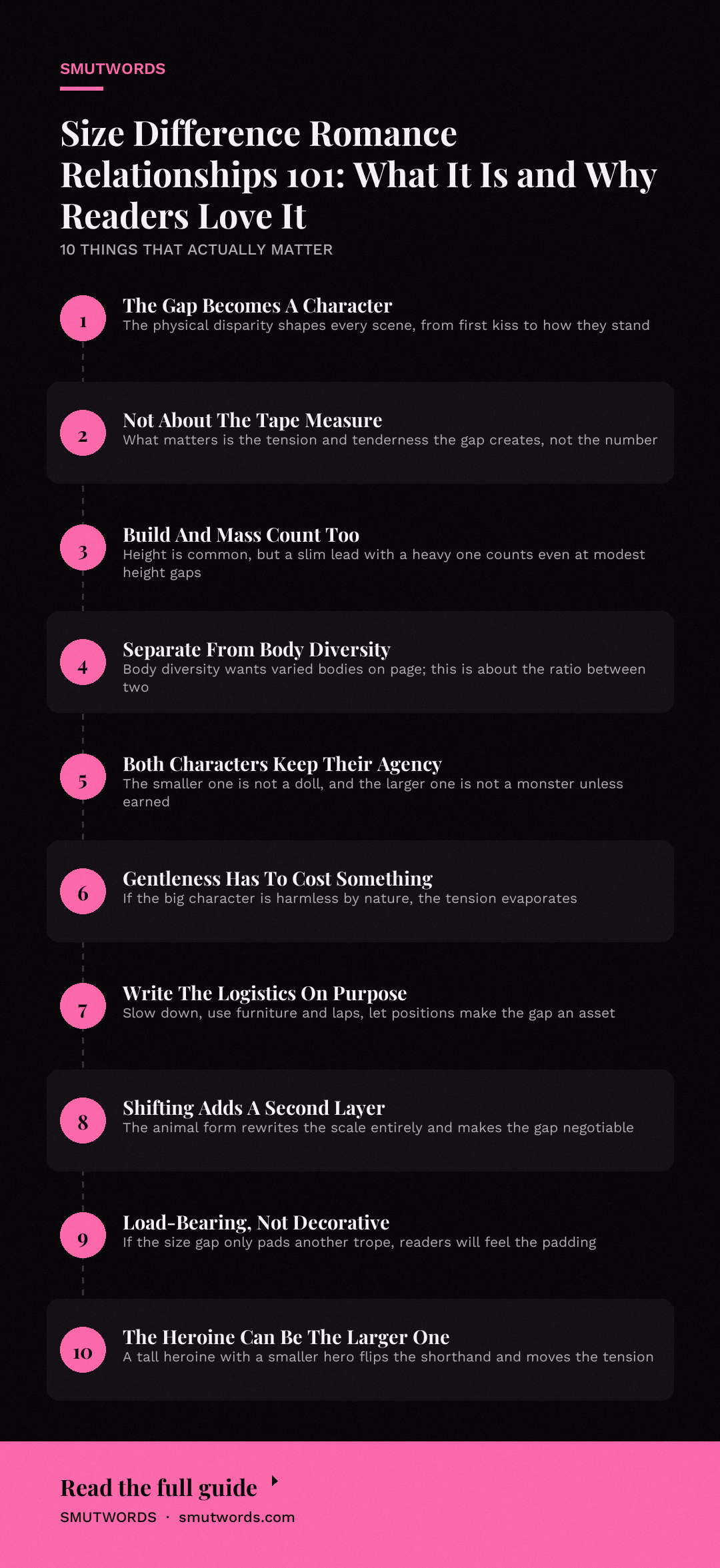
Size difference romance is a love story built around a physical gap so wide it becomes a character in the book. The hero and heroine differ dramatically in height, build, or sheer mass, and that contrast shapes everything: how they stand next to each other, how a first kiss gets staged, how protection and vulnerability get distributed between them.
It is one of the oldest visual shortcuts in the genre and one of the most flexible, which is why it keeps showing up in historicals, paranormal, monster romance, and contemporary alike.
What makes the trope sing is not the number on a tape measure. It is the gap as a source of tension, tenderness, and heat, and the way both characters stay fully themselves inside it. Get that wrong and you have a gimmick. Get it right and you have a dynamic readers will chase through an entire backlist.
What Size Difference Romance Actually Means
The term describes a romance where the physical disparity between the leads is pronounced enough to be a defining feature of the relationship. Height is the most common axis, often a foot or more, but build and mass matter just as much. A five-foot-two heroine and a six-foot-six hero is the classic shape.
So is a slim, delicate lead paired with someone broad-shouldered and heavy, or a human paired with something that is not human at all and outweighs her by a factor of three.
Worth separating height gap romance from the broader plus-size and body-diversity conversation. The two overlap, and a plus-size heroine with a large hero is a fully recognized sub-variant, but they are not the same thing.
Body diversity asks for honest, varied bodies on the page. Size difference romance is about the relationship between two bodies and how that ratio drives the plot and the intimacy. A book can have a big hero and a big heroine and still be a size difference romance if the gap between them is sharp.
What counts:
- A measurable, noticeable disparity in height, build, or mass that the narrative keeps returning to.
- The disparity carrying emotional weight: protectiveness, awe, caution, deliberate gentleness.
- Intimacy scenes written with the logistics of the gap in mind, not glossed over.
- Both characters retaining agency. The smaller one is not a doll, and the larger one is not a monster unless the book earns it.
What does not count:
- A throwaway line about him being tall. That is set dressing, not a dynamic.
- Contrast used only as an aesthetic, with no effect on how the two people treat each other.
- Stories where the size gap exists purely to infantilize the smaller lead or flatten her into something to be handled.
The most common misconception is that this trope belongs to one subgenre. It does not.
It shows up hard in alien romance, where the hero may be a head taller and built on a completely different skeleton. It is arguably the whole engine of a lot of cryptid romance, where the love interest is a seven-foot something with claws. Historicals use it constantly, often without naming it, because a petite heroine and a broad, war-hardened hero is a convenient way to signal both stakes and safety in one image.
Where Size Difference Romance Comes From
The dynamic is older than the romance genre's modern marketing categories. Fairy tales ran on it. Beauty and the Beast is a size and form difference story before it is anything else, and so is Bluebeard, and so is half the folklore where a mortal woman ends up entangled with something enormous. But the trope as a recognizable, sought-after romance convention took shape in the twentieth century, and its publishing history is the interesting part.
Mid-century gothic romances leaned on it heavily. The heroine was small, alone, and vulnerable in a big house with a larger, more powerful man whose intentions were unclear. Size stood in for danger and for the promise of safety, sometimes in the same paragraph.
By the 1970s and 80s, category romance had codified the petite heroine and the commanding hero into something close to a default, and readers who loved the contrast could find it in nearly every line without ever needing a label.
The 2000s and 2010s changed two things at once. Paranormal romance brought non-human love interests to the mainstream, and the size gap exploded. Vampires, werewolves, demons, and shifters were written as bigger, heavier, faster, and more primal, and the contrast stopped being a subtle social signal and became explicit body horror and body heat in equal measure.
You can trace a straight line from that era into today's monster romance boom, where the gap is often the point rather than a side effect.
The second shift was digital. Self-publishing and niche romance communities made size difference a searchable, taggable preference rather than a buried convention. Readers could now find exactly the flavor they wanted, giant and gnome, orc and human, seven-foot alien and small-town human, without waiting for a traditional publisher to greenlight it.
That is when the trope grew its own vocabulary and its own dedicated audience, and when authors started writing the logistics scene on purpose instead of eliding it.
How It Shows Up in Erotica
On the page, a size difference romance lives and dies on specificity. The strong versions do a handful of things well and do them repeatedly.
First, they establish the scale early with concrete, sensory detail. Not "he was tall" but the heroine's eyeline hitting his sternum. Not "he was strong" but the way one of his hands spans most of her back. The reader needs a clear internal picture before any intimacy begins, because the entire payoff depends on that picture being sharp.
Second, they make the gap reciprocal. The smaller character gets power of her own: defiance, wit, wanting, a willingness to reach up and pull him down. The larger character gets restraint, awe, and the constant awareness that he could hurt her and will not.
That mutual charge is what separates a real size difference dynamic from a one-note power fantasy. It is the same principle that makes dominant vs submissive dynamics work: the roles only land when both people are choosing them.
Third, they write the logistics. Good authors do not fade to black when the geometry gets complicated. They slow down. They use hands, pillows, furniture, laps, and positions where the disparity becomes an asset instead of an obstacle.
The smaller lead climbing into a lap that dwarfs her, the deliberate care of a kiss where the larger one has to bend, the moment of hesitation before weight is put on someone who weighs half as much. Those beats are the genre's version of foreplay, and the readership notices when they are skipped.
Enjoyed this? Get a free book.
Join the list and we will send a complete free story straight to your inbox, plus new releases every week after that. No credit card, no catch.
Fourth, they keep the larger character's gentleness earned. The gentle giant trope is only compelling when the gentleness costs something. If he is written as harmless by nature, the tension evaporates. If he is written as capable of serious damage and consciously measuring every touch, every scene gains a charge the reader can feel.
Here are the variants that show up most often:
- Height gap romance. The baseline. Earthly, contemporary, and easy to slot into any subgenre.
- Plus-size heroine with large hero. Two kinds of body on the page at once, often with the heroine's own self-image as part of the arc.
- Giant and gnome (or giant and small human). A fantasy staple, where the species gap stacks on top of the physical one.
- Shifter size difference. Human form is already large, and the shifted form rewrites the rules entirely. Often tied to territorial shifter trope beats, where the size gap feeds the protectiveness and the claiming.
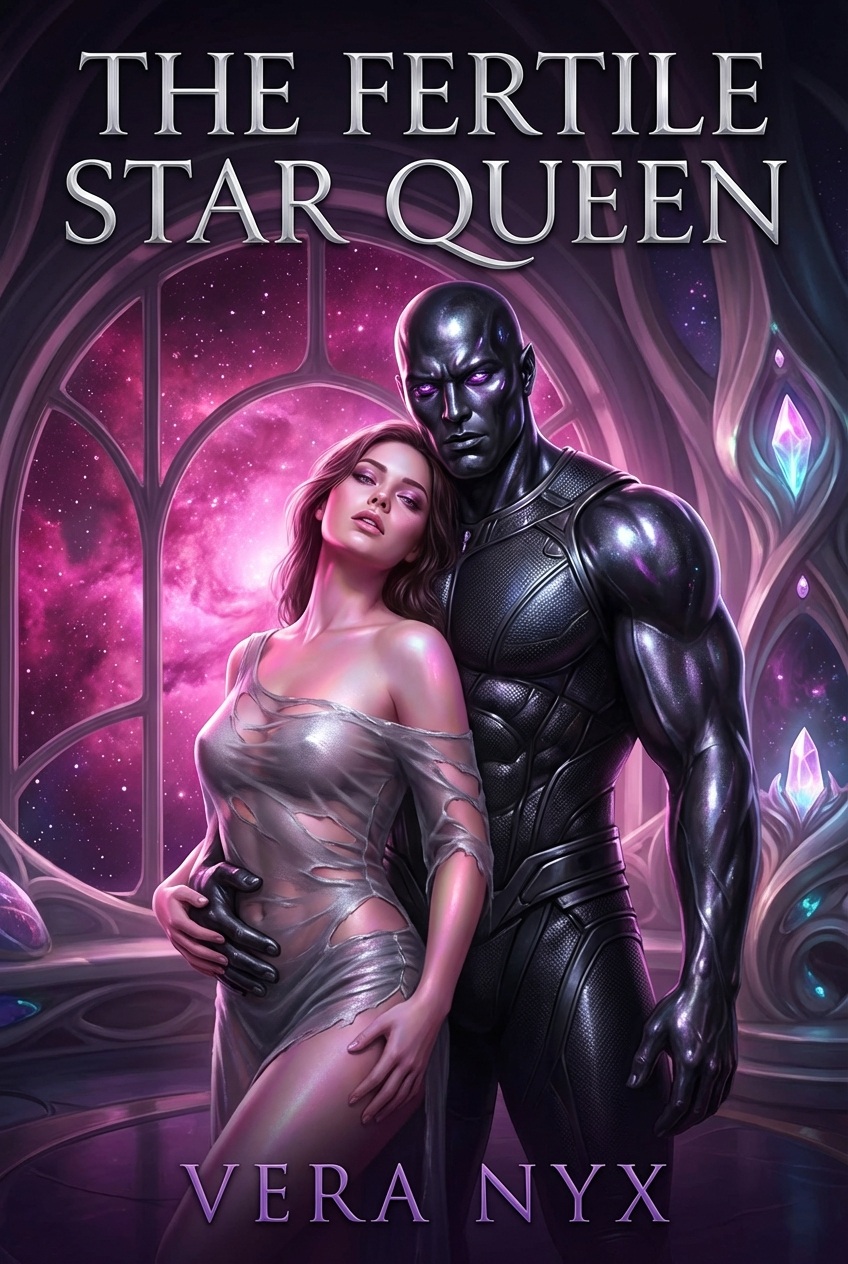
- Non-human and human. Alien, cryptid, demon, angel, or something with no clean earthly analogue. The gap becomes part of the world-building, not just the body.
- Historical petite heroine and broad hero. The old default, still going strong, often with the size gap doubling as a class or reputation contrast.
Flat versions fail in predictable ways. The size gap is mentioned once in chapter two and never matters again. Or the smaller lead is written as passive, a thing to be lifted and arranged. Or the intimacy is vague because the author is not sure how the bodies actually fit together, and the reader feels the evasion.
The fix is almost always the same: get more specific, give the smaller character more initiative, and let the larger character's restraint be visible in real time.
One more craft note for writers working in secondary-world romance. If your love interest is non-human, the size gap can pair with other dynamics that do the heavy lifting. A soulbond can explain why a small human and an enormous alien are drawn together despite every practical problem.
An alien breeding trope can make the physical disparity part of the stakes rather than just the scenery. An angel romance can play the gap as divinity against mortality. The size difference works best when it is load-bearing, not decorative.
Size Difference Romance vs Soulbond
These two get tangled up often enough to be worth sorting out, especially in paranormal and science fiction romance where both are in play at once. They are not competing tropes. They answer different questions.
Size difference romance answers a physical question: what does it look like and feel like when two bodies are dramatically mismatched, and how do the characters handle that in daily life and in bed? The tension is spatial and sensory. It does not require any supernatural explanation, which is why it works just as well in a contemporary office romance as it does on an alien warship.
A soulbond answers a metaphysical one: why are these two people inextricably tied, and what does that tie obligate them to do? The tension is emotional and fated. A soulbond can exist between two people of identical build and lose nothing. A size gap can exist between two people with no bond at all and still carry a whole book.
When writers stack them, the effect is potent. The bond explains the pull, and the size gap makes the pull physical.
Just be careful not to let one do the other's job. If the size gap is only there to make the soulbond seem more dramatic, readers will feel the padding. If the bond is only there to justify a pairing that would otherwise be logistically awkward, they will feel that too. Both need their own scene-level justification, and both need to be doing real work on the page.
The same caution applies to elf romance, where the long-lived, elegant, and often taller partner is a common pairing with a shorter human. The contrast is real and readers enjoy it, but if the only thing the size gap is doing is signaling that elves are refined and humans are earthy, you have a metaphor instead of a dynamic.
Frequently Asked Questions
Is size difference romance the same as a height gap trope?
Height gap romance is the most common form, but size difference is broader. It includes build and mass, so a slim, small lead paired with a broad, heavy one counts even if the height difference is modest. The term also covers non-human love interests whose proportions do not map onto human height at all.
Can a size difference romance work in a contemporary setting?
Absolutely. The dynamic does not need a supernatural excuse. Plenty of contemporary and small-town romances run on a petite heroine and a large, physically imposing hero, and the contrast carries the same charge. If the gap is written with specificity and both characters stay active, the setting is irrelevant.
What is the gentle giant trope, and how is it different?
The gentle giant is a character type, while size difference romance is a relationship dynamic. A gentle giant is a very large character written as kind and careful, often to comic or tender effect. Pair that character with a much smaller love interest and you get a size difference romance. The two frequently appear together, but either can exist without the other.
Do these books always involve dominance and submission?
No, although the tropes overlap often because the physical disparity makes protective and commanding dynamics easy to stage. A size difference romance can be entirely equal in tone, with the smaller lead running the show. What matters is that both characters are choosing their roles rather than having them assigned by body type. Readers who want a deeper look at that balance can start with our breakdown of dominant vs submissive roles.
Why do readers specifically search for shifter size difference?
Because shifting adds a second layer. The human form is already larger than the heroine, and the animal form changes the scale entirely, which makes the gap something the characters have to negotiate rather than just inhabit. It also pairs naturally with the possessive, protective instincts central to the territorial shifter archetype, where the larger partner's instinct is to keep and guard.
How do authors handle the physical logistics in explicit scenes?
The good ones slow down and get concrete. Positions get adjusted. Furniture gets used. The larger character checks in, and the smaller character gives direction.
The awkwardness is often written in on purpose because it is realistic and because working through it becomes part of the intimacy. Scenes that skip straight to the finish without acknowledging the geometry read as thin to anyone who came for this trope.
Is there a size difference romance sub-variant where the heroine is the larger one?
Yes, and it is growing. A tall or plus-size heroine with a smaller hero flips the usual visual shorthand, and the dynamic shifts with it.
The protective instinct often moves to the heroine, and the tension comes from a hero who has to be secure enough to be handled. It is less common in traditional publishing but well represented in indie and self-published romance. For a closer look at how possessive instincts get written across two very different archetypes, see territorial shifter vs possessive monster.
Final Thoughts
Size difference romance works because it turns a simple physical fact into a running source of tension, tenderness, and heat. The books that do it best stay specific about the bodies, give both leads real agency, and never let the gap become a decoration.
If you are coming to the trope fresh, the surest way in is to read one where the disparity drives the plot instead of just the cover art. Start with a monster or shifter romance where the author commits fully to the logistics, because that is where this dynamic is written with the most care right now, and you will feel the difference on the first page.





Loading comments…