Polyamory is a relationship structure in which everyone involved agrees that love and sex can be shared openly among more than two people, with every partner aware of the arrangement and consenting to it. That's the whole idea in one sentence.
What makes polyamory a permanent fixture of erotica and romance, though, is everything that sentence leaves out: the negotiation, the jealousy, the scheduling, the specific thrill of watching the person you love light up for someone else. The best polyamorous fiction treats open love as a source of tension and intimacy rather than a loophole that removes it.
If you've landed here from a glossary entry, you already know the bare definition. This guide goes further: where the term comes from, how it actually works on the page, why some polyamorous books sing and others fall flat, and what the real-world version of this arrangement demands of the people living it.
What Polyamory Actually Means
The word combines the Greek poly (many) and the Latin amor (love), a hybrid that linguists hate and everyone else ignores. It entered common usage in the early 1990s, though the relationships it describes are as old as people are. The term itself was popularized by Morning Glory Zell-Ravenheart in a 1990 essay and picked up steam through alt-weekly columns, early internet newsgroups, and eventually mainstream media coverage in the 2000s and 2010s.
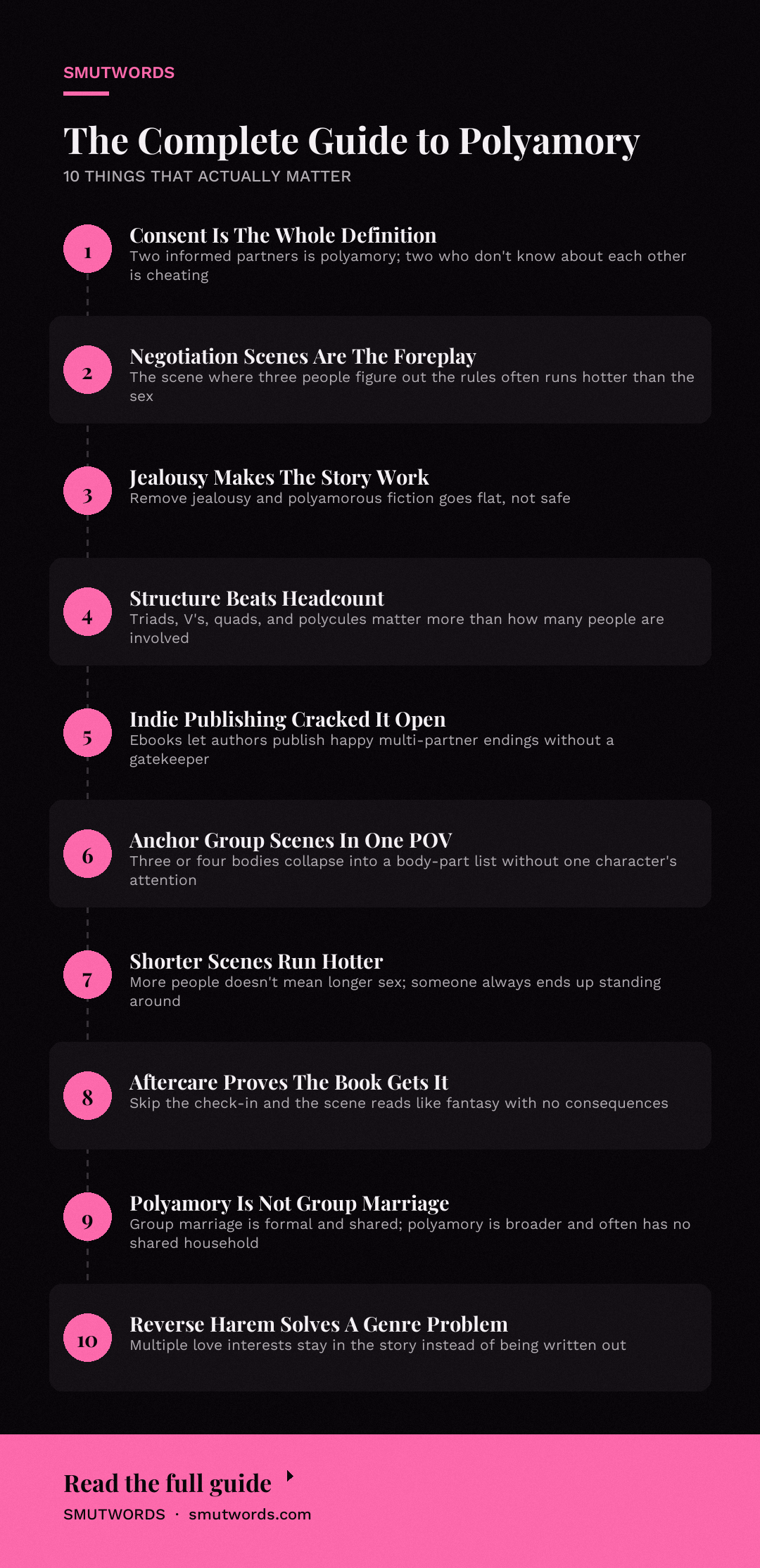
The defining feature of polyamory is not the number of people. It's the consent and the transparency. A person with two partners who are both fully informed and on board is polyamorous. A person with two partners who don't know about each other is cheating, and no heartfelt speech about being "wired for multiple loves" changes that.
Several things get mistaken for polyamory and aren't:
- Swapping or swinging. Recreational sex with other couples, usually with a primary partner and often with rules that keep emotions out of it. Overlaps with polyamory for some people, but the two are distinct. Many swingers are not polyamorous and many polyamorous people don't swing.
- Cheating with extra steps. If a partner doesn't know, it doesn't count. Polyamory requires ongoing consent, not retroactive permission asked for after the fact.
- A phase or a workaround. Polyamory isn't something couples do to fix a dying relationship, and it isn't a stopgap before someone settles down "for real." Books that treat it as either tend to read as fantasy in the wrong way.
- An orgy that keeps happening. Group sex and multiple simultaneous partners are separate things. Plenty of polyamorous people have quiet, logistically complicated lives involving a lot of texting and very little group nudity.
The internal architecture matters more than the headcount. A triad is three people all involved with each other. A V has one person at the hinge dating two people who aren't involved with each other. A quad is four people in some configuration of connections.
A polycule is the broader network, sometimes sprawling, often drawn as a diagram that looks like a chemical compound. The vocabulary is precise because the arrangements are precise, and readers who live this way notice immediately when an author gets it wrong.
Where Polyamory Comes From
As a published genre phenomenon, polyamory in romance and erotica has a shorter, messier history than its real-world counterpart. For most of the twentieth century, fiction featuring multiple simultaneous loves almost always framed them as tragedy, scandal, or a problem to be resolved by the final chapter. Someone had to lose.
The love triangle, still a staple of romance publishing, is the most familiar version of this: the structure assumes that choosing is the point and that monogamy is the only happy ending.
The shift started in the 1990s and 2000s, when the internet made polyamorous communities visible to each other and to writers. Early polyamorous fiction was often published by small presses, distributed at conventions, and read by people already inside the community. The quality varied wildly. A lot of it was didactic: characters who existed to explain compersion to each other and to the reader.
Then indie publishing and ebook distribution cracked the market open. Authors no longer needed a gatekeeper to publish a book where the heroine ends up with both men and nobody has to apologize for it.
Reverse harem, a subgenre that almost always delivers a happy ending with multiple partners, took off in the 2010s and pulled polyamorous structures into the mainstream romance market, even when the books carefully avoided the word. Same-sex romance, paranormal romance, and later the "why choose" category all pushed the same door open wider.
By the 2020s, polyamory had moved from subtext to text in trad-pub romance, and the portrayals grew more specific. Earlier books often treated polyamory as an exotic setting; newer ones treat it as a relationship with its own logistics, its own arguments, its own proposals. That's the evolution worth tracking: not the existence of multiple partners in fiction, which is ancient, but the shift toward writing those arrangements as ongoing, negotiated, and happy.
How It Shows Up in Erotica
On the page, polyamory does something structurally useful that monogamous romance has to work much harder for: it creates intimacy in multiple directions at once. A single romantic pairing has one axis of tension. A polycule has three, four, five, and each axis can pull against the others. That's what makes polyamorous erotica feel dense when it works.
The Craft of the Negotiation Scene
The strongest polyamorous books treat negotiation as foreplay. One partner asks a question that's really a confession. Another answers with a condition that's really a promise. Someone admits they're jealous, and the admission builds heat instead of killing it. When an author handles this well, the scene where three people figure out the rules is often sexier than the scene where they follow them.
Flat polyamorous writing skips the negotiation entirely. Everyone is instantly on board, nobody has any hang-ups, and the multiple partners exist mainly to increase the number of bodies in a scene. That reads as wish fulfillment, which has its place, but it doesn't produce the emotional complexity readers say they come to polyamory for in the first place.
Common Structural Variations
Authors spin the same basic setup into very different books depending on where they put the tension:
- Hierarchical polyamory. A primary couple with other partners who rank below them. Common in romance because it maps cleanly onto the central pairing the genre already favors. Also the setup most likely to create real conflict, since "secondary" is a label someone has to accept.
- Kitchen table polyamory. Everyone in the network can sit down together for a meal. Stories built on this produce ensemble scenes, shared houses, and a lot of banter. Warmth is the draw.
- Parallel polyamory. Partners know about each other but don't socialize. Useful when an author wants jealousy to simmer without a full group dynamic.
- Solo polyamory. One person with multiple partners and no primary, keeping their own home and their own life. Rare in romance because it resists the "settling down" ending, which is a shame, since the books that try it tend to have a sharper voice.
- The triad and the quad. Everyone is involved with everyone. High heat, high logistical chaos, and the version most likely to include a group scene that earns its length.
Jealousy, Compersion, and Why the Conflict Matters
The single biggest mistake in polyamorous erotica is removing jealousy altogether. Jealousy is what makes the form work. A partner who feels a stab of something watching their lover with someone else, sits with it, talks it through, and then finds the feeling turning into compersion, real joy at a partner's joy, has just completed the most interesting arc a polyamorous story can offer.
Compersion itself is hard to write. It's easy to make it sound like a character gritting their teeth and pretending. The books that get it right show it arriving through something specific: a partner catching their lover's expression mid-laugh with someone else and feeling it land as pleasure rather than threat. That's a moment, not a declaration, and it has to be built.
One common failure mode: a book introduces a monogamous character as a foil and has the entire polycule spend three hundred pages fixing them. Better books let the monogamous character have a point. Sometimes a person wants one person, and the story is about whether that's compatible with the person they love, which is a real conflict with no easy answer.
Enjoyed this? Get a free book.
Join the list and we will send a complete free story straight to your inbox, plus new releases every week after that. No credit card, no catch.
What Polyamory Does to Other Tropes
Because polyamory is a structure rather than a kink, it interacts with everything. A voyeur husband setup becomes a different story when the wife's other partner is a full romantic partner rather than a one-time guest. A use kink scene runs differently when the person sharing their partner has actually negotiated who does what and for how long.
Writing a polyamorous relationship that's also a shibari practice takes research, but a rope scene where two partners tie a third and then trade the control back and forth is the kind of thing that makes readers remember a book.
The same is true across subgenres. A polyamorous billionaire romance usually runs on different class tensions than the standard two-person version, since part of the appeal is one person being able to fund a life that nobody has to fit into a single income.
A polyamorous relationship in a forest spirit romance can lean on the fantasy of time and lifespan, where a mortal partner and a centuries-old spirit negotiate different expectations of forever. The polyamory doesn't replace the subgenre. It changes the math inside it.
The Sex Itself
Erotica readers come for the scenes, and polyamorous sex scenes have their own craft problems. The biggest is choreography. Three or four bodies are harder to stage than two, and a lot of group scenes collapse into a list of body parts with no emotional throughline.
The fix is usually to anchor the scene in one character's point of view, so the reader experiences the group through a specific person's attention: what they notice, who they're watching, what they feel when two other partners interact with each other.
Scene length is the other common issue. Authors often assume a scene with more people should run longer. The opposite is usually true. A tight scene where every character has a clear role and a specific emotional stake runs hotter than a sprawling one where somebody's just standing around waiting for written instructions.
And the section after the sex matters more, not less. Real-world polyamory runs on check-ins: what felt good, what needs to change, whether anyone's agreements need updating now that something has actually happened. Aftercare in polyamorous fiction is where the book proves it understands the structure. Skip it and the scene reads like a fantasy with no consequences.
Polyamory vs Group Marriage
These two get used interchangeably, and they aren't the same thing. Group marriage is a specific, usually formal arrangement in which three or more people consider themselves married to each other, often with shared property, shared legal structures where they exist, and a commitment that looks a lot like conventional marriage with more participants.
Polyamory is broader and less formal. A polyamorous person might have a primary partner, a long-term secondary, and a couple of casual connections, with no shared household and no intention of merging their lives legally. Two polyamorous relationships can look completely different from each other, while group marriages tend to share recognizable features.
The confusion makes sense. Group marriage is one possible endpoint for a polyamorous group that wants to formalize. But plenty of polyamorous people have no interest in the legal or financial entanglement group marriage implies, and plenty of group marriages describe their arrangement as something other than polyamory. When a book uses one term, check which it actually means.
Frequently Asked Questions
Is polyamory the same as an open relationship?
Not exactly. An open relationship usually refers to a couple who agree to have sex with other people while keeping each other as their only romantic partner. Polyamory includes the possibility of falling in love with those other partners. Some people use the terms loosely, but the distinction matters in fiction because romantic involvement changes every scene that follows.
What is a polycule?
A polycule is the wider network of people connected through polyamorous relationships, including partners of partners who may never meet. The term comes from the way these connections are sometimes diagrammed, which looks a bit like a molecule. In practice, polycules range from tight three-person triads to sprawling webs of dozens of people.
Can polyamorous relationships work long-term?
Yes, and plenty do. Long-term polyamory runs on the same things that sustain any relationship, with an extra layer: ongoing consent, honest communication, and regular check-ins on whether existing agreements still fit. Initial enthusiasm isn't enough. The relationships that last are the ones where people keep talking after the excitement wears off.
How do polyamorous people handle jealousy?
By treating jealousy as information rather than failure. In practice that means naming the feeling, figuring out what's underneath it (fear of replacement, an unmet need, an agreement that needs revising), and talking about it before it hardens into resentment. Many polyamorous people describe the shift from jealousy to compersion as a skill they built over time rather than a feeling that came naturally.
Why is polyamory so popular in reverse harem and why choose romance?
Because the structure solves a genre problem. Readers want multiple love interests to stay in the story after the heroine falls for someone, and reverse harem lets the central character end up with all of them without anyone being written out. The best books in the category do the negotiation work; the weakest ones skip straight to the group scenes and lose the tension that made the setup interesting.
What's the difference between polyamory and swinging?
Swinging is usually about shared sexual experiences, often between couples, with rules designed to keep emotions out of it. Polyamory is about the relationships themselves, and emotional involvement isn't a bug to be managed; it's the point. There's overlap, since some people do both, but the two come with very different agreements and very different kinds of conflict on the page.
Final Thoughts
Polyamory rewards the reader who wants more than one source of intimacy in a book, and it only works when the author commits to the part that's hard: the talking, the jealousy, the check-ins, the awkward scheduling, the fact that opening a relationship multiplies the ways a person can be hurt and the ways they can be held.
If you want to see how a story handles the emotional mechanics of dominance and surrender inside the same kind of structure, our breakdown of dominant vs submissive is a useful companion read, since a polycule's negotiations borrow heavily from the same vocabulary of trust and limits.
Start with a book that takes the negotiation seriously. The list below has the ones we'd hand to anyone who wants polyamory written with real stakes, real jealousy, and a happy ending that nobody has to apologize for.






Loading comments…