
Hybrid shifter romance is a subgenre of paranormal romance where one or both protagonists can change between human and animal form, and the shifter in question carries the traits of two different species at once. A wolf-dragon who runs with a pack but breathes fire. A bear-lion with the patience of neither.
The hook is simple and brutally effective: the love interest is already more than human, and the story goes one step further by making him more than one animal, too. Readers who came for a werewolf and stayed for a creature that shouldn't exist by any natural law know exactly what this category delivers.
What Hybrid Shifter Romance Actually Means
The word "hybrid" is doing the heavy lifting here, and it's worth being precise about it. A standard shifter romance features a protagonist who moves between a human body and a single animal form: wolf, bear, big cat, occasionally something stranger. The animal is fixed. The drama comes from the human-animal tension.
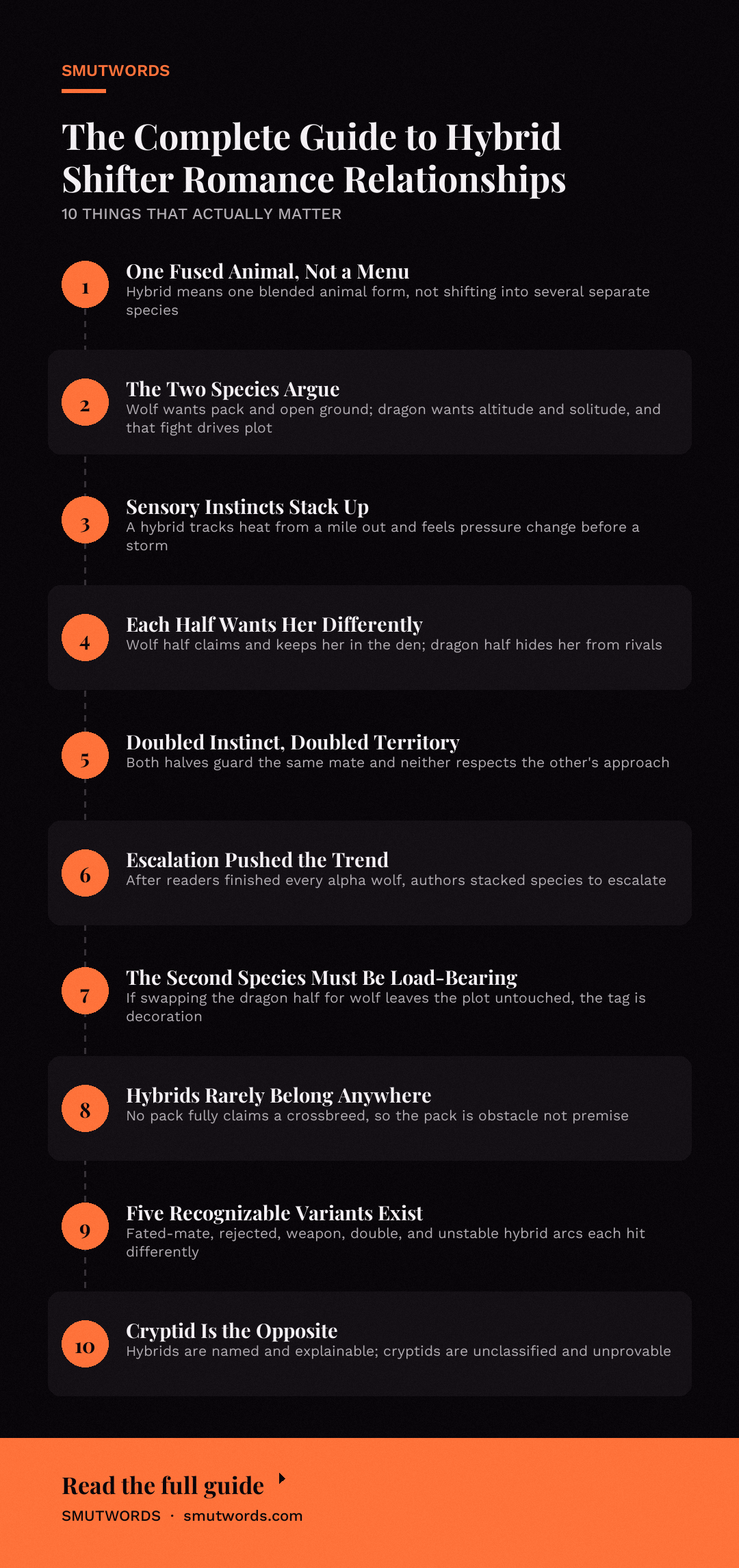
In a hybrid shifter romance, the animal side is itself a blend. The character might shift into a wolf-dragon, a bear-lion, a fox-coyote, a serpent-eagle, or any cross the author finds interesting. The two species don't sit quietly side by side. They argue.
The wolf wants a pack and open ground; the dragon wants altitude and solitude. The character's personality is built from that internal conflict, and so is the plot.
It helps to be clear about what doesn't count. A shifter who can take multiple separate forms (wolf one scene, hawk the next, bear after that) is a multi-shifter, but that's not the same as a hybrid. Hybrid means one fused animal, not a menu of options. And a human with an animal soul bonded to him isn't a hybrid shifter either, no matter how much growling happens.
Common misconceptions pile up fast in this corner of the genre:
- It's just a werewolf with extra steps. No. The two-species fusion changes how the character thinks, fights, and bonds, which changes the whole romantic arc.
- Hybrid means sterile or tragic. Some authors play the "can't reproduce" card for angst. Plenty of others breed hybrids freely and make the offspring part of the series premise.
- It's the same as chimera shifter. Often used interchangeably, though "chimera" usually implies a more monstrous, less taxonomic mix, and it shows up more in dark romance than in lighter paranormal.
- The hybrid is always the love interest. Just as often the heroine is the hybrid, or both leads are, which doubles the cultural friction inside the pairing.
The alternate names float around depending on who's publishing. Poly-shifter, multi-shifter, crossbreed shifter, chimera shifter, dual-form shifter. Indie authors tend to grab whatever label reads fastest on a cover; traditional publishers usually sand it down to plain "shifter romance" and let the blurb do the work.
Where Hybrid Shifter Romance Comes From
Shifter romance as a market category owes most of its commercial shape to the paranormal romance boom of the 2000s, when werewolf and big-cat series started pushing vampires off the shelf. Those books established the template: fated mates, pack politics, a hero whose animal instincts make him possessive in ways a human man would never get away with.
The hybrid angle grew out of that template needing somewhere to go. Once readers had consumed every alpha wolf in the catalog, authors needed escalation. The natural move was to stack species. A wolf who is also a dragon offers two sets of instincts, two sets of physical advantages, and two sets of problems, all in one love interest.
Two other forces pushed the trend. First, indie publishing made it cheap to test a wild premise. A hybrid bear-lion romance could be written, cover-designed, and released in weeks, and if readers bit, the author had a series. Second, fanfiction communities had been writing cross-species shifters for years before the trade market noticed, and a lot of that audience migrated into original romance with expectations already set.
Over the last decade the trope has drifted in a few visible directions. Early hybrids were usually wolf-plus-something, because wolves sold. Now the mixes are wider: Kraken romance logic has crept into shifter books, where sea-monster hybrids and deep-water shifters show up alongside the land predators.
Fae bloodlines get folded in too, pulling from the same well as Fae romance, so a hybrid might be half wolf and half something older and stranger with wings. And there's been a real shift from "the hybrid is a freak to be pitied" toward "the hybrid is the strongest thing in the room," which tells you exactly what readers decided they wanted.
How It Shows Up in Erotica
On the page, the hybrid gives an author a very specific toolkit, and the best books use all of it.
Two sets of sensory instincts. A hybrid wolf-dragon doesn't just smell fear. He tracks heat from a mile out and feels the pressure change before a storm.
Writers who lean into this make the love interest feel genuinely non-human, which is the whole point. Writers who skip it end up with a brooding man who occasionally has claws, and readers notice the difference immediately.
The internal argument. Strong hybrid shifter romance treats the two species as two opinions about the heroine. The wolf half wants to claim her, mark her, keep her in the den. The dragon half wants to carry her somewhere no rival can reach.
Both halves are obsessive; they simply disagree about method. That friction is free conflict, and it's the single most reliable thing separating a good hybrid book from a flat one.
Territorial behavior with a twist. Hybrids almost always read as more territorial than single-species shifters, because both halves are guarding the same mate and neither respects the other's approach. This sits squarely inside the territorial shifter trope, with the added wrinkle that the character's own body is contested ground. For a closer look at how that instinct plays against other possessive archetypes, the piece on territorial shifter vs possessive monster gets into the mechanics.
Enjoyed this? Get a free book.
Join the list and we will send a complete free story straight to your inbox, plus new releases every week after that. No credit card, no catch.
Size and power imbalance. A blended apex predator is almost always larger, heavier, and stronger than the human heroine, which puts the book in conversation with size difference romance. Good authors use the physical gap to build tension and tenderness; lazy ones use it as set dressing.
Authors also work recognizable variants. Knowing which one you're reading helps you find more of it:
- The fated-mate hybrid. The bond arrives first and the couple negotiates it second. Highest heat, lowest ambiguity.
- The rejected hybrid. The hero is cast out of his pack for being an abomination, and the heroine is the first person who doesn't flinch. Heavy on hurt-comfort.
- The weapon hybrid. Bred on purpose by a faction that wanted a soldier. The romance is about him choosing a person over a purpose.
- The double hybrid. Both leads are crossbred, often from rival bloodlines, and their mating is a political event as much as a romantic one.
- The unstable hybrid. The two species are at war inside him, and the heroine's presence is the only thing holding the shift together.
What makes a hybrid book land comes down to one editorial question: does the second species actually change anything, or is it a coat of paint? If you could swap the dragon half for ordinary wolf and the plot would survive untouched, the hybrid tag is decoration.
The books that work make the second species load-bearing. It changes how the character grieves, how he fights, what he's afraid of, and what he can offer a mate that no single-species shifter could.
Dominance dynamics also read differently here. A hybrid who is used to being the most dangerous creature in any room has to negotiate submission somewhere, and that negotiation is often the emotional spine of the relationship. The breakdown of how those roles function in practice is worth reading alongside this: dominant vs submissive covers what each role actually does in a scene and why the trade of power is the point.
Hybrid Shifter Romance vs Related Tropes
Two comparisons actually trip readers up, so they're worth sorting out.
Hybrid shifter vs cryptid romance. A cryptid romance centers a creature that is supposed to be unclassified and unprovable, often with no human form at all. The appeal is the unknown.
Hybrid shifters are the opposite: the species are named, the biology is explained, and the love interest can sit across a dinner table and hold a fork. If the book is about a man who turns into something no taxonomy can hold, that's cryptid. If it's about a man who turns into a wolf-dragon and has opinions about both halves, that's hybrid.
Hybrid shifter vs pack mates romance. Pack mates romance is about belonging to a group and the politics that come with it. Hybrid shifter romance is often about not belonging anywhere, because no pack will fully claim a crossbreed.
The pack can be present in a hybrid book, but it's usually an obstacle or a prize rather than the premise. Where the two overlap hardest is the mate bond itself, and that's where soulbond mechanics tend to take over.
Frequently Asked Questions
What is hybrid shifter romance?
It's a paranormal romance subgenre where a shifter carries the traits of two species in a single animal form, such as wolf-dragon or bear-lion. The hybrid nature is usually central to the character's identity and to the conflict of the romance, not a background detail.
Is hybrid shifter romance the same as poly-shifter romance?
Mostly, yes, in casual use. Poly-shifter and multi-shifter are marketing labels for the same idea, though some authors reserve "multi-shifter" for characters who shift into several separate animals rather than one blended form. Check the blurb if the distinction matters to you.
Do hybrid shifters have fated mates?
Usually, because fated mates are standard equipment in the wider shifter genre. The hybrid twist often makes the bond messier, since the character's two halves may want the mate for different reasons or fight over how to claim her.
Can hybrid shifters have children?
It depends entirely on the author's world-building. Plenty of series let hybrids reproduce, and the offspring become the next generation of the story. Others use infertility as a source of angst, or establish that hybrids can only conceive with a specific kind of mate.
Why are hybrid shifter heroes so territorial?
Because both species are guarding the same mate and neither yields to the other's method. That doubled instinct makes the character more intense than a standard alpha, and it's a big part of why readers find the archetype compelling.
How do I find good hybrid shifter romance?
Look for books where the second species changes the plot, not just the cover art. If reviews mention the hero's internal conflict between his two natures, or a mate bond complicated by an unstable shift, you're in the right territory. Readers chasing that specific friction can also look at forest spirit romance, which runs a similar dual-nature tension, or the billionaire romance playbook for how a single overpowered archetype gets recycled across a whole market.
Final Thoughts
Hybrid shifter romance works because it refuses to let the love interest be simple. Two predators, one body, one mate, and no clean way to reconcile any of it. If you want to see the trope at full strength, start with a book where the hero's second species is the reason he can't have her and the reason he'll burn the world down to keep her anyway. That's the version that earns the tag.





Loading comments…