
Strap-on play is sex play where one partner wears a harness holding a dildo and uses it on someone else. The wearer can be any gender, the receiver can be any gender, and the toy is the instrument rather than the point.
What makes the scene hot, in fiction and in life, is the swap: someone puts on a prosthetic cock and the room reorganizes around who is driving and who is taking it. The harness makes power visible, buckled and physical. That is exactly why it shows up so often in use kink scenes where a character gets taken thoroughly by something that never tires.
What Strap-On Play Actually Means
The name comes from the gear: a strap-on harness, usually nylon webbing or leather, built to hold a dildo at the wearer's pelvis so it moves with their body. The toy stops being held in a hand and becomes an extension the wearer has to thrust with, angle with, and feel through.
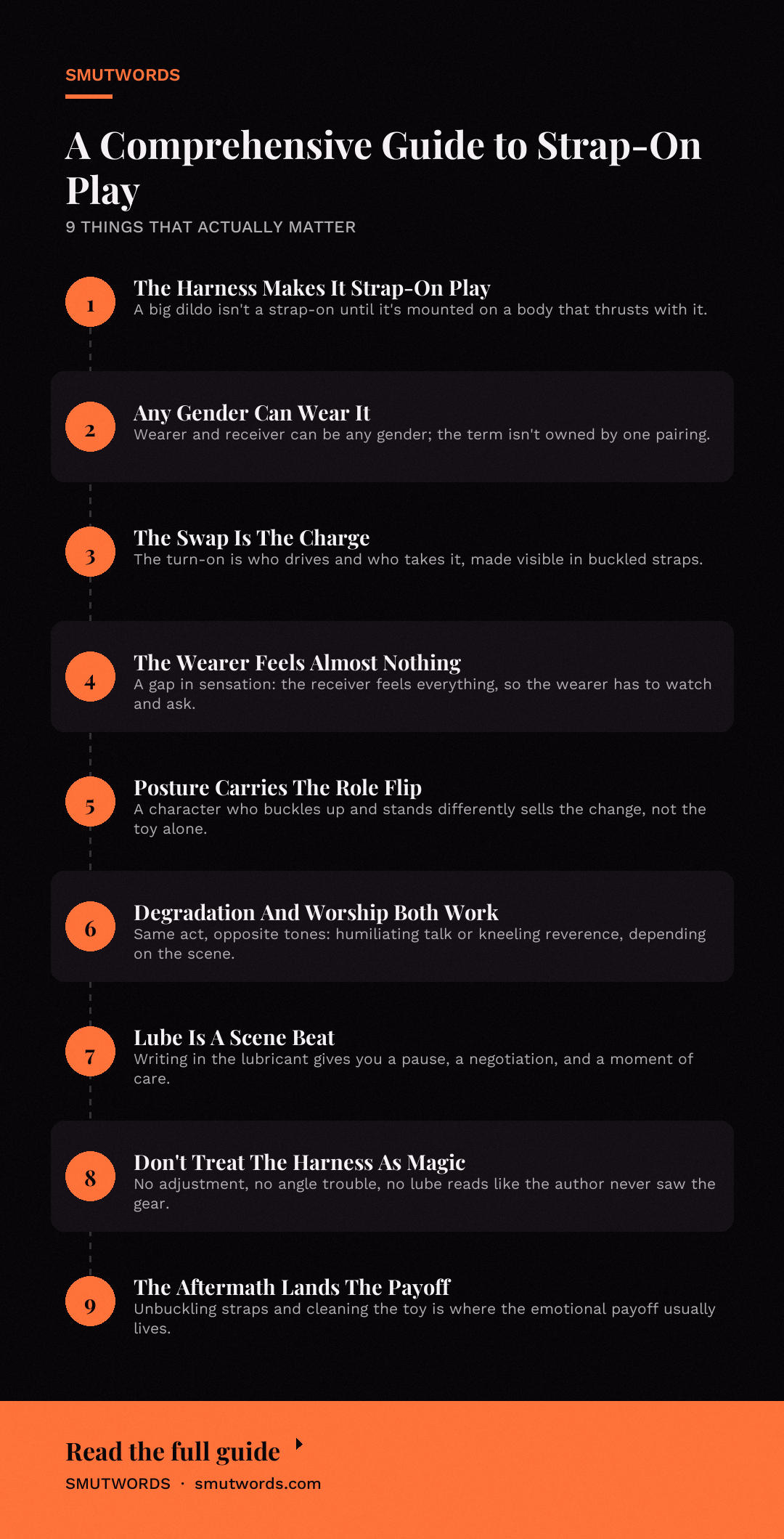
That is the first thing people get wrong. A strap-on is not simply a big dildo. Plenty of dildos are big and none of them are strap-ons until they are mounted on a body. The harness is what makes it play, because the harness is what makes the wearer a participant rather than a hand.
Strap-on play covers a lot of ground. Backless harnesses, brief-style harnesses, jock style, chest harnesses for double-ended toys, thigh rigs. The classic use is anal penetration of the receiver, but plenty of scenes use a strap-on for vaginal play, for double penetration with a second toy or a second partner, or for grinding and frottage with no penetration at all.
What does not count: a partner using fingers, a handheld dildo, or a wand on you. Those are not strap-on play no matter how good they are. The gear matters to the definition. So does the role shift, because the person wearing the harness is by definition the one inside the scene doing the penetrating, and that is where the tension lives.
The wearer's own anatomy is irrelevant to the term. A woman in a harness is doing strap-on play. A man in a harness is doing strap-on play. A nonbinary character with a chest harness and a double-ended toy is doing strap-on play.
Most of the confusion around the term comes from assuming it belongs to one pairing, usually f/f, and it does not.
Where Strap-On Play Comes From
Harnesses have been part of sex-toy manufacturing since at least the 1970s, when the first commercial leather and webbing rigs reached the market through fetish and leathercraft shops. Those early harnesses were built for a niche: adventurous couples, lesbian communities, leather scenes, sex-positive bookstores with a back room.
The publishing history is where things get interesting. For a long stretch, the harness showed up in lesbian erotica as a matter of course while mainstream romance barely acknowledged it. That shifted in the 2010s as self-publishing opened room for kink romance as its own category, and by the late 2010s the pegging scene had become a recognized beat in m/f romance rather than a novelty.
The bigger shift since is in who gets the harness. Older books treated the strap-on as a fixed prop for a specific kind of character, usually butch or dominant. Contemporary erotica has loosened that: the shy heroine who tries it and likes it, the boyfriend who asks, the experiment that turns into a preference. The harness became a plot device for revealing something rather than confirming something.
How the scene gets framed emotionally has changed too. Early depictions leaned on shock value, the strap-on as the point of a joke or a threat. Modern versions treat the gear as a neutral tool for a specific charge, and the charge is whatever the two characters bring to it: curiosity, surrender, showing off, love, humiliation, worship.
How It Shows Up in Erotica
On the page, strap-on play has three jobs. It changes who is in charge. It gives the scene a prop that can be described, handled, buckled, tightened. And it produces an asymmetry of sensation, because the receiver feels everything and the wearer feels almost nothing through the toy.
That gap is a gift to a writer, if the writer uses it.
The role flip
The most common version is the switch: a character who is normally in control hands the harness to the other person, or puts it on themselves to give something up. In f/f romance it can be the butch lead letting her femme top for the first time. In m/f it is often the man who asks, and the scene's charge comes from how his partner reacts to the asking.
The flip works best when the author lets the harness change the wearer's body language. A character who buckles up and stands differently, plants their feet wider, uses a lower register. The toy should not be the only thing that changes. Posture, voice, and eye contact carry most of the scene's weight.
Discovery and first-time scenes
The beginner scene is its own subgenre. One partner nervous, one partner patient, a lot of communication, a moment where the toy goes in and everything goes quiet. These scenes can run sentimental, and the good ones keep some awkwardness in the mix so the tenderness lands. A fumbled buckle is more charming than a perfect one.
Power and possession
Strap-on play pairs naturally with possessiveness kink, the version where the wearer claims the receiver aloud. The toy provides the object the claim is made around, the harness provides the visual of ownership, and the receiver's reaction to both is the payoff. Several authors use the harness as a stand-in for marking, the physical evidence of a claim that can be seen and touched.
Degradation and worship
The scene can run in two opposite directions. In degradation mode, the strap-on is used to humiliate the receiver, with talk about being taken, being filled, being put in place. In worship mode, the receiver treats the harness and the wearer's body with reverence: kneeling, kissing the base of the toy, thanking the wearer. Both work, and the difference is tone rather than content.
Enjoyed this? Get a free book.
Join the list and we will send a complete free story straight to your inbox, plus new releases every week after that. No credit card, no catch.
The wearer's experience
The best versions of these scenes pay attention to what the wearer feels, which is often not much physically and a great deal emotionally. The wearer cannot feel inside the receiver, and that is a vulnerability of its own: they have to read the other person, ask, watch. A scene that ignores this is flatter than one that uses it.
Harder variants
Strap-on play scales up into rougher territory when an author wants it to. A character can be restrained while wearing a harness, as in a shibari scene where the ropes hold the wearer and the harness holds the toy.
A scene can tip into primal play territory if the characters drop into a taking and being-taken register with growls and pinned wrists. Authors who want an amplified toy often borrow the language of monster cock kink and describe the strap-on as anything but realistic in size.
What separates a strong scene from a flat one
- Specific gear. A harness with straps that have to be threaded and tightened, a toy with a name and a texture, a bottle of lube on the nightstand. Vagueness kills the scene.
- Adjusted pacing. The wearer cannot feel the toy, so a realistic scene has them asking, moving slower than they want, watching the other person's face. Fast, oblivious pounding reads as fantasy in a bad way.
- Lube as a beat. Real strap-on play runs on lubricant. Writing it in gives the author a pause, a negotiation moment, and a chance to make the receiver vulnerable while the wearer handles them.
- A safeword or check-in. Even in pure fantasy, one line acknowledging that the receiver can stop it adds charge. Consent language is foreplay in the genre.
- An aftermath. The harness has to come off. Cleaning up the toy, unbuckling straps, the small mundane moment after is where the emotional payoff usually lives.
Common mistakes editors see
The most frequent is treating the harness as magic. If the wearer thrusts with no adjustment, no angle trouble, and no lube, the scene reads like the author has never seen the gear. Next is forgetting the receiver's body: real anatomy needs warming up, especially for anal. The third is treating the scene as the climax when the better version treats it as the middle, with aftermath and conversation carrying the last third.
If a writer wants to show the negotiation honestly, the mechanics of anal play work like any other first-time edge play: start with smaller toys, use more lubricant than feels like enough, go slow, and check in. The same logic that applies to reading first restraints applies here. New gear, patient introduction, clear signals.
Strap-On Play vs Monster Cock Kink
These two overlap enough in glossary terms that readers mix them up, but they do different work. Monster cock kink is a fantasy about size that exceeds what a human body could realistically produce. Strap-on play is about a wearable toy of any size and the shift in roles that comes with putting it on.
A strap-on scene can borrow the language of size, and plenty do. But the strap-on is a real, physical object a partner can hand to someone else. The charge comes from the exchange of roles rather than the size of the thing.
Monster cock fiction usually runs on awe and impossibility. Strap-on fiction runs on negotiation and trust. Both are good. They hit different spots.
Frequently Asked Questions
Is strap-on play only for lesbians?
No. It shows up across every pairing, and m/f pegging scenes have become one of the most requested categories in kink romance. Anyone can wear a harness, and anyone can be on the receiving end.
What is pegging?
Pegging is the specific term for a woman wearing a strap-on and anally penetrating a man. It is one variant of strap-on play rather than a synonym for the whole category, though people often use the words interchangeably.
Can the wearer feel anything?
Less than you would think. Some harnesses hold a textured base or a second toy that presses against the wearer's body, and double-ended toys give the wearer real sensation. Most strap-on play requires the wearer to read the receiver's reactions instead of relying on their own feedback.
Do I need a harness, or can I use a handheld toy?
You can absolutely use a handheld dildo, and many people do. The harness is what makes it strap-on play, because it puts the toy on the wearer's hips and turns thrusting into a shared action. A harness is optional as a sex act and essential as a term.
Is strap-on play safe?
Yes with basic real-world care: plenty of lubricant, unhurried entry, pace adjusted to the receiver, and clear communication or a safeword. The receiver is the one who feels the toy, so their feedback has to drive the scene, not the wearer's guesswork.
What lube should I use with a strap-on?
Silicone toys are safest with water-based lubricant, since silicone lube can degrade the toy's surface over time. Thicker gels tend to work better for anal play because they last through slower pacing. Keep a bottle within reach for the whole scene.
How do I write a strap-on scene without it feeling cliché?
Get specific. Name the harness, show the buckle trouble, describe the lube, give the wearer a moment where they realize they cannot feel the toy and have to watch the other person's face instead. Small physical details carry more charge than big declarations.
Final Thoughts
The gear is what makes strap-on play work on the page: a power exchange you can buckle, tighten, and take off. The best scenes keep that physical honesty.
The harness is real, the lube is real, the wearer's uncertainty is real, and the surrender on the other end only lands when the mechanics do. If you want a book that treats the harness as furniture of a real relationship rather than a punchline, look for the pegging titles on our ranked list. For more craft notes on adjacent kinks, our guide to vibrator training covers the same discipline of pacing and escalation with a different toy.





Loading comments…