
Vibrator training is a sexual practice, and a staple of power-exchange fiction, in which one partner uses a vibrator under another person's direction. The rules cover when they can turn it on, how long it stays on, what speed they're allowed, and whether they get to come.
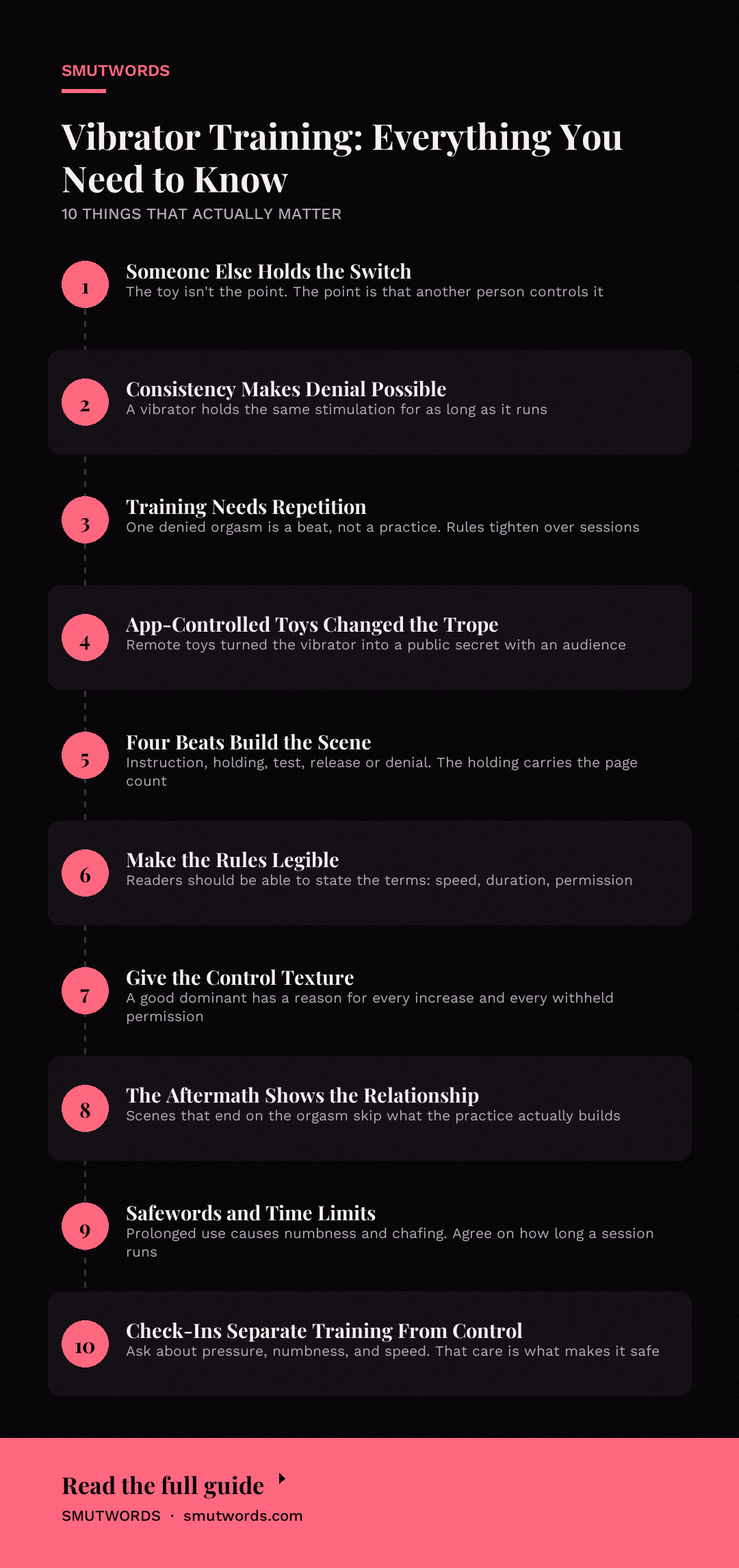
The point isn't the toy. The point is that someone else holds the switch. In erotica, vibrator training turns a piece of hardware into a leash, and the slow accumulation of denied and granted orgasms becomes the engine of the whole story.
That's the version readers search for at two in the morning, and it's the version this guide takes seriously: the mechanics, the history, the craft, the way a good scene is built beat by beat, and the real-world safety notes that make any of it work with an actual partner. If you've read a dozen books where a character is told to hold still and not come until given permission, you already know the appeal. This is the deep version.
What Vibrator Training Actually Means
The term borrows from two older vocabularies. "Training" is the language of obedience and instruction, lifted from military and animal-training idioms and long ago absorbed into D/s writing to describe a structured program of behavior a dominant imposes on a submissive. "Vibrator" is the appliance itself: a device that produces sustained, mechanical stimulation rather than the variable, human rhythm of a hand or mouth.
Put together, vibrator training describes a deliberate practice with a schedule and rules. The submissive is instructed to use the toy, or is made to wear or hold it while someone else controls it.
Sessions repeat. Rules tighten. Permission to orgasm becomes the currency of the relationship, granted or withheld by the dominant partner.
What counts as vibrator training is narrower than it looks. A single scene where a character uses a vibrator during sex is not training. A scene where a partner says "not yet" once is not training either, though it's a step in that direction. Training implies duration, repetition, and a structure someone is enforcing across multiple encounters.
What Doesn't Count
Solo masturbation with a vibrator, however elaborate, isn't training unless a partner is directing it. A one-off denial during an otherwise ordinary sex scene is a single beat, not a practice. A character who happens to own a vibrator and uses it whenever they like isn't being trained; they're just having a good time.
Common Misconceptions
The biggest one: readers assume vibrator training is about the toy being intense. It's actually about the toy being consistent. A vibrator delivers the same stimulation for as long as it runs, which makes it uniquely suited to holding someone at a plateau.
A hand gets tired. A mouth can't sustain the same pressure for forty minutes. A vibrator can, and that's what makes the denial possible.
The second misconception is that training means one continuous ordeal. In most fiction it's episodic: short sessions, repeated, escalating. The structure is closer to a workout plan than a marathon, which is exactly why it reads as a form of discipline.
Where Vibrator Training Comes From
The honest history here is publishing history, not a tidy lineage from any single real-world tradition. Three streams feed into the fictional trope, and they merged gradually over the last several decades.
The Orgasm Control Stream
Orgasm control and edging have been fixtures of erotic writing since long before the internet. Mid-century pulp and the underground erotic presses of the 1960s and 70s ran heavily on denial: the tease that goes on for chapters, the permission that arrives on the last page. The vocabulary of "training" came along with the D/s writing that flourished in the 1980s and 90s, as power-exchange fiction developed its own conventions and its own audience.
In that era, the mechanics were mostly hands and mouths, because that's what characters had. The vibrator existed as a product for decades, but it lived in the bedside drawer, not the plot.
The Toy Goes Mainstream
Two things changed in the 2000s and 2010s. Vibrators got quietly ubiquitous, sold in drugstores and marketed with pastel respectability. And remote-controlled and app-controlled toys arrived, which meant one person could genuinely hold the controls while the other person stood in a room full of strangers.
Fiction noticed immediately. The remote-controlled vibrator became one of the defining devices of contemporary erotic romance: the dinner party scene, the meeting, the wedding. The toy moved from a private object to a public secret, and that shift put a new kind of tension on the page.
The Modern Trope
What solidified in the last decade is the program version of vibrator training: a named practice with rules, homework, scheduled sessions, and a power dynamic that treats sexual response as something to be shaped over weeks. Contemporary romance and web fiction drove this, partly because serialized formats reward slow escalation, and partly because readers clearly wanted the discipline to be the plot rather than an interruption of it.
The dominant has become a kind of coach, and the submissive a student with a syllabus. That's the current form of the trope, and it's the one most readers are looking for when they search the term.
How It Shows Up in Erotica
Here's what an editor sees after reading a few hundred of these. Vibrator training is one of the most structurally versatile tropes in the genre, because it can be compressed into a single scene or stretched across an entire book. The good versions understand that the toy is a clock, and the story is about how long the clock runs.
The Session Structure
A well-built training scene has four beats, and the strongest writers hit all of them.
- The instruction. The dominant sets the terms: speed, position, duration, and the rule about orgasm. This is where the power gets established, and it should be specific. "Hold it there and don't move your hand" lands harder than a vague command to touch yourself.
- The holding. The character endures. This is the slow-burn core, and it's where most of the page count should go. The tension is in the gap between what the body wants and what the rules permit.
- The test. Something pushes the character toward the edge: a speed increase, an unexpected question, a countdown, a witness. The dominant may or may not grant permission.
- The release or the denial. Either the orgasm arrives as a gift with strings attached, or it doesn't arrive and the character is left wanting. Both endings work. What doesn't work is a scene that skips the holding.
That holding beat is where anticipation play does its heaviest lifting. The vibrator provides the physical plateau; the writer provides the dread and the want on top of it.
Common Variations
Writers have built a real repertoire here, and most books mix several of these.
- Edging on a schedule. The submissive is allowed to approach the edge a set number of times but not finish. The count becomes the plot.
- Remote-controlled toys. The dominant holds the controls in public, and the submissive has to behave. Great for scenes with an audience that doesn't know.
- Forced orgasms. Permission arrives as an order rather than a gift, and the character is made to come repeatedly past the point of comfort. This is the inverse of denial, and it carries its own tension.
- Instruction and obedience. The dominant's voice is the main event. The vibrator is almost a prop for a spoken-word dynamic, close cousin to breath play JOI in the way it centers command and response.
- Overstimulation. Sensitivity becomes the punishment. The toy keeps going after orgasm, and the character has to take it.
- Denial play with a deadline. The character is told they'll be allowed to come on a specific day, and the entire story is the wait. This is where training borders on torture in the best way.
A subset of the remote-toy scenes borrow heavily from the milking table scene in their logic: a partner is reduced to a body receiving stimulation on someone else's terms, immobilized and attended to. The geometry differs; the surrender is the same.
What a Strong Version Does
The best vibrator training writing gets three things right.
It makes the rules legible. The reader should be able to state the terms of the training at any point. Speed, duration, permission. If the rules are vague, the tension evaporates, because the reader can't feel the character straining against anything specific.
It gives the control a texture. The dominant's decisions need to feel deliberate and intimate, not arbitrary. A good dominant in fiction has a reason for every increase and every withheld permission. A flat one is just a person with a remote.
It lets the character's interiority carry the scene. The vibrator is the loudest thing in the room, and the writing gets quieter. The best pages track what the character is thinking about: what they're allowed, what they want, what it means that someone else decides. That's the intimacy readers come for.
Enjoyed this? Get a free book.
Join the list and we will send a complete free story straight to your inbox, plus new releases every week after that. No credit card, no catch.
What a Flat Version Does
The common failure is the "vibrator montage": scene after scene of a character using a toy with no accumulating structure. Nothing changes between sessions, so there's no story. The second failure is the dominant who never actually holds power. The character uses the toy, gets permission on the first ask, and the training dissolves into ordinary sex.
A third failure is the loss of aftermath. Training is a relationship, and the aftermath is where the relationship shows. Scenes that end on the orgasm and skip the follow-up miss the whole point of the practice, which is what it builds between two people over time.
Vibrator Training vs the Neighboring Tropes
Readers regularly confuse vibrator training with a handful of adjacent terms, so it's worth drawing the lines.
Versus Edging
Edging is a technique: bringing someone close to orgasm and stopping, often repeatedly within a single session. Vibrator training is a practice that contains edging. The vibrator makes sustained edging easier to write, and the training frame gives the edging a purpose beyond that one encounter.
Versus Forced Orgasms
Forced orgasms sit on the opposite side of the same axis. Denial withholds release; forced orgasms impose it. Both can be components of vibrator training, and many books use both in the same relationship to show the dominant's range.
Versus Scene Play
Scene play describes a single, contained erotic encounter with a beginning and an end. Vibrator training is a multi-session practice that frames many scenes. In real-life BDSM terms, training sits above individual scenes and gives them context.
Versus Aftercare
These aren't alternatives; they're adjacent. Aftercare is what happens when a session ends, and it's the part that demonstrates the relationship is caring rather than merely controlling. A training arc with no aftercare scenes reads as cold. The warming is the point.
Writing the Training Arc
For authors building this trope into a longer book, the training works best as a three-act structure.
Act One: Rules
The dominant establishes the terms and the submissive agrees to them. This early phase is where the reader learns the vocabulary: what "permission" means in this relationship, what the safeword is (and yes, good BDSM fiction includes one), and what the character is allowed to ask for and what they're not. The sessions are short. The tension comes from the newness of it.
Act Two: Escalation
The rules tighten. Session length grows. New toys enter, or old ones get faster. The submissive's behavior outside sessions starts changing, because training reshapes daily life.
This is the part that serializes well, because each chapter can deliver a distinct escalation beat while keeping the arc moving.
Act Three: The Breakdown and the Aftermath
Either the submissive fails (comes without permission, or can't take the session, or pushes back on a rule), or the dominant surprises them with a session that reframes the whole practice. Either way, the ending needs to resolve the power dynamic in a way that honors both characters. A good domspace breakdown helps writers keep the dominant's side of the relationship alive during the final act; a training arc with no interior life for the dominant reads hollow.
Real-World Consideration
Actual vibrator training on consenting partners is a real practice, and it needs three things to stay safe and pleasurable: clear consent, agreed limits, and check-ins. That's straight out of any responsible guide to RACK (risk-aware consensual kink).
The Safeword and Time Limits
Every session needs a safeword or a physical signal, agreed in advance, that ends the scene immediately. Time limits matter with vibrators specifically, because prolonged use can cause numbness, chafing, or overstimulation past the point of pleasure. Agree on how long a single session runs, and honor it even when whoever's on the receiving end wants to keep going.
Check-Ins During the Session
In person or over text, check-ins are what separate training from just turning a toy on and walking away. Ask how the pressure feels, whether there's numbness, whether the speed should change. If you want script ideas that don't break the mood, the guide to how to check in during a scene without killing the mood is useful here.
Aftercare After the Session
Aftercare after vibrator training matters as much as aftercare after more physically intense practices like impact play. Water, warmth, blankets, conversation, and a genuine return to ordinary care. Training is a relationship, and the return from training is part of the relationship too. If a training session involves any kind of restraint, the safety principles covered under bondage safety apply, and the gear considerations are usually covered by guides to bondage furniture use.
Consent and Negotiation
Before any session, the people involved agree on what's allowed, what's off-limits, and what the safeword is. Written notes or a quick conversation works. The point is that consent is explicit and can be withdrawn at any moment. A vibrator training dynamic built on anything less isn't training; it's just control without the structure that makes it safe.
Writers who keep these safety details in their fiction, even briefly, tend to produce stronger scenes: the negotiations and check-ins add a layer of care and intimacy that makes the control feel more, not less, charged.
Frequently Asked Questions
Is vibrator training a real practice or just a fictional trope?
It's both. Consenting partners in real BDSM dynamics do use vibrators within orgasm-control and training structures, with agreed rules, safewords, time limits, and aftercare. Erotica and romance have adapted and dramatized the practice into a narrative trope, often with serialized escalation and emotional stakes. The mechanics are real; the plotting is fiction.
What's the difference between vibrator training and edging?
Edging is a technique within a session: teetering near orgasm and backing off. Vibrator training is a broader practice that usually includes edging, repeated over many sessions, governed by rules a partner enforces. Training is the structure; edging is one move within it.
Can vibrator training involve forced orgasms?
Yes. Many books use denial and forced orgasms as opposite poles of the same dynamic, sometimes within the same relationship. Training can withhold permission as a denial technique or impose multiple orgasms as a different kind of control. Writers often use both to demonstrate a dominant's range and the submissive's limits.
Why is vibrator training so popular in power-exchange fiction?
It converts a piece of hardware into a source of control that's intimate and continuous. The toy can sustain stimulation for as long as the dominant decides, which makes denial, edging, and scheduled permission possible in ways hands and mouths can't easily manage. That sustained tension does the slow-burn work that readers of D/s romance seek out.
Does vibrator training in fiction include aftercare?
Strong fiction usually does, and it's a sign of a writer who understands the trope. Aftercare scenes are where the relationship between the two characters is reaffirmed after the power exchange, and they let the writer show that the control is caring rather than cold. Books that skip aftercare altogether often read as harsher than intended.
What should I look for in a good vibrator training scene?
Clear rules the reader can track. A dominant whose decisions feel deliberate. A submissive whose inner life carries the scene.
And aftermath: a check-in, a return to ordinary care, a line that shows what the session meant. A strong scene leaves the reader able to explain the training structure afterward.
Final Thoughts
Vibrator training earns its place in the deepest reaches of the genre because it's a practice about time. The toy runs, the rules hold, permission gets granted or doesn't, and the relationship between two people is built out of all those stretched minutes. If you want a book that handles the trope with full attention to its power exchange, its pacing, and its aftermath, the catalog below is where to start.





Loading comments…