A succubus romance is a love story built around a demon who feeds on sexual energy and the person she chooses to feed from, keep, or love. The protagonist is usually the succubus herself, sometimes the mortal caught in her hunger. The plot runs on a single engine: she needs what he has, and she wants him for reasons that have nothing to do with appetite.
That split between feeding and feeling is the whole genre. Readers come to succubus romance for a heroine who is sexually unapologetic, powerful, and a little dangerous. They stay for the part where something as ordinary as affection becomes the one thing her nature cannot digest.
What Succubus Romance Actually Means
The name comes straight out of medieval European demonology. A succubus was the female demon said to visit men in their sleep and draw vitality from them; an incubus was her male counterpart. Folklore framed both as predators and as explanations for everything from nightmares to unexplained illness.
The word's roots sit in the Latin succubare, to lie beneath. The old church writers meant it as a warning.
Erotica and romance took that warning and flipped its moral charge. In modern succubus romance, the hunger is real but the demon is a person. She has a job, opinions, a favorite coffee order, and a body that does something supernatural when she is turned on.
The feeding is erotic because the genre makes it erotic. The romance is the project of turning a one-way drain into something mutual.
What counts as succubus romance, specifically:
- A demonic or energy-feeding lead. She takes something from her partner that she cannot manufacture herself: sexual energy, life force, lust, dreams, memories of pleasure.
- A romantic arc, not just a premise. The relationship has to change both people. A string of feedings with no attachment is paranormal erotica, full stop.
- A negotiation of hunger. Every strong book in this lane makes the appetite a problem to solve together, whether the solution is a willing donor, a magical workaround, or a life sentence of devotion.
- Consent on the page. The good ones are explicit about it. The lazy ones skip it, and readers notice.
What does not count: a vampire who happens to be female, a witch with a high libido, or a demon who is simply evil and gets vanquished. The feed has to be sexual or eroticized, and the demon has to be the one doing the needing. If the book's demon is a side character or a villain, you are reading something else with a demon in it.
The most common misconception is that succubus romance is a dark romance subgenre first. It overlaps with dark romance constantly, but plenty of books in this lane are funny, tender, or downright cozy.
The other misconception is that the succubus is always the top. She is often dominant in bed and often the more powerful being. But a lot of the best books put her in a position where she has to ask for something, and that is where the heat comes from.
Where Succubus Romance Comes From
The demon lover is one of the oldest figures in erotic literature. Medieval and Renaissance texts treated the succubus as a theological problem, and the witch-trial literature spent real ink on whether a demon could conceive a child with a human. That question, whether a succubus can make a baby, is still one of the most reliable plot devices in the modern genre. Which tells you how long the idea has been circulating.
As a publishing category, succubus romance is much younger. It grew out of the paranormal romance boom of the 2000s and 2010s, when urban fantasy heroines with fangs, claws, and complicated love lives dominated bookstore shelves. Vampire romance led that wave. Succubus heroines came along as a spicier, more explicitly sexual variation, and they found a home in ebooks and indie publishing exactly when those channels could sell heat levels traditional publishers would not touch.
Two things shifted the genre in the last decade. Self-publishing let authors write the feed scenes at full length instead of fading to black, and the audience followed. Then the reverse-harem and why-choose formats arrived and gave the succubus a way to have multiple partners without anyone calling her a villain. A succubus with a pack of willing donors is a natural fit for that structure, which is why so many current releases use it.
The incubus side has its own history. Male energy-feeders show up more often in m/m and reverse-harem books, and they tend to be written as brooding, possessive, and physically overwhelming. The incubus romance is a genuine sibling to the succubus romance, not a footnote. Treat them as one family when you are browsing.
None of this is real-world BDSM history, and the genre does not pretend otherwise. It is a fantasy of appetite with a soul attached, and it has been evolving in that direction since the first ebook store let someone sell a demon heroine with a body count and a heart.
How It Shows Up in Erotica
On the page, the feeding scene is the genre's signature set piece. A good one works like a sex scene with a second current running through it: the physical pleasure is the surface, and the draining is the undertow. Editors who read a lot of these books look for one specific thing. Does the author make the hunger characterized, with a texture and a schedule and a downside, or is it just an excuse for a hot scene?
When the hunger is characterized, the whole book gets better. She has to feed every few days, or only during a full moon, or only when she is genuinely aroused, or only with a partner who trusts her. Each version creates a different set of problems, and each problem is a scene. The strongest books build a feeding rhythm the reader can feel coming, then break it at the worst possible moment.
Common variations authors use:
Enjoyed this? Get a free book.
Join the list and we will send a complete free story straight to your inbox, plus new releases every week after that. No credit card, no catch.
- The succubus redemption arc. She has hurt people, or believes she has, and the romance is the process of earning a clean slate. This version leans hard on guilt and forgiveness.
- The willing donor. A mortal partner who offers himself on purpose, sometimes to save her life, sometimes because he is into it. This is where the genre overlaps with financial domination in tone: someone giving up something precious on purpose, with enormous erotic charge in the giving.
- The demonic pact. The relationship starts as a deal. He gets something, she gets a steady feed, and the contract turns into love before either one admits it.
- The reverse harem or pack arrangement. She needs more than one partner to survive, and the book engineers a household of willing men. This is where the genre touches pack mates romance and pack dynamics, borrowing the group structure and the jealousy plotlines.
- The rival feeders. Two demons competing over one mortal, which lets the author write jealousy, jealousy sex, and a very satisfying final choice.
The tutor/student romance structure shows up more than you would expect, with the succubus cast as the experienced one teaching an inexperienced mortal what his body can do. That power imbalance, flipped so the woman holds the knowledge, is one of the genre's most reliable engines.
What makes a strong version of this trope work, from an editor's chair:
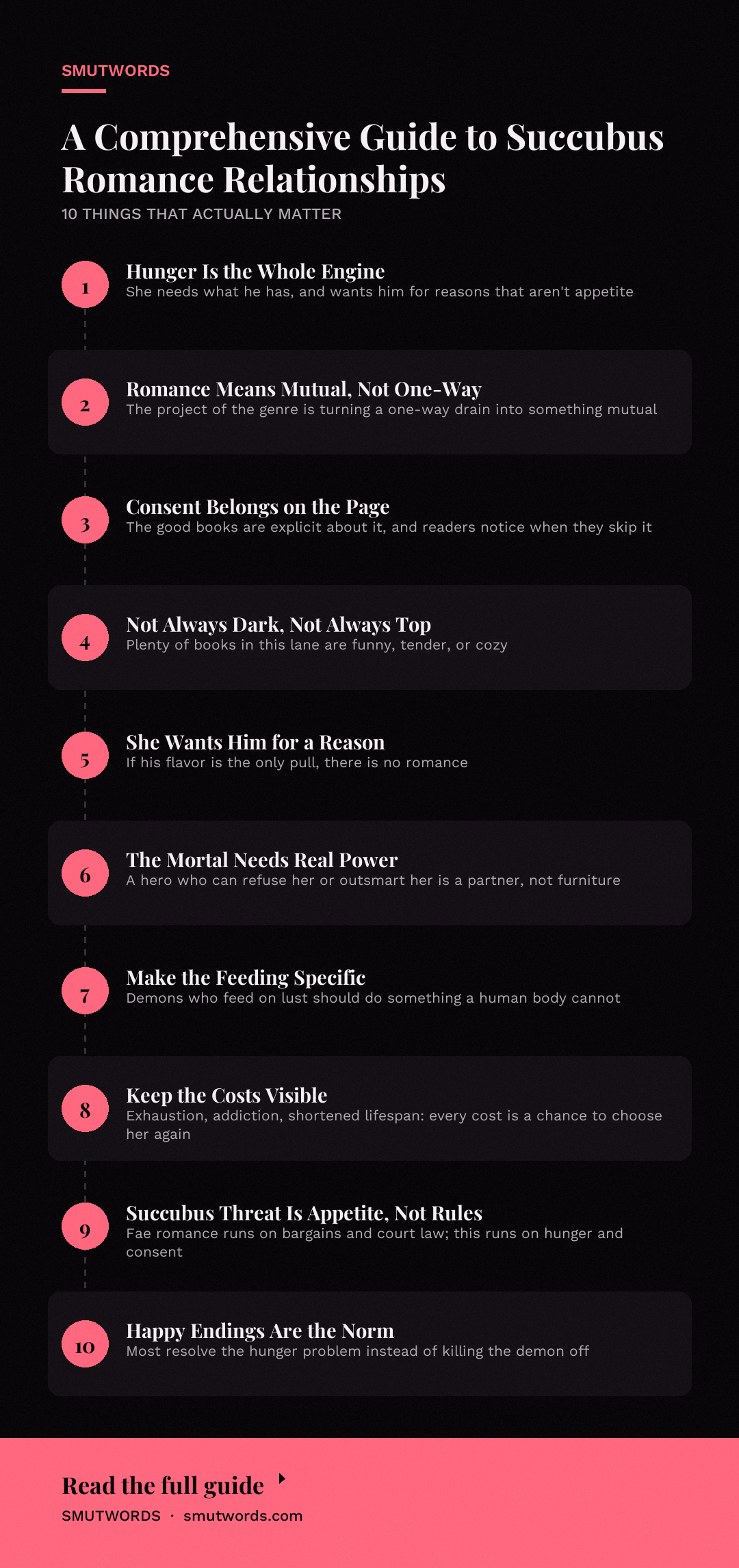
- She wants him for a reason that is not food. If the only thing pulling her toward the hero is his flavor, there is no romance. He needs a quality she cannot find in anyone else, and the book needs to name it.
- He gets to have power too. A mortal who can refuse her, outsmart her, or feed her better than anyone ever has is a real partner. A mortal who is simply overwhelmed is furniture.
- The cost stays on the page. Feeding has consequences. Exhaustion, addiction, a shortened lifespan, an angry ex from a previous arrangement. Every cost is a chance for him to choose her again.
- The heat is specific. Demons who feed on lust should be doing something with that lust that a human body cannot do. Vague glowing and gasping is a wasted scene.
- She has a life beyond him. A job, a demon community, a sister, a grudge. Isolated succubi get boring fast.
Where lazy versions go flat: the succubus is all appetite and no interiority, the hero is a sex object with a heartbeat, and the feeding scenes start to blur into each other. A flat version treats consumption as the goal. A strong version treats consumption as the obstacle and intimacy as the goal, and the reader feels the difference within the first chapter.
The genre also borrows from adjacent supernatural lanes constantly. A succubus with a fallen-angel ex reads a lot like an angel romance, and books that blend the two usually lean on the same redemption machinery. A succubus bound to a fae court runs on courtly bargains and dangerous flirtation in the same register as fae romance.
When an author pulls the rules of one of those lanes into her world, the book gets sharper. When an author borrows the aesthetic without the rules, you get a demon in a corset and nothing else.
Succubus Romance vs Fae Romance
These two get mixed up constantly because both feature a beautiful immortal woman who is dangerous to love and a mortal who should probably run. The difference is the nature of the danger and where it comes from.
In a succubus romance, the threat is appetite. She takes something physical from her partner, and the plot has to make him safe or make her stop. The genre's core argument is about consumption and consent, and the resolution is usually a new arrangement that lets both people survive.
In fae romance, the threat is rules. The fae lead is bound by bargains, iron, debts, and court law, and the tension comes from a mortal who does not know the rules trying to love someone who cannot break them. You can read more about how those relationships get structured in this breakdown of elf romance relationships, which tracks the same court-of-bargains logic.
If your taste runs to "dangerous immortal woman with a code the hero has to learn," you will like both. Just know which one you are picking up. A succubus story without real hunger is a fae story in a black dress, and a fae story without binding rules is a succubus story without teeth.
Frequently Asked Questions
Is succubus romance the same as paranormal romance?
No. Paranormal romance is the broader shelf, and succubus romance is one specific lane on it. The distinguishing feature is the energy-feeding lead and the sexual nature of what she takes. A paranormal romance can have a demon side character and be nothing like this.
Can a succubus romance have a happy ending?
Yes, and most do. The genre has a strong tradition of resolving the hunger problem rather than killing the demon off. Common solutions are a partner she truly loves, a magical bond that feeds her safely, or a life sentence that both people choose on purpose.
What is an incubus romance?
The male-lead version of the same setup, with an incubus who feeds on sexual energy. It appears most often in m/m and reverse-harem books. Same engine, same need to balance appetite with real attachment, different packaging.
Is succubus romance always dark?
Not at all. The lane runs from very dark (guilt, power imbalances, a body count the heroine cannot escape) to light and funny (a demon with a 9-to-5 who has to explain her diet to her boyfriend's mother). Check the heat and tone tags before you buy.
How explicit are succubus romance books?
It ranges from closed-door to fully explicit, with the spicier end coming mostly from indie and ebook publishers. The feeding scenes are usually where the heat rating comes from, so a book can be light on plot but heavy on those pages and vice versa.
Do I need to read the series in order?
Sometimes. Succubus series often follow one heroine across several books, with a romantic arc that resolves late. Reverse-harem versions sometimes serialize the whole relationship. Check the reading-order note on the series page before starting book two.
Final Thoughts
The best succubus romance treats a demon's appetite as a relationship problem, and relationship problems are where the heat lives. If you want one book to test the lane with, look for a series opener where the heroine has to negotiate her first real feeding arrangement: it will tell you within 40 pages whether this subgenre is your flavor. From there, the ranked list below has everything else worth picking up.
If adjacent supernatural dynamics are your thing, our guides on hybrid shifter romance and alien abduction romance run the same hunger-and-consent machinery in very different settings. And if you want the mortals-and-bargains side of the family, this piece on couple swapping goes at negotiation from a more grounded angle.




Loading comments…