
Most people who ask "am I dominant or submissive" are really asking a scarier question underneath it: what if I try this and the answer is something I don't like about myself?
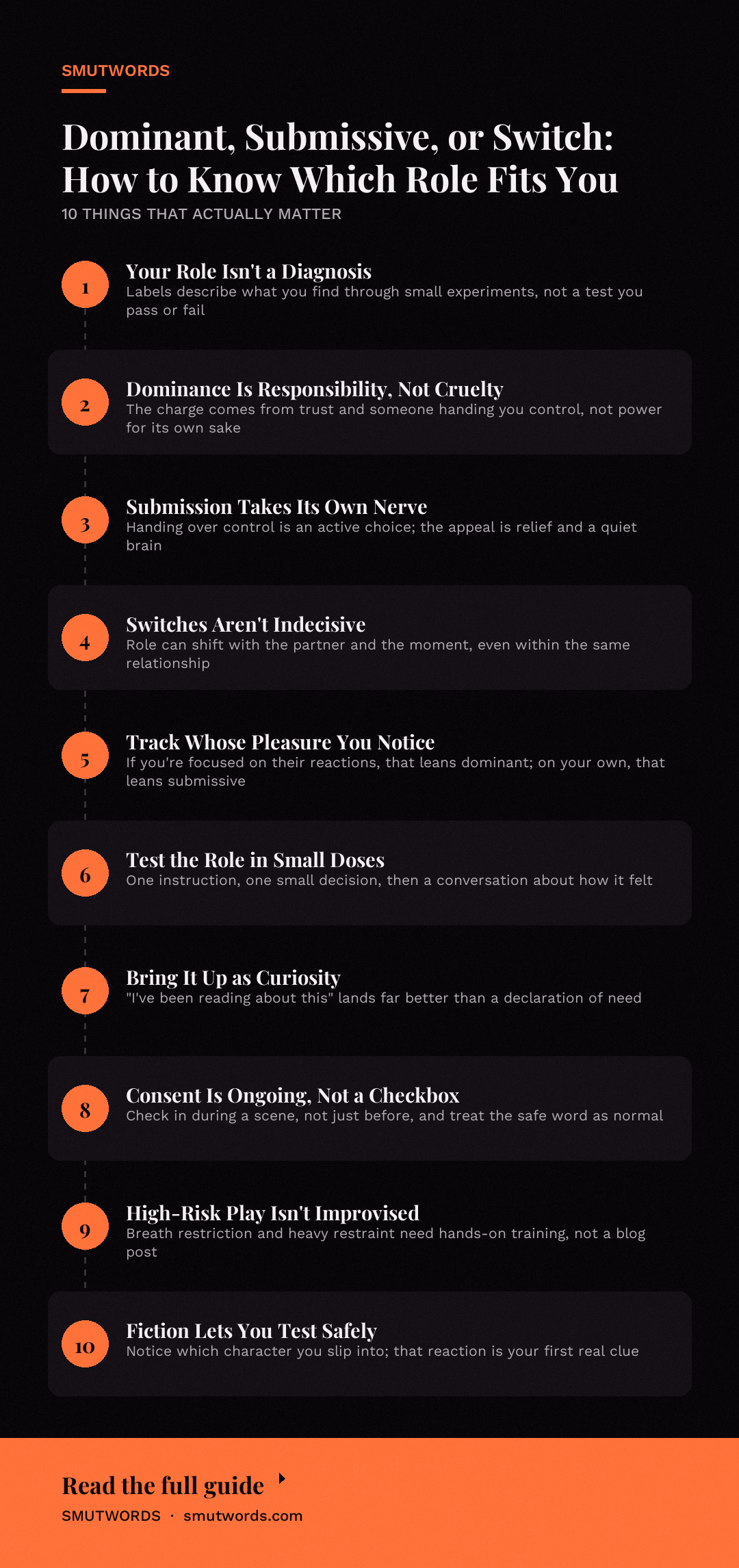
That fear is worth naming right away, because it's usually the thing actually blocking the exploration. The honest answer is that figuring out your role isn't a personality quiz you pass or fail. It's a series of small experiments. Some will feel obvious, some will surprise you, and the label comes at the end as a description of what you found, not a diagnosis you have to live up to.
This guide is for people who are curious but haven't committed to anything yet. Maybe you read a scene in a book and felt a pull you can't fully explain. Maybe you want a real-world way to test that pull without diving into the deep end.
We'll cover what the three main roles actually mean in practice, how to experiment with low stakes, how to bring it up with a partner, and how to tell the difference between a genuine turn-on and a fantasy that's better left on the page.
What Do Dominant, Submissive, and Switch Actually Mean?
Strip away the leather and the aesthetics and the roles come down to who holds the wheel in a given scene. A dominant takes the lead, sets the direction, and carries responsibility for what happens. A submissive hands over control and follows, trusting the dominant to steer. A switch moves between both depending on the person, the mood, or the scene.
None of those descriptions tell you anything about someone's personality outside the bedroom. Plenty of people who run teams and make decisions all day want nothing more than to be told what to do once the door closes. Plenty of quiet, agreeable people turn out to have a very specific idea of how they want a scene to go. The role is context-specific, which is exactly why it's so hard to figure out from the outside.
The dominant side, in plain terms
Being dominant is mostly logistical and emotional labor that looks effortless from the outside. You're reading your partner's reactions, adjusting in real time, keeping track of limits, and making decisions so they don't have to.
The turn-on for most dominants isn't cruelty or power for its own sake. It's the trust, the responsiveness, and the specific charge of someone handing you the controls and meaning it.
If the idea of being in charge sounds exhausting rather than exciting, that's useful information. Some people love the responsibility. Others find it a buzzkill. Neither is wrong.
The submissive side, in plain terms
Submission gets mischaracterized as passivity, which misses the point entirely. A submissive is actively choosing to hand over control, which takes its own kind of nerve. The appeal is usually about relief, focus, and the freedom of not having to decide anything for a while. Some people describe it as the only time their brain goes quiet.
If the thought of someone else making the calls makes you tense up rather than relax, you're probably not submissive in that way, and that's fine. Plenty of people who love the fantasy of surrender in a book find the reality of it claustrophobic.
What it actually means to be a switch
Switches get treated like they're indecisive, which is nonsense. A switch simply finds that the role depends on the partner and the moment. Someone might dominate confidently with one person and melt into submission with another, or flip within the same relationship depending on the week.
If you keep feeling pulled in both directions, you're not confused. You might just be a switch who hasn't had the right scene yet to show you which way you lean.
Signs You Might Lean Dominant or Submissive
Before you touch anything resembling a scene, spend some time noticing what your brain does when you imagine different scenarios. Not the polished fantasy version. The messy real one. Here are the questions that tend to sort people out fastest:
- When you imagine a scene, whose pleasure are you tracking? If you're focused on the other person's reactions and what you'd do to draw them out, that leans dominant. If you're focused on what's being done to you and how it feels, that leans submissive.
- Does the idea of deciding everything feel thrilling or tiring? Thrilling points toward dominance. Tiring points away from it.
- When you read a scene, which character are you? Pay attention to who you identify with, not who you find attractive. The person you imagine being is the tell.
- How do you feel about being watched, praised, or told what to do? A pull toward being directed or evaluated often signals submissive wiring.
- Does the thought of someone trusting you completely feel like a turn-on or a burden? Dominants usually feel the first. Everyone else feels the second, at least at first.
None of these are definitive on their own. They're starting points.
The real answer usually shows up when you actually try something, not when you imagine it. If you want a low-effort way to test the waters before involving another person, reading fiction where the dynamic is central can tell you a lot about your own reactions.
Something like Absolute Surrender puts a submissive's headspace front and center. Notice whether that reads as hot or claustrophobic. Either reaction is useful data.
How to Experiment Without Committing to a Label
The biggest mistake beginners make is treating the first experiment as a verdict. It isn't. You're gathering information, and the goal is to make the experiments low-stakes enough that you're not performing a role you haven't figured out yet.
Start solo. Notice what you fantasize about when nobody's watching and there's no one to impress. Do your fantasies stay consistent, or do they shift with your mood?
Then start small with a partner: a single instruction, a single moment of handing over or taking control, and a conversation afterward about how it felt. Build from there.
Low-stakes play might look like one partner deciding what the other wears for an evening, or one person directing a make-out session, or a simple rule that lasts an hour and then gets dropped. The point is to feel the shape of the dynamic in your body before you add intensity, restraints, or anything that requires a safe word.
For a clearer framework on matching risk to experience level, this guide to RACK (Risk-Aware Consensual Kink) is worth reading before you escalate anything.
Enjoyed this? Get a free book.
Join the list and we will send a complete free story straight to your inbox, plus new releases every week after that. No credit card, no catch.
Testing the dominant role
Try giving one clear instruction during a make-out session and watch how it lands, both for you and for your partner. Notice whether you enjoy the follow-through or whether it feels like work. If you find yourself wanting to check in constantly and getting anxious about getting it wrong, that's a sign you may need more practice, more communication, or that dominance simply isn't your lane.
Testing the submissive role
Ask your partner to make a small decision for you and notice whether the loss of control feels relaxing or stressful. Some people need a few tries before submission clicks, especially if they're used to being in charge of everything. Others discover immediately that it's not for them, and that's a clean answer too.
Testing the switch role
If you're drawn to both, try each side with the same partner across different sessions and see which feels more natural, or whether it genuinely depends on the day. Many switches describe a kind of mood-based flip where stress, energy, and who they're with all change the answer. Track it over a few weeks rather than deciding after one scene.
How to Bring It Up With a Partner
The conversation is usually scarier in your head than in reality. The trick is to bring it up as curiosity rather than a confession. "I've been reading about this and I'm curious whether it's something we'd want to try" lands very differently from "I need you to dominate me or I can't be happy."
Ask questions instead of making declarations. Find out what your partner already knows, what they're curious about, and what's a hard no before you share the full extent of your own interest. If your partner is firmly vanilla and you're discovering you're not, that's a real conversation with its own article: when one partner is kinky and the other is vanilla covers how to negotiate that gap without turning it into a fight or a guilt trip.
Keep the first conversation light and explicitly temporary. "Let's try one thing and see how it feels" is a much easier yes than "let's redefine our whole dynamic." You can always go further once you've established that the first step was fun for both of you.
Consent, Communication, and Knowing When to Stop
Consent in kink is an ongoing conversation, not a checkbox at the start. That means checking in during a scene, not just before it, and having a way to pause or stop that both people actually trust. A safe word is the baseline. It only works if using it is treated as normal rather than as a failure of the scene.
Communication is also how you catch the difference between a fantasy and a limit you didn't know you had. Someone might love the idea of being told what to do and then discover that a specific instruction hits a nerve. That's not a reason to abandon the whole thing. It's a reason to talk about it afterward, adjust, and try again more carefully.
Some practices carry real risk and shouldn't be improvised. Breath restriction of any kind can cause serious injury or death and requires hands-on training and a partner who knows what they're doing. It is not something to figure out from a blog post. Heavy restraint, especially anything that limits circulation or restricts movement near the neck, is in the same category.
If a scene involves anything in that territory, it needs a partner with actual experience, a plan for what happens if something goes wrong, and a way to release the restraint immediately. Anything that leaves someone unable to communicate needs far more caution than the low-stakes experiments above.
Stop when something stops feeling good, when a limit gets crossed even by accident, or when either person's ability to consent gets compromised by alcohol or exhaustion. A scene that ends early because someone needed to stop is a successful scene, because the communication worked.
Where Fiction Fits Into Figuring It Out
Reading is one of the safest ways to test a role, because there's no risk and no partner to perform for. If you find yourself consistently drawn to stories with a clear dominant or submissive dynamic, that's a pattern worth paying attention to. The Incubation Tower puts control and submission at the center of its premise. Your reaction to the person giving up control tells you something about your own wiring.
Fiction also lets you try on roles you'd never choose in real life. A reader who identifies as dominant in reality might get a genuine charge out of a story where the power flips. Subroutine: Stretch Her leans into directives and control.
Weekend at the Bull's is built around a partner stepping outside the relationship, a dynamic some people find themselves drawn to in fantasy long before they'd ever consider it in practice. That gap between fantasy and reality is useful to notice.
If your interest pulls toward the social side of things, where power dynamics play out among multiple people, articles on group sex and the specifics of an FFM threesome can help you tell whether that pull is about the role itself or about the setup. Plenty of people who think they're curious about group dynamics are actually curious about a specific role within them. Reading helps separate the two.
Common Questions About Role Identity
Do I have to pick a permanent label? No. Labels are descriptions, not contracts, and plenty of people land on one and then change their mind months later. You're allowed to be wrong, and you're allowed to revise.
Can I be submissive in bed and dominant everywhere else? Yes, and this is extremely common. Role is about the dynamic, not your personality, and the two often run in opposite directions on purpose.
What if I don't enjoy either role? Some people are perfectly happy vanilla, and some people's kink doesn't fit neatly into the dominant/submissive binary at all. Not finding yourself in either label is a valid answer, not a failure to launch.
How long does it take to figure out? Some people know within one scene. Others take months of experimenting and reading before the picture sharpens. There's no deadline, and rushing the answer usually produces a label that doesn't fit.
Final Thoughts
The clearest way to answer "am I dominant or submissive" is to stop trying to answer it in the abstract. Do something small, with someone you trust, and pay attention to what your body tells you afterward.
If you want a place to start reading that will give you a concrete feel for a dominant or submissive headspace before you try anything in real life, pick up Free Use Strip Club VIP Room and notice which character you keep slipping into. That's your first real clue, and it's a lot more reliable than a quiz.





Loading comments…