
The cloning kink is a fantasy in which arousal comes from duplication: a character is copied, a partner is copied, or the reader is dropped into a scenario where two bodies share one identity. Who belongs to whom stops having a clean answer. Most of it lives in speculative romance and science fiction erotica, where cloning gives writers a tool for examining selfhood through desire.
The scope runs from near-identical copies standing in for a lover to fully divergent duplicates who hate each other. The heat in every version comes from the same place: the intimacy of being confronted with your own body from outside.
What Cloning Kink Actually Means
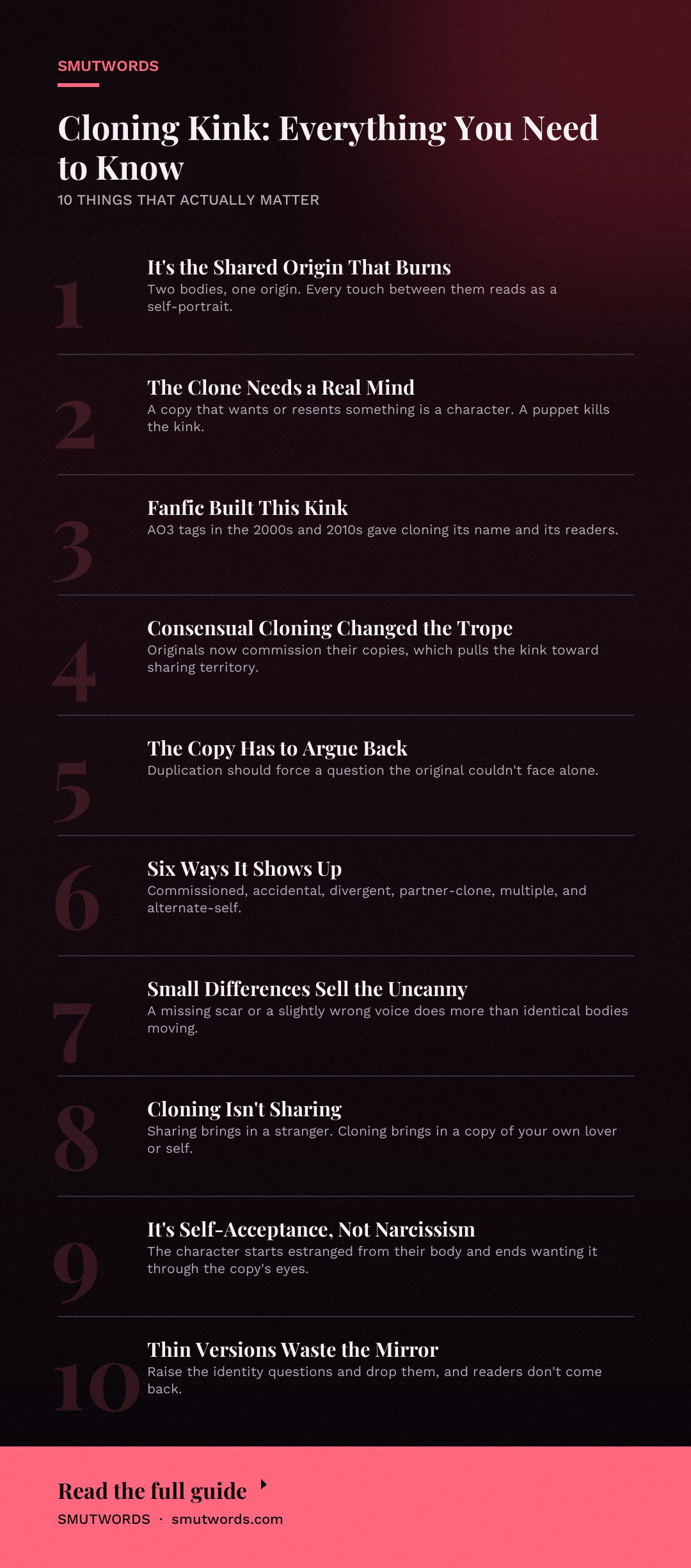
The name is literal. A clone appears, and desire spikes. What separates it from other doubling fantasies is the shared origin: the two bodies are the same body, genetically or functionally, which makes every touch between them a kind of self-portrait.
The mechanism itself stays in the background. Tanks, labs, magic mirrors: scaffolding. What duplication does to personhood is the actual subject.
Three features define the category:
- Identical or near-identical bodies. The physical sameness is the point, or close to it. Writers can bend this (a clone with minor divergences, a clone aged forward or back), but the resonance comes from the mirror.
- Separate minds. Two consciousnesses occupy those bodies. The moment the clone becomes a puppet, the kink collapses into something else entirely.
- Desire that crosses the copy line. The clone wants, or is wanted, and the wanting is what the scene is built around.
What does not count: twins who happen to be identical, a shapeshifter wearing your partner's face, a doppelgänger with no erotic charge, an android built to imitate. Those stories share surfaces with cloning kink but lack the tension of two versions of one identity colliding in bed. A copy of your partner without your partner's mind is a lookalike. A copy with the mind is a clone, and the clone is where the heat lives.
The most common misconception is that this kink is identical to selfcest. Selfcest (sometimes spelled self-cest) is the broader umbrella term for erotic scenarios between copies or versions of the same person: time-travel loops, alternate-universe doubles, body-swap variations.
Cloning kink is one delivery method for selfcest, and it's the one most associated with speculative genres. A reader who loves selfcest doesn't necessarily need the lab. A reader whose kink is specifically cloning probably does want the duplication to happen inside the plot, as an event.
Where Cloning Kink Comes From
The term's publishing history is short and traceable. Cloning entered the cultural vocabulary seriously after Dolly the sheep in 1996, and speculative fiction had already been playing with duplicates for decades: the doppelgänger tradition of nineteenth-century Gothic, the identical-twin comedies of Shakespeare, the mirror-self horror of Edgar Allan Poe. Erotica absorbed these threads later and mostly through fanfiction.
The real origin point for cloning kink as a named reader interest is fanfic communities in the 2000s and 2010s. Writers working with canons that had canonical clones (Star Wars, various comics, anything with an engineered-double plot) discovered that putting the original and the copy in bed produced an emotional flavor regular ship fic couldn't replicate. The tag culture of AO3 formalized it: "selfcest," "cloning," "duplicate," "original character/clone" became findable categories, and readers flocked to them.
Two shifts reshaped the trope in the 2010s. The first was the rise of what readers call "regency clone" or "gothic clone" romance, where writers set the cloning in older-feeling worlds and made duplication feel like a curse or a fairy bargain rather than tech.
The second was the sharp rise of consensual cloning scenarios: the original explicitly commissions the copy, sometimes with the goal of giving a partner more than one body to play with. That shift moved cloning kink closer to the sharing kink conversation, since a partner who consents to being cloned for you has essentially consented to being shared with a version of themselves.
Publishing caught up around the 2020s. Indie romance authors now use cloning and duplicate premises as central plot engines rather than side curiosities, and the reader base has grown well past the fanfic origin. The kink has its own shorthand now: "clone romance," "self-duplication," "duplicate desire." Those phrases didn't exist as marketing terms a decade ago. Readers type them straight into search bars today.
How It Shows Up in Erotica
The strongest cloning scenes share one rule: the duplicate has agency. A clone who exists to be used is a prop. A clone who wants something, resents something, or knows more about the original than the original knows about herself is a character, and characters generate friction. The friction is the sex scene.
Editors who have read hundreds of these manuscripts tend to agree on what separates a strong version from a flat one. The flat version introduces a clone, describes the physical duplication in detail, runs a scene between the original and the copy, and ends. It works mechanically but leaves nothing behind.
The strong version uses duplication to force a question the original character could not otherwise face. What if the version of me that I'd call a copy is actually the one who's honest? What if being wanted by someone who is me shows me something about my own self-loathing that a normal lover never could?
Common variations in published work:
- Commissioned clone. A character asks to be cloned, often for a partner's benefit or to fulfill a fantasy they can't perform personally. Heat comes from the original watching.
- Accidental clone. Duplication goes wrong or unexpected. The original and the copy must negotiate what to do, and desire emerges from the negotiation.
- Divergent clone. The copy develops differently, sometimes physically, sometimes emotionally. The original has to accept that the "duplicate" is not really a duplicate anymore.
- Clone of a partner. Rather than the POV character being copied, their lover is. This often becomes a sharing or cuckolding structure, and it plays particularly well with the voyeur husband trope when the original partner watches his copied body with his actual lover.
- Multiple clones. Two or more copies enter the frame, often as a route into group dynamics without the awkwardness of bringing in strangers. Readers drawn to this variation tend to also read group sex scenarios, though the clone version has a built-in intimacy the stranger version doesn't.
- Alternate-self romance. The "clone" is a version of the same person from a different timeline. Less mechanically about duplication, more about identity collision.
Where the scene actually spends its word count matters. Strong cloning erotica focuses on:
- Recognition. The uncanny moment of seeing your own face turned toward you with desire in it.
- Mirror-touch. Kissing, touching, and the doubled sensory feedback that comes from knowing exactly what the other body responds to, because it is your body.
- The jealousy beats. A clone doesn't have to compete with the original for a lover to feel jealous. Sometimes the original is jealous of the copy for being wanted, or of themselves for wanting it.
- The philosophical aftermath. Post-coital scenes in strong cloning erotica almost always land on identity, on self-acceptance, on what it means to love a version of yourself.
Craft details that make a scene land:
Enjoyed this? Get a free book.
Join the list and we will send a complete free story straight to your inbox, plus new releases every week after that. No credit card, no catch.
Specific physical sensation sells cloning better than abstract weirdness. A hand touching a hand that has identical knuckles, a scar the copy doesn't have, a patch of skin the original remembers from inside and now sees from outside. Writers who lean into these micro-frictions get the uncanny effect. Writers who stay at the level of "two identical bodies moved together" produce a doubled stock description.
The clone's voice is the second make-or-break. Give the copy a way of talking that is almost the original's voice, with one or two unsettling differences: a flatter affect, an older-sounding vocabulary, a willingness to say the thing the original won't. That difference is where the erotic charge sharpens.
Cloning scenes often borrow the emotional register of degradation kink without the humiliation. The copy speaks truths the original won't admit, and being known that precisely by someone who shares your body has a similar heat to being talked down to by someone who actually sees you. Different mechanism, real reader overlap.
Cloning kink plays least naturally with feral play, since the animal-instinct angle needs a body that isn't identical in most successful versions. It plays most naturally with anal play, since the double-body scenario lets a writer choreograph two positions at once when the copies work in tandem. Writers who want to push the tandem choreography often reach for FFM threesome structures as a template, then swap one participant for a copy.
For writers building original characters who thrive on this trope, the same role-clarity that works in any power-exchange scene applies. The original is often coded dominant, the copy submissive or switch, though strong versions refuse to fix the roles cleanly and let them shift mid-scene. The guide to figuring out which role fits you is a useful lens if you're writing a character whose relationship to their own copy keeps flipping.
Where the kink gets thin: when the writer treats the clone as a body double rather than a person, when the philosophical questions are raised and then dropped, when the scene ends before anyone has to deal with the aftermath. Readers don't come back to cloning erotica for the mechanism. They come back for the mirror. A scene that never makes the character look in it wastes the premise.
Cloning Kink vs Sharing Kink
These two get confused constantly, and the confusion makes sense: in both, a partner's body is being engaged by more than one person. The difference is where the second body comes from.
Sharing kink involves a real second party. The lover is shared with another person, and the heat comes from the partner's pleasure with someone else, or from the original partner watching.
Cloning kink involves a copy: physically the same person, consenting separate mind, no outside party at all. A reader turned on by the idea of watching a partner with a stranger has a sharing kink. A reader turned on by watching a partner with a copy of themselves has a cloning kink. They can overlap, and a cloned copy being shared with a third party is a real and published scenario, but the kinks are distinct.
Frequently Asked Questions
Is cloning kink the same as selfcest?
Selfcest is the broader category of erotic scenarios between two versions of the same person: clones, mirrors, time-displaced selves, alternate-timeline selves. Cloning kink is a subset of selfcest specifically involving duplication as a plot event. All cloning kink is selfcest-adjacent, but plenty of selfcest fic has no cloning in it at all.
Is cloning kink about narcissism?
It's often assumed so, but the strongest cloning erotica is about self-acceptance more than self-worship. The character usually starts by finding their own body strange or shameful and ends by finding it desirable through the copy's eyes. The fantasy is seeing yourself from outside, not needing to be the center of your own world.
Can cloning kink work in a contemporary setting, without sci-fi?
Yes, and lots of successful romance does it. Magical duplicates, cursed mirrors, identical twins mistaken for each other, alternate-universe visitors, and dream-self scenarios all land in contemporary settings. The mechanism is flexible. What matters is the shared-identity charge, and that can be delivered without a lab.
Is there a real-world equivalent?
Not in the literal sense, since duplicating a person isn't physically possible. The fantasy-only nature of the kink means there's zero physical risk in the fiction, but readers sometimes find the scenario surfaces real questions about self-image and desired-ness that belong in a conversation with a partner. A lot of the same communication guidance in the RACK guide applies: talk about what the fantasy represents before assuming what it means.
Why do readers like a copy of their own body in bed?
Because it makes the character look at themselves with desire they usually can't access alone. The clone functions as an external mirror that can want back. That kind of intimacy with your own body is rare in real life, and erotica is one of the few places a reader can experience it safely.
Does the kink require an identical twin appearance?
No, and strong versions often lean on small divergences: a scar that the copy doesn't carry, a slightly different speaking register, a minor physical change that signals the copy has a life the original didn't. The heat comes from near-sameness, not strict identity. Twins, in fact, are a separate trope (twin fantasy) that gets conflated with cloning often enough that it belongs in the adjacent-terms conversation.
Final Thoughts
Cloning kink is the rarest kind of speculative kink in that it doesn't require you to escape the body you're in. It asks the reader to look at that body, meet a version of it under different light, and want what that version wants.
If you're new to the trope and looking for something to read, start with something that lets the copy argue back. The premise is only worth its word count when the duplicate has teeth.
And if you're a writer curious where to file your own work in the wider kink taxonomy, the use kink and monster cock kink entries make a useful contrast: cloning is quieter, more philosophical, and far more interested in the interior of a character than the exterior of a body.





Loading comments…