
Vacation romance is the trope where two people meet somewhere far from home, fall into bed and then into something bigger, and have to reckon with a return date hanging over every scene.
The setting does the heavy lifting: sun, anonymity, a hotel room that isn't theirs, a clock that starts running the moment they say hello.
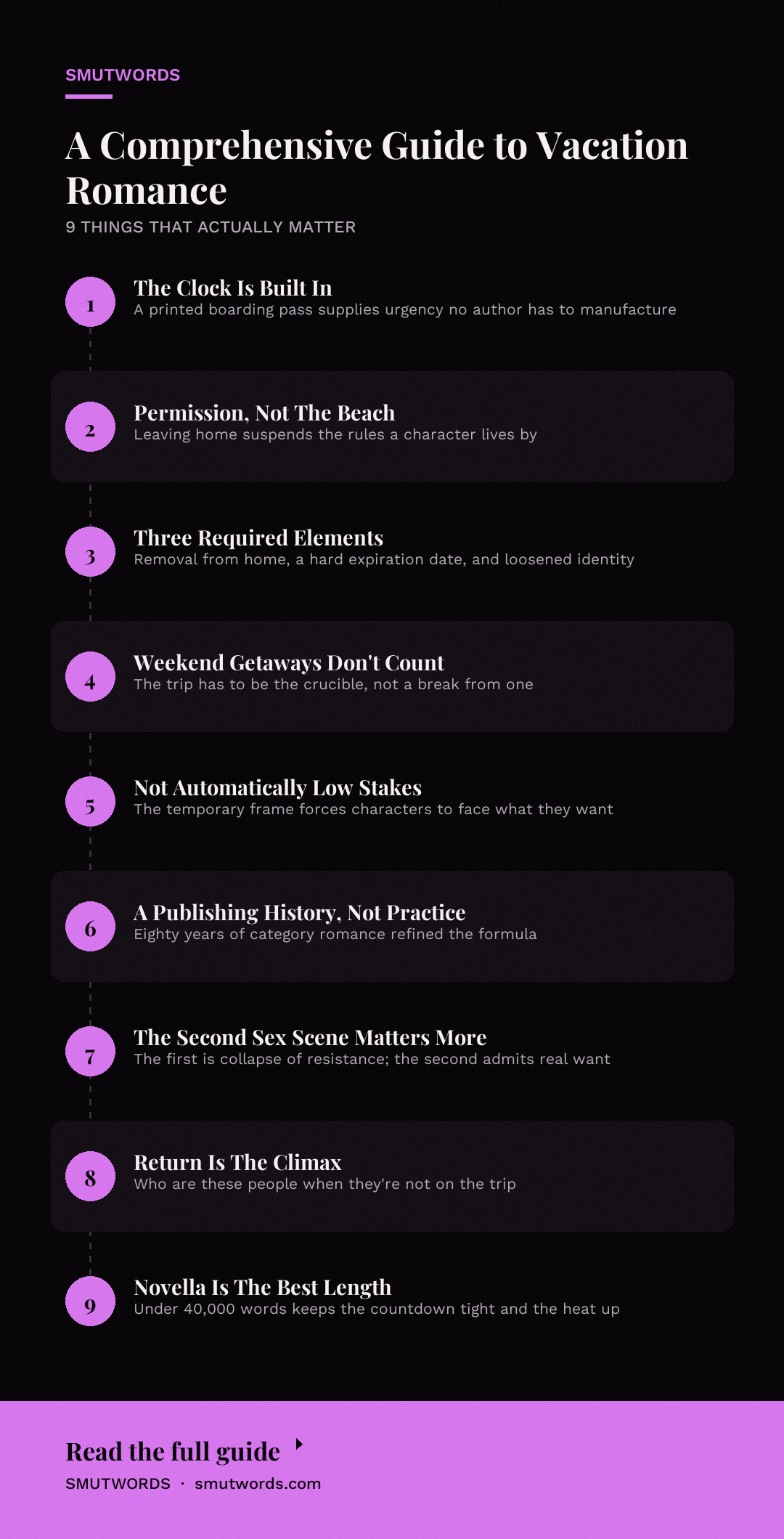
It's one of the most reliable engines in erotic romance because the clock is built in. Nobody has to manufacture urgency when the boarding pass is already printed.
What makes the trope work is the permission, not the beach. A character who would never approach a stranger at her own neighborhood bar will do it three margaritas deep in Lisbon, and the reader knows exactly why. Vacation romance runs on the idea that leaving home temporarily suspends the rules governing a person's ordinary life. That suspension is where all the heat lives.
What Vacation Romance Actually Means
The name covers any erotic or romantic storyline where the central relationship is forged during a defined, temporary trip away from home. The trip doesn't have to be tropical.
A conference in Chicago counts. A two-week canal boat rental counts. What matters is the container: a start date, an end date, and a version of the characters who exist only inside that window.
The genre has several working names for roughly the same thing. Island fling, holiday hookup, resort romance, work trip romance, vacation-to-forever. Publishers and readers swap them freely, though the labels carry slightly different flavor.
"Holiday hookup" leans toward short and purely physical. "Vacation-to-forever" signals upfront that the couple is going to make it past the flight home.
Three things have to be present for a book to actually be a vacation romance rather than a romance that happens to include a trip:
- Removal from home context. The characters are outside their normal geography, their normal social circle, and usually their normal obligations.
- A hard expiration date. Something concrete ends the trip. A flight, a checkout time, the start of a semester, a work contract.
- Identity loosening. At least one character behaves in ways they wouldn't at home, and the story notices this and makes it matter.
What doesn't count: a couple who lives in the same city and takes one weekend away together. That's a weekend getaway scene inside a different trope. The vacation has to be the crucible, not a break from it.
The most common misconception is that vacation romance is inherently low-stakes or fluffy. Plenty of them are light, but the trope's real power is the opposite. The temporary frame forces characters to confront what they actually want, because they can't hide behind routine.
A vacation romance can carry grief, career crises, and the slow collapse of a marriage the heroine hasn't admitted is over. The sunscreen is not the point.
Where Vacation Romance Comes From
This trope is older than the paperback industry that codified it. Nineteenth-century fiction is full of disastrous, transformative trips: the Grand Tour, the seaside excursion, the spa town where respectable people did slightly less respectable things. The Brontës and their contemporaries understood that removing a character from the village was the fastest way to make them interesting.
The modern version grew up alongside mass tourism. Once commercial air travel put a Caribbean island within reach of a middle-class reader, the vacation romance became a fantasy readers could picture themselves inside.
Mid-century category romance publishers leaned on it hard. Harlequin's catalog from the 1960s through the 1980s is stuffed with nurses and secretaries falling for brooding men on Greek islands, in Alpine ski lodges, aboard cruise ships. The settings were aspirational, the arithmetic was reliable, and the covers sold themselves.
The 1990s and 2000s shifted the destination list. Authors started writing vacations readers were actually taking: all-inclusive resorts, backpacking trips through Southeast Asia, destination weddings, honeymoons that one party is attending alone. The fantasy got closer to the reader's own life, which made it sharper.
The last decade brought two clear changes. First, the destinations diversified well past Europe and the Caribbean, with more stories set in the characters' own countries and regions. Second, the trope absorbed the lessons of contemporary romance's consent conversation without losing its edge.
Today's vacation romances are more likely to show the negotiation, the check-in, the moment a character asks instead of assumes. Readers respond to that because it makes the eventual scene hotter, not colder. If you want the full breakdown on how that dynamic works across the genre, Dubcon (Dubious Consent) Explained covers the history and the modern handling in detail.
Worth noting: unlike tropes rooted in a specific subculture, vacation romance has no real-world practice behind it. Its history is entirely a publishing history. The trope exists because readers buy it, repeatedly, and the market has spent eighty years refining the formula.
How It Shows Up in Erotica
On the page, the trope follows a recognizable architecture. Understanding the architecture is how you tell a strong version from a flat one, whether you're writing one or just tired of picking up the same paperback twice.
The arrival scene sets the temperature
Strong vacation romances spend real page time getting the character out of their skin and into the new place. The heat of the pavement, the wrongness of the hotel carpet, the way the heroine notices her own clothes look different against a backdrop that isn't hers.
Flat versions skip straight to the meet-cute. The good ones let the reader feel the loosening happen first, so that by the time the two characters fall into bed, the reader has already accepted that this version of the protagonist is capable of it.
The countdown structure
Authors signal time passing in obvious ways and subtle ones. Chapter headers with dates. A running count of remaining nights. A scene that ends with a hotel bill slid under the door.
The countdown is the trope's engine, and the best books make the reader feel it in the body, not just the plot. Every sex scene gets a little more desperate as the trip runs out.
Enjoyed this? Get a free book.
Join the list and we will send a complete free story straight to your inbox, plus new releases every week after that. No credit card, no catch.
Common variations authors reach for
- Island fling. Pure heat, limited emotional promise, often the shortest form. Works best as a novella.
- Work trip romance. Colleagues or strangers at a conference. Adds professional consequences and a shared office to return to.
- Resort romance. Structured setting, staff characters, a built-in social ecosystem. Good for ensemble subplots.
- Destination wedding. The couple meets as guests or as guest and local. Bonus drama from an ex or a sibling present.
- Vacation-to-forever. The couple hits the end of the trip and has to decide whether to upend a life. Longer book, bigger third act.
- Honeymoon solo trip. The jilted traveler goes anyway. Reliable setup for a rebound that turns serious.
- Stranded extension. Weather, a canceled flight, a lost passport. The trip runs long against everyone's will.
The stranded extension is the most useful variation for writers who want a long book, because it forcibly delays the reunion with real life and forces the characters to get honest with each other. It also pairs beautifully with Enemies to Lovers, where the trapped-together pressure does most of the emotional work.
What makes a strong version
The best vacation romances commit to the identity question. The heroine isn't just on holiday; she's someone who has spent years being careful, and the trip cracks that open in a way she can't fully reseal. The hero isn't just a hot stranger; he's got his own escape logic, and the collision of two people's temporary selves is where the heat comes from.
Weak versions treat the setting as wallpaper and the temporary frame as an excuse to skip the hard parts. If the couple could have met at a coffee shop in their shared hometown and the story would play out identically, the vacation isn't doing its job.
The other marker of quality is what happens at the end. A strong vacation romance has to answer the question the trope raises: who are these people when they're not on the trip? The best versions make the return itself the climactic obstacle. The airport scene matters more than the sex scene, or at least it should carry equal weight.
Worth flagging a structural cousin: books where the "elsewhere" isn't a geographic location at all. Parallel Universe Romance uses the same temporary-world logic, and much of the same craft advice applies.
Heat level and the pacing of physical scenes
Vacation romance accommodates everything from closed-door to explicit, but the trope's natural register is high heat. The built-in deadline makes first-times believable at a speed that would feel rushed in a slow-burn office romance. A couple who would date for six months at home can plausibly end up in bed on night two, and readers accept it because the trip reframes what's reasonable.
Successful explicit scenes in this trope tend to use the location as an active participant. Balcony, shower with bad water pressure, rented car, beach after dark, hotel bar bathroom. The setting raises the risk of getting caught, which is a big part of what readers are here for. If that's a thread you want to pull, Exhibitionism in Erotica Explained goes deep on how public-adjacent settings function in erotic scenes.
One more craft note: the second sex scene in a vacation romance usually matters more than the first. The first is the collapse of resistance. The second is where the characters start admitting what they actually want, and that's where the emotional stakes get real.
Pairings that work especially well
Vacation romance is a flexible shell that combines cleanly with several other tropes. The most reliable combinations:
- Grumpy/sunshine. One character is on the trip because someone made them go. Instant friction.
- Second chance. The stranger turns out to be someone from years ago. The temporary frame lets them re-litigate the past without committing to the future.
- Class or wealth gap. Tourist and local, guest and staff, honeymoon suite and hostel bunk. Adds a power differential the story has to actually address.
- Celebrity in hiding. Works because the vacation's anonymity gives the famous character a taste of normalcy. Celebrity Romance covers the broader trope and how it plays with visibility.
- Hate to love. Cabin-mates, tour companions, rival guests. The confined setting does the rest. See Hate to Love for the mechanics.
Redemption stories also slot in naturally here. The trip gives a character with a messy past a clean slate, and the reader gets to watch them choose differently. The Redemption Arc Romance entry covers how that arc is built.
Vacation Romance vs Celebrity Romance
These two trip people up because they overlap constantly and aren't the same thing. A vacation romance is defined by the temporary geographic container. A Celebrity Romance is defined by a fame differential between the two leads, whether they're on a beach in Bali or stuck in the same Los Angeles zip code.
You can write a vacation romance with zero celebrities, and you can write a celebrity romance where nobody leaves home.
The overlap happens when a famous character goes on holiday specifically to escape the press, meets a civilian, and has to decide whether to drag them into the spotlight. That book is both, and if you're reading one, the question to ask is which engine is actually driving the plot. If the answer is "the trip ends on Sunday," it's a vacation romance with a celebrity in it.
Frequently Asked Questions
What counts as a vacation romance?
A romance where the relationship forms during a temporary trip away from the characters' normal lives, and where the end of that trip is a real, plot-relevant event. A weekend away in an otherwise home-based relationship doesn't qualify. The trip has to be the pressure chamber.
Do vacation romances always end happily?
In the romance genre, yes. The couple ends up together, though "together" might mean one of them moves, they agree to long distance with real plans, or they reconfigure their lives around the relationship. Vacation-to-forever books are explicit about this. The unhappy-ending version belongs to literary fiction, and readers who pick up a labeled romance are not signing up for that.
Why do readers like the temporary-trip setup so much?
Because it delivers urgency without contrivance. The deadline is real, the characters know it, and every scene carries that weight automatically. It also offers a fantasy of permission: the reader gets to imagine being braver, more open, and more physical than they'd be on a Tuesday at home.
Is a work trip romance the same thing?
It's a close cousin and often shelved with the same tag. The difference is what the characters return to. In a true vacation romance, the return is to separate lives. In a work trip romance, they return to the same office, which adds professional consequences and usually shifts weight into the third act.
What's the difference between a holiday hookup and a vacation-to-forever?
A holiday hookup is short, physical, and often ends at the airport with a wistful look. A vacation-to-forever book spends real time on the aftermath, showing how the couple handles geography, jobs, family, and the slower work of building something that outlasts the trip. The first is a novella shape, the second is a full novel shape.
Can a vacation romance work as a novella?
It's arguably the trope's best length. Under 40,000 words keeps the countdown tight, eliminates room for subplots that dilute the heat, and lets the writer end the book at or just past the airport. Longer vacation romances need the stranded-extension variation or a strong external conflict to keep the middle from sagging.
Does the setting have to be tropical?
No, and the tropical default has gotten stale enough that readers notice when a book reaches for it lazily. Ski towns, European cities in the off-season, remote cabins, ferry routes, and cross-country road trips all work. What matters is that the location is genuinely not-home and that the story uses it.
Final Thoughts
Vacation romance works because it gives the reader a clean shot at a fantasy most people have actually had: what would I do if I were somewhere nobody knew me, with a fixed number of days and no consequences waiting on the other end of the flight. The best books in the trope take that fantasy seriously and then complicate it. The trip ends. The people don't stop existing. What they do about that is the book.
If you want a starting point, look for a vacation-to-forever novel where the return home isn't a tidy epilogue but a genuine third-act crisis. The list below ranks the strongest ones in the SmutWords catalog right now.






Loading comments…