
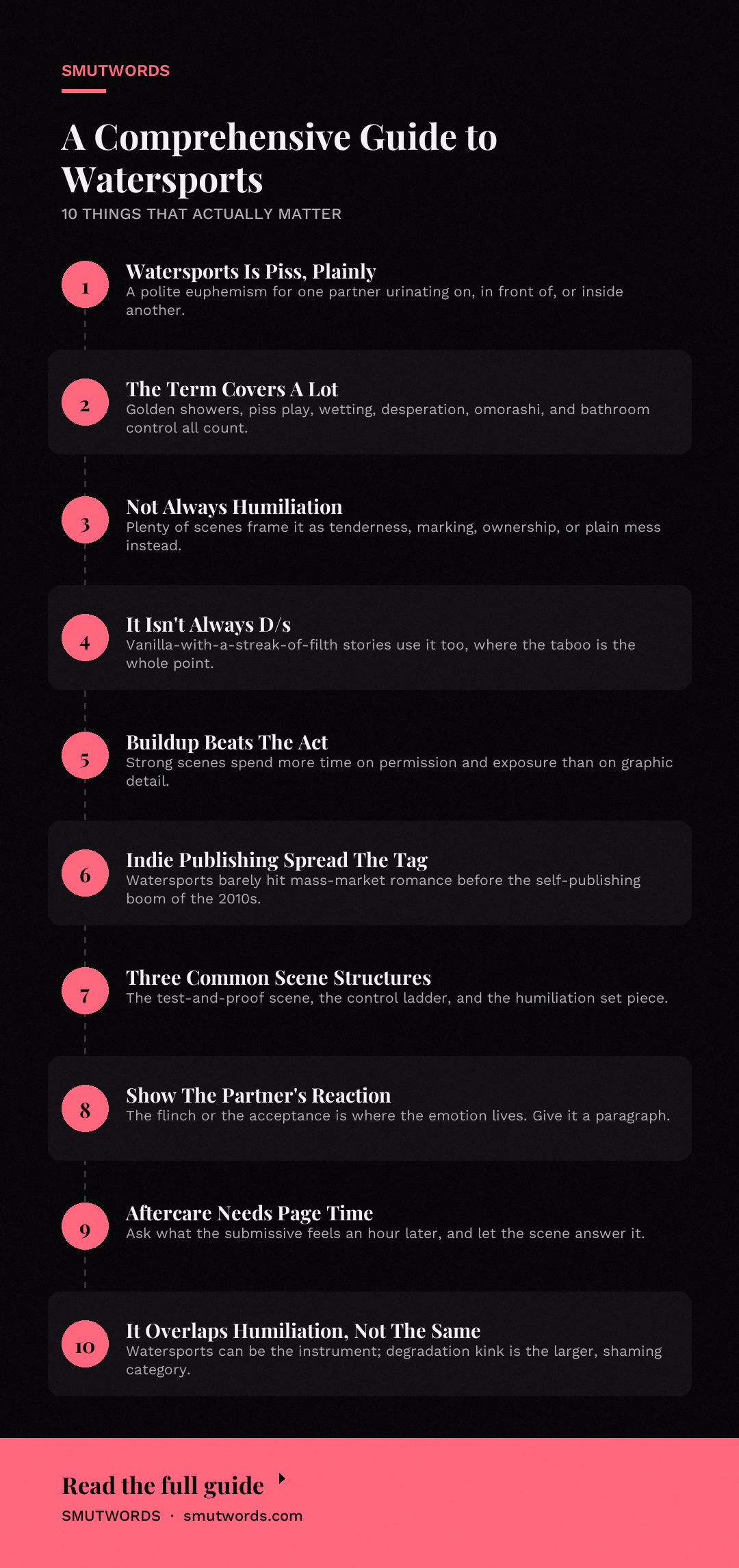
Watersports is the kink of urine in sex: one partner pissing on, in front of, or inside another, usually inside a scene built on power exchange, humiliation, or sheer filthy intimacy. In erotica it rarely shows up as a standalone act. It arrives as an escalation, a test, a rite of passage inside a dynamic that has already stripped away the polite stuff.
The term covers golden showers, piss play, wetting, desperation, and bathroom control. It earns its heat from the same thing that makes it squirm-inducing: someone is being seen, and used, at their least guarded.
What Watersports Actually Means
The word itself is a polite piece of euphemism, the kind the internet specializes in. "Watersports" sounds like jet skiing. It means piss. That mismatch is part of the appeal in writing: the term lets a book signal the kink on a cover or a content warning without saying the word outright, and it lets characters talk around the act before they do it.
A quick boundary on what counts. Watersports requires a person urinating on, near, or in front of another person as part of sexual or intimate play. A character who simply needs the bathroom during a long scene isn't doing watersports. Neither is a single mention of a full bladder used purely for tension.
What does count is broad:
- Golden showers: direct urination onto a partner's body, often chest, back, or face.
- Piss play: the general umbrella, including urinating into a partner's mouth or onto genitals.
- Wetting: a character deliberately soaking their own clothes or a partner's while fully dressed.
- Desperation play: the buildup, holding it, being made to wait, begging for permission.
- Bathroom control: a dominant deciding when, where, and whether a submissive gets to go.
- Omorashi: the Japanese term for the desperation-and-wetting end of the spectrum, more about the agony of holding than the release.
Common misconceptions are worth clearing up here, because they shape how readers approach the tag. The first is that watersports always equals humiliation. Plenty of scenes frame it as tenderness, marking, ownership, or simple mess without a drop of degradation.
The second is that it's always a D/s act. It shows up in vanilla-with-a-streak-of-filth stories too, where the taboo is the whole point and nobody is holding a leash.
The third misconception: that the act has to be graphic to work on the page. Some of the strongest watersports scenes in romance are almost entirely about the buildup and the permission, with the actual moment rendered in a single filthy line. The kink lives in the consent and the exposure, which means a skilled writer can deliver it without an anatomy lesson.
If humiliation is the engine of the scene, it usually shares DNA with degradation kink, and the craft notes there apply: the sting has to come from someone the submissive chose, and the desire underneath has to stay visible.
Where Watersports Comes From
The act is ancient. The genre term is young. Watersports as a named kink in English-language publishing is a late-twentieth-century phenomenon, shaped by the internet far more than by any single book. In the 1970s and 80s, piss appeared in underground and fetish press as a niche interest alongside other fluid play, treated as extreme and mostly documented rather than dramatized.
The real shift happened in the 1990s and 2000s, when online forums and early kink publishing catalogs gave the practice a searchable name and a community. "Golden showers" entered mainstream vocabulary through tabloid gossip, which, predictably, made it more taboo and more interesting. Fetish publishers started releasing themed anthologies, and the term "watersports" became the industry-friendly label of choice.
In mainstream romance and erotica, the timeline is shorter still. Watersports barely appeared in mass-market romance before the self-publishing boom of the 2010s. Once indie authors could publish dark romance and hard kink without a gatekeeper, the tag spread fast. It went from a whispered curiosity to a recognizable subgenre marker, appearing in dark mafia romance, hardcore BDSM series, and the filthier corners of monster and paranormal romance.
The most interesting shift is tonal. Early erotica treatments tended to play watersports for shock value, the act as a gross-out climax or a punishment. Contemporary romance writers have moved toward integration: the kink appears as one step in a longer arc of surrender, often paired with aftercare scenes and emotional fallout.
That's where the readership has settled. Readers aren't scanning for the act alone; they're scanning for what it costs a character to get there. The genre has learned that the kink lands hardest when it's the visible proof of how far someone has gone.
How It Shows Up in Erotica
Here's what the page actually does with it, from the perspective of someone who has read a lot of these books and seen the same three structures over and over.
The dominant structure is the test-and-proof scene. The dominant proposes it, or the submissive offers it, and the scene's real function is to answer a question the couple has been circling: is this person really all in? The urination is the physical proof, and the emotional payoff is in the partner's reaction, whether they hold steady or flinch.
The second structure is the control ladder, common in full-time D/s and total-power-exchange stories. Bathroom permission is one of the earliest rules a dominant imposes, and the escalation from "ask permission" to "you'll go when I say" to "here, now, on me" is a clean three-rung progression that writers use to ladder the dynamic.
Desperation play is the middle rung and often the most page-time-heavy, because the agony of holding is easier to sustain across a chapter than the release.
The third structure is the humiliation set piece, where the act is the visible expression of a character's chosen degradation. This is the hardest to write well. Flat versions treat the act as punishment and stop there, leaving the reader with shock and no desire.
Strong versions give the submissive a reason to want it, or at least to choose it, and they keep the dominant's hunger on the page. The humiliation only works if arousal is visibly riding underneath it. Good degradation scenes show both people getting off; great ones make the reader feel the sting and the heat in the same beat.
Wetting and omorashi is its own craft tradition with a distinct rhythm, usually more interior than the other variants. The reader lives inside the character's body, tracking the pressure, the small leaks, the shame, the eventual loss of control. It rewards writers who can sustain physical tension slowly. The characters don't have to be into watersports as a kink; the situation supplies the heat.
Bathroom control and denial is the quietest variant and the most D/s-native. A rule, a permission, a held door. The drama comes from the submission of ordinary bodily function. It's a favorite for writers building the day-to-day texture of a power dynamic, because it turns something nobody thinks twice about into a constant small act of surrender.
Enjoyed this? Get a free book.
Join the list and we will send a complete free story straight to your inbox, plus new releases every week after that. No credit card, no catch.
What separates a strong watersports scene from a flat one:
- Negotiation on the page. The best versions let the reader see the conversation, or feel its aftermath. Consent makes the kink hotter, not tamer.
- A reason beyond the act. Marking, ownership, proof, shame traded for pleasure, a couple that has run out of polite firsts. Give the act weight in the relationship.
- The partner's reaction held on screen. The flinch or the acceptance is where the emotion lives. Spend a paragraph there.
- Sensory specificity. Temperature, sound, the smell, the aftermath. The flat versions are the ones that wave at the act and look away.
- Aftercare and emotional consequence. What does the submissive feel an hour later? The strongest scenes give that question page time.
One more craft note: euphemism is your friend. "Watersports" or "piss" or body-fluid terms can all work, but the strongest writing uses the vocabulary of the characters. A protocol-heavy dominant says one word; a submissive who's embarrassed says another; a brat says a third. The word choice is character work.
Finally, the fantasy doesn't have to mirror real practice. Plenty of authors write watersports without a single reference to testing status or hygiene, treating it as a token of taboo inside an otherwise polished narrative. That works.
Real-world practitioners need to discuss consent, testing status, hygiene, and cleanup beforehand, and any humiliation framing should be negotiated with safewords and aftercare in place. But scenes in fiction don't need the full checklist.
When authors do bring check-ins onto the page, the honesty makes the scene better. There's a useful guide on how to check in during a scene without killing the mood if you want your characters to negotiate without a lecture.
The dominant's experience deserves page time too. Characters who drop after a scene carry real weight in fiction; the guide to understanding domspace covers what happens when a dominant goes deep, which is exactly the territory a watersports scene can send them into.
A practical note for pairing: this kink lands with the same trust-heavy thrills that drive feral play, where raw abandon and mutually chosen intensity give the scene its charge. Both share a preference for scenes that strip back social convention and get to something unignorable. Where feral play is about animal instinct, watersports is about willingness to be truly seen.
Forced-proximity romance writers reach for it when the boundary between two characters has already been crossed a dozen ways, and it becomes the one that says "there is no going back." Many of the best dark romance examples are quietly indebted to the same obsession-with-total-marking energy that runs through degradation kink, even when the two scenes look nothing alike.
Watersports vs Humiliation Play
Watersports overlaps with humiliation play but isn't the same thing. Humiliation play is the larger category, built on the thrill of being shamed, mocked, or reduced in front of someone who already holds power over you. Watersports can be humiliation, but it can also be ownership, marking, erotic tenderness, or simple gross-out intimacy with no shame in the frame.
If you're looking for scenes where the act is the shaming and the sting is the point, that's degradation kink doing the heavy lifting, with watersports as one possible instrument. If you want the act to feel tender, forbidden but cherished, the humiliation tag might be the wrong one to use. Most books carry both tags because most authors blend them, which makes the distinction worth knowing when you're sorting through a new release.
Frequently Asked Questions
Is watersports a common kink in romance novels?
More common than readers expect, though often buried inside dark romance, hardcore BDSM, and the filthier monster and paranormal subgenres. It almost never headlines a mainstream romance. It tends to appear as one scene inside a longer arc, usually as an escalation marker rather than the main engine.
Do I have to write it as humiliation?
No. Humiliation is the most common frame but not the only one. Plenty of scenes treat watersports as tender, as marking, as a private ritual between two people who've stopped performing for each other. Choose the frame that fits your characters; the tag doesn't dictate the tone.
What's the difference between watersports and omorashi?
Watersports is the broad term for urine play, including on a partner. Omorashi is a Japanese term specifically for the desperation-and-wetting end of the spectrum, usually about holding and the loss of control, frequently with no partner present. Some books use both; some use only one. The tags are related but not interchangeable.
What safety considerations should appear in a realistic scene?
Consent, testing status for both partners, hygiene, and cleanup plans, discussed well before anyone gets undressed. In humiliation framing, safewords and aftercare need to be negotiated in the same conversation. A well-written scene can show all of this without slowing down, and some of the best romances do. The guide to checking in during a scene is worth reading if you're drafting one.
Can I write a watersports scene that's dark without being cruel?
Yes. Keep the submissive's desire visible, even in a scene about shame. Cruelty without charge reads as flat. Charge comes from a character who wants the scene to happen, or who discovers mid-scene that they do.
Give them at least one beat of choice, even if it's a choice made through gritted teeth.
Why is this kink so often paired with total-power-exchange stories?
Because bathroom control is one of the most ordinary, most stubbornly private things a body does, and bending it signals the relationship has moved past surface conventions. Once a submissive is asking permission for that, the dynamic is no longer a game. It's the new architecture of the relationship, which is exactly the payoff that full-power-exchange readers are chasing.
Final Thoughts
Watersports in fiction is the scene where someone stops being careful. It's the moment a character lets their partner see them at their least polished and finds out whether they're wanted anyway. That's why it works in romance, and that's why the best versions of it spend more time on the permission and the aftermath than on the act itself.
Read it with that in mind and the scene stops looking like a shock tactic. It starts looking like the honest, filthy proof of how far two people have come.
If you want one next read that lives in this territory with the throttle wide open, follow the arc into a dark, hard-edged power-exchange novel. Watch how the author handles the first small surrender. That's where the real craft lives.




Loading comments…