Domspace is the altered headspace a dominant drops into during a scene: sharp, warm, single-minded, and occasionally so absorbing that hours vanish without a clock check. If you have read a kink romance where the top suddenly goes quiet and still, eyes fixed on their partner like nothing else in the room exists, you have watched an author write domspace.
It is the counterpart to the floaty trance a submissive can sink into, and in the best erotica it does as much emotional work as any rope or command in the scene. This guide covers what the term means, where it came from in the genre, how writers handle a domspace scene on the page, and what the state asks of a real dominant who wants to come back down in one piece.
What Domspace Actually Means
Domspace is a focused, often euphoric mental state that a dominant partner enters during a scene. Control feels effortless. Attention narrows to the submissive and the dynamic between you. Confidence and clarity both spike, and the dominant has a strong sense that they know exactly what to do next and exactly why.
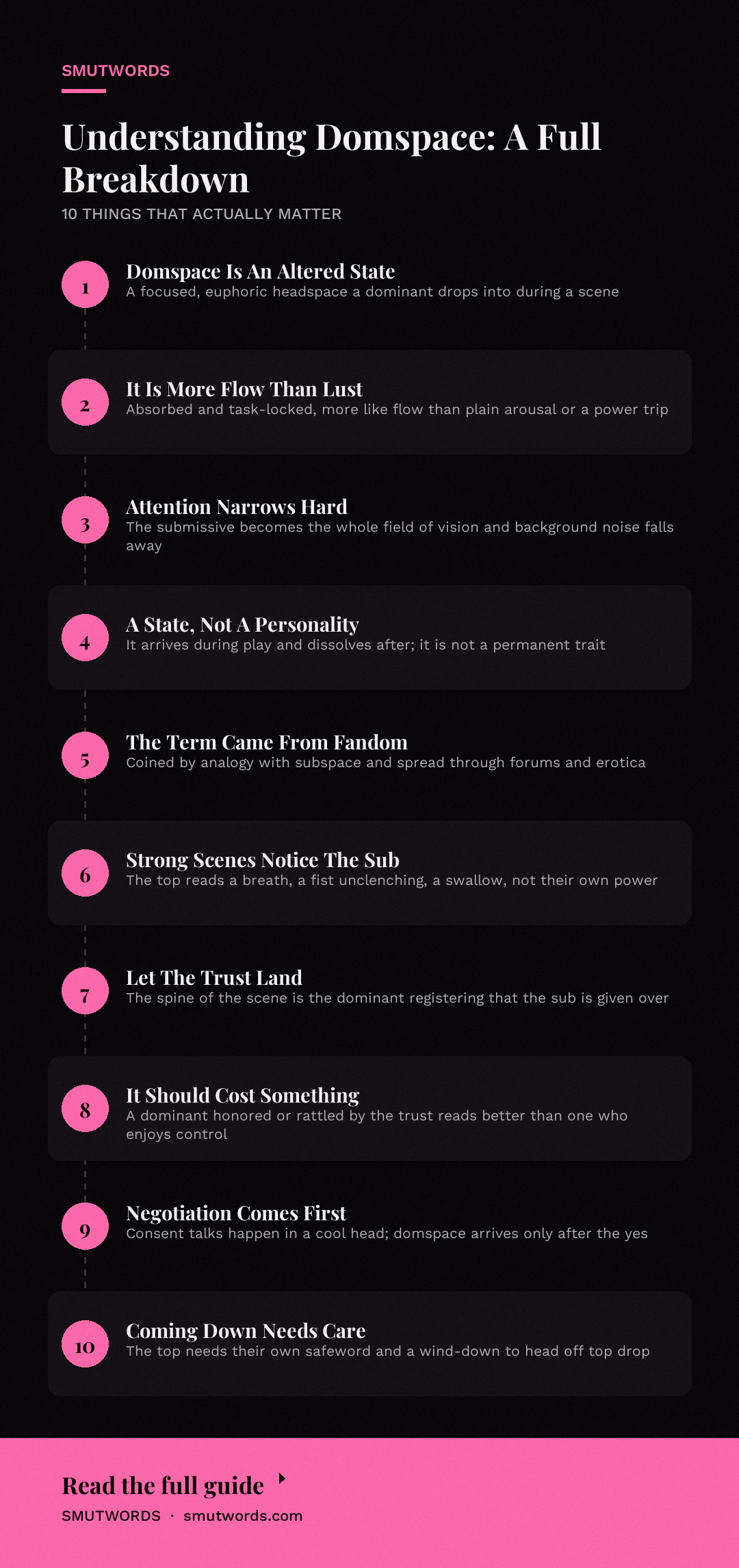
The short definition is the easy part. The useful one goes deeper, because domspace is not one single feeling. It is a cluster of shifts that tend to arrive together: a drop in self-consciousness, a rise in responsibility-drive, a changed relationship to time, and a very specific kind of pleasure that comes from being trusted with someone else's safety. Writers who only capture the "he felt powerful" layer are leaving most of the state on the table.
Where the name comes from, the trail is mostly fandom shorthand rather than formal literature. Subspace was already in kink vocabulary by the 1990s, used to describe the endorphin-heavy trance that can overtake a bottom during intense play. Domspace was coined by analogy and spread through forums, Tumblr, and eventually published erotica. "Top headspace" and "dominant mindset" get used as gentler synonyms; "zone of control" and "ceremonial authority" show up as flavored variants in fiction.
What counts and what doesn't is worth pinning down, because readers argue about it. The state usually involves most of these:
- Narrowed attention. The submissive becomes the whole field of vision. Background noise falls away.
- Effortless decision-making. The dominant stops second-guessing and just acts, with a sense of rightness rather than calculation.
- Heightened sensory pickup. Breath changes, small flinches, skin temperature, the particular sound a partner makes before they speak. Dominants in domspace read their partner unusually well.
- Time distortion. Twenty minutes feel like five. A scene runs long and the top is surprised by the clock.
- Euphoria or elation. A warm, humming sense of purpose that can border on giddy.
- Emotional exposure. Under the control, there is usually tenderness or protectiveness that the dominant did not plan to feel.
The clearest misconception is that domspace is just being turned on while giving orders. Arousal is frequently part of it, but the state has more in common with flow than with lust: absorbed, present, task-locked. Another misconception is that domspace is a power trip. In practice it feels more like stewardship than conquest, closer to the feeling of being trusted with something breakable and rising to the occasion.
One more distinction that readers get tangled: domspace is not a personality. It is a state that arrives, usually during active scene play, and dissolves afterward. The confident, clear-eyed dominant who cannot remember the drive home is a different animal from the one answering emails at 9 a.m. Fiction that blurs those two into a permanent trait ends up with a flat character and a flat trope.
Where Domspace Comes From
The honest history here is publishing and fandom history more than practice history. "Subspace" as a term had a head start. BDSM community writing from the 1980s and 1990s, largely circulated in print newsletters and early Usenet groups, described the bottom's trance state with real specificity.
The dominant's equivalent got less ink, because the top was assumed to be in control of themselves by default. Domspace was not so much discovered as named late.
Kink erotica picked it up in the 2000s, and the arc is visible: early use treated domspace as an occasional flourish, a paragraph where the dominant's focus sharpens before a whip stroke or a command. The internal state got attention only as a way to escalate a scene. The dominant's own feelings stayed mostly scenic.
The bigger shift came as romance publishing absorbed kink content. Once authors were writing primarily for readers who wanted a love story with power exchange in it, the dominant's inner life became commercially and emotionally essential.
A hero who only dispenses commands reads as furniture. A hero who enters domspace, feels the trust land, and then has to sit with how much that means is a protagonist. That is the version that dominates contemporary kink romance now.
Self-publishing accelerated it. Once authors could write the length they wanted without chasing a genre category, domspace scenes got longer and more internal. Readers started asking for the top's point of view explicitly, and authors obliged with dual-POV structures where the domspace chapter is a clear structural beat. There is a fair amount of this in the adjacent alternate reality romance space too, where a dominant's headspace gets recast in fantasy or speculative settings.
The community side has caught up. Contemporary kink writing, including the more practical material rather than the fiction, treats top drop and dominant burnout as real concerns. Domspace is discussed with the same care as subspace. The frame of RACK (Risk-Aware Consensual Kink) makes obvious sense here: a dominant who is deep in the state may make faster, bolder calls than they would from a neutral chair.
How It Shows Up in Erotica
On the page, domspace does most of its work through interiors. The mechanics are fairly consistent across the books that handle it well.
The dominant's POV narrows. Sentences get shorter. The prose loses its jokes, its hedging, its side comments, and turns into a series of clean observations and instructions.
The author cuts background and leaves the submissive's body and voice. What distinguishes a strong domspace scene from a flat one is what the dominant is actually noticing.
A weak version has the top noticing how powerful they feel. A strong version has the top noticing the submissive: a fist unclenching, a breath catching, a swallow, the wooden paddle in their hand suddenly heavier because they know the wooden paddle scene is about to be a real one. The focus is outward, and the pleasure comes from being accurate about another person.
Authors use several reliable variations. Naming a few helps readers spot what is going on.
- The quiet immersion. The dominant goes almost silent. Nothing but detailed attention, maybe a single command or a hand on a hip. Used heavily in slow scenes, restraints, and the more elaborate setups.
- The ceremonial mode. The domspace state turns formal and slightly ritualized. The dominant speaks in settled, declarative sentences. It suits any mummification scene, where the submissive is wrapped and completely at the dominant's disposal, and it works well for high-protocol dynamics in general.
- The burning focus. Domspace arrives as a rush of heat, with the dominant suddenly impatient to be rough or exact. It pairs naturally with impact play, and with the piercing-and-blood side of things as in blood play, where the state has to coexist with real risk. The good books keep the risk on the page rather than glossing it.
- The vulnerable version. The dominant notices the state because it exposes something. Tenderness, fear of failing, protective urgency. This is the reader favorite, and the reason domspace sells.
- The comic version. Used in lighter books. Domspace gives the top a slightly ridiculous certainty, and the narration plays with how they are probably wrong about something. Not as easy as it looks, and readers notice when it lands.
The variation matters less than the depth of one specific choice: what the dominant does with the moment when they realize the submissive is fully given over. That moment is the spine of the scene. What a strong book does is let the dominant register that trust and let it change them, even slightly, in the run of the scene. A flat book skips the registration entirely and jumps straight to the next act.
Enjoyed this? Get a free book.
Join the list and we will send a complete free story straight to your inbox, plus new releases every week after that. No credit card, no catch.
Craft-wise, several moves separate the pros from the amateurs. The first is restriction. The author picks one or two sensory details and sticks with them for the whole domspace stretch: the submissive's pulse, the texture of a collar, the weight of a tool. Dumping every available detail reads as a survey rather than absorption.
The second is restraint on internal monologue. Too much thought and the state feels like a debate rather than a trance. The dominant's mind is mostly quiet, and the prose should reflect that.
The third move is consequence. Great domspace writing lets the state cost the dominant something: their own nerves, their cool, an admission of how much they needed this. A dominant who enjoys control is less interesting than a dominant who is honored, rattled, or undone by the trust they are holding. That is the vulnerability angle readers keep coming back for, and it is why the state has become a feature of power-exchange romance rather than a niche detail.
There is real machinery around this. A domspace scene has to be built on negotiation and limit-setting that the author has already done, either on the page or in the story's backstory, or the scene reads as an exploit rather than a dynamic. A confident bondage furniture use entry in the story, the scene where the pair agree on what the bench is for and what it isn't, does more to sell the domspace later than any paragraph of atmosphere.
Tightening a strap on a bench with real understanding of the rules is a very different beat than a sudden dramatic flourish. The other structural note: domspace scenes tend to land better when paired with a lower register shortly after. The dominant comes out of the state, notices the submissive is floaty or shivering, and shifts into aftercare.
That hinge is where the writer proves the state is real. A top who never leaves domspace and never cares for their partner is not a dominant with depth; they are a cardboard prop.
Domspace vs Consent Negotiation
These get compared often by newer readers, usually because both show up in the same scene file and both get described as "the responsible part." They are not the same operation. Consent negotiation is the conversation before play: what everyone wants, what is not on the table, what safewords are, what the stopping conditions are. It is deliberate, often awkward, and it requires a clear head.
Domspace is the state during play. It is absorbed, warm, and considerably less deliberative than the conversation that set it up.
The sequencing matters. A dominant who enters domspace during negotiation is a problem, because the whole point of the negotiation is to be unhurried and candid. A dominant who enters domspace during the scene is doing exactly what the conversation was meant to allow.
Fiction gets this wrong by placing the negotiation and the state in the same moment. A dominant who is swept into euphoric single-mindedness while asking their partner's limits is not romantic; they are a warning sign.
The strong version separates them. The negotiation happens earlier, in a cooler register; the domspace arrives only when everyone has already said yes and the limits are already on the table. The contrast between the two registers, and the reader's awareness of how naked the dominant is once the brakes come off, is half the reason the scene works. For the broader map of how these headspaces fit together, see subspace vs domspace vs drop.
Frequently Asked Questions
Is domspace the same as subspace?
No. Subspace is the bottom's altered state, usually a floaty, endorphin-heavy trance where pain sensitivity and time awareness both shift. Domspace is the top's altered state, typically hyper-alert, focused, and euphoric rather than floaty. The two can happen at once, and reading both from either side is where the strongest scenes come from.
Can a switch experience domspace and subspace in the same session?
Yes, and it is a source of a lot of good writing. A switch can move from one state to the other as the scene shifts, and the transition can be disorienting. That disorientation is real and worth respecting in both life and fiction. Books that treat a switch as simply "whoever has the leash right now" miss the internal switch that the character has to make.
How do you come out of domspace safely?
The dominant needs their own safeword, regular check-ins during the scene, and a deliberate wind-down afterward. Top drop, the flat, irritable, second-guessing crash that can follow deep domspace, is a real thing and deserves its own care. Eat something, drink water, get physical contact from the partner, and talk through what happened while the details are still fresh.
Is domspace dangerous?
It can be, in the same way subspace can be: the state reduces caution and can stretch a dominant's sense of how long or how hard is reasonable. That is why negotiated limits and a safeword on both sides matter. It is not inherently risky, and most people who enter it do so within whatever safety structure they built beforehand. The state is not the risk; the risk is what happens when no structure exists.
Do all dominants experience domspace?
Not all. Plenty of dominants stay fully conscious of the clock, the plan, and the small logistics, and that is a completely valid way to top. Domspace is common enough to be a named trope, but treat "I never go into it" as normal rather than as a deficiency. Many people enjoy the scene without the altered state, and that is not a lesser version of dominance.
What is the difference between domspace and top drop?
Domspace is the state during and immediately after the scene. Top drop is the delayed low that can arrive hours or a day later.
If you are reading a scene and the dominant's focus is euphoric, that is domspace; if they are looking at a wall at 2 a.m. and re-reading the scene for mistakes, that is top drop. Good erotica covers both. For a wider map of how these states relate, the SmutWords guide to subspace vs domspace vs drop is the place to start.
Final Thoughts
Domspace is one of the more generous things erotica has added to the vocabulary of dominance. It gives the top a real interior, a state worth losing a little of yourself to, and a reason to be careful with what they are handed.
Read the trope the way you would read any good scene: looking for the specific detail that tells you the dominant is in it, and the specific moment when they come out and take care of their partner. If you want a starting point, look for a book where the top notices the submissive's breath before the scene even starts. That is the moment domspace is actually being written.




Loading comments…