
You're twenty minutes into a rope scene, everything's going fine, and then your partner's breathing changes. It's not the good kind. You can't tell if it's the rope or the headspace or something you can't see from where you're standing, and asking "are you okay?" right now will either sound like panic or like you've stopped paying attention. Knowing how to check in during a scene is what answers that, and the answer gets easier the more you practice it.
Most people figure check-ins out the hard way: one scene that went sideways, one partner who went quiet, one moment where the mood evaporated because nobody had a script. The fix isn't a mood killer. A real check-in should feel like part of the scene, not a fire drill in the middle of it.
This is the practical version. Phrasing, quick systems, what to watch on a face, and how to pause and pick back up without anyone feeling like the world stopped.
Why Checking In Is Part of the Scene, Not a Pause Button
Every experienced dominant I know has a version of the same line: they'd rather check too often and look slightly unimpressive than miss something and find out later. The people who are actually good at this don't treat a check-in as interrupting a scene. They treat it as one more thing they're doing to their partner.
Here's the thing about bottoms and subs: they're often the worst source of information in the room. In a deep scene, the part of the brain that would raise a hand and say "this is too much" is also the part that's happily switched off. That's the appeal. That's also why the dom can't rely on their partner volunteering a problem.
The other thing check-ins do is keep the dominant out of domspace going too far and off the rails. Rope tops and impact tops drift too, and a check-in is a small anchor back to the actual person in front of them.
How to Check In During a Scene: What Actually Works in the Moment
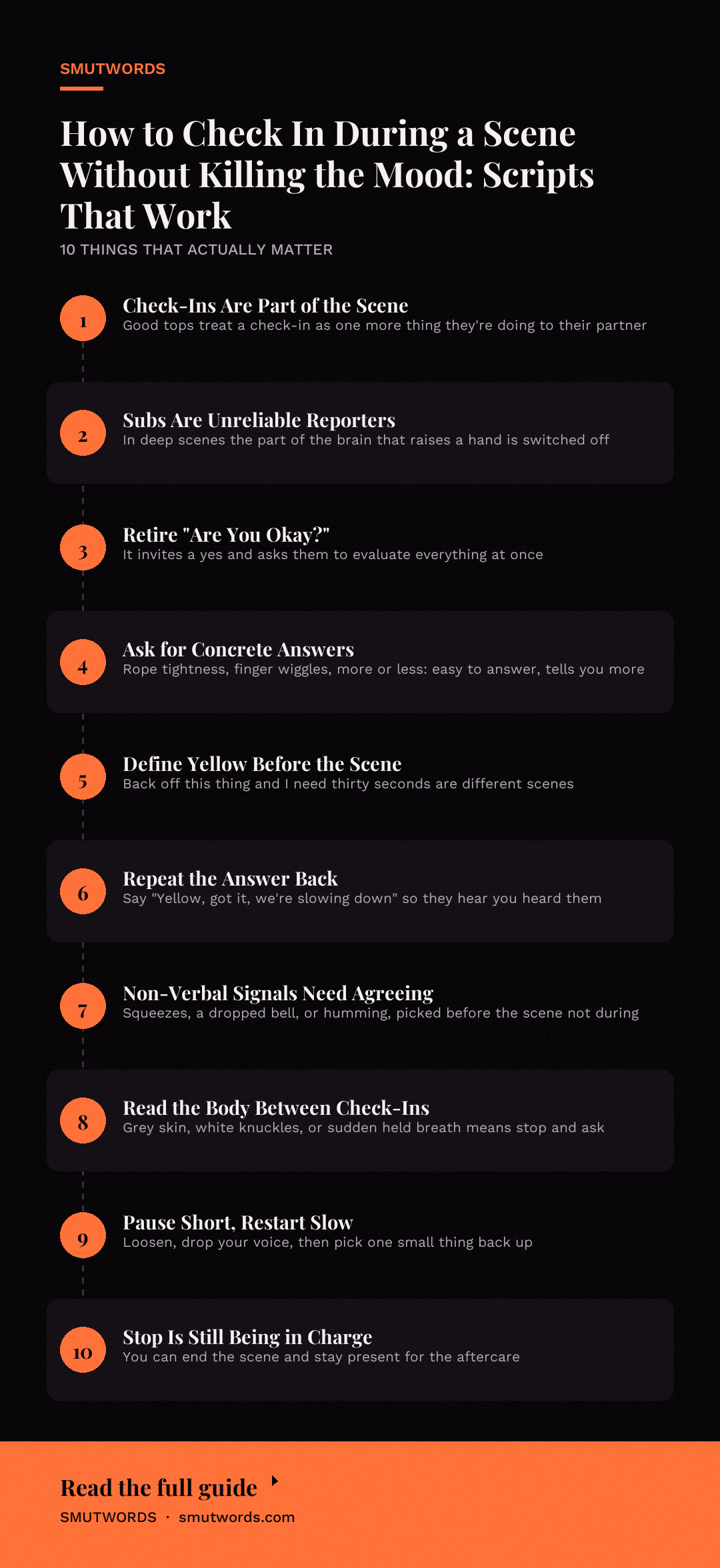
Good check-in phrasing has three qualities. It's short, it's specific to what's happening, and it leaves the partner an easy way to answer that doesn't require them to build a whole sentence out of a foggy head.
The classic failure is "are you okay?" The problem is the word okay. It's a yes/no question that invites the sub to say yes because they're already in it and stopping feels like failing. "Okay" also asks them to evaluate everything at once.
Swap in something with a number or a word in it:
- "Green, yellow, or red?"
- "On a scale of one to ten, where are we?"
- "Is the rope tight, right, or loose?"
- "Tell me one word for how it feels right now."
- "Can you feel your fingers? Wiggle them for me."
- "Want more, less, or the same?"
Notice what a lot of those do: they ask the bottom to report on something concrete. Rope tightness. Fingers. Whether they want more or less of a specific thing.
Concrete answers are easier to give than abstract ones, and they tell you more.
The Traffic Light System, and Why It Sticks
The traffic light is the most common check-in system for a reason. Green means keep going. Yellow means slow down or take a break, I'm at my edge. Red means stop now, no conversation required first.
The value is that the words are short, they mean the same thing to everybody, and they don't require the sub to explain themselves under pressure.
A few things most guides get wrong about the traffic light:
- You have to agree on what yellow means before the scene. For some people yellow means "back off on this specific thing," for others it means "I need thirty seconds and then I'm fine." Those are different scenes. Define it out loud with your partner at the start.
- Red is not a failure of the dom's skill. If a bottom never says red, the dom has no idea where the actual limit is, and they're guessing every time.
- Use it for real outside of scenes. Anytime a person is unsure whether they want something, yellow works as a lay-person word too. "I'm yellow on that" saves a whole awkward conversation.
- Repeat it back. If your partner says yellow, respond out loud: "Yellow, got it, we're slowing down on the rope." Acknowledgment matters as much as the answer.
Some people prefer a different vocabulary, and that's fine as long as you both speak it. Animal sounds, a nonsense word, "mercy," a hand signal for when the mouth is occupied. The traffic light is popular because it's intuitive and you don't have to remember what "unicorn" means at two in the morning.
Other Quick Check-In Systems for When You Can't Speak
Scenes that involve a gag, a hand over the mouth, or a partner who's gone non-verbal need a system that doesn't require speech. Pick one before the scene, not during it:
- The squeeze. Two squeezes of the partner's hand means "I'm good," one long squeeze means "slow down," three quick squeezes means "stop now." Agree which is which.
- A held object. The bottom holds something that makes a noise when dropped (keys, a small bell). Dropping it is the signal. Do not agree that a partner will "hold on tight no matter what" and use a squeeze as the only signal when their hands are tied.
- Humming. A sustained hum means yes, silence means something's off. This works for breath-play-adjacent scenes (though see the note below) and scenes where the mouth is otherwise occupied.
- A phrase. Some people want to hear or say a specific phrase that means "green" in the middle of a scene and "I want more of that" the next time. This dovetails nicely with things like the control in Subroutine: Stretch Her, where the whole dynamic runs on being told and repeating back.
One real warning here: any scene that restricts breathing is its own category of risk, with a documented body count. Hold the line at "not this." No check-in system makes breath restriction or unsupervised heavy restraint safe, and anyone who tells you otherwise doesn't know what they're talking about.
For scenes involving equipment or restraints, read up on bondage furniture use and make sure you know how to get someone out of a tie quickly.
How to Read Body Language Mid-Scene
Between check-ins, your eyes should be doing half the work. Most problems show up on the body before the bottom has a word for them.
The face and skin first. Flushed is normal; grey or clammy is not. Sweating heavily when the room isn't warm, or going from flushed to pale, means stop and check in. A jaw that's clenched hard is often a bottom in pain they're not naming.
Look at the hands too. Hands that are relaxed or reaching toward you are usually a good sign. A fist curled so hard the knuckles are white is not.
Breathing is the big one. Fast, shallow, ragged breathing can be the good kind during a high-intensity moment, but it can also be a panic response, and you can't always tell the difference from across the room. That's what check-ins are for. Steady breathing that suddenly goes quiet and holds is a stop-and-check moment.
Speech and attention are the other tells. If your partner was answering back and suddenly goes silent and won't make eye contact, they may have tipped into subspace or the start of drop, and they may not have words anymore. Going silent isn't automatically bad; if you've agreed that silence is fine, fine. If you haven't, treat silence as a yellow until proven otherwise.
A useful rule: if you have to ask yourself "is that normal for them," stop and ask them.
Enjoyed this? Get a free book.
Join the list and we will send a complete free story straight to your inbox, plus new releases every week after that. No credit card, no catch.
How to Pause and Restart Without Killing the Mood
Most people fear that pausing ends the scene. The good news is the opposite happens. A scene that pauses, checks in, and picks up again feels more controlled, which is exactly the point.
The pause itself should be short and physical. You don't need to turn on the lights and get a notepad unless something's actually wrong. You need to loosen the rope, drop your voice, put a hand somewhere steady, and say the check-in.
"Hey. My hand." "Look at me. Green or yellow?"
The tone matters more than the words. A calm voice says you've got this, even if the answer turns out to be red.
If the answer is green, restart the way you would a slow song after a bump. Pick one small thing back up. A hand on the hip. A single order. Let the sub follow you back into it.
Don't go from zero back to full intensity in one jump. That jump is its own kind of whiplash.
If the answer is yellow, change something on purpose, and say what you're changing: "Yellow, okay. The rope's coming off your wrists but you stay where you are." Naming the change lets the sub stay in the scene while their body catches up. If yellow keeps coming back in the same spot, stop asking the same question and take that whole thing off the table for the night.
If the answer is red, the scene is over as a scene. Stop everything physical, get them out of the gear, get warm, get water, and get them talking. That's a separate operation, and it's the most important one. What comes next is aftercare, which often runs longer than the scene itself, especially if the answer came after an hour of intensity.
For a partner who wants the pause to feel like part of the dynamic instead of an interruption, tie the check-in language directly to the roleplay. In a high-control dynamic like the one in The Caregiver's Covenant, a check-in can live inside the game as a command the bottom has to answer.
In something like Bull for the Weekend, the constant low-grade uncertainty is part of the fiction, and a real-life scene built on that fantasy needs its check-ins working overtime. Fiction gets to skip them. You don't.
A Script for Talking About Check-Ins Before You Need Them
None of this works if the two of you haven't picked your system before the clothes come off. Here's how the conversation can go, in plain words:
"I want to try something new tonight. Before we start, I want to agree on a system. Green, yellow, red, and what yellow means for you. If you can't speak, squeeze my hand once for go, twice for slow. And if I ask you a question mid-scene, you don't have to answer nicely, just answer. Deal?"
Then get them to repeat it back. "Tell me in your own words what red means." If they can't repeat it back, they haven't agreed to it, they've just heard it.
Two more things to nail down before you start:
- What's off-limits tonight, even if it's fine other nights. Last week's yes is not this week's yes.
- What the wind-down looks like. Water, a blanket, an hour of no phones, a specific text message an hour after the scene to confirm everyone's okay. Pick the thing and mean it.
The same conversation applies to the everyday version, the one where nobody's in rope and a partner says "hey, that thing you just said landed weird." The blind date romance energy of getting to know someone over the first handful of encounters is exactly why these conversations happen early: you're still learning what a given person's silence, flush and clenched jaw mean, and check-ins are how you find out.
If talking hard things is your weak spot, get practice by reading how it's done in fiction, then do it in real life over dinner rather than on the bedroom floor. The Free Use Airplane gets to have its characters skip the conversation. You have actual risk on the line, so have the conversation.
When to Stop a Scene Entirely
Stop immediately, no discussion needed, when any of these happen:
- A red, or a dropped object, or any agreed stop signal.
- Any sign of trouble breathing, discoloration, numbness, or cold extremities in a restraint.
- A partner who's saying they're fine while their body says green went to yellow three check-ins ago.
- A partner who can't answer a check-in at all.
- You, the dominant, need to stop. That's a valid reason. Say it, stop it, deal with the rest after.
Stopping isn't the same as ending the dynamic. You can stop the scene and stay in charge of the aftercare. A partner who's come back from a hard red with their dom calm and present is going to trust that dom more than one who's never had a scene go wrong, because they've seen what happens when it does.
If you're curious what that aftercare looks like in a scene with real stakes, Claimed Under Twin Suns spends a lot of time on what a captive character does when the intensity finally breaks, and it's the closest thing to a real check-in system that a fiction book gets.
For a different register, The Fertility Games: Survival in the Breeding Arena is a reminder that high-stakes scenes in fiction are written with a safety net. Yours isn't, so use the system.
Final Thoughts
Practice the check-in out loud before you need it. Say "green, yellow, red, what does yellow mean for you?" to your partner over dinner this week, when the stakes are zero and nobody's tied up.
Do it enough that it stops feeling like a special occasion and starts feeling like putting on a seatbelt. If you want a book where the check-ins happen on the page as part of the dynamic rather than as an interruption, start with The Caregiver's Covenant. It's the closest most readers get to seeing a real check-in script delivered with a straight face.




Loading comments…