
Most erotica gets the climax right and the twenty minutes after it wrong.
The spanking stops, the collar comes off, and the scene just evaporates. Nobody checks the sub's breathing. Nobody hands anyone water. Everyone rolls over and the chapter ends.
Take that in for a second. A person's nervous system doesn't get a landing strip, and the book acts like it doesn't need one. Read enough kink-heavy fiction and the gap starts to glare at you. This is where aftercare romance fiction separates the writers who understand submission from the ones who just like typing the word "Sir."
Aftercare is the unglamorous part. It's also the part that makes the hot part believable, and if you're writing this stuff, it's the cheapest way to make a reader trust you.
What Aftercare Actually Is (and Isn't)
Aftercare is the physical and emotional care a dominant gives a submissive once a scene ends. Water. A blanket. A shower. Words. Sometimes just silence and a hand on the back of the neck.
It can last five minutes or two days depending on how deep the scene went.
What it isn't: a plot device you bolt on so your characters seem like good people. If the aftercare is there purely to reassure the reader that the dom isn't so bad after all, you've already lost. Characters don't need defending. Scenes need finishing.
The best aftercare in fiction does two jobs. It resets the body, and it says something about the relationship that the sex couldn't. That second job is why it's worth writing.
Why Scenes That Skip It Feel Incomplete
A submissive who just took a beating, a humiliation scene, or an extended denial session is in an altered state. Endorphins, adrenaline, the specific floaty headspace that kink calls subspace. The person who comes out the other side of that isn't the same person who walked in, and the drop afterward can be brutal.
When a story cuts from orgasm straight to the next morning, it's lying about what happened. The reader feels it even if they can't name it. The scene was a big deal and the book treated it like a sneeze.
You see this a lot in cuckold and hotwife fiction, where the emotional weight lands on the husband or partner watching. A story like Permission Slip: A Cuckold Erotic Short Story earns its ending because someone has to sit with what just happened, and that sitting-with-it is aftercare in a different shape. The reclaimed partner, the whispered check-in, the two of them alone again after the room emptied out.
Watching carries more than people assume, and the aftermath is where that weight gets spent. Voyeurism in Erotica Explained goes deep on why the position itself does so much work.
The Specific Beats Readers Are Actually Looking For
"Aftercare" sounds abstract until you list the actual moves. Readers who love this beat tend to scan for the same handful of details, and they'll notice when a writer skips straight past them.
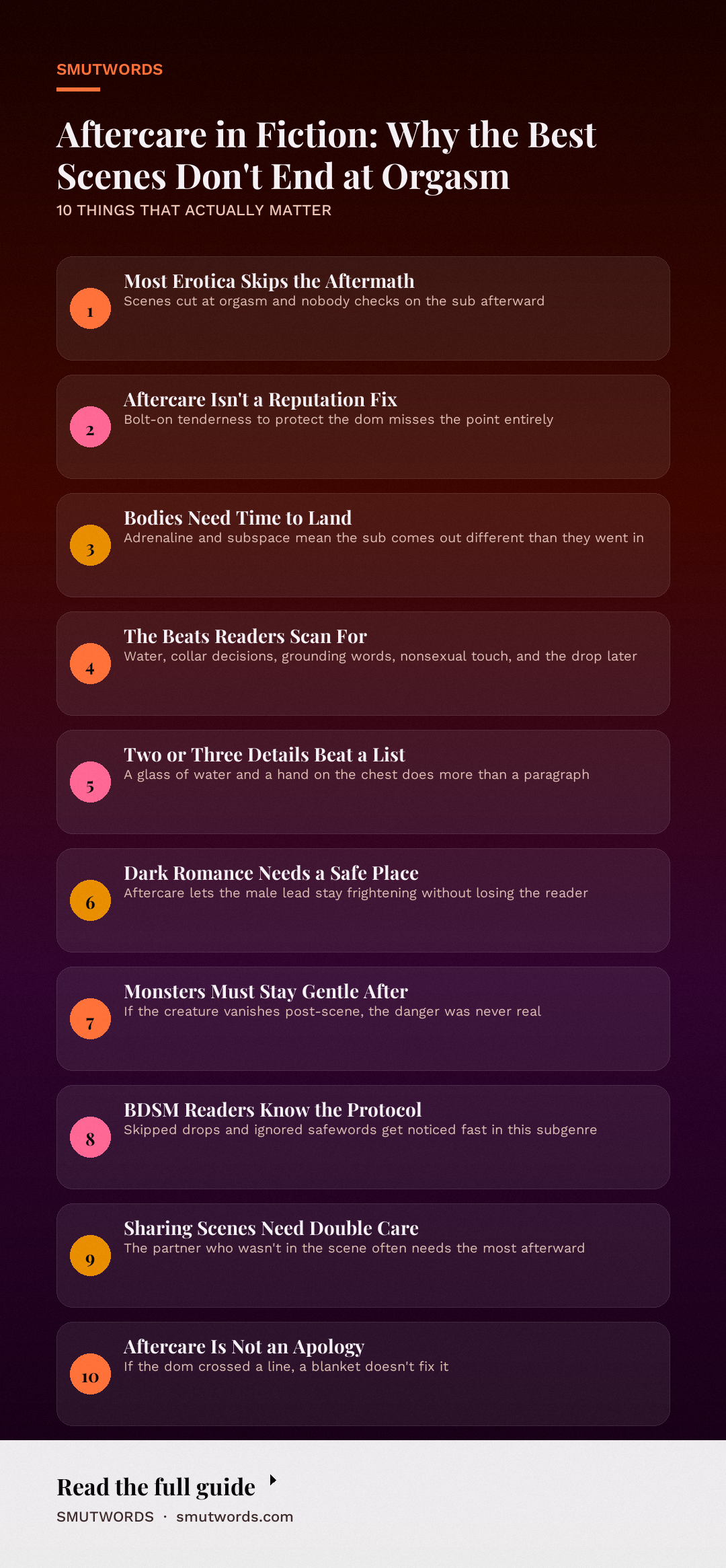
- Physical triage. Water, food, a warm shower, tending to marks. The dom checking wrists, checking circulation, checking that nothing went past the agreed line.
- The collar coming off, or staying on. Both are meaningful. Removal can be a gentle reentry into ordinary life. Leaving it on can be a claim that outlasts the scene. Either way, someone has to address it.
- Verbal grounding. "You did so well." "I've got you." "Are you back with me?" Simple sentences that pull a person out of subspace without yanking.
- Reassurance the scene didn't mean anything bad. Especially after degradation, humiliation, or anything with a CNC flavor. The dom naming that it was play matters.
- Physical contact that isn't sexual. Holding, hair-stroking, a hand on the sternum. The body has just been used for pleasure and now it needs to be used for nothing.
- Decompression over time. Some of the best scenes are followed by an entire scene of low-stakes domesticity: takeout, a bath, an argument about nothing. The drop happens later, and the story catches it.
Not every scene needs all six. But a good scene needs at least two, and the best ones pick the ones that reveal character.
How Aftercare Changes Depending on the Subgenre
Aftercare looks different depending on what kind of book you're in, and the mismatch is where a lot of writers slip.
Aftercare in Dark Romance and Stalker Fiction
Stalker romance has a structural problem: the male lead does genuinely frightening things, and the reader is supposed to find the obsession delicious anyway. Aftercare is the mechanism that makes that possible without softening him. He doesn't become a nicer person. He becomes a person who, once the terror is over, is the only safe place in the room.
Enjoyed this? Get a free book.
Join the list and we will send a complete free story straight to your inbox, plus new releases every week after that. No credit card, no catch.
The scene where a stalker who has been systematically dismantling a woman's life sits on the floor with her and checks whether she ate is doing more work than three chapters of backstory. It's also the reason the subgenre has legs.
Aftercare in Monster and Nonhuman Romance
When the dominant party is a creature, an alien, or a beast, aftercare carries extra weight because the appeal is built on danger. Something enormous and predatory has just been gentle with the heroine. The return to gentleness is the whole point, and if the monster vanishes the moment the scene ends, the book has told you the danger was fake.
Stories that handle this well play with the sensory strangeness of comfort coming from something that shouldn't be comforting. Claws withdrawing. A warm hide instead of a blanket.
This is where a book like Lured by the Lizard Beast gets the rhythm right: the intensity is high, and the aftermath matches it, just turned down. If you're writing in this lane, A Comprehensive Guide to Eldritch Romance Relationships breaks down how these partnerships stay legible when the other party is genuinely not human.
Aftercare in BDSM and Power-Exchange Romance
This is the subgenre where readers are most likely to know the real-life protocol and to notice mistakes. Safewords that get ignored, drops that get skipped, tops who don't check in. The marriage in trouble arc works beautifully here because power exchange is already a negotiation about what two people owe each other, and aftercare is the receipt.
A believable dom in this lane does the boring work. He keeps track. He remembers what the sub said she'd need afterward. And when he forgets, that's a plot, not a footnote.
Aftercare in Hotwife, Sharing, and Cuckold Fiction
In sharing dynamics, aftercare is often doubled: both partners need it, and often the one who wasn't in the scene is the one who needs the most.
A hotwife exhibition and sharing fantasy that ends with the two original partners choosing each other again is doing aftercare at the level of the relationship, not the body. Stories that skip it leave the reader with the uncomfortable feeling that someone got left in the hallway. The ones that land it treat the reclaimed moment as the payoff, not the anticlimax.
A Craft Checklist for Writers
If you're trying to write aftercare that actually reads as care instead of as a checklist, work through these in order.
- Decide what the scene did to the submissive before you write the aftercare. The response should match the damage, not be generic cozy behavior.
- Pick two or three concrete details, not all of them. A glass of water and a hand on the chest beats a paragraph listing every tender thing anyone has ever done.
- Let it take as long as it needs. A short scene gets a short aftermath. A brutal one can get an entire chapter.
- Use it to reveal the dominant. What he chooses to do first tells the reader who he is. Does he reach for the blanket or the conversation? Does he ask or does he already know?
- Don't resolve the tension too fast. Aftercare isn't automatically a happy ending. Sometimes it's a truce. Sometimes it's the moment a character realizes the arrangement has become something else.
- Watch for drop. The emotional crash can come hours or days later. If you want your book to feel honest, one of your characters should still be feeling it long after the scene ends.
One more thing: don't confuse aftercare with the apology beat. If a dominant crossed a line, water and a blanket don't fix it. That's a different story and it needs a different resolution.
What Readers Get Out of It
There's a real reason people go looking for this beat specifically. Aftercare is where fictional power exchange becomes safe enough to enjoy. The danger can be as filthy as you want, because the text has quietly told you there's a floor under it.
It's also the one part of kink fiction that translates to readers who've never touched a flogger. Everyone understands being wrung out and then held. Everyone understands the moment someone chooses to stay.
That's why aftercare scenes get bookmarked, re-read, and argued about in comment sections more than the actual sex does. The sex is the fantasy. The afterwards is the feeling.
For readers who want it done well, look for books where the aftermath gets more page time than feels strictly necessary. For writers, that's the test. If the aftercare feels like too much, you're probably finally giving it the right amount of room.
Final Thoughts
Start with Zorgon's Pet if you want to see how much an aftermath can carry in a nonhuman dynamic, where comfort arrives from something that has no business being gentle. Read it once for the heat and then go back and watch the closing pages, because that's where the book does its actual work. If your own writing stalls out at the orgasm, that ending is your blueprint.








Loading comments…