
Nobody at their first munch is cool about it. The whole point of walking into a bar on a Tuesday night to meet strangers who found each other through a fetish group is that you're nervous, and the people already at the table know exactly what that feels like because they did it too.
So if you're trying to figure out what is a munch and whether you should go to one, here's the short answer: a munch is a casual, non-sexual social meetup for kinky people, usually in a pub or a diner, in street clothes, where the actual activity is talking and eating. That's it. No dungeon, no whips, no one in a harness.
The longer answer is that a good munch is one of the most useful things a beginner can do, and a bad one can make you feel like you've wandered into a clique you'll never crack. This guide covers what actually happens, how the etiquette works, what to wear, how to introduce yourself without dying inside, and how a munch differs from the play parties people picture when they hear "kink event."
What Is a Munch, Exactly?
The word comes from the eating. A munch was originally a lunch, a meal where kinky people could meet in public, in plain view of the restaurant staff, and just talk. The name stuck even though most munches now happen in the evening at a pub or a rented side room.
Most are organized through a local group on a platform like Fetlife, and the organizer is usually called the host or the munch lead. They book the venue, set a start time, post a code of conduct. They'll often be the one who spots you hovering near the door and waves you over.
Some munches run monthly for years with the same twenty people. Others are one-off events attached to a bigger convention or a leather weekend. The defining feature is that a munch is about community, not play. You don't scene there, you don't take your shirt off, and you definitely don't corner a stranger to ask about their kinks in the first ten minutes.
What Happens at a Munch
The structure is almost insultingly ordinary. People arrive over the first hour in dribs and drabs, order drinks or food, and the group splits and re-forms as new people sit down. There's usually a table of regulars who've known each other for a decade and a slightly awkward orbit of newcomers near the edge of the room. Good hosts actively mix these.
Around the middle of the event there's often a short announcement: upcoming events, a birthday, a reminder about the venue's rules, a mention that someone's running a beginner's rope class next month. Then more talking. Then people drift out at the time the host announced, because venues have closing times and the host has a relationship with the bar that depends on the group leaving when it said it would.
You'll hear the same handful of things over and over: what people do for work, what they're reading, what events are coming up, who just got back from a trip. The kink talk is there, and often quite frank, but it's woven into normal conversation rather than delivered as a series of personal confessions to strangers.
What a munch is not
- Not a play party. No pick-up play, no dungeon furniture, no nudity. If someone touches you without asking, that's a problem the host needs to know about.
- Not a hookup app in physical form. People do meet partners at munches, but treating the event like a dating pool gets noticed fast and it doesn't go well.
- Not a class. Nobody is formally teaching you anything. That said, informal mentorship happens constantly.
- Not a place to out yourself or anyone else. What's said at the munch stays there. The person next to you might be a teacher, a nurse, or someone whose ex doesn't know they're kinky.
Why Bother Going to a Munch?
You can learn rope from a video. You can't learn whether your local scene is full of people you'd trust with your body from a video. That's the real function of a munch: it's the trust layer under everything else.
The people who host play parties vet new attendees through the munch circuit. The person who'll let you practice flogging on a cushion was probably someone you met over nachos first. If you're curious about a specific dynamic, a munch is where you get to watch how people who actually do it interact with each other, and whether the twenty years of marriage sitting across from you looks like something you'd want.
For readers who mostly meet kink through fiction, this is also where you find out which parts of the fantasy are navigable in real life. The Absolute Surrender brand of total, cinematic submission is a great read. The real version involves a lot more conversation about limits and a lot less music swelling.
What to Wear to a Munch
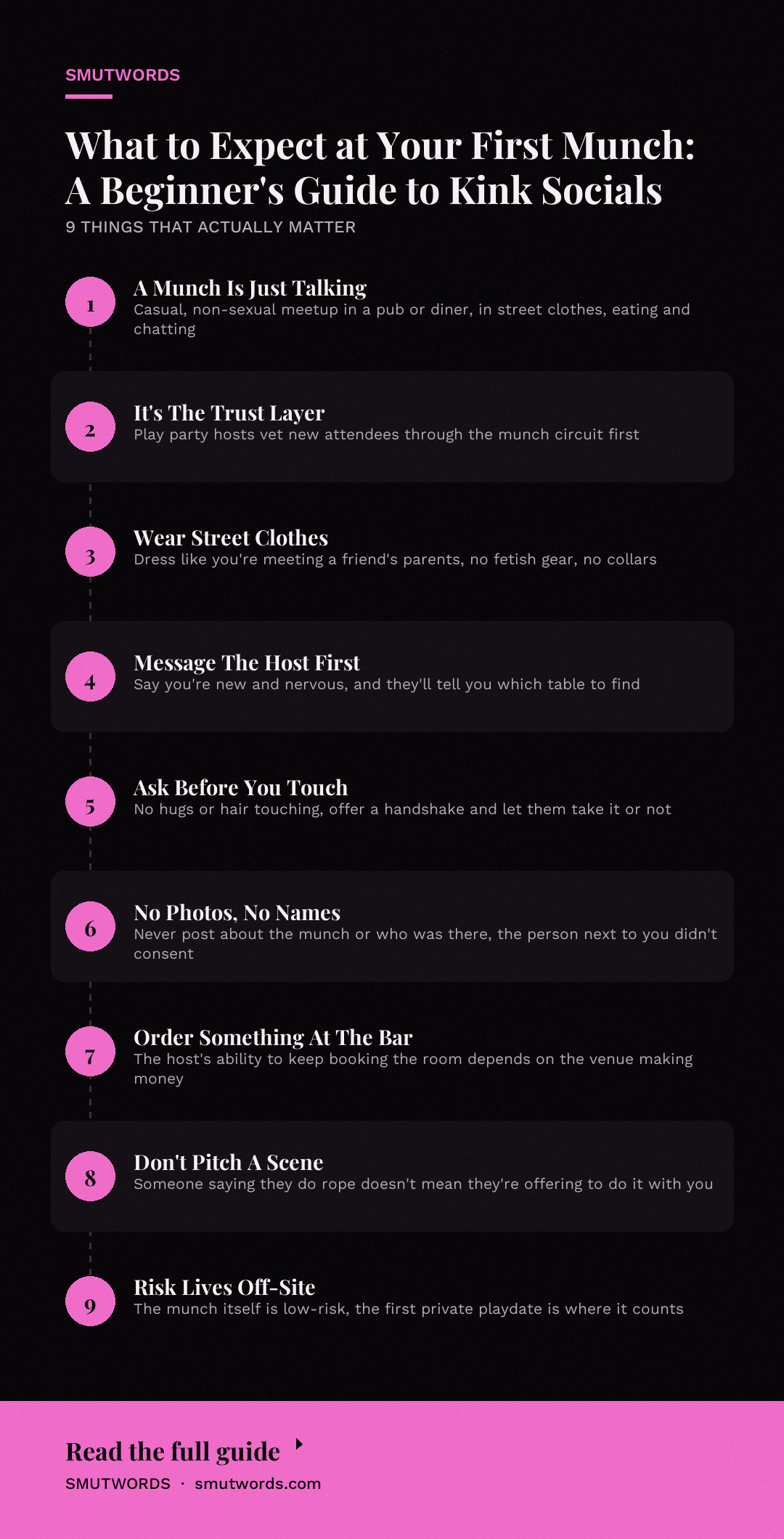
Street clothes. That's the whole answer, but the useful version is: the clothes you'd wear to meet a friend's parents at a casual lunch. Jeans, a clean shirt, boots or sneakers. Some people dress a bit alternative, some look like they just came from a hardware store, some show up in full workwear because they did.
The one rule is don't wear fetish gear. No collars as a fashion statement unless a partner invited it and you know it's welcome, no leather harnesses, no PVC. Munches happen in public venues and organizers work hard to keep a low profile so the bar keeps letting them book the room.
Bring a layer if the venue runs cold, and check whether it takes cash or card, because some older pubs are cash-only. The host might hand you a sticker with your name or handle on it. Use whichever name you actually want to be called.
Munch Etiquette: The Stuff Nobody Explains
Most munch codes of conduct are short and boil down to the same handful of norms. Here's what actually matters.
Ask before you touch
No hugs, no hand on the shoulder, no hair touching. Some people are fine with it and some aren't, and you don't know which one you've got in front of you. Offer a handshake and let them take it or not. This applies to everyone, including the person who's clearly the most experienced in the room.
Don't ask invasive questions
It's fine to say "I'm new, I'm trying to figure out what I'm into." It's not fine to ask the first person you meet which of their kinks are "the real ones" or how their last scene went. If someone wants to share, they will. If they don't, that's their business and not a rejection of you.
No photos, no names, no posting
Do not take photos unless the host explicitly says it's fine and everyone in frame has agreed. Do not post "great time at the [venue] munch with [names]" anywhere public. The person you sat next to might be a public figure, and even if they're not, they didn't consent to being searchable.
Watch what you say about other people
Gossip is the fastest way to get quietly frozen out of a scene. If someone's reputation is a mess because of how they treated people, you can say "I've been warned about them" in private to someone you trust. If you don't have a specific reason, keep your mouth shut.
Order something
Buy a drink or a plate of fries. The venue is doing the group a favour by hosting people in non-fetish clothing who probably look a bit unusual. The host's ability to keep booking the room depends on the venue making money and having no trouble. Be a good customer.
How to Introduce Yourself
The most common first-munch failure is standing by the door for forty minutes trying to figure out where to sit. Do the opposite: message the host beforehand, say you're new and nervous, and ask what the plan is. Most hosts will meet you at the entrance or tell you exactly which table to look for.
When you walk up, the script is simple: "Hi, I'm here for the munch, is this the right table? I'm [name], first time." That's enough. Someone will shuffle their chair over. If the group's already mid-conversation, sit at the edge, listen for a while, and pick up on the tone before you start talking.
A few things to have ready so you're not caught flat-footed:
Enjoyed this? Get a free book.
Join the list and we will send a complete free story straight to your inbox, plus new releases every week after that. No credit card, no catch.
- What you're into, at the level you're comfortable saying. "I'm pretty new, mostly reading and trying to figure it out" is a complete answer.
- What brought you. "Someone recommended this group" or "I moved here recently" works fine.
- One question. People love being asked about something they know. "What's the best event coming up for a total beginner?" gets you a real conversation.
If you're trans and worried about being asked a pile of invasive questions about your body by people who don't know you, you're not being paranoid. Most munches are good about this and the host should shut it down if it happens. If it does and they don't, that tells you something about the group.
What to Bring to a First Munch
You need very little. A phone, a wallet, a jacket, and your own transportation arranged so you can leave when you want to rather than waiting for a lift that may be an hour late.
If you want to be efficient, have a way to give people your contact info that doesn't reveal your legal name if you don't want to. Some people use a burner account or a handle-only profile. That's completely normal, and nobody will think less of you.
One thing you don't need: a partner to bring. Going alone is common, and most regulars respect someone who shows up solo and holds their own.
How a Munch Differs From a Play Party
People use "kink social" and "munch" interchangeably, but a play party is a different animal entirely. Here's the practical split.
- Location: a munch is in a public bar or restaurant. A play party is in a private dungeon, rented hall, or someone's home with proper equipment.
- Dress: street clothes at a munch. Fetish wear, nudity, and partial undress are normal at a play party.
- Activity: conversation at a munch. Scenes, often including impact play, rope, and sex, at a play party, depending on the venue's rules.
- Consent structure: at a munch you're agreeing to sit at a table and talk. At a play party you're agreeing to a negotiated scene with a specific partner, often with a dungeon monitor enforcing house rules.
Almost every good play party will ask you to have been to a munch or a class first, or to be vouched for by an existing attendee. That's not gatekeeping for its own sake. They're worried about people who show up at nine p.m. trying to find a stranger to tie them up without any prior conversation, which is a real safety problem for everyone in the room.
If your kink reading leans toward the full-throttle stuff, the gap between fantasy and event is worth understanding before you go looking. The mind control kink guide covers the fantasy side of power exchange in fiction; a play party is where that becomes a negotiation of safewords and hard limits with an actual person.
Consent and Safety at Kink Socials
The short version: munch etiquette is a consent conversation happening at low volume. You don't touch people without asking, you don't ask people to scene with you at a munch, and if someone says no or "not tonight," you say "no problem" and move on without sulking.
The host is your first point of contact
Good munch hosts have a process for complaints. If someone makes you uncomfortable, you tell the host, and a functioning group bans people who don't respect the code of conduct. If you ask a host "what happens if someone behaves badly?" and they shrug, that's a munch to skip next month.
Consent is ongoing, not a one-time checkbox
Even in a non-sexual setting, consent is an ongoing check-in. If you're talking to someone and the conversation gets heavier than you're comfortable with, it's completely fine to say "that's more than I want to get into" and change the subject or move tables. Nobody's owed a detailed explanation.
Don't offer to scene with people you just met
This is the biggest etiquette landmine. Someone telling you they do rope doesn't mean they're offering to do it with you. Asking is technically allowed but the timing matters. If you're new, the move is to get to know people over several munches and let them know you'd be interested in learning if they ever want a practice partner.
Real risk, and where it lives
The risk profile of a munch itself is low. The risk lives in what happens after you meet people: the first private playdate, the first scene in someone's living room, the first time someone ties you up in a space where nobody's around.
Any kind of breath restriction carries a genuine risk of death and brain injury, even with people who've done it before, and you should not agree to it with someone you just met. Heavy restraint that leaves no way out is a separate category of serious risk. If a first meet is going somewhere, insist on a public first date and a friend who knows where you are.
The post-scene conversation is where you learn whether someone is worth doing it again with. There's a full breakdown of the post-coital scene debrief that walks through the questions to ask. Munch regulars often talk about this stuff openly, and it's a great way to find out who's actually serious.
Reading the Room: The Kink Social Vocabulary
You'll hear a handful of terms thrown around at your first munch. Here's a quick translation so you don't have to stop the conversation to ask.
- Vanilla: outside the kink scene, or non-kinky activity. A vanilla relationship isn't lesser; some people at the munch are in one.
- Top / bottom / switch: who's giving the action, who's receiving it, and who enjoys both. These describe a role in a specific scene, not a personality.
- Dom / sub: shorthand for the power-exchange roles. Dominant and submissive, which is a longer game than top and bottom.
- Scene: a single negotiated session of kink. It has a start, a negotiated shape, and an end, which is where the debrief comes in.
- Dungeon: a private space set up for play. Some are run by a group in a rented building, some are in someone's converted garage.
- Aftercare: what happens after a scene to look after everyone's body and head. Water, a blanket, snacks, and someone not immediately leaving.
The vocabulary is worth learning because the abbreviations in event listings are a whole other dialect. A "DM" is a dungeon monitor in play-party listings, not a direct message. You'll see the shorthand and the etiquette both in the trapped together trope breakdown, where the forced-proximity setup is a fictional version of the same trust-in-a-small-room dynamic that makes real play possible.
First-Munch Mistakes to Skip
- Showing up early and leaving before anyone talks to you. Give it thirty minutes. It takes time to loosen up.
- Treating the host like a concierge. They volunteer for this. Be polite, not demanding.
- Oversharing in your first ten minutes. Tell people you're new. Don't tell them your whole history and every kink in alphabetical order.
- Drinking to steady your nerves. Have one, if you want, but get drunk and you'll get escorted out by someone who's seen it before.
- Being openly critical of the group. If you don't like the vibe, leave quietly. A polite "thanks, good to meet you" costs nothing.
- Ignoring the no-photos, no-names rule. The consequences for the other person could be much bigger than your little social media post.
How Munches Fit Into the Wider Beginner Path
Most people arrive at kink through reading, and the reading is often where the curiosity starts. If your fantasy runs on the raunchier end, Free Use Casino and The Cum Couch Confessions both do the fantasy of no-negotiation intensity very well, and both are easier to enjoy when you know what the real version involves.
The alphahole hero guide covers the fictional version of dominant energy that makes a lot of reader hearts race, and it's a useful reminder of the gap between a character who takes what they want and a partner who negotiates first.
That doesn't mean you have to approach kink as homework. It means a munch is the place where the fictional version and the real version finally have a conversation with each other. Someone there has been doing this for twenty years and will answer a beginner question without making you feel stupid. There's a good chance the answer is "yeah, I thought that was how it worked too, and then I learned."
For readers who like a big group dynamic, Mothership Orgy and The Weekend Bull Rotation are two of the wilder versions of what a group setting can be, and the group marriage glossary entry is a useful anchor for the fictional conventions.
The The Pleasure Drone Experience goes a different direction entirely, into the technology-and-control side that cyberpunk romance readers tend to like. None of it replaces sitting across from a real person and asking a question. It's a good way to figure out what questions you want to ask.
Final Thoughts
The first munch is mostly a test of whether you can sit with a bit of awkwardness for an hour and let people be normal at you. Go in expecting that nobody's going to hand you a manual or a partner, and treat meeting one or two people you'd be happy to see again next month as the win.
If you want something to read while you're working up the nerve, Absolute Surrender is a good reminder of the gap between cinematic power exchange and the real version, which involves a lot more talking than the cover would suggest. Start with a small munch, stay for the fries, and leave when you want to.






Loading comments…