
Alternate reality romance is a love story built across two versions of the world. One small change to history, physics, or fate splits everything into a before and an after and drops the couple on opposite sides of the seam. The protagonist meets a love interest who belongs to a parallel world or timeline, or discovers that someone they already know exists in a radically different form on the other side.
The romance has to survive the fact that the rules, the history, sometimes the person's own identity, don't match up between realities. That's the engine of it: love that has to prove itself twice, under two different sets of laws, and often against a version of the beloved who never agreed to any of it.
What Alternate Reality Romance Actually Means
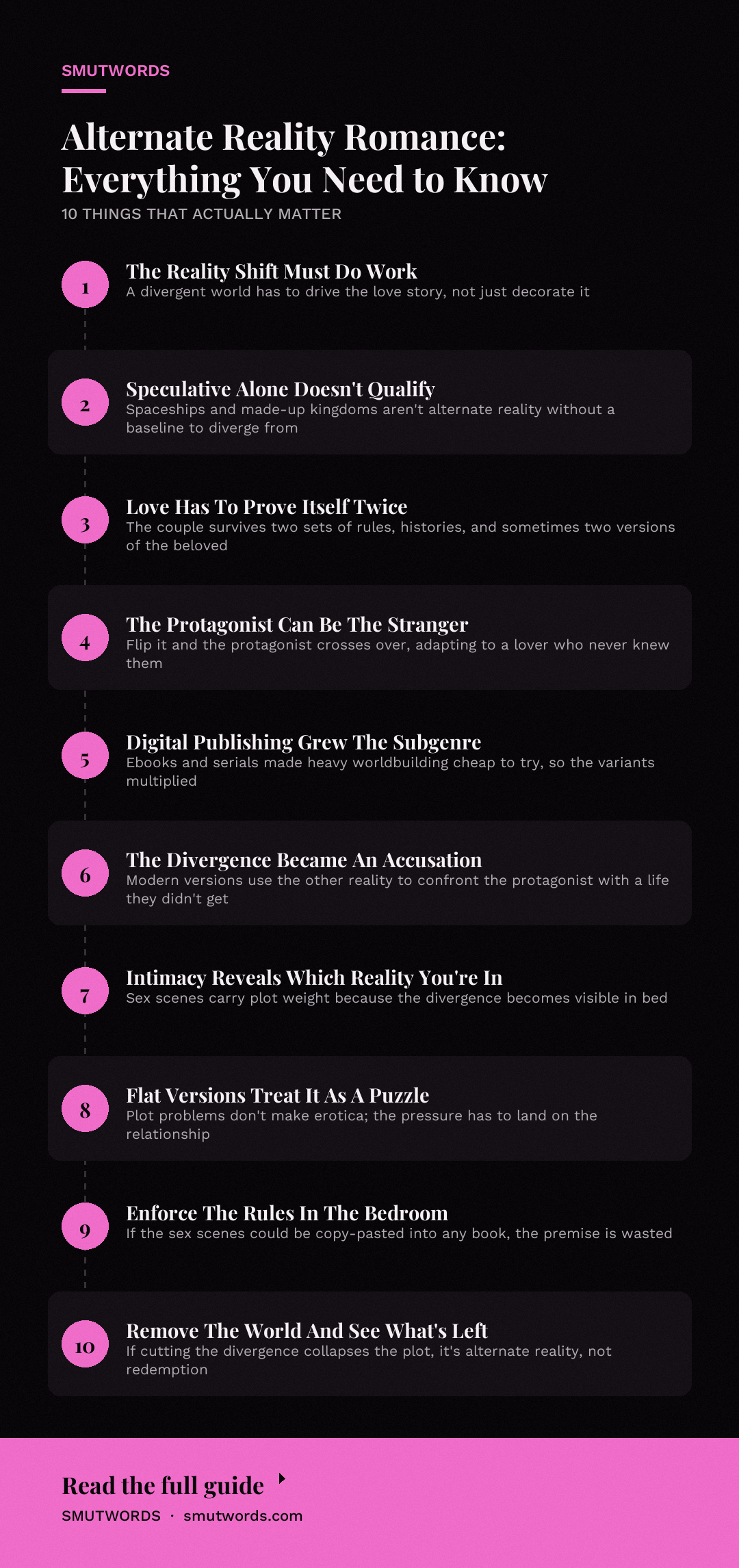
The name is fairly literal. "Alternate reality" describes a world that diverges from the one the reader knows, and "romance" describes the central love story. Put together, the term covers any romance where a parallel world, timeline, or dimensional rift is load-bearing for the plot. The reality shift has to matter to the relationship, not just decorate it.
Plenty of things get filed under the label that don't quite belong. A fantasy romance set entirely in a made-up kingdom is secondary-world romance, not alternate reality, because there's no known world for the invented one to diverge from. A time travel romance usually counts, since the past or future is a different reality with different rules, though purists separate the two.
A story where a character simply moves to another country is not this. The distinction is divergence from a recognizable baseline.
What does count, broadly:
- A world where history took a different turn and the love interest lived through the other version.
- A parallel dimension where the protagonist's own life played out differently, complete with a different partner, a different career, a different death date.
- A timeline split where two versions of the same person both exist and both want the protagonist.
- A portal the couple crosses together, so they're foreign in the love interest's world or vice versa.
- A doppelgänger who arrives from elsewhere wearing the protagonist's lover's face and none of their memories.
The common misconception is that alternate reality romance means anything speculative. It doesn't. A story can have spaceships and still be a straight sci-fi romance if there's no competing version of the known world pressing on the couple. The reality divergence has to do structural work on the love story.
The other misconception is that the love interest has to be the one from the other world. Plenty of strong books flip it: the protagonist crosses over and has to adapt to a lover who's always lived in the divergent reality. That makes the protagonist the stranger, and the relationship a study in how much of yourself you can keep in a place that never produced you.
Where Alternate Reality Romance Comes From
The trope's publishing history starts in the speculative genres, not romance. Alternate history as a fiction mode goes back to the nineteenth century, and parallel worlds arrived with twentieth-century physics popularizing the many-worlds idea. Writers spent decades using divergent timelines to examine politics, war, and fate before anyone pointed that machinery at a love story.
Romance publishing absorbed it slowly. The 1970s and 1980s produced a wave of time-travel romances that borrowed the divergent-reality premise and softened it into a vehicle for passion across eras. The 1990s and 2000s brought portal romances into the mainstream of paranormal romance, where a doorway to another realm became a standard way to write a love interest who was exotic, dangerous, and governed by different laws than the reader's own.
The doppelgänger strain ran parallel, drawing on older folklore about doubles and fetch-spirits to give romance a plot where the beloved is also the threat.
The real publishing shift happened with the rise of digital-first romance in the 2010s. Alternate reality romance is an expensive plot to write in print, because it demands heavy worldbuilding and readers who will follow you past the first chapter's strangeness. Ebooks and serialized web fiction made it cheap to experiment and easy for niche readers to find each other. So the trope proliferated, especially in indie and small-press romance, and the variants multiplied faster than the market could name them.
You can trace the evolution by looking at what the divergent world is used to do. Early versions used it for wonder and adventure. The 2010s shifted it toward emotional violence: the other reality becomes a way to confront the protagonist with a version of their life they didn't get, a lover they lost, or a self they buried.
That's the version dominating the genre now. The reality itself often matters less than the fact that it offers the couple an accusation.
Alongside that shift, the subgenre absorbed the tropes it's most compatible with. It's a close cousin of Gothic romance in the doppelgänger variants, where the beloved's other self looms like a ghost with a body. It overlaps with Cyberpunk romance in the virtual-world and constructed-reality variants, where the divergence is synthetic and the love story runs on simulation and infrastructure.
How It Shows Up in Erotica
On the page, alternate reality romance does a specific job: it makes every intimate scene a test of which version of the world is in bed. The craft comes in the doubled stakes. In an ordinary romance, sex reveals character. Here, sex reveals which reality the couple is currently obeying, whose body remembers what, and whether the lover is the version who knows the protagonist or a stranger in the same skin.
That's where the best of the subgenre gets its heat. The variation in rules between worlds is the seduction. Maybe the divergent reality has different customs about touch, marriage, or who gets to belong to whom.
Maybe the lover is the same person but with different history, so they carry none of the tenderness the protagonist earned and the protagonist has to win it again or choose not to. Either way, sex scenes carry plot weight because the intimacy is where the divergence becomes visible.
A handful of variations do most of the work in the books that sell:
- The stranger-in-your-lover's-face variant, where a doppelgänger arrives and the protagonist has to decide whether the body is enough or the memories are the person. The erotic tension sits entirely in the ambiguity of consent and recognition.
- The crossover, where one of them is foreign to the other's world and the sex is a tutorial in different physical laws, different taboos, different orifices of etiquette.
- The both-versions variant, where two realities' worth of the same person both want the protagonist and the book leans hard into the impossibility of choosing.
- The constructed reality, where the divergent world is virtual, artificial, or a dream-architecture, and the question becomes which body is real and which one is a way of getting off without consequence.
- The lost-world variant, where the protagonist stumbles into a divergence where a dead lover still lives, and the sex is grief that got a second chance.
What Separates a Strong Version From a Flat One
Stakes that stay personal. A flat alternate reality romance treats the divergence as a labyrinth the couple has to solve before the relationship can progress. That's a plot problem, and plot problems don't make good erotica.
A strong version uses the divergence to change who the lovers are to each other and what the body remembers. The world is the pressure, and the relationship is the thing under pressure. Put the squeeze on the relationship and the heat follows.
The other mark of a strong version is that the divergent reality has rules the author actually enforces. If crossing over means the protagonist's body is subtly different, or the lover's vocabulary has words for things the protagonist's world doesn't, the book should show that in the bedroom as well as in the plot. An alternate reality romance where the sex scenes could be copy-pasted into any other book has wasted its premise.
Enjoyed this? Get a free book.
Join the list and we will send a complete free story straight to your inbox, plus new releases every week after that. No credit card, no catch.
There's real craft in the pacing of revelation, too. The best books hold back the full shape of the divergence until the couple is already intimate, so the reader feels the ground shift under a scene that was going one way. That's a technique borrowed from horror, and it lands hard in erotica. The mid-scene revelation about which reality you're actually in is one of the genre's most effective tools.
A word on the doppelgänger variants specifically. That template borrows from Redemption arc romance in a surprising way, because the arrival of an alternate version of the lover often forces the protagonist to decide what the lover is actually being redeemed for, and by whom. The lover is both defendant and evidence.
Crossing into a divergent world also puts the couple in a place where the social rules are unfamiliar, which is a classic setup for the kind of forced intimacy erotica likes. If the divergence means the protagonist has to pass as someone's partner, or has to marry a stranger to survive in the other reality, the story borrows the shape of Blind date romance even when the lovers already know each other.
Two familiar faces wearing unfamiliar roles can be as charged as one stranger.
And there's a specific sub-strain where the couple crosses realities and finds that their marriage or partnership played out with entirely different outcomes in the divergent world. That's the beating heart of the best Marriage in trouble plots in the subgenre, because the divergent timeline offers a working version of the union the couple couldn't maintain, and the eroticism lies in whether they can bring that version home or only borrow it.
The role of scene headspaces gets unusually literal here. When a lover is a different version of themselves, the question of who is in what headspace during a scene becomes plot-critical. Our breakdown of subspace vs domspace vs drop is worth reading alongside the subgenre for that reason alone. In alternate reality romance, you sometimes can't tell whether a character is in subspace because of the scene or because of the world they came from.
For readers drawn to the constructed-reality variants, our piece on the JOI game for women covers the way instructions and simulations change what a body does when it can't entirely tell what's real. That's the same engine the artificial-world romance runs on, pushed to its logical end.
The subgenre also shares DNA with Soldier romance whenever the divergence is a war the couple didn't fight together. The lover comes back from a version of the conflict the protagonist never knew, and the book explores what it means to love someone built by a history you can't share.
Alternate Reality Romance vs Redemption Arc Romance
These two get confused because both feature a love interest who arrives as a problem to be solved. In a redemption arc the love interest's flawed past is the material to be worked through, and the romance is the story of whether they can become someone who deserves love. In alternate reality romance the love interest's difference is structural rather than moral. The divergence made them, and the love story is about whether two people from different versions of the world can build a shared one.
The overlap is real, and some books run both. A doppelgänger who arrives to steal the protagonist's life can carry redemption-arc machinery too, since that version has their own crimes to answer for. But the engine is different. In Redemption arc romance the question is whether the lover can change. Here the question is which version of the lover the protagonist is actually falling for.
When a book asks both at once, that's usually the strongest version of the trope.
The way to tell which one you're reading is simple. If removing the divergent world still leaves the plot mostly intact, it's redemption arc. If removing the divergent world collapses the plot, it's alternate reality romance.
Frequently Asked Questions
What is alternate reality romance?
It's a romance where one or both lovers come from a parallel world, timeline, or dimension that diverges from the known one, and the divergence has to be dealt with for the relationship to work. The love story runs alongside the problem of reconciling two versions of reality. The world-shift drives the plot rather than decorating it.
Is alternate reality romance the same as portal romance?
Portal romance is a subset. In portal romance the characters cross between worlds through a doorway, a rift, or a device, and the act of crossing is central. Alternate reality romance can also happen without a portal, as when two timelines simply coexist and intersect through some other mechanism. Portal romance usually implies a physical journey between sides.
Why do readers love alternate reality romance so much?
Because it takes a familiar love story and arranges a second version of it where the outcome might be different. Readers get to see the what-if played out without losing the original. That doubled vision amplifies every emotional beat, and it lets the author explore a relationship's assumptions by breaking them in the other world.
Can alternate reality romance include a doppelgänger of the protagonist rather than the love interest?
Absolutely. The doppelgänger variant works from either side. When the protagonist crosses over and meets their own alternate self, the story becomes a study in self-recognition and jealousy, and often in what the protagonist has secretly wanted.
When the love interest has a doppelgänger, the tension shifts to recognition and consent. Both versions sell.
How much worldbuilding does alternate reality romance need?
Enough to make the divergence real in the sex scenes, which is more than you'd think and less than a fantasy novel needs. The world has to be legible in physical details and social rules rather than in a long history chapter. If the erotic scenes can't tell which reality the characters are in, the worldbuilding has failed.
Is alternate reality romance the same as alternate history romance?
Alternate history is one type of alternate reality, where the divergence is a specific historical event. Alternate reality romance also covers parallel dimensions, timelines without a historical split, virtual worlds, and doppelgänger arrivals. All alternate history romance is alternate reality romance, but not the reverse.
Final Thoughts
The subgenre works best when the divergent world is treated as a pressure test rather than a puzzle. The couple gets pushed until something breaks, and the best books make you care whether what breaks is the relationship or the world. Start with a book where a doppelgänger arrives with the lover's face and none of the history, because that strain forces the author to answer the only question that matters: which version of a person is the one you're in love with.
The whole subgenre lives on that question.




Loading comments…