The search bar doesn't lie. Somewhere between the monster romance binges and the single-dad novel that made you cry on a Tuesday, a lot of women have typed "joi game for women" into a search box with the lights off and the door locked.
The results are usually grim. The same four hundred videos of a male voice calling a hypothetical bro "buddy." A wall of text written by someone who clearly pictured a teenage boy the entire time. A comments section that confirms it.
So the searching keeps happening. And slowly, the thing being searched for is starting to exist, mostly because readers who already devour explicit fic have figured out that the instruction format translates just fine when you point it at a woman instead of a man. That's the niche. It's real, it's growing, and the good stuff is good once you know what separates it from the recycled bro-script.
What a JOI Game Actually Is When the Recipient Is a Woman
Jerk off instruction gets its name from a male default, but the underlying structure is just a second-person voice telling you, step by step, what to do with your own body and how long to do it. Swap the anatomy and the whole machine still runs.
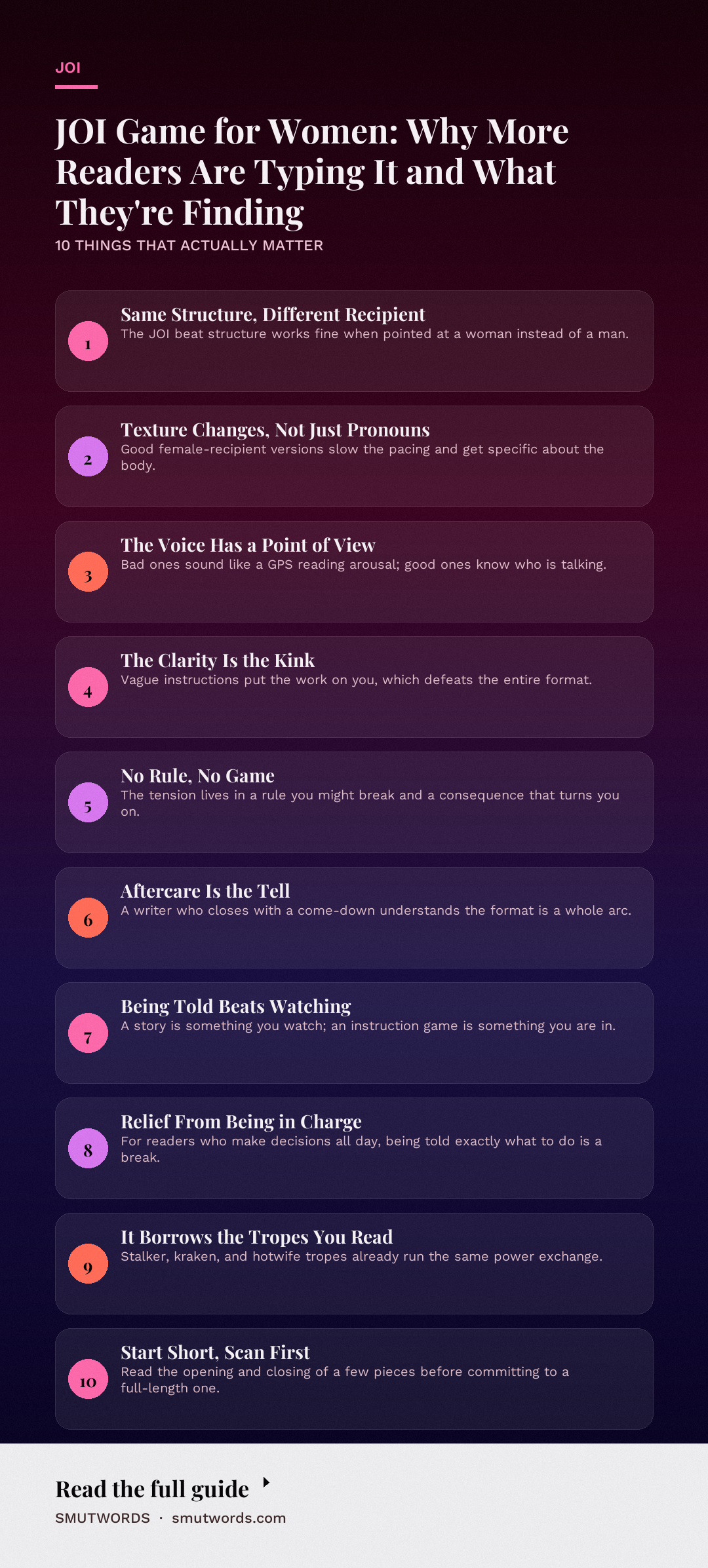
A JOI game built for women keeps that same beat structure (warm-up, escalation, a rule to follow, a build, a payoff) and points it at the reader instead of a stock male listener.
What changes is the texture. The pacing slows down. The vocabulary of the body gets specific instead of generic.
The voice in the story is usually a woman, or a man written by someone who has actually paid attention to what a woman might want to hear, or something else entirely that doesn't map neatly onto a gender at all. The instructions stop assuming a single rigid act and start giving options.
If you've ever read the broader breakdown of how these formats work in interactive JOI game writing, the female-recipient version is the same skeleton wearing different clothes. The clothes matter more than you'd think.
The Differences Between a Good One and a Bad One
Most of the bad ones give themselves away in the first paragraph. You can spot them fast once you've got a checklist. Here's what separates a written joi game for women that lands from one that reads like it was copy-pasted from a forum thread in 2009.
- The voice has a point of view. Good ones know who's talking. A bossy stranger, a teasing partner, a stranger from a dating app who has somehow guessed your address. Bad ones use a neutral narrator voice that sounds like a GPS reading arousal at you.
- Instructions are specific enough to follow. "Touch yourself" is worthless. "Two fingers, slow, count to thirty, don't move them" is a game. The clarity is the whole kink.
- There's a rule and a consequence. The tension comes from a rule you might break and a penalty that turns you on. No rule, no game, just a paragraph.
- Pacing respects the reader's body. A good one gives you time. A bad one sprints to the ending in four hundred words and leaves you clicking out annoyed.
- The anatomy is written for a body that isn't a Ken doll. This sounds obvious. You'd be amazed how many "for women" lists are just the male script with "she" swapped in.
- There's aftercare or a soft landing. The best authors close with a line that brings you down instead of dumping you back into the search results tab.
That last one is the tell I look for first. A writer who bothers to write the come-down understands that the instruction format is a whole arc, not a single peak. If the story ends the second the climax does, the writer was thinking about the scene they wanted to write, not the reader who has to live in their body afterward.
Why Readers Are Typing It In the First Place
The honest answer is that the format does something regular erotica can't. A story you read is something you watch. An instruction game is something you're in, and being told what to do by a voice you trust (or a voice that's slightly scary) hits a different set of nerves than watching two characters go at it.
Women who read a lot of dark and explicit romance have already trained themselves to put their own body into the scene. The joi game for women format just removes the last layer of distance and hands the steering wheel to a stranger who knows the route. Same reason reader-insert fic outperforms third-person in a lot of corners of the internet: people want the "you."
There's a practical side too. If you've spent the day making decisions for everyone in your house, being told exactly what to do, in what order, for how long, is an enormous relief. The instruction is the fantasy. It doesn't have to be a domination kink for it to work; it just has to be a break from being the one in charge.
The Femdom, Maledom, and Everything-Between Question
The female-recipient niche spans the whole map: gentle domme voices, sharp ones, a male voice that's quietly bossy, and a category that's grown enough to have its own dedicated audience. The common thread is that the person giving instructions is in control of the scene and the reader isn't, and that dynamic has nothing to do with the genders on the page.
If the tone you're after leans into breath control, the breathplay JOI guide covers the subgenre that overlaps most with the female-recipient version. If dominating another character in the story is the part that gets you, the financial-domination angle in Financial Domination runs on the exact same power exchange, just with a wallet instead of a body.
The best writing in the niche doesn't force a label. It builds a voice you'd actually want in the room with you and lets the labels take care of themselves. That's also why the female-recipient version borrows so heavily from romance tropes that already do this well. Take the single-dad thing: there's a reason "I know what's best for you, now go to bed" hits so hard when the character saying it is tired, competent, and not asking permission.
If that flavor of authority is your thing, the breakdown in single dad romance walks through why the competent-but-exhausted dad voice works so well as a dom, and how the joi version of that voice borrows the same toolkit.
What a Well-Written Female-Recipient Game Does Differently
The good ones do a handful of specific things the lazy ones don't. These are the moves that make a joi game for women actually land.
It starts before the instructions do
Setting matters. A scene where you already know where you are, who you are, and what the room smells like earns the reader's trust before a single directive. A lazy version opens with "Hi, here's what to do." A good one opens with a stranger in your kitchen, or a hotel door that clicks shut, or someone sitting on the edge of your bed who has clearly been waiting.
Enjoyed this? Get a free book.
Join the list and we will send a complete free story straight to your inbox, plus new releases every week after that. No credit card, no catch.
It builds the pacing in layers
Good authors write in three or four acts. The first act is about getting still and paying attention. The second is where the instructions sharpen.
The third is where the rules start to bite. The fourth is the long, slow ramp where all the stops are pulled. A bad version tries to do all of this in one paragraph and the reader feels the squeeze.
It gives you something to lose
The stakes in a good one are tiny and brutal. Don't make a sound. Don't move your hand. Keep your eyes closed.
The penalty for breaking the rule is usually something the writer knows you'll hate more than the rule itself. This is where the female-recipient version beats the male-default version, because the writers were working without a template and actually had to think about what earns the payoff.
It understands that the voice is the kink
The flattest versions read like a list of tasks. The best ones read like a person.
The voice matters more than the choreography. A confident voice that's slightly mean and slightly tender and clearly paying attention to you is doing ninety percent of the work. Get the voice wrong and no amount of careful instruction can rescue it.
How to Spot One You'll Actually Want to Finish
Here's the fast read. Before you commit to a full-length piece, do a scan of the opening and the ending. That tells you almost everything.
- Does the opening scene establish a who and a where? If the first paragraph is pure instruction with no world around it, the writer probably had one paragraph in mind and padded the rest.
- Does the voice have a consistent personality? Read the first and last lines out loud. If they sound like the same person, good. If they sound like two different authors, walk away.
- Are the instructions physical and specific? Vague instructions mean the writer was relying on you to do the work. The whole draw of the format is that they do it for you.
- Is there a real rule with a real consequence? No stakes, no game.
- Does it close? Even a soft line at the end tells you the writer cared enough to think about what happens after.
Pass five of those and you're probably in good hands. Fail three of them in the first two hundred words and close the tab.
Why Female-Recipient JOI Pairs With the Tropes You Already Read
The female-recipient version borrows heavily from the tropes that already dominate explicit romance, and that's not an accident. The tropes do the same job: they establish a power imbalance, a voice, and a set of stakes before the scene even starts.
Stalker romance is the most obvious overlap. The Stalker Romance trope is basically a joi game stretched over three hundred pages, with a narrator who knows where you live and a reader who is, on some level, into that.
A well-written joi game for women borrows the same unnerving confidence. So does the creature-romance corner: the Kraken Romance glossary entry covers a voice that's enormous and not quite human, and the female-recipient joi authors have clearly read a few of those.
Even the arranged-marriage and group-marriage corners feed the format. The Group Marriage entry lays out a setting where instruction comes from more than one voice at a time, which is exactly the trick some of the best joi pieces pull off: two narrators, trading instructions, never agreeing on who's really in charge.
The hotwife trope contributes the stranger-in-the-room energy, the "go ahead, he's watching" tension that translates almost perfectly into a second-person instruction piece. And if the power exchange in what you're reading leans on ownership and permission, the cuckold breeding kink breakdown explains why the "you're going to do exactly what I say" dynamic reads so much hotter when there's a partner watching from the corner.
What to Read First If You're New to It
Start short. A full-length game is a commitment of forty-five minutes to an hour if the writer is doing it right, and you don't want to burn that on your first attempt with a writer you've never read before.
Read the opening and the closing of three or four pieces. Pick the one whose voice you'd actually want talking to you. Then go back and read it all the way through.
The female-recipient niche is still small enough that the good writers are findable. That won't last forever. The market is growing, which is good for readers and eventually going to be very bad for quality. Enjoy the early days while the average piece is still written by someone who cared.
Final Thoughts
If you only read one to get your bearings, start with The Complete Guide to JOI Game and use it as your map. It walks through the format, the pacing, and the way the voice is supposed to work, which is the fastest way to train your eye for the good stuff. Once you can hear the difference between a writer who's actually talking to you and one who's reading a script, the whole niche opens up.



Loading comments…