Most people learn the word "subspace" from a novel and then go looking for it in real life with no idea what they're actually hunting. The books make it look like fainting on cue in a silk robe.
What it actually is, what domspace feels like from the other side, and the reason both of them can leave you crying on a bathroom floor for no reason two days later, is a set of things nobody hands you when you buy your first set of cuffs.
So consider this the map. Subspace vs domspace is the first distinction worth getting straight, but it only makes sense once you understand that both are altered states with a predictable crash on the far end of them.
This is a beginner's guide, and that word matters. If you've been doing this a decade, you already know what your drop feels like and how to pre-empt it. If you haven't, read all of it before you go anywhere near a scene that lasts longer than a hand on your throat.
What a "headspace" actually is
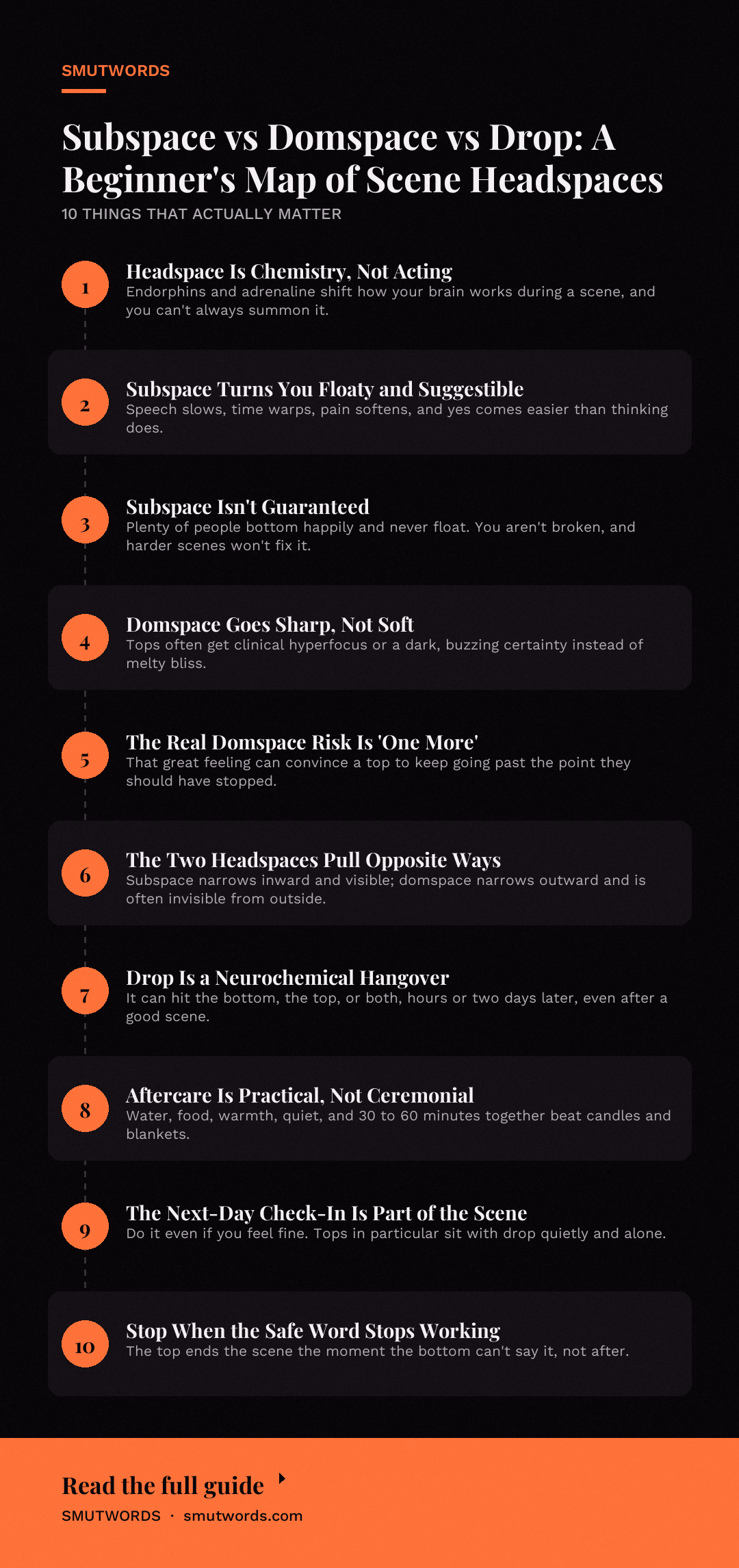
Headspace is the loose word kink uses for the shift in how your brain works during a scene. It's chemistry as much as it is psychology: endorphins, adrenaline, and the whole cascade of feel-good neurochemicals that a heavy scene trips. Your sense of time warps. Your inner editor goes quiet.
Pain and fear can start registering as something else entirely, and that's exactly why people chase it.
It isn't the same as "getting into character." It isn't purely voluntary, and you can't always summon it on command. Some scenes drop you into it in five minutes. Some scenes you're present and thinking the whole way through, and the headspace never really arrives. Neither is a failure.
Why it matters before anything else
A top who doesn't know the signs of headspace can push a bottom past what they agreed to without either of them noticing in the moment. And a bottom who doesn't know what drop is can mistake the crash for something being genuinely wrong with them. Knowing the names is most of the safety.
Subspace, explained in plain English
Subspace is the headspace the person on the receiving end slides into during a scene. It's usually triggered by sustained intensity: pain, praise, anticipation, restraint, whatever the specific dynamic key is for that person. The endorphin flood does the rest.
People describe it as floaty, melty, drunk-without-drinking. Words get hard. Thinking gets slow. You can feel very far away from your own body, or extremely present in a very small and focused way.
There's often a warm, blissed-out, slightly stupid feeling to it that tops will describe as you looking "piloted by someone else."
The reason subspace vs domspace confuses beginners is that only one of them looks like what the books describe. Subspace is the one everybody has heard of. The other one is quieter, and tops get less credit for it.
How to tell you're in subspace
- Your speech slows or stops. You give one-word answers or none at all.
- Time goes strange: a minute feels like five, or a whole hour disappears.
- You stop tracking pain in the way you normally would, and the pain starts feeling good or deeply neutral.
- You feel intensely agreeable. You say yes to things you hadn't planned on and might not want tomorrow.
- Your body goes loose and heavy and the impulse to close your eyes is strong.
That fourth bullet is the one to sit with. People in deep subspace are famously suggestible. If your top asks "more?" while you're under, you may say yes because yes comes easier than thinking. This is why tops need to be reading the bottom's actual state, not just their words, and why "I'll ask in the scene" is a weak consent model for a heavy scene.
What subspace is not
It is not a guarantee. Plenty of people take to a bottom role just fine and never once float. If you're one of them, you aren't broken and you don't need to chase harder scenes to unlock it. Enjoying submission is its own thing and doesn't require the chemistry to fire.
Domspace, explained in plain English
Domspace gets its own name because tops have a chemical experience too. Running a scene is a job that takes total attention, fast decisions, and a certain amount of calculated risk. The body doesn't distinguish between that and other forms of high-stakes focus.
The result is often a sharp, clear, almost clinical hyperfocus, or a dark, warm, powerful, "I could do anything" feeling, or some blend of the two depending on the day.
If subspace is going soft and floaty, domspace is more often going sharp. Some tops describe it as an intense, quiet, buzzing certainty. Some say they feel a flood of tenderness that scares them a little. A few describe a cold, level, almost dispassionate clear-headedness that lets them do things they couldn't do in ordinary head.
How to tell you're in domspace
- Your attention narrows to the other person down to the near exclusion of everything else.
- You feel unusually decisive. You stop second-guessing.
- Your voice drops or your speech gets very trimmed, short, and directive.
- You can feel a kind of focused elation that borders on head-swimmy.
- You notice you're having a very good time and the thought "we could keep going" arrives on its own.
That last bullet is the real hazard in domspace. The clinical hyperfocus feels great, and that great feeling is exactly the thing that can convince a top to keep going after they should have called the scene. The first time you catch yourself thinking "one more" in a scene that's already been long, that's domspace talking. Treat it as your cue to actually check in, not to push.
How subspace and domspace differ
They're not mirror images. They tend to have opposite textures and often pull in opposite directions in the middle of a scene.
The short version
- Direction of attention: subspace narrows inward; domspace narrows outward onto the other person.
- Speech: a bottom may lose words; a top may get clipped and directive.
- Risk profile: in subspace the risk is agreeing to things you wouldn't otherwise; in domspace it's pushing past the point where you should stop.
- Visibility: subspace is visible and obvious; domspace is often invisible from the outside and needs to be checked for.
Understanding both matters for the same reason how desire and conflict tangle together matters for fiction: the intensity that makes the scene feel good is the same intensity that can override judgment if nobody named it.
The crash: what drop actually is
Drop is the aftermath. It's the neurochemical hangover from the buildup of a scene, and it can hit the bottom, the top, or both. Often a few hours later or the next day, sometimes two days after.
Common experiences include an inexplicable low mood, weepiness, flatness, self-doubt, anxiety about whether the scene was okay, and physical exhaustion. For tops it often shows up as shame or self-recrimination: "what did I just do to someone I love."
Enjoyed this? Get a free book.
Join the list and we will send a complete free story straight to your inbox, plus new releases every week after that. No credit card, no catch.
Drop is not a sign that anything went wrong. It happens after good scenes. It often happens after scenes where everybody had a lovely time.
Some people don't get it at all. But if you're going to play heavily, plan for it the way you'd plan for the gym soreness after a hard session, and don't try to override it with another scene.
Signs to catch in each other
- An off, sad, or numb feeling that doesn't match anything that happened.
- Crying easily or feeling raw about small things.
- Second-guessing the scene, the partner, or the whole relationship.
- Feeling clingy or, in the other direction, cold and distant.
- Physical fatigue, low blood sugar feeling, headache, or a foggy head.
Aftercare that actually works
Aftercare gets a reputation as a candle-and-blanket ceremony. The useful parts are more practical. Get water and food in both of you, get warm, get the room quiet, and stay together for at least the length of the immediate crash, usually 30 to 60 minutes.
Skin-to-skin contact if you both want it. Low-stakes talking. Check in verbally and specifically: "how's your head right now," not "you good?"
For the top in domspace, the important aftercare is often decompression from that hyperfocus. Step fully out of role. Say something ordinary and affectionate.
Then have the partner who was bottomed say one clean sentence about how it was, because the top's brain tends to spend the whole crash second-guessing whether the bottom actually wanted it. Give them the data.
Next-day check-in, and why it's part of the scene
The day-after check-in is the part beginners skip and then wish they hadn't. A text or call the next morning: "did you drop, how bad, what helped." Do it even if you feel fine, because tops in particular tend to sit with the drop quietly and neither of you sees it.
If someone crashes hard, don't start a fresh scene until they're back to baseline. And treat low mood that lasts more than a couple of days as worth a real conversation.
What subspace vs domspace fiction gets right and wrong
There's a reason the fiction pulls you toward this stuff. Free Use Vampire Coven nails the surface texture of subspace, that floaty, taken-over, stop-thinking feeling, without ever showing the recovery. Inserted by the Mainframe plays with what it feels like to be steered by something that has absolute control, which is the headspace a lot of people are actually chasing. Bound to the Galactic Alpha is the same fantasy with a captive, forced-obedience premise.
All three are great fun and all three skip the crash, because nobody writes the group chat the next morning.
If you want a lighter version of the "taken over" feeling, a hotwife pickup story like the hotwife 101 guide is a good read on the psychological layer of giving up control in a way you can enjoy from the safety of a page. If you want the flip side, the top's perspective, His New Addiction shows the person in the driver's seat starting to lose their grip on themselves, which is domspace with the brakes off.
How to bring it up with a partner
The conversation is much easier than it feels from the inside. You don't need a formal proposal. You need a quiet, non-horny moment, the two of you, and a few concrete questions. Three that do most of the work:
- "Have you ever felt floaty or out of it during sex or a scene?"
- "What helps you come back to yourself afterward?"
- "What's a thing you'd want to try but be nervous about?"
That third question opens the door without making a scene of it. From there, agree on a safe word that actually works in subspace. Something short, unsexy, and easy to say with a slow brain. "No" doesn't count, because in subspace "no" can come out as "yes."
Agree on a check-in signal for the moment the top starts to worry they've pushed. Agree on what the aftercare looks like in advance, while you're both clear-headed and not in either headspace.
Real risks and how to lower them
Subspace and domspace don't create danger. They reduce your judgment at exactly the time you need it. Everything below is about cutting the actual risks.
- Suggestibility in subspace. Lower it by agreeing limits in advance, on a clear head, and refusing to make new limit decisions mid-scene. The top needs to remember what was actually agreed to.
- Overextension in domspace. Lower it by deciding the scene's plan and its length ahead of time and by checking in at fixed intervals, not on a whim. If the scene was 30 minutes, it's 30 minutes even if it's going well.
- Anything that restricts breathing or circulation. These carry real physical risk and need serious study, in-person training, and a partner watching at all times. Breathplay JOI is a fiction-first take on the theme, which is where it should stay until you know what you're doing. Get it wrong and you can put someone in a hospital. Don't wing it.
- Restraints nobody can get you out of. Have a way to release anything in seconds, keep an implement within reach, and never leave someone restrained alone. Your ability to get out fast matters as much as the first-aid kit does.
- Drop nobody is watching for. Lower it by treating the next-day check-in as part of the scene, not an optional extra.
When to stop
Every scene needs a stop rule that lives outside the headspace. The obvious one is a safe word. The less obvious and more useful one: the top stops the scene the moment the bottom stops being able to say the safe word.
Or the moment the top notices the "one more" thought has arrived and can't point to anything in the plan that led to it. Stop, end on purpose, do the aftercare, do the next-day check-in. A scene that ends five minutes earlier than it could have is not the one you'll regret.
And if someone drops hard, or the drop doesn't lift within a few days, get a real conversation and, if it's persistent low mood or anxiety, an actual clinician. Nothing about this guide is a substitute for that.
Final Thoughts
If you only take one thing from all this, make it the day after. Subspace and domspace are two of the best feelings a body can manufacture. Drop is the bill, and it comes due whether or not you planned for it.
The people who do this well are the ones who plan the aftercare as carefully as the scene, and who treat the next-morning check-in as part of the fun rather than homework. If you want a fiction read that gets the domspace feeling into your head with the brakes off, His New Addiction is the one to pick up next.




Loading comments…